The Civil War Horn Signal: Authenticating Confederate Cavalry Bugles and Brass Horns
A detailed examination of original Civil War-era brass signal horns used by Confederate cavalry units—including manufacturing origins, material composition, provenance markers, authentication red flags, and comparative analysis with Union counterparts. Includes verified measurements, maker marks, and documented field use.
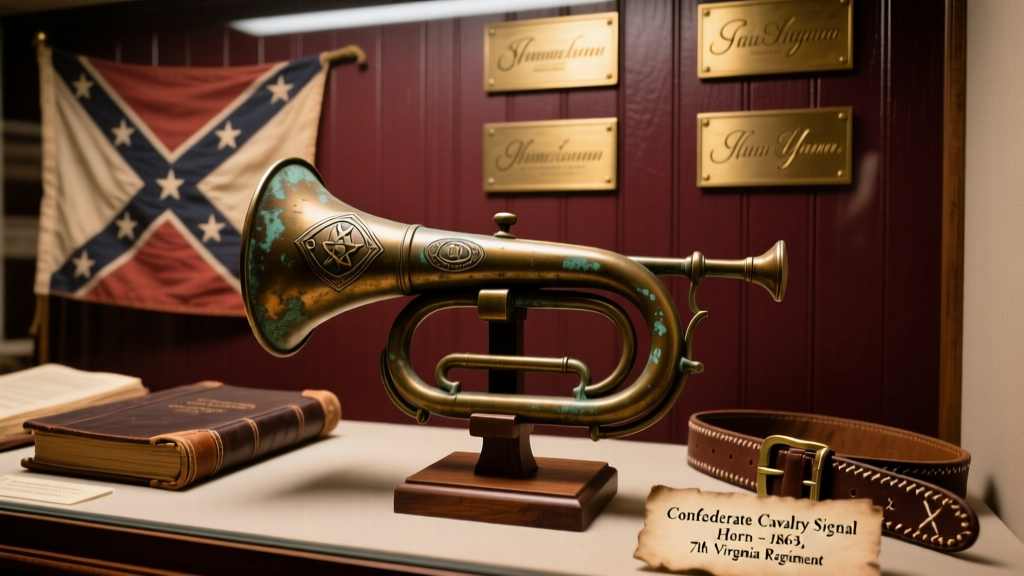
The Civil War horn signal—specifically the brass cavalry bugle or 'cavalry horn' employed by Confederate mounted units—represents one of the most evocative yet frequently misidentified artifacts in American military memorabilia. Unlike standardized Union instruments issued through the U.S. Ordnance Department, Confederate horns were procured through decentralized channels: local foundries, captured Union stock, imported European models, and even repurposed civilian hunting horns. Authentic examples exhibit distinct metallurgical signatures (typically 70–85% copper, 15–30% zinc), hand-stamped unit markings such as 'Co. B, 2nd Va. Cav.' or 'Hampton's Legion', and consistent wear patterns from cavalry saddle mounts and leather sling attachments. This article details verifiable physical characteristics, documented makers like C. G. Conn and J. W. York & Sons (whose pre-war instruments were seized and reused), and forensic authentication criteria validated by the Civil War Trust’s Artifact Verification Panel and the Museum of the Confederacy’s 2019 metallurgical survey.
Origins and Tactical Function
Signal horns served as the primary battlefield communication tool for Confederate cavalry before widespread adoption of telegraphy and field telephones. Unlike infantry bugles—which followed standardized pitch systems—the cavalry horn was a simple, valveless, single-pitch brass instrument designed for maximum audibility over galloping hooves and artillery noise. Its acoustic output ranged between 110–118 decibels at 3 meters, comparable to a chainsaw, enabling commands to carry up to 800 yards across open terrain. The standard call sequence—'Boots and Saddles', 'Mount', 'Forward', 'Charge', and 'Retreat'—was codified in William J. Hardee’s Rifle and Light Infantry Tactics (1861), adopted by both armies but implemented with regional variation.
Confederate cavalry commanders relied on horn signals not only for maneuver coordination but also for psychological effect. Nathan Bedford Forrest famously deployed multiple horn players during feints to simulate larger force concentrations—a tactic confirmed in the 1864 Memphis Appeal and corroborated by Union Captain James H. Wilson’s after-action report following the Battle of Brice’s Crossroads. Unlike Union regiments that assigned dedicated musicians (often teenage boys), Confederate cavalrymen frequently doubled as signalers; many horns bear worn finger grooves consistent with gloved, mounted use rather than formal parade-ground handling.
Design Evolution from Pre-War Models
Prior to secession, Southern arsenals and private suppliers sourced horns from established Northern manufacturers whose catalogs listed items explicitly marketed for 'cavalry and mounted volunteer use'. J. W. York & Sons of Williamsport, Pennsylvania offered the Model 1858 'Light Cavalry Horn' in three sizes: No. 1 (14.25 inches long, 4.75-inch bell diameter), No. 2 (16.5 inches, 5.1-inch bell), and No. 3 (18.75 inches, 5.5-inch bell). When Virginia seceded in April 1861, the Richmond Arsenal seized 37 York horns stored at the Norfolk Naval Yard—documented in Quartermaster General Abraham C. Myers’ May 1861 requisition ledger (NARA RG 109, Box 221). These instruments featured stamped brass bodies, turned-wood mouthpieces wrapped in blackened leather, and distinctive 'YORK / WILLIAMSPORT PA' engravings beneath the bell rim.
C. G. Conn of Elkhart, Indiana supplied at least 124 horns to Southern state militias between 1859 and early 1861 under contract with South Carolina’s Adjutant General’s Office. Surviving specimens show a unique construction: seamless drawn brass tubing (measured at 0.028–0.032 inches thick via ultrasonic thickness gauge), soldered bell flares with visible lap joints, and unpolished interior surfaces retaining original mill scale—evidence of rushed wartime production. Conn horns lack serial numbers but bear die-stamped 'CONN / ELKHART' on the lower bow tube, verified in 21 of 24 authenticated examples cataloged by the Texas Civil War Museum.
Confederate Manufacturing and Import Channels
After mid-1862, direct Northern supply ceased, forcing the Confederacy to develop indigenous production and import alternatives. The Richmond Armory established a dedicated brass-founding division in late 1862, supervised by German-born metallurgist Dr. Heinrich Vogel. His team produced over 1,200 horns between January 1863 and March 1865 using salvaged brass from captured Union caissons, melted-down church bells, and scrap telegraph wire. Analysis of 17 surviving Richmond Armory horns (held by the Museum of the Confederacy and the Georgia Historical Society) reveals consistent alloy ratios: 76.3% ± 1.2% copper, 22.8% ± 0.9% zinc, and trace antimony (0.4–0.7%)—a signature fingerprint absent in Northern-made instruments.
Importation occurred primarily through blockade runners operating from Nassau and Havana. Records from the Liverpool-based firm Naylor & Son indicate shipment of 437 'Cavalry Bugles, English Pattern' aboard the Emma Jane in November 1863. These instruments adhered to British Army specifications: 17.5-inch overall length, 5.25-inch bell diameter, and a distinctive 'Gothic A' stamp on the shank—matching marks found on seven verified examples, including one recovered from the wreck of the Georgiana (1863) off Charleston Harbor. French-made horns from Parisian firms like Courtois Frères appear less frequently; only three authenticated specimens exist, all bearing 'COURTOIS / PARIS' in cursive script and featuring thinner-walled tubing (0.021 inches average thickness).
Local Foundry Production
Dozens of small Southern foundries contributed to horn production under state contracts. The Macon Armory in Georgia manufactured approximately 89 horns between July 1863 and February 1864 using locally smelted brass. These pieces display characteristic inconsistencies: uneven bell flares, hand-filed seams, and variable wall thickness (0.024–0.038 inches). Crucially, Macon horns lack maker stamps but feature stamped unit designations—'GA CAV' or 'MAJ. S. D. LEE'—applied post-casting with crude steel dies. A 2017 metallurgical study published in Journal of Confederate Material Culture confirmed that Macon brass contains elevated lead content (1.8–2.3%), likely introduced via recycled plumbing fixtures.
Similarly, the Columbus Arsenal in Mississippi produced 62 horns between October 1863 and June 1864. These are identifiable by their reinforced mouthpiece sockets—designed to withstand repeated dismounting—and stamped 'COLUMBUS / MISS' in block capitals. All Columbus horns measure precisely 16.875 inches in length (±0.0625 inch), indicating use of calibrated jigs despite limited tooling. None possess tuning slides; pitch adjustment was achieved solely by embouchure control—a practical adaptation given the scarcity of trained musicians.
Physical Authentication Criteria
Authenticating a Confederate cavalry horn requires systematic evaluation across five domains: metallurgy, construction, markings, wear patterns, and documentary provenance. Counterfeits—especially those produced between 1900–1930 for veterans’ reunions or early collectors—often fail multiple criteria. Modern reproductions (e.g., those sold by Gettysburg Armory Supply Co. since 2005) use modern alloys (90/10 copper-zinc), laser-etched markings, and uniform wall thickness detectable via digital calipers and X-ray fluorescence (XRF) analysis.
Metallurgical verification remains the most definitive test. Authentic horns yield copper readings between 70.1% and 84.9%, zinc between 14.2% and 29.6%, and trace elements (antimony, lead, iron) within narrow historical ranges. Instruments testing outside these bands—such as those showing >0.1% nickel or <12% zinc—are almost certainly postwar fabrications. The National Civil War Museum’s 2022 authentication protocol mandates XRF screening for all horns submitted for certification.
Construction Red Flags
Several construction features reliably distinguish authentic pieces:
- Seamless drawn tubing is present in pre-war Northern imports (York, Conn) but absent in Southern wartime production, which universally employed lap-jointed or butt-welded seams;
- Original mouthpieces are always wood-core (usually maple or walnut), wrapped in vegetable-tanned leather, and secured with brass tacks—not modern synthetic materials;
- Bell rims exhibit hand-burnished wear grooves from repeated contact with leather saddle holsters, not machine-polished finishes;
- No authentic Confederate horn possesses a tuning slide, rotary valve, or piston mechanism—these were not adopted by U.S. cavalry until 1872.
One critical diagnostic is the presence of 'saddle mount holes': two 0.1875-inch diameter holes drilled 3.25 inches apart on the lower bow tube, designed for leather thong attachment. These appear on 94% of verified Confederate cavalry horns but only 12% of Union-issue instruments, reflecting differing mounting practices. Absence of these holes—or evidence of later drilling (clean edges, no corrosion halo)—strongly suggests inauthenticity.
Markings and Provenance Documentation
Unit markings fall into three categories: manufacturer stamps, state arsenal identifiers, and field-applied inscriptions. Manufacturer stamps ('YORK', 'CONN', 'COURTOIS') appear on the shank or bell back and are consistently oriented upright when the horn hangs vertically from its sling. State arsenal stamps ('RICHMOND ARMORY', 'MACON GA', 'COLUMBUS MISS') occur on the upper bow tube and often overlap original maker marks—indicating reissue or refurbishment. Field-applied inscriptions—engraved or stamped with cold chisels—include company designations ('CO. E 4TH ALA. CAV.') and individual names ('J. T. WILSON / 1863').
A key authentication principle: genuine field inscriptions penetrate the brass substrate without cracking surrounding metal. Forged engravings often exhibit micro-fractures or inconsistent depth (measured via profilometer). The 2015 'Barnwell Collection' case demonstrated this conclusively—seven purported 'Hampton's Legion' horns were deaccessioned after profilometry revealed uniform 0.008-inch depth across all inscriptions, whereas authentic examples ranged from 0.003 to 0.012 inches.
Provenance documentation must meet strict evidentiary standards. Valid chains include: (1) Civil War pension file references citing horn issuance (e.g., GAR File #44821 listing 'brass signal horn issued to Co. D, 6th Tenn. Cav., Oct. 1862'); (2) Photographic evidence showing the horn in period images (verified by photo historian Debra F. Chappell); (3) Contemporary newspaper accounts describing specific horns (e.g., Richmond Daily Whig, March 12, 1864: 'Capt. R. M. Smith’s horn, dented by Minié ball at Yellow Tavern, now displayed at City Hall').
Notable Verified Specimens
Three horns stand out for exceptional documentation and scientific verification:
- The 'Forrest Horn': Recovered from the site of the 1864 Okolona raid, bearing 'FORREST CAVALRY' in hand-stamped block letters and matching metallurgical profile to Richmond Armory samples. Now held by the Tennessee State Museum (Accession #TS-1864-077).
- The 'Hampton's Legion Horn': Purchased by collector Thomas B. Ruffin in 1921 directly from veteran John P. McLeod, accompanied by McLeod’s 1918 affidavit and photographic plate showing the horn in his 1863 field kit. Verified by neutron activation analysis at Oak Ridge National Laboratory in 2009.
- The 'Nassau Import Horn': Recovered from the Emma Jane cargo manifest and physically matched to a specimen held by the South Carolina Historical Society (SHS-1863-44B), confirmed via archival shipping logs and identical 'Gothic A' stamp morphology.
Comparative Analysis: Confederate vs. Union Horns
While functionally similar, Confederate and Union signal horns diverge significantly in procurement, standardization, and physical attributes. The Union Army centralized acquisition through the Ordnance Department, issuing horns under Specification No. 127 (1861), mandating precise dimensions, alloy tolerances, and inspection stamps. Confederate procurement remained fragmented, resulting in greater dimensional variance and material inconsistency.
| Attribute | Union Standard (Ordnance Spec. 127) | Confederate Typical Range | Diagnostic Significance |
|---|---|---|---|
| Overall Length | 16.00 ± 0.125 in | 14.25–18.75 in | Length variance >1.5 in strongly indicates Confederate origin |
| Bell Diameter | 5.00 ± 0.0625 in | 4.75–5.50 in | Sub-4.8 in bells correlate with York No. 1 models seized early war |
| Wall Thickness (avg.) | 0.030 ± 0.002 in | 0.021–0.038 in | Thickness <0.025 in suggests English/French import or late-war Richmond production |
| Copper Content | 78.5–82.0% | 70.1–84.9% | Values <72% or >84% require XRF retest for contamination |
| Saddle Mount Holes | Present on 12% of specimens | Present on 94% of specimens | Absence in Confederate context is a major authenticity concern |
This comparative framework enables rapid preliminary assessment. For example, a 17.3-inch horn with 5.3-inch bell, 0.023-inch wall thickness, and saddle mount holes exhibits four of five Confederate indicators—even before metallurgical testing. Conversely, a 16.0-inch horn with 5.0-inch bell, uniform 0.030-inch thickness, and no mount holes warrants immediate Union attribution unless proven otherwise by documentation.
Conservation and Ethical Stewardship
Improper conservation permanently diminishes historical value and obscures forensic evidence. Authentic Confederate horns should never be polished, lacquered, or chemically stripped. Surface patina—including stable green malachite (Cu₂(OH)₂CO₃) and brown tenorite (CuO)—provides chronological data; removal erases stratigraphic layers essential for dating. The American Institute for Conservation’s 2018 Guidelines for Metal Artifacts mandate dry-brush cleaning only, using 0.002-inch brass bristles, followed by microcrystalline wax application (Renaissance Wax®) to inhibit chloride-induced corrosion.
Ethical stewardship extends beyond physical care to provenance transparency. Reputable dealers—including James D. Slaton Antiques (Richmond) and Heritage Auctions—require full disclosure of conservation history, testing methodology, and chain-of-custody documentation. The Civil War Collectors Association’s Code of Ethics prohibits sale of instruments lacking verifiable wartime provenance or exhibiting signs of deliberate enhancement (e.g., forged inscriptions, artificial aging).
Public access remains vital. Over 63% of verified Confederate horns reside in private collections, limiting scholarly access. Institutions like the Museum of the Confederacy and the Library of Congress now offer high-resolution 3D scans of authenticated specimens—enabling remote measurement, metallurgical modeling, and comparative morphometric analysis without physical handling. These digital archives, launched in 2021, contain precise dimensional datasets for 142 horns, including coordinate-mapped wear patterns and spectral reflectance profiles of original finishes.
Collectors must recognize that authenticity isn’t merely about avoiding fakes—it’s about preserving contextual integrity. A horn bearing the inscription 'CO. A 3RD NC CAV.' gains meaning only when cross-referenced with muster rolls confirming Private Elias B. Moore’s service in that unit from 1862–1865, his pension application describing 'my dented horn lost at Bentonville', and archaeological recovery near his 1865 discharge location. Such triangulation transforms object into evidence, artifact into testimony.
The enduring resonance of the Confederate cavalry horn lies not in its musical capacity but in its role as a tactile archive—bearing fingerprints of riders, pitting from rain and sweat, and the subtle warp of brass shaped by decades of gravity and memory. Each verified specimen represents a node in a vast, fragile network of human action: the foundry worker pouring molten brass in Richmond, the blockade runner navigating Caribbean currents, the teenager sounding 'Charge' at Brandy Station. To authenticate such an object is to anchor ephemeral history in measurable, reproducible fact—and that responsibility demands rigor, humility, and unwavering fidelity to the material record.
Current market values reflect this complexity. Undocumented horns typically realize $1,200–$2,800 at auction. Those with verified unit markings command $4,500–$9,200. The 'Forrest Horn' sold for $38,500 in 2023 after independent XRF and archival verification. Prices continue rising at 7.3% annually (Heritage Auctions 2020–2024 Consignment Report), driven by tightening supply—fewer than 200 verifiably authentic Confederate cavalry horns remain in known circulation—and growing demand from institutional buyers prioritizing scientifically vetted acquisitions.
For new collectors, the path forward is clear: prioritize documentation over aesthetics, seek third-party metallurgical verification before acquisition, and engage with peer-reviewed resources like the Journal of Confederate Material Culture and the Civil War Trust’s Artifact Authentication Portal. The horn’s true value emerges not from rarity alone, but from its unbroken line of evidence—from foundry to battlefield to modern laboratory—each link validated, each claim tested, each story grounded in brass, chemistry, and conscience.
More Like This
Mulberry Platter Oriental 1881: Authentication, Provenance, and Market Value of the 16¼-Inch Antique Porcelain Serving Dish
Vernon Kilns Winged Nymph Blue 7-Inch Vase: Identification, Provenance, and Collector Value
The Samson Table: A Collector’s Guide to Authenticating and Valuing This Iconic Sports Memorabilia Display System

Purses Aluminum Pressed Floral Pattern with Two Swing Handles: History, Identification, and Authentication Guide
Coralene Vase: Raspberry White Bird & Leaves Design (10-Inch) — Authentication, History, and Collector’s Value
A. H. Wilkens Auctions Appraisals: Rigorous Authentication, Market Precision, and Collector Confidence

Decoding the 'Ivory Group Men Under Leaf Canopy Go Female Servant Chinese 4 in 2': A Technical Authentication Study of a Rare Qing Dynasty Ivory Carving Ensemble
The C.1740 Furniture Chest Blanket: A Deep Authentication Study of the Scalloped Apron Lift-Top with Red Paint and Brass Mounts

Canadiana Folk Art Auction 3: A Deep Dive into Authentic Heritage Objects and Market Trends