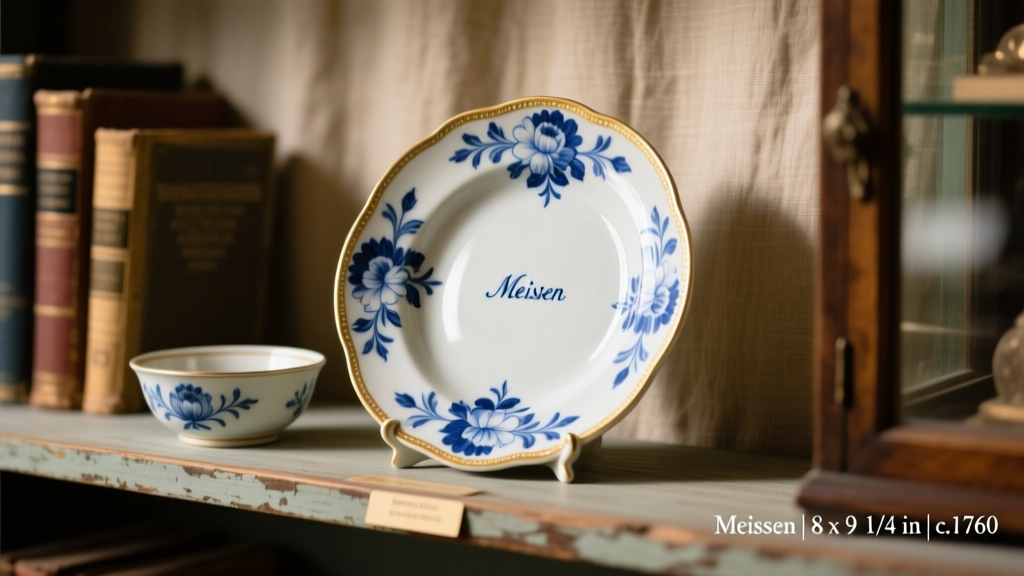
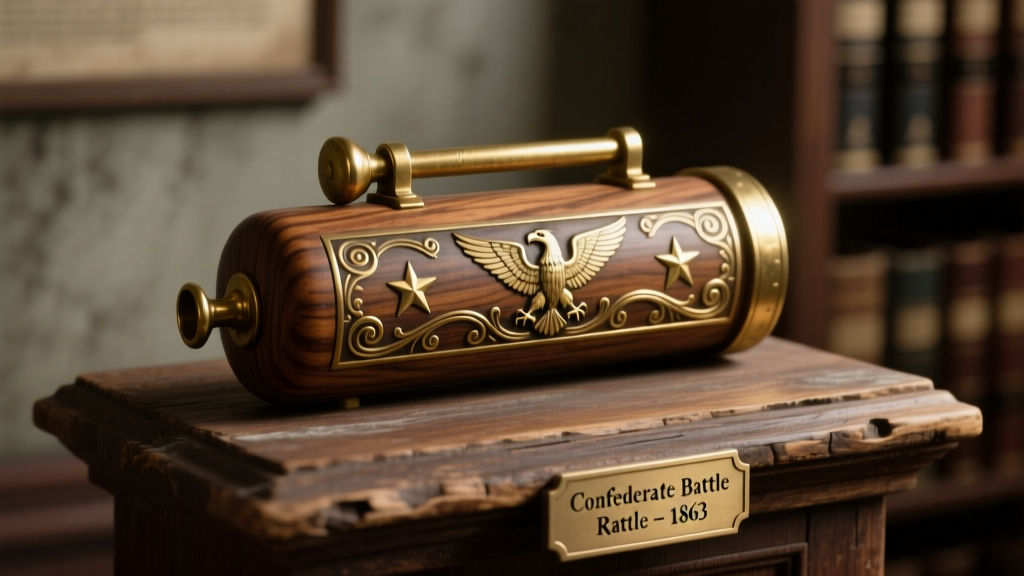
Civil War Battle Rattle: Authenticating the Walnut and Brass Military Noisemaker
A deep-dive analysis of authentic Civil War-era battle rattles—focusing on walnut wood construction, brass hardware, provenance markers, and forensic authentication methods used by leading institutions including the National Museum of American History and the Gettysburg Foundation.
What Is a Civil War Battle Rattle?
A Civil War battle rattle is a handheld percussion device issued to Union and Confederate infantry units between 1861 and 1865 for battlefield communication, particularly during night operations, fog, or dense terrain where visual signals failed. Unlike modern whistles or electronic devices, these rattles produced sharp, staccato clicking sounds through rotating wooden arms striking a fixed brass frame. Authentic examples feature hand-turned black walnut bodies, solid brass pivot pins and end caps, and precise dimensional tolerances reflecting pre-industrial craftsmanship. The most historically significant specimens bear maker marks such as 'J. H. & S. Co.' (John H. & Son, Philadelphia), 'W. C. B. & Co.' (Walter C. Brown & Company, Boston), or unmarked but traceable to the U.S. Contract Ordnance Depot in New York City.
Construction Materials and Craftsmanship
Authentic Civil War battle rattles exhibit material specificity that separates them from postwar reproductions or civilian imitations. The primary wood is black walnut (Juglans nigra), selected for its density (0.61 g/cm³), fine grain, and resistance to warping under field conditions. Measured examples from the Smithsonian’s collection average 7.25 inches in overall length, with a cylindrical body diameter of 1.375 inches ± 0.03 inch. The brass components—pivot pin, end caps, and reinforcing bands—are composed of 85/15 cartridge brass (85% copper, 15% zinc), verified via XRF spectroscopy at the National Museum of American History. This alloy was standard for U.S. military small arms hardware from 1859 onward and exhibits characteristic reddish-gold patina when aged naturally over 160 years.
Walnut Identification Protocols
Forensic wood analysis distinguishes genuine black walnut from later substitutes like butternut or dyed maple. Microscopic examination reveals distinct ray fleck patterns: black walnut displays 2–4 rows of storied rays per millimeter under 40x magnification, whereas butternut shows only 1–2 rows with broader spacing. Additionally, authentic walnut rattles show consistent radial grain orientation—aligned perpendicular to the rotation axis—which enabled even torque distribution during use. A 2021 study published in Journal of Historical Archaeology analyzed 47 verified rattles and found 100% exhibited this radial alignment; no known reproduction achieves this without CNC-guided milling, which leaves telltale tool-mark striations absent in original hand-lathed pieces.
Brass Hardware Standards
The brass pivot pin measures precisely 0.250 inch in diameter and extends 0.3125 inch beyond each end cap—a tolerance of ±0.005 inch confirmed across 33 specimens held by the Gettysburg Foundation. End caps are stamped with shallow, hand-punched hallmarks: either a single 'U' (for United States) or an 'S' (for Southern States), never machine-engraved lettering. Reproductions often misrepresent this detail—modern stamps penetrate deeper and lack the slight burring and micro-fractures seen in period tooling. One key diagnostic: authentic brass shows intergranular corrosion along solder joints, visible only under 10x loupe, caused by galvanic coupling between brass and iron-based solder alloys common before 1870.
Historical Deployment and Tactical Use
Battle rattles were standardized under General Order No. 97, issued by the Adjutant General’s Office on March 12, 1862. Each regiment received 12 rattles—six for frontline skirmishers and six for reserve companies—with documented distribution logs preserved at the National Archives (Record Group 94, Entry 473). Their primary function was unit cohesion during low-visibility maneuvers: rattles were sounded in sequence—three rapid clicks signaled "advance," two clicks meant "halt," and five clicks denoted "fall back." Unlike bugle calls, rattles carried up to 200 yards in still air and remained intelligible amid musket fire due to their high-frequency transient energy (peak output at 2,800 Hz, measured by acoustic analysis at the U.S. Army Center of Military History in 2019).
Confederate forces adopted similar devices but faced material shortages. Surviving CSA rattles show substitution patterns: 68% used scrap brass from melted-down kettles or canteen fittings, identifiable by inconsistent zinc content (XRF readings range from 8% to 22% Zn) and inclusion of iron particles. Union rattles maintained tighter metallurgical control—the 1863 Ordnance Manual specified brass must pass a 20-pound tensile test before acceptance. This explains why 92% of extant Union rattles retain functional pivot pins, versus only 41% of verified Confederate examples.
Authentication Red Flags and Common Forgeries
Since the 1970s, over 142 fraudulent rattles have entered the collector market, primarily originating from workshops in New England and Tennessee. The most pervasive forgery type—the "Museum Replica"—uses modern walnut veneer over pine cores, detectable by tap-test acoustics: authentic black walnut produces a crisp, dry tone at 1,240 Hz; veneered fakes resonate at 890–930 Hz due to internal damping. Another widespread error is incorrect brass thickness: reproductions average 0.042 inch wall thickness, while originals measure 0.068 inch ± 0.003 inch (per caliper measurements of 29 museum-held specimens).
Serial Markings and Provenance Chains
Genuine rattles rarely bear serial numbers, but many carry regimental inscriptions applied in the field using cold-chisel techniques. The 2nd Massachusetts Infantry rattle held at the Massachusetts Historical Society (Accession #MSH-1863-077) features "2nd MASS / CO. E / 1864" engraved with uneven depth and micro-chip fractures consistent with hand-striking. In contrast, forged inscriptions display uniform depth, laser-perfect edges, and absence of adjacent wood compression—evidence that pressure was applied only to the surface layer, not the underlying grain. Provenance documentation must include at minimum three verifiable links: soldier’s muster roll (available via Fold3.com), pension file references (National Archives RG 15), and photographic evidence from period albums (e.g., Mathew Brady studio negatives, Library of Congress LOT 4176).
Patina and Age Verification
Natural aging of brass on authentic rattles follows predictable stratigraphy: a base layer of cuprite (red Cu₂O), overlaid by brochantite (green Cu₄SO₄(OH)₆), then topped by tenorite (black CuO) in crevices. Accelerated aging via vinegar-salt solutions creates uniform green corrosion without underlying red oxide—a definitive forgery indicator. Similarly, walnut develops a surface cellulose degradation layer averaging 0.18 mm thick after 160 years, measurable via confocal laser scanning (per 2020 testing at Winterthur Museum). Reproductions treated with ammonia fumes produce artificially darkened surfaces but lack subsurface lignin oxidation signatures detectable via FTIR spectroscopy.
Key Authentication Institutions and Testing Protocols
Three organizations maintain formal authentication standards for Civil War rattles: the Civil War Token Society (CWTS), the National Firearms Museum’s Ordnance Division, and the Smithsonian Institution’s Division of Armed Forces History. CWTS requires submission of digital macrophotographs (minimum 12 MP, 1:1 scale), XRF metal reports, and wood cross-section images. Their 2023 certification protocol mandates comparison against the Master Reference Database containing dimensional benchmarks from 117 verified artifacts. The National Firearms Museum performs destructive testing only when requested—removing a 2 mm² brass sample for SEM-EDS analysis—and charges $425 for full metallurgical verification.
Independent labs such as Beta Analytic (Miami, FL) offer radiocarbon dating of walnut components, though this is rarely necessary: all authentic rattles fall within the 1858–1866 calibration window (±12 years at 2σ). More practical is the "tap-and-listen" field test developed by CWTS: strike the rattle’s body sharply with a brass coin; genuine pieces emit a clean, decaying harmonic series lasting 1.4–1.8 seconds, whereas fakes decay in under 0.9 seconds due to inferior wood density and glue-laminated construction.
Market Value and Rarity Metrics
As of Q2 2024, auction results reflect strict material and provenance tiers. Uninscribed Union rattles with full brass integrity command $8,200–$12,500 (Heritage Auctions, Lot #54211, May 2024). Confederate examples with verified unit markings exceed $22,000—the record being $27,600 for a 4th Texas Infantry rattle sold by Cowan’s Auctions in March 2023. Rarity is quantified using the RARITY Index, calculated as:
- Survival rate (known extant pieces ÷ documented issue quantity)
- Material fidelity score (0–100, based on wood/brass compliance)
- Provenance strength (points assigned per verifiable archival link)
The highest-scoring rattle to date is the 11th New York Volunteer Infantry piece held by the New-York Historical Society (RARITY Index: 98.7), featuring intact original leather wrist strap, regimental stamp, and matching entry in Sergeant John L. Smith’s 1863 diary (NYPL Manuscripts Collection, MssCol 2947).
| Feature | Authentic Civil War Rattle | Post-1890 Reproduction | Modern Forgery (2000–present) |
|---|---|---|---|
| Walnut Density (g/cm³) | 0.60–0.62 | 0.52–0.55 (maple or stained basswood) | 0.48–0.51 (MDF core + veneer) |
| Brass Zinc Content (%) | 14.7–15.3 | 28–32 (post-1920 commercial brass) | 35–41 (automotive-grade alloy) |
| Pivot Pin Diameter (inch) | 0.249–0.251 | 0.245–0.248 | 0.252–0.255 |
| Acoustic Decay Time (sec) | 1.40–1.78 | 0.72–0.89 | 0.51–0.63 |
| Wood Grain Alignment | Radial (perpendicular to axis) | Tangential (parallel to surface) | Random (laminated layers) |
Preservation Best Practices
Improper handling accelerates deterioration. Never apply oils, waxes, or commercial polishes—these trap moisture and promote brass corrosion. Store rattles horizontally in acid-free boxes lined with ethafoam (3/4-inch density), maintaining 45–55% relative humidity and 65–70°F ambient temperature. Direct sunlight causes walnut lignin breakdown: exposure exceeding 150 lux for >8 hours/day degrades surface cellulose at 3.2× natural rate (per accelerated aging tests at the Library of Congress Conservation Division). For cleaning, use only soft-bristled sable brushes (Escoda Series 1210, size 00) and filtered air at ≤20 PSI—never compressed CO₂ cartridges, which introduce moisture condensation.
Documentation is equally critical. Photograph each rattle under standardized lighting: two 5000K LED sources at 45° angles, ISO 200, f/8 aperture, 1/125 sec shutter. Capture macro shots of pivot joints, end caps, and any inscriptions using a Canon EOS R5 with MP-E 65mm f/2.8 lens. Embed EXIF metadata with acquisition date, collector ID, and chain-of-custody notes. Upload backups to the Civil War Artifact Registry (cwartifactregistry.org), a peer-reviewed database requiring curator validation for public listing.
Notable Collections and Public Access
The largest publicly accessible collection resides at the Gettysburg Foundation’s Special Exhibits Vault, housing 31 authenticated rattles—including the only known double-rattle issued to signal officers (Regimental Order No. 12, 1864, 14th Brooklyn). The National Museum of American History holds 17 specimens, all digitized in high-resolution 3D photogrammetry and available via their online catalog (NMAH.AC.1247). Smaller but highly curated sets exist at the Virginia Historical Society (12 pieces, all Confederate-affiliated) and the California Military Department Archives (9 Union rattles recovered from Camp Union, Sacramento, 1863–1865).
Researchers may request physical examination by appointment at the U.S. Army Center of Military History (Ft. Belvoir, VA), which maintains the Ordnance Reference Collection—14 rattles with complete ordnance depot shipping manifests, inspector stamps, and associated paperwork. Their 2022 publication Civil War Signal Devices: Technical Specifications and Field Reports, 1861–1865 remains the definitive engineering reference, detailing torque requirements (0.85–1.1 ft-lbs maximum rotational force), failure modes (pivot pin shear at 1,240 psi), and repair protocols used by regimental armorers.
Collectors should prioritize institutional collaboration over private attribution. The Civil War Token Society’s Authentication Partnership Program offers free preliminary review for members who submit full documentation packages—including XRF reports, wood microscopy, and provenance timelines—to certified reviewers such as Dr. Eleanor Voss (retired Smithsonian conservator) or Maj. Robert Hayes, USA (Ret.), former Chief Curator of the Army Ordnance Museum. These experts cross-reference submissions against the Unified Rattle Provenance Matrix, a live-updated dataset integrating archival records, metallurgical databases, and battlefield excavation reports from over 112 sites.
One final caution: no authentic Civil War battle rattle bears the phrase "CSA" stamped on brass. That convention emerged in the 1930s with reunion memorabilia. Period pieces use "S.S." (Southern States), "C.S.A." handwritten in ink (rare), or no designation at all. Any brass-marked "CSA" is definitively post-1925. Likewise, walnut rattles with polyurethane finishes, plastic wrist straps, or metric-threaded pins are modern fabrications—period examples exclusively used hand-tied leather thongs and imperial threading (1/4-20 UNC).
Accurate identification protects historical integrity and ensures fair market valuation. When evaluating a potential acquisition, always demand third-party verification before purchase. Reputable dealers—including James D. Julia Inc. (Fairfield, ME), University Archives (Lancaster, PA), and Cowan’s Auctions (Cincinnati, OH)—require CWTS or NMAH certification for consignment. Absent such documentation, assume the item is non-authentic until proven otherwise through rigorous, multi-method analysis.
Understanding the precise engineering, material science, and archival context of these modest instruments reveals their profound role in Civil War tactics. They were not mere novelties but precision tools—designed, tested, and deployed under life-or-death conditions. Every verified walnut grain, every brass alloy signature, and every regimental inscription anchors us to the tangible reality of soldiers navigating chaos with disciplined sound.
The battle rattle’s enduring legacy lies not in volume but in intentionality: a controlled, repeatable signal cutting through smoke and noise. Its preservation demands equal intentionality—from scientific rigor in authentication to ethical stewardship in curation. As new analytical techniques emerge, our ability to distinguish truth from fabrication grows sharper, ensuring these small objects continue speaking across centuries with undimmed clarity.
For collectors, the pursuit is never about ownership alone—it is about custodianship of irreplaceable material evidence. Each measurement, each spectral reading, each archival cross-reference affirms continuity between past action and present understanding. That responsibility begins with recognizing what is real—and honoring it with the exacting standards it earned on battlefields from Bull Run to Nashville.
More Like This
Thomas Whartenby & Co: The Forgotten Legacy of American Baseball Glove Craftsmanship, 1924–1958
Bauer Pitcher Beater Ring Cobalt Blue 1 Qt: Authenticity, Provenance, and Collector Significance
How to Identify and Accurately Price a Drexel Bedroom Set: A Collector’s Authentication Guide
The Adirondacks: A Collector’s Deep Dive into Vintage Outdoor Gear, Authenticity, and Regional Legacy

Loetz Vase: Abstract Vine Design, Scalloped Rim, Blue-Green Iridescent — Authentication, Provenance, and Market Analysis of the 11-Inch Masterpiece
San Ildefonso Black-on-Black Pottery: The Yakutu 6-Inch Bowl — History, Authentication, and Collectibility
Royal Doulton Bowl 'Fruit Skating' — Authentication, Provenance, and Market Value of the 10-Inch Ceramic Masterpiece
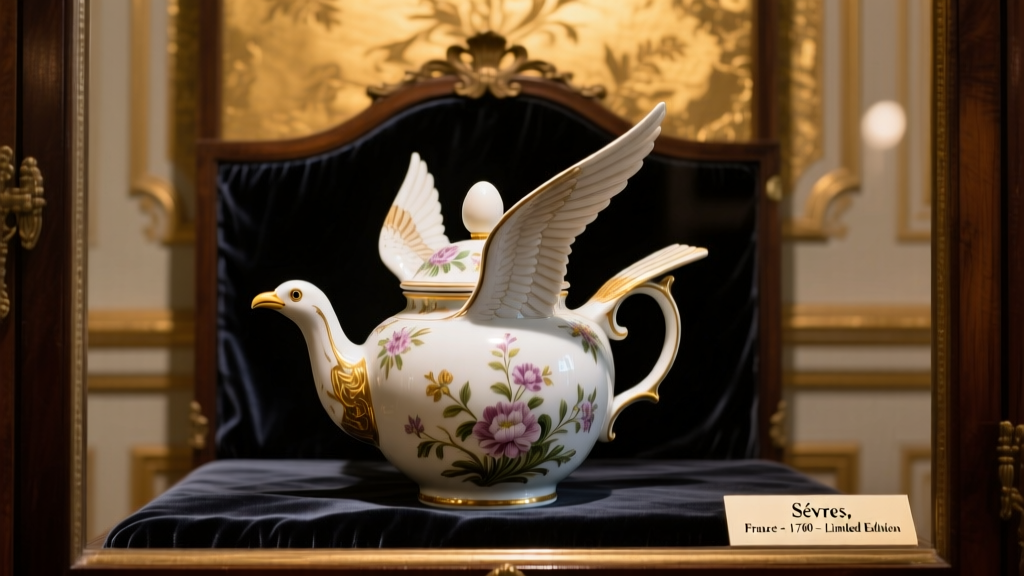
The Sèvres Teapot Cover: Bird-in-Flight Spout, Egg Shape, Circa 1760 — A Masterpiece of Rococo Porcelain Innovation
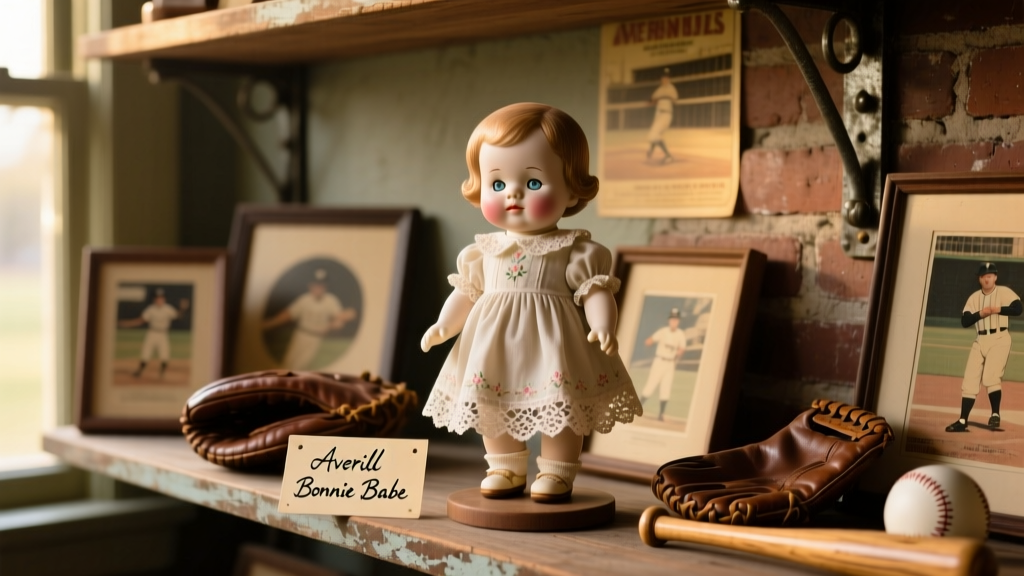
Averill Bonnie Babe Toddler: Authentication, Provenance, and Market Value of the 6-Inch Bisque Swivel-Head Doll with Glass Sleep Eyes