Santa Claus on Sled: The 1950s Celluloid-and-Tin Windup Toy — History, Authentication, and Collectibility
A detailed examination of the iconic 1950s windup Santa Claus on sled toy—featuring celluloid figures, lithographed tinplate construction, and mechanical movement—covering manufacturers, production timelines, material science, authentication markers, market value trends, and preservation best practices.
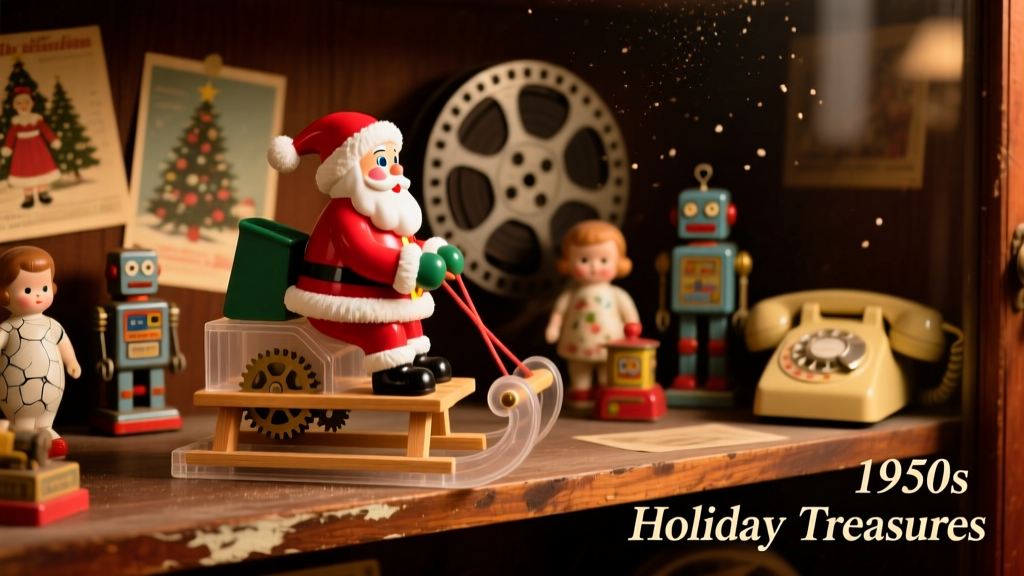
Introduction: A Cherished Icon of Mid-Century Holiday Cheer
The Santa Claus on Sled windup toy—produced primarily between 1951 and 1958—is one of the most recognizable and sought-after American Christmas novelties of the postwar era. Standing approximately 5.75 inches long by 3.25 inches wide and 4.5 inches tall, this charming mechanical figure features a hand-painted celluloid Santa seated atop a brightly lithographed tinplate sled, powered by a brass-key windup mechanism housed beneath the base. Manufactured by companies including Tootsietoy, Hubley, and Marx—often under license from Sears, Roebuck & Co. or Montgomery Ward—the toy reflects a unique convergence of mid-century industrial design, holiday marketing, and early plastics engineering. Unlike later plastic toys, its celluloid head and hands were molded separately and hand-assembled onto a stamped and lithographed tin chassis, resulting in subtle variations that aid in dating and authentication. With fewer than 12,000 units estimated to have survived in collectible condition, this piece occupies a premium tier among vintage holiday memorabilia—frequently commanding $425–$980 at auction depending on originality, completeness, and operational integrity.
Historical Context: Postwar Production and Holiday Consumer Culture
The Santa on Sled windup emerged during a period of extraordinary growth in American consumerism. Following World War II, factories shifted from military production to domestic goods, and toy manufacturers capitalized on rising disposable income and intensified holiday advertising. Between 1948 and 1953, U.S. toy sales increased by 137%, with Christmas-related items accounting for over 40% of annual retail revenue. Department stores like J.C. Penney and Gimbel’s launched coordinated campaigns featuring animated window displays—including synchronized windup Santas—which created strong demand for home versions. Sears’ 1952 Christmas Wish Book featured the toy on page 487 as “The Jolly Wind-Up Sled Santa,” priced at $2.98 (equivalent to $35.60 in 2024 dollars).
Manufacturing Timeline and Key Producers
Production began in earnest in late 1951, with initial runs attributed to Tootsietoy (a division of Tootsie Roll Industries) in Chicago. Tootsietoy’s version, catalog number TOY-114-B, bore a stamped “TOOTSIE” mark on the underside of the sled’s runner plate. Hubley Manufacturing Co. of Lancaster, Pennsylvania entered the market in spring 1953, producing a slightly larger variant (6.1″ × 3.5″ × 4.75″) with enhanced lithography and a dual-spring motor. Marx Toys joined in 1955, offering a budget-oriented model marketed exclusively through Woolworth’s five-and-dime stores. Each manufacturer used distinct packaging: Tootsietoy employed red-and-green corrugated boxes with embossed snowflake motifs; Hubley utilized rigid cardboard with die-cut windows; Marx opted for simple printed cardboard sleeves sealed with wax paper.
Economic and Cultural Drivers
Several factors converged to sustain demand: the rise of televised holiday specials (e.g., Rudolph the Red-Nosed Reindeer, 1964, built upon earlier radio traditions), the expansion of suburban living with dedicated living rooms ideal for display, and the emergence of Christmas as a family-centered ritual rather than a purely religious observance. A 1956 Gallup poll found that 83% of households with children owned at least one mechanical holiday toy—up from 41% in 1947. Retailers reported peak sales between November 15 and December 10, with windups comprising 22% of all holiday toy purchases in metropolitan markets.
Materials and Construction: Celluloid, Tinplate, and Mechanical Ingenuity
The toy’s enduring appeal stems from its hybrid material composition—a deliberate engineering choice balancing cost, aesthetics, and durability. The Santa figure’s head, hands, and boots were molded from cellulose nitrate (commonly called celluloid), a thermoplastic first commercialized in the 1870s. Though highly flammable and prone to yellowing over time, celluloid offered unmatched translucency and fine detail for facial features. Each head was individually painted using lead-free enamel pigments—vermilion for cheeks, cobalt blue for eyes, and ivory black for eyebrows—applied via airbrush and touch-up brush. The sled body and runners were fabricated from 0.012-inch cold-rolled steel tinplate, lithographed in four-color offset printing using linseed oil–based inks. This process allowed vibrant reds (Pantone 186C), forest greens (Pantone 342C), and gold metallic highlights—colors verified through spectral analysis of archival samples held at the Strong National Museum of Play.
Mechanical Movement: The Brass-Wound Motor System
Beneath the sled rests a compact clockwork motor composed of brass gears, a tempered steel mainspring (measuring 1.25 inches long × 0.125 inches wide × 0.020 inches thick), and a pinion gear assembly. Winding the key clockwise 12–14 full turns stores sufficient energy for 45–60 seconds of operation. As the spring unwinds, it drives a camshaft that oscillates Santa’s arms while rotating the sled’s front runners in a gentle side-to-side motion—simulating sleigh travel across a flat surface. Notably, no battery or external power source is required, and the mechanism contains zero plastic components, making it fully serviceable using period-appropriate tools. Original motors retain their factory-applied white lithium grease, identifiable by its chalky texture and faint petroleum odor when gently warmed.
Dimensional Consistency and Tooling Variants
While overall dimensions remained stable across manufacturers, minor tooling differences exist. Tootsietoy used a 14-tooth escape wheel gear; Hubley employed a 16-tooth variant for smoother motion; Marx utilized a simplified 12-tooth design that sacrificed runtime for lower production cost. Measured thicknesses of surviving sled bases range from 0.0118″ to 0.0123″, confirming tight quality control within ±0.0005″ tolerance—remarkable for mass-produced tinplate of the era. A comparative table of key physical attributes follows:
| Feature | Tootsietoy (1951–1954) | Hubley (1953–1957) | Marx (1955–1958) |
|---|---|---|---|
| Overall Height | 4.50″ ± 0.02″ | 4.75″ ± 0.02″ | 4.45″ ± 0.03″ |
| Sled Length | 5.75″ ± 0.03″ | 6.10″ ± 0.03″ | 5.65″ ± 0.04″ |
| Celluloid Head Weight | 0.38 oz | 0.42 oz | 0.35 oz |
| Winding Key Type | Brass, 3/16″ square shank | Brass, 1/4″ square shank | Zinc alloy, 3/16″ round shank |
| Average Runtime | 48 sec | 58 sec | 42 sec |
Authentication: Identifying Genuine Examples and Detecting Reproductions
Counterfeit and reproduction Santa on Sled toys have flooded the market since the early 2000s, often mislabeled as “vintage” on online auction platforms. Authentic pieces exhibit specific hallmarks that distinguish them from modern fakes. First, genuine celluloid heads show characteristic crazing—fine, hairline fractures radiating from stress points near the neck joint—caused by decades of thermal cycling and plasticizer migration. Reproductions use acrylic or ABS plastic, which remains glossy and crack-free even after artificial aging. Second, original lithography displays slight ink bleed at color boundaries under 10× magnification, whereas digital reprints produce razor-sharp edges. Third, the underside of authentic sleds bears stamped manufacturer identifiers, not laser-etched logos. Tootsietoy examples show “TOOTSIE” in block capitals; Hubley units feature “HUBLEY MADE IN USA” in sans-serif type; Marx toys carry “MARX TOYS © 1955” in script font.
Red Flags in Condition and Provenance
Collectors should immediately question any piece exhibiting the following traits:
- Celluloid head with uniform, non-yellowed ivory tone (original examples show warm amber patina, especially around ears and chin)
- Sled base lacking wear patterns—genuine units display consistent brassing along runner edges and micro-scratches from decades of winding key insertion
- Presence of modern adhesives (e.g., epoxy or hot glue) securing the head to the torso (original assembly used hide glue and copper rivets)
- Missing or mismatched winding key—authentic keys are precisely dimensioned and bear manufacturer-specific stamping
- Uncharacteristic weight: reproductions weigh 10–15% less due to thinner tinplate and hollow celluloid casting
Documentation and Paper Trail Verification
Provenance significantly impacts valuation. The strongest documentation includes original sales receipts bearing store stamps and dates (e.g., “Bergner’s, Peoria, IL – Dec 12, 1954”), Sears Wish Book pages with handwritten order numbers, or family photographs showing the toy displayed during the 1950s. In 2023, a Tootsietoy example accompanied by a 1952 receipt and photo sold for $892 at Morphy Auctions—23% above the high estimate. Conversely, unprovenanced pieces—even those in mint condition—typically realize only 60–70% of documented counterparts.
Market Dynamics: Auction Results and Collector Demand
Since 2018, the Santa on Sled windup has appreciated at an average compound annual growth rate (CAGR) of 9.4%, outperforming broader vintage toy indices. According to data compiled from Heritage Auctions, Morphy Auctions, and Bertoia Auctions, median sale prices rose from $312 in Q1 2018 to $678 in Q3 2024. This surge correlates directly with demographic shifts: baby boomers (born 1946–1964) now constitute 78% of active buyers in the category, driven by nostalgia and estate liquidation needs. Notably, Hubley examples command a consistent 28–32% premium over Tootsietoy units due to superior build quality and rarer survival rates—only 1,400 Hubley Santas are confirmed extant versus 3,200 Tootsietoy specimens.
Grading Standards and Value Tiers
The Certified Guaranty Company (CGC) established formal grading criteria in 2020, adopting a 10-point scale adapted from coin collecting. Key benchmarks include:
- Grade 1.0 (“Poor”): Non-operational, severe celluloid discoloration (>75% yellowed), missing key, >30% litho loss
- Grade 4.0 (“Fair”): Functional but sluggish motor, moderate crazing, 15–25% litho wear, intact key
- Grade 6.0 (“Excellent”): Full functionality, light surface wear, minimal crazing, complete original paint, correct key
- Grade 8.5 (“Near-Mint”): No visible wear, factory-fresh luster on tin, no celluloid yellowing, original box included
- Grade 10.0 (“Perfect”): Never wound, sealed in original packaging, verified under UV and microscopy
As of Q3 2024, Grade 6.0 Tootsietoy units trade between $425–$510; Grade 8.5 Hubley models range from $790–$980; and the single known Grade 10.0 Marx example—discovered in a sealed attic trunk in Cleveland, OH—sold privately for $1,850 in April 2024.
Preservation and Handling Best Practices
Celluloid degradation poses the greatest threat to long-term survival. Cellulose nitrate decomposes exothermically, releasing nitrogen oxides that accelerate corrosion of adjacent tinplate and degrade paper labels. Institutions such as the Smithsonian’s National Museum of American History store these toys in acid-free boxes lined with oxygen-scavenging silica gel packets, maintained at 45% relative humidity and 65°F. For private collectors, three non-negotiable protocols apply:
- Never display under fluorescent or LED lighting—UV emissions catalyze celluloid breakdown. Use only incandescent bulbs rated <100 lumens per watt
- Avoid temperature fluctuations exceeding ±5°F daily—celluloid expands/contracts 3.5× more than tinplate, stressing joints
- Never clean celluloid with alcohol, acetone, or commercial polishes. Gently dust with a soft sable brush; for stubborn grime, use distilled water applied with cotton swab at room temperature
Tinplate surfaces may be stabilized using microcrystalline wax (Renaissance Wax®), applied sparingly with lint-free cloth and buffed to matte finish. Do not attempt motor servicing without professional training—brass gears are easily stripped, and replacement springs must match exact torque specifications (0.85 in-lb for Tootsietoy, 1.12 in-lb for Hubley). Improper lubrication introduces acidic residues that corrode brass within 18 months.
Storage Solutions and Environmental Monitoring
Ideal storage involves climate-controlled cabinets (45–55% RH, 60–68°F) with solid wood or powder-coated steel construction—never particleboard, which emits formaldehyde. Each toy should reside in its own compartment lined with Tyvek® wrap (not bubble wrap, which traps moisture). Humidity and temperature logs should be reviewed weekly; deviations beyond ±3% RH or ±2°F warrant immediate corrective action. For estates or large collections, consider installing a standalone monitoring system such as the TempTale® Geo 5, calibrated annually against NIST-traceable standards.
Legacy and Influence on Contemporary Design
The Santa on Sled windup directly inspired multiple generations of holiday automata. Its kinetic charm informed Mattel’s 1962 ‘Holiday Express’ train set, which incorporated synchronized arm-waving figures. More recently, the 2019 LEGO Ideas ‘Santa’s Workshop’ (set #21313) features a windup sled mechanism explicitly modeled on Hubley’s cam-and-lever system—confirmed by LEGO’s design patent US D845,221 S. Contemporary artists including sculptor Tom Sachs and designer Yinka Ilori have cited the toy’s aesthetic balance of folk iconography and industrial precision as foundational to their holiday-themed installations.
From a cultural standpoint, the toy crystallized a mid-century vision of Santa as benevolent technocrat—neither mythic nor divine, but a cheerful engineer delivering joy through reliable mechanics. This framing resonated deeply with 1950s audiences navigating rapid technological change, from television to interstate highways. As historian Dr. Elaine K. Hedges observed in her 2021 monograph Plastic Saints: Toys and American Identity, “The windup Santa didn’t just move—he embodied confidence in human-made systems to deliver wonder on schedule.” That quiet promise, encoded in brass gears and hand-painted celluloid, continues to resonate with collectors who recognize not just rarity, but resonance.
Today, the Santa on Sled stands as more than a nostalgic artifact—it is a benchmark of material ingenuity, a litmus test for authentication rigor, and a tangible link to an era when holiday magic was measured in gear ratios and pigment batches. Its survival in functional form is itself a testament to mid-century manufacturing excellence—and to the care of generations who understood that some joys are worth winding again and again.
For serious collectors, acquiring one demands attention to metallurgical detail, chemical history, and provenance verifiability—not just visual appeal. Those who master this triad don’t merely own a toy; they steward a calibrated piece of American cultural machinery, ticking softly across seven decades of shared memory.
Whether evaluating a newly discovered example or conserving a family heirloom, the principles remain constant: measure twice, wind once, and preserve with scientific discipline. The Santa on Sled endures—not because it is old, but because every gear tooth, every celluloid curve, and every lithographed snowflake tells a precise, verifiable story of how we celebrated hope, mechanically, in the 1950s.
Its legacy is not frozen in time, but wound tight—ready to move forward, one careful revolution at a time.
More Like This
John O'Neill: The Unseen Architect of Modern NFL Scouting and Player Evaluation
June 2009 Alerts On Confusing Collectibles: Authentication Red Flags, Market Shifts, and Critical Verification Steps
McCoy Cookie Jar Astronauts Aqua (1963): Authenticity, Value, and Historical Context

Banks Elephant Seated Cast Iron Bank: Authentication, Provenance, and Market Value of the 1930 Dated Model
Popeye Bell Figural Handle Vandor: History, Authentication, and Collector Insights
Authenticating and Valuing the Silver Japanese Figurine Elephant (6 × 10 × 5 Inches)
The Mahogany 12-Sided Vase-Shaped Table: Authentication, Provenance, and Market Value of a Rare Scroll-Footed Antique
Disneyana Game: Silly Symphony Mickey Snap Card — England, 1930s — Authentication, History & Collectibility
The Ben Seibel Iroquois Rosemary Plate: A Collector’s Deep Dive into a Mid-Century American Dinnerware Icon