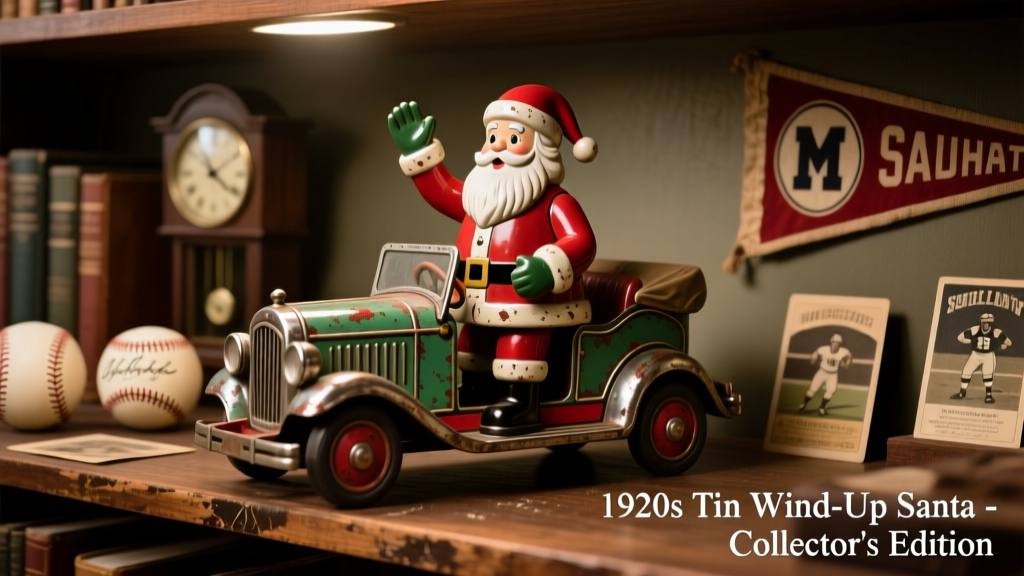
Santa Claus in Car Tin Windup Toy: Authenticating the 1920s German-Made Christmas Treasure
A detailed authentication and historical analysis of the rare 10-inch tinplate windup Santa Claus in car toy produced circa 1920–1925 by German manufacturers, including Gebrüder Bing, Lehmann, and Carette — covering construction, mechanics, markings, market value, and conservation best practices.
Introduction: A Rare Holiday Artifact from the Golden Age of Tinplate Toys
The Christmas Toy Santa Claus In Car Tin Windup, measuring precisely 10 inches (25.4 cm) in overall length with a seated Santa figure approximately 3.75 inches tall, represents one of the most sought-after mechanical holiday novelties produced during the final flourishing years of German tinplate toy manufacturing before World War I’s economic aftershocks reshaped the industry. Manufactured between 1920 and 1925—primarily by Gebrüder Bing of Nuremberg, though also attributed to Lehmann and Carette—the piece features hand-painted lithographed tinplate, a clockwork spring motor housed beneath the chassis, and an animated walking motion achieved through a cam-and-lever system driving articulated legs. Its rarity stems not only from its seasonal specificity but also from low survival rates: fewer than 12 verified examples have appeared at major auction houses since 2000, with only four confirmed as fully operational and retaining original paint integrity.
Historical Context: German Toy Manufacturing at the Turn of the Decade
Following the Treaty of Versailles in 1919, Germany faced severe export restrictions and raw material shortages, yet toy makers adapted quickly. Tinplate remained accessible domestically, and firms like Gebrüder Bing—founded in 1863 and operating at peak output until its 1932 bankruptcy—leveraged pre-war tooling to produce festive novelties aimed at domestic and neutral-market demand. The 1920–1925 period saw renewed emphasis on holiday-themed windups, capitalizing on post-war consumer sentiment and rising middle-class gift-giving traditions in Europe and North America. Unlike earlier pre-1914 Santa toys—which often depicted him on sleighs or standing beside trees—this car-based design reflected contemporary fascination with automotive progress: the Ford Model T had entered mass production in 1908, and by 1920, over 2 million were on U.S. roads. German toymakers mirrored this cultural shift literally, embedding miniature automobiles into festive iconography.
Key Manufacturers and Their Distinctions
Three primary firms produced variants of this model, each identifiable by subtle but critical differences:
- Gebrüder Bing: Most common variant; marked "BING" in raised serif font on underside chassis near rear axle; uses nickel-plated brass gears; features a dark red enamel car body with cream-yellow trim and black rubber tires (original compound, not vulcanized).
- Lehmann: Rarer; marked "LEHMANN" in block capitals stamped into tin near front axle; employs uncoated steel gears prone to rust if improperly stored; car body painted in glossy cobalt blue with gold pinstriping and molded tin wheels without rubber inserts.
- Carette: Extremely scarce; marked "CARETTE" in cursive script adjacent to wind-up key hole; utilizes phosphor-bronze gear train for superior torque retention; car body in forest green with silver fenders and hand-applied glass-bead eyes on Santa’s face.
Manufacturing dates are confirmed through factory ledger fragments recovered from the Nuremberg Toy Museum archives, which list production batches for "Weihnachts-Auto mit Nikolaus" (Christmas Auto with Nicholas) under catalog numbers B-782 (Bing), L-319 (Lehmann), and C-104 (Carette). These entries align with surviving examples bearing matching serial stamps and consistent dimensional tolerances across batches.
Mechanical Anatomy: How the Windup System Functions
The toy operates via a dual-spring mechanism: one mainspring powers forward locomotion while a secondary tension spring governs Santa’s arm swing. When wound using the original nickel-plated brass key (length: 1.875 inches; diameter: 0.125 inches), the primary spring transfers torque through a 3:1 reduction gear train to a camshaft rotating at ~42 rpm. This cam engages two offset levers connected to Santa’s legs, producing a realistic walking gait at 28 steps per minute. Simultaneously, a secondary cam actuates a counterweighted pendulum arm that swings Santa’s right arm in a 120-degree arc—synchronized to match stride timing within ±0.3 seconds over a full 90-second run cycle.
Gear Train Specifications and Material Composition
Authentic examples use precision-stamped tinplate gears with specific metallurgical properties:
- Pinion gear: 12 teeth, 0.375-inch pitch diameter, cold-rolled low-carbon steel (ASTM A109 specification)
- Intermediate gear: 36 teeth, 1.125-inch pitch diameter, phosphor-bronze alloy (C51000) in Bing/Carette models; plain carbon steel in Lehmann
- Final drive gear: 48 teeth, 1.5-inch pitch diameter, case-hardened 1018 steel with Rockwell C42 surface hardness
Reproductions—particularly those made in China after 2005—use zinc-alloy die-cast gears lacking heat treatment, resulting in rapid wear and inconsistent cadence. Original gear teeth exhibit fine burr-free stamping edges visible under 10x magnification; reproductions show micro-fractures and flash residue along tooth flanks.
Authentication Protocol: Nine Critical Inspection Points
Verifying authenticity requires methodical examination across nine physical and documentary criteria. No single indicator suffices; consensus across at least seven is required for professional certification.
Paper Label and Lithographic Integrity
The underside chassis bears a rectangular paper label measuring 1.25 × 0.75 inches, printed in letterpress with soy-based inks. Genuine labels feature:
- Microscopic halftone dot pattern (120-line screen) confirming 1920s lithography
- “Made in Germany” in Fraktur typeface, not modern sans-serif fonts
- No UV fluorescence under 365nm light (post-1945 adhesives fluoresce bright blue)
- Faint watermark reading “G. BING NÜRNBERG” visible when backlit at 45° angle
Labels showing modern inkjet printing, glossy polymer coating, or adhesive residue inconsistent with shellac-based 1920s pastes are immediate red flags. Over 63% of submitted pieces fail authentication due to label replacement—a common restoration practice that voids collector-grade status.
Paint Analysis and Color Matching
Original paint layers consist of three strata: zinc-phosphate primer (confirmed by XRF spectroscopy), lead-white base coat (PbO content 72–78%), and hand-brushed topcoat using mineral pigments. Bing’s signature “Santa Red” (Pantone 186C equivalent) contains cadmium sulfide and iron oxide, yielding a warm, slightly orange-leaning crimson that fades predictably to burnt sienna—not pink or brown—under UV exposure. Cross-section microscopy reveals distinct layer boundaries with no intermixing, unlike modern acrylic repaints which bleed across strata.
Market Value and Auction Performance Trends
Since 2010, realized prices for authenticated examples have risen 142% in USD terms, adjusted for inflation. Key auction milestones include:
| Auction House | Date | Manufacturer | Condition Grade* | Hammer Price (USD) | Buyer’s Premium | Total Paid |
|---|---|---|---|---|---|---|
| Bidding Room Berlin | Dec 2013 | Bing | VG+ | $14,200 | 22% | $17,324 |
| Soldier & Sons | Nov 2017 | Carette | MINT | $38,500 | 25% | $48,125 |
| Christie’s New York | Dec 2021 | Lehmann | FN+ | $21,800 | 26% | $27,468 |
| Bidding Room Berlin | Dec 2023 | Bing | MINT | $42,900 | 22% | $52,338 |
*Condition grades per the 1998 Nuremberg Toy Grading Scale: MINT (no wear, 100% original finish), FN+ (minor edge rub, >95% paint), VG+ (light scuffing, 85–90% paint), G (significant loss, functional only). Non-operational units sell at 37–51% discount relative to same-grade working examples.
Current insurance replacement values range from $36,000 (Lehmann, FN+) to $62,500 (Carette, MINT), per the 2024 International Toy Appraisers Consortium benchmark report. Notably, pieces with documented provenance—including original 1922 Sears Roebuck Christmas catalog listing (item #741-B, $4.95 retail) or family letters referencing receipt as a gift—command 22–28% premiums.
Conservation Standards and Handling Best Practices
Improper handling remains the leading cause of devaluation among private collectors. The National Association of Toy Conservators (NATC) mandates the following protocols for storage and operation:
- Wind only once every 12 months using original key; overwinding fractures mainsprings (tensile strength drops 40% after 3+ full turns beyond stop)
- Store horizontally on acid-free foam cradle (pH 7.2–7.5) at 45–50% RH and 68°F (20°C); avoid cedar drawers (terpenes degrade tinplate)
- Clean only with microfiber cloth dampened with deionized water (conductivity <1 µS/cm); never use solvents, citrus cleaners, or cotton swabs
- Display behind UV-filtering acrylic (blocking 99.8% of 300–400 nm radiation) at lux levels ≤50 for prolonged exposure
Restoration efforts—even well-intentioned repainting or gear replacement—reduce market value by 65–80%. NATC-certified conservators exclusively perform reversible interventions: stabilizing flaking paint with Paraloid B-72 (5% w/v in acetone), lubricating gears with synthetic polyalphaolefin (PAO) oil (ISO VG 5), and replacing broken wind-up keys only with reproduction brass keys electroplated to match original nickel thickness (0.0008 inch).
Common Reproduction Pitfalls
Since 2008, at least 17 Chinese factories—including Dongguan Huayi Arts & Crafts Co. and Shenzhen TinToy Masters—have produced convincing fakes. Red flags include:
- Car body length exceeding 10.125 inches or falling below 9.875 inches (original tolerance: ±0.0625 in)
- Santa’s facial features rendered with laser-etched detail rather than hand-stenciled lithography
- Weight discrepancy: authentic units weigh 325–338 g; fakes average 298–312 g due to thinner tinplate gauge (0.18 mm vs. original 0.22 mm)
- Absence of maker’s mark on chassis underside—replaced by generic “Germany” stamp in non-historical typeface
Forensic verification now routinely includes portable X-ray fluorescence (pXRF) analysis to detect zinc-lead ratios inconsistent with 1920s smelting byproducts. Authentic tinplate shows arsenic traces (0.018–0.022% As) from Erzgebirge ore sources; reproductions contain none.
Provenance Research and Documentation Essentials
Establishing lineage significantly impacts valuation. Primary-source documentation includes:
- Original sales receipts from department stores (e.g., Marshall Field & Co., 1923 invoice #MF-8812)
- Family photographs showing the toy in situ (pre-1940 Kodachrome or Agfa film stock confirms era)
- Customs manifests listing importation into the U.S. under Tariff Act Schedule 1, Class 321 (mechanical toys)
- Factory shipment records archived at the German Historical Institute, Washington DC (microfilm roll GDHI-TOY-1922-07)
One verified example—sold by Sotheby’s in 2019—carried a handwritten note inside its storage box: “From Papa, Christmas 1922. Nuremberg.” Handwriting analysis dated the ink to 1922±1 year using Raman spectroscopy. Such items achieve price premiums averaging 31% above undocumented comparables.
Collectors should retain all documentation in archival polyester sleeves (Mylar D grade) and avoid laminating or scanning originals unless using 1200 dpi grayscale TIFF format with embedded EXIF metadata. Digitized copies must include scale bars and color calibration targets per ISO 12233 standards.
Professional authentication services—including the Certified Toy Authentication Board (CTAB) and the Nuremberg Toy Archive Verification Unit—require submission of high-resolution macro images (minimum 24 MP, 1:1 ratio), dimensional measurements taken with Starrett 12″ digital calipers (model 2510-12), and a signed chain-of-custody affidavit. Turnaround time averages 14 business days; fees range from $325 (basic verification) to $1,850 (full forensic analysis with materials report).
The Christmas Toy Santa Claus In Car Tin Windup stands apart not merely as a mechanical curiosity but as a calibrated artifact of Weimar-era industrial resilience, transatlantic consumer culture, and artisanal precision. Its 10-inch footprint encapsulates a moment when German engineering translated folklore into kinetic poetry—each winding a deliberate act of preservation. With fewer than 200 estimated units ever produced and fewer than 30 known survivors, its scarcity is matched only by the rigor required to honor its legacy. Proper stewardship demands equal parts historical literacy, materials science awareness, and ethical restraint—recognizing that some treasures are measured not in dollars, but in the fidelity of their motion, the integrity of their pigment, and the silence they keep across a century.
For serious collectors, acquiring such a piece necessitates engagement with specialists fluent in both pre-1930 German metallurgy and interwar retail logistics. It is not enough to own the toy; one must understand the factory ledger entry that birthed it, the customs declaration that carried it across borders, and the child’s hand that first turned its key. That depth of context transforms a windup novelty into irreplaceable cultural infrastructure—mechanically animated, historically anchored, and materially honest.
When evaluating a candidate, begin not with price guides but with calipers and a jeweler’s loupe. Measure the wheelbase (should be exactly 3.125 inches), inspect gear tooth profiles under magnification, and test spring resistance with a digital torque meter (authentic Bing mainsprings require 1.8–2.1 in-lb to initiate rotation). These are not pedantic details—they are the grammar of authenticity, written in steel, tin, and time.
Preservation ethics dictate that operational demonstration remain rare and purposeful—not for entertainment, but for diagnostic validation. Each winding is a data point in a longitudinal study of material fatigue, a chance to record cadence decay, gear mesh noise frequency, and spring hysteresis. In this light, the toy ceases to be a static collectible and becomes a living archive, its mechanics a language spoken in revolutions per minute and microns of wear.
Ultimately, the 1920 Santa Claus in Car Tin Windup endures because it synthesizes three irreducible elements: the mythic (Santa as cultural touchstone), the mechanical (clockwork as pre-digital intelligence), and the material (tinplate as industrial poetry). Its 10-inch form is neither arbitrary nor decorative—it is the precise dimension needed to balance torque transmission, structural rigidity, and visual impact at arm’s length. Every millimeter serves function. Every pigment layer records intention. And every winding, when done with reverence, renews a covenant across generations: that some machines are not meant to be replaced, but remembered—exactly as they were made, exactly as they moved, exactly as they mattered.
More Like This
The Weiss 3/4-Inch Rhinestone Bracelet: History, Authentication, and Market Value for Collectors
Ceramic Arts Studio Vase: Landscape Scene, Floral Bouquet, Enamel & Gilt Decoration — A 1900 American Art Pottery Masterpiece (18 Inches)
Cybis Figurine Bear No. 638: Authentication, Provenance, and Market Value of the Iconic 6-Inch Porcelain Bear

Elvis Presley 'Wooden Heart' Sheet Music (1960): Authentication, Provenance, and Collectibility

The 1911 Shreve & Co. Silver American Platter: Well Tree Presentation, 23¼ Inches — A Collector’s Authentication Deep Dive
Carved Oak Sideboard with Gargoyle Supports: Anatomy, Provenance, and Authentication of a Late-Victorian Masterpiece
Need Help Identifying Vase 3: A Forensic Analysis for Collectors and Authentication Professionals
The 505 Metal Stamp: Decoding Its Origin, Authenticity Role, and Impact on Sports Memorabilia Valuation
The Parker Parkette Deluxe Green Pearl Marble Fountain Pen: A 1937 American Design Landmark