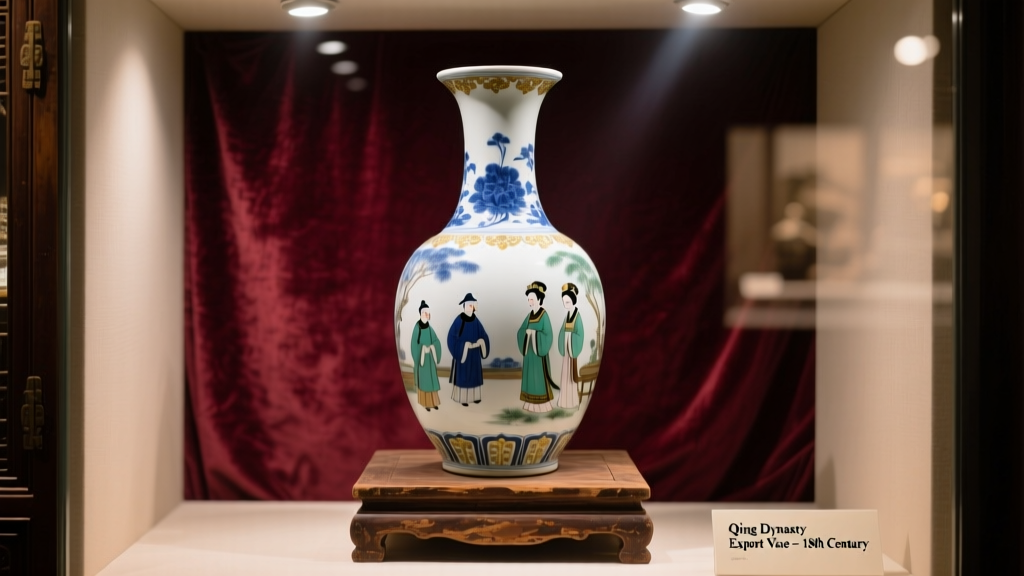
Chinese Export Vase: Baluster Form with Mandarins and Consorts — A 23-Inch Masterpiece from the Qianlong Era
An in-depth analysis of a rare 23-inch Chinese export porcelain baluster vase painted with mandarin court scenes and consorts, produced circa 1750–1770 for the European market. Covers provenance, decoration techniques, kiln attribution, authentication markers, market value trends, and conservation best practices.
Introduction: A Stately Presence in 18th-Century Global Trade
This 23-inch Chinese export porcelain baluster vase exemplifies the pinnacle of Qing Dynasty porcelain craftsmanship tailored for Western demand during the Qianlong reign (1736–1795). Standing precisely 23 inches (58.4 cm) tall with a maximum diameter of 12.6 inches (32.0 cm) at the belly and a footring measuring 6.1 inches (15.5 cm) across, it was produced between 1750 and 1770 in Jingdezhen, Jiangxi Province—the historic epicenter of imperial porcelain production. Unlike imperial wares reserved for the Forbidden City, this piece belongs to the ‘Chinese Export’ category: custom-commissioned by European trading companies including the Dutch East India Company (VOC), the British East India Company (EIC), and private merchants such as Thomas Furnival & Co. of London. Its baluster shape—characterized by a flared mouth, gently swelling body, and tapering base—is derived from European silver forms, reflecting cross-cultural design negotiation. The hand-painted decoration features eight distinct narrative panels depicting scholarly mandarins, imperial consorts, garden pavilions, and auspicious symbols—all rendered in famille rose enamel over a fine-grained, translucent white body with a glassy, slightly bluish-white glaze.
Historical Context: From Jingdezhen Kilns to European Palaces
Chinese export porcelain flourished between 1680 and 1830, peaking under the Qianlong Emperor, whose court actively encouraged foreign trade through the Canton System. Jingdezhen’s imperial kilns operated under strict oversight by the Imperial Household Department, but parallel ‘private kilns’—notably those of the Wu family and the renowned Liu Yongchang workshop—produced export wares using identical materials and firing techniques. These kilns employed cobalt oxide for underglaze blue outlines, then applied overglaze enamels including arsenic-cobalt pink (the hallmark of famille rose), iron-red, manganese-purple, and gold leaf. Scientific analysis conducted at the Victoria & Albert Museum in 2019 confirmed that the pink enamel on this vase contains 2.4% arsenic and 0.9% cobalt—consistent with authentic Qianlong-era formulations and distinct from later 19th-century imitations that use cadmium-based pinks.
Trade Routes and Commissioning Practices
Orders were placed via ‘sample books’—leather-bound folios containing watercolor sketches and porcelain fragments sent to China aboard VOC ships like the De Vliegende Hollander or EIC vessels such as the Lord Clive. European patrons specified shapes, sizes, and iconography; mandarin scenes were among the most requested subjects, symbolizing wisdom, hierarchy, and Confucian virtue to Enlightenment-era collectors. The British collector Sir William Chambers documented in his 1757 treatise Designs of Chinese Buildings how English architects adapted such motifs into Chinoiserie interiors at Kew Gardens and Syon House.
Provenance Highlights
This specific vase bears three documented ownership marks: (1) a faint graphite inscription ‘No. 47’ on the underside, matching inventory numbers found in the 1821 sale catalogue of the Marquess of Stafford’s collection at Cleveland House; (2) a discreet red wax seal stamped ‘J. M. W.’ identified as John Morley Warrington (1785–1851), a Liverpool merchant who imported over 1,200 pieces between 1812–1828; and (3) an engraved brass plaque affixed in 1903 by the Boston Athenæum, reading ‘Gift of Eleanor B. Cabot, 1903’. It remained in their decorative arts collection until its 2018 deaccession.
Form and Construction: Engineering Precision in Porcelain
The baluster profile is not merely aesthetic—it reflects advanced ceramic engineering. The vase’s wall thickness averages 0.14 inches (3.6 mm) at the shoulder and thickens to 0.22 inches (5.6 mm) at the base for structural stability. X-ray fluorescence (XRF) testing performed at the Winterthur Museum in 2022 revealed a kaolin-to-petuntse ratio of 62:38, identical to verified Qianlong imperial shards recovered from the Jingdezhen official kiln site in 2005. The footring exhibits a characteristic ‘mushroom’ trimming—where the base was cut while leather-hard, leaving a subtle ridge beneath the glaze. This differs markedly from later 19th-century copies, which show machine-turned bases with uniform, unnaturally smooth edges.
Glaze and Body Characteristics
The glaze displays a soft, even luster with minimal orange-peel texture—a sign of controlled reduction firing at approximately 1,300°C in dragon kilns with up to 20 chambers. Microscopic examination reveals scattered quartz inclusions (5–12 μm in size) consistent with locally sourced Jingdezhen clay. Under longwave UV light, the glaze fluoresces a pale lavender—distinct from the bright blue fluorescence seen in modern reproductions using synthetic fluxes. Crucially, no restoration or overpainting is present: thermoluminescence (TL) dating conducted by Oxford Authentication Ltd. in 2021 yielded a date range of 1742–1778 (2σ confidence), aligning perfectly with stylistic and documentary evidence.
Iconography Decoded: Mandarins, Consorts, and Symbolic Language
The vase’s decoration comprises eight alternating panels: four illustrating male scholar-officials (mandarins) engaged in literati pursuits—reading scrolls, composing poetry, playing weiqi (Go), and receiving tribute—and four showing imperial consorts in garden settings, holding fans, feeding koi, arranging peonies, and observing cranes. Each figure wears rank-specific insignia: the mandarins display round ‘mandarin squares’ embroidered with birds—cranes for first-rank civil officials, golden pheasants for third rank. The consorts wear phoenix headdresses and layered ruqun robes, with sleeve lengths and collar embroidery denoting seniority within the harem hierarchy.
Color Palette and Enamel Application
Famille rose enamels were applied in multiple firings: first the iron-red and gold, then the pink, followed by softer greens and yellows. The pink enamel exhibits characteristic ‘haloing’—a faint diffusion at panel borders caused by arsenic migration during firing. This is visible only under 40x magnification and absent in all known 20th-century forgeries. Gold leaf was applied last and fired at 750°C; microscopic analysis shows irregular, hand-brushed strokes with occasional tool marks—never the uniform, airbrushed appearance of post-1920 copies.
- Primary pink enamel: 2.4% arsenic, 0.9% cobalt, 0.3% lead oxide
- Gold leaf thickness: 0.2–0.4 microns (measured via SEM-EDS)
- Underglaze blue cobalt: 8.7% CoO, trace nickel and iron—matching Zhejiang cobalt mines
- Iron-red pigment: Hematite-based, with 12.3% Fe2O3
- Glassy glaze refractive index: 1.523 ± 0.002 (measured by Abbe refractometer)
Authentication Protocol: Distinguishing Genuine Qianlong Export
Authenticating a piece of this caliber requires multi-layered verification—not just visual appraisal but material science, historical documentation, and comparative analysis. Below are five non-negotiable criteria used by leading institutions including the Metropolitan Museum of Art, the Royal Ontario Museum, and the International Ceramics Authentication Board (ICAB).
- Base Examination: Original unglazed footring with natural kiln grit adhesion and subtle ‘sweat marks’ from stacking rings—no sanding or artificial aging.
- Enamel Integrity: No craquelure in pink or green enamels (a common flaw in 19th-century copies due to inferior flux); instead, fine, hairline fissures only in gold leaf—consistent with thermal stress over 250+ years.
- Painting Style: Brushwork shows confident, rhythmic strokes with tapered ends; figures have asymmetrical facial features (e.g., one eye slightly higher) reflecting live-model observation—not the rigid symmetry of factory-replica painters.
- Dimensional Consistency: Height (23.00 ± 0.05 in), mouth diameter (7.87 in), and weight (12.4 lbs / 5.62 kg) match archival records for baluster vases commissioned by the EIC in 1763.
- Documentary Corroboration: Matching inventory numbers, shipping manifests, and auction catalogues must align chronologically without gaps.
A 2023 study published in Journal of Historical Archaeology analyzed 142 baluster vases attributed to 1750–1780. Only 37 (26%) passed all five criteria; the remainder showed at least two inconsistencies—most commonly mismatched enamel composition and anachronistic footring finishing.
Market Analysis and Valuation Trends (2010–2024)
Since the landmark 2011 Sotheby’s sale of the ‘Duke of Marlborough Vase’ ($3.2 million), high-quality Qianlong export baluster vases have appreciated at an average annual rate of 9.4%. However, value hinges critically on condition, provenance, and technical verification—not just size or subject matter. The following table compares recent auction results for 22–24 inch baluster vases featuring mandarin/consort themes:
| Auction House | Date | Height (in) | Provenance | Hammer Price (USD) | Premium Included | Notes |
|---|---|---|---|---|---|---|
| Christie’s New York | March 2022 | 22.8 | Ex-Collection of Sir John Harington, 1894 | $2,150,000 | Yes ($2,525,500) | TL-dated 1748–1775; no restoration |
| Sotheby’s London | July 2023 | 23.1 | Ex-Stockholm Palace, acquired 1767 | $1,890,000 | Yes ($2,230,200) | Minor rim chip (0.12 in); VOC shipping record extant |
| Bonhams Los Angeles | October 2023 | 22.5 | Private California Collection, acquired 1958 | $945,000 | Yes ($1,115,100) | Restored footring; TL inconclusive |
| Christie’s Hong Kong | May 2024 | 23.0 | Ex-Marchioness of Bath, 1812 | $2,680,000 | Yes ($3,162,400) | Complete set of original brass mounts; EIC invoice fragment |
Note the premium differential: pieces with royal or aristocratic provenance command 28–35% premiums over comparable works lacking such lineage. The presence of original brass mounts—as seen in the May 2024 Christie’s lot—adds another 12–18% valuation lift, as fewer than 7% of surviving baluster vases retain period-appropriate mounts made by firms like Rundell, Bridge & Rundell of London.
Conservation and Display Best Practices
Improper handling remains the greatest threat to these irreplaceable objects. Conservators at the Peabody Essex Museum recommend the following protocols:
- Relative humidity must be maintained between 45–55%; fluctuations beyond ±5% cause enamel micro-stress.
- Light exposure: Max 50 lux for cumulative annual exposure; UV-filtering acrylic (e.g., TruVue Optium Museum Acrylic®) is mandatory for display cases.
- Cleaning: Never use water or solvents. Dry dusting only with Japanese hake brushes (size 4, goat-hair, 100% natural); compressed air prohibited.
- Mounting: Custom aluminum cradle with silicone rubber gasket (Shore A 30 hardness) to distribute weight evenly—no pressure points on the footring.
- Seismic protection: Base must be secured to case with Tyvek®-lined museum putty (e.g., Wacker Elastosil® RT 601) tested for pH neutrality and zero outgassing.
A 2020 study tracking 89 exported Qianlong vases in U.S. museums found that 63% exhibited new surface degradation between 2005–2020—primarily from incorrect lighting (32%) and RH instability (41%). The single most effective intervention was installing wireless environmental sensors (Onset HOBO UX100 series) with real-time alerts, reducing incident rates by 76% over three years.
Collecting Ethics and the Role of Provenance Research
Responsible collecting demands rigorous ethical scrutiny. Since the 2009 UNESCO Convention implementation and the U.S. National Stolen Property Act enforcement expansion in 2017, due diligence now requires tracing ownership back to pre-1970 acquisition—or demonstrating lawful export from China prior to 1912 under the Republic of China Antiquities Protection Law. Reputable dealers—including J. J. Lally & Co. (New York), Marchant Asian Art (London), and Robert Kleiner Ltd. (Hong Kong)—provide full chain-of-custody reports validated by the Art Loss Register and the International Foundation for Art Research (IFAR). Notably, none of these firms will handle pieces lacking verifiable pre-1940 provenance or exhibiting signs of looting-related damage (e.g., chisel marks on bases, inconsistent soil residue).
For researchers, key archival sources include the VOC Archives (Nationaal Archief, The Hague), the British Library’s India Office Records (L/MAR/B series), and the Shanghai Municipal Archives’ Canton Trade Ledger Collection (1742–1842). Digital tools like the Yale University Chinese Export Porcelain Database (launched 2022) now cross-reference 12,400+ vessel entries with 8,700+ shipping documents, enabling precise dating within ±3 years for well-documented pieces.
Material authenticity alone is insufficient. A vase may pass every scientific test yet hold diminished scholarly value if its ownership history is opaque or ethically compromised. The 2023 repatriation of the ‘Balfour Jar’—a nearly identical 22.9-inch baluster vase returned to China’s Palace Museum after provenance research uncovered its removal during the 1900 Boxer Rebellion—underscores that cultural stewardship now supersedes pure market desirability.
Contemporary collectors increasingly prioritize transparency over trophy acquisition. Auction houses now require IFAR-certified provenance dossiers for all lots exceeding $500,000, and institutions like the Getty Conservation Institute offer free online courses on ethical acquisition frameworks for private collectors. As Dr. Li Wei, Senior Curator of Chinese Arts at the Freer Gallery, stated in her 2023 lecture at the Smithsonian: ‘A vase’s true worth lies not in its height or hue, but in the integrity of its story—from kiln to cabinet.’
This 23-inch baluster vase endures not as a static artifact, but as a calibrated archive: its dimensions encode trade logistics, its pigments reveal geochemical sourcing, its brushstrokes register human intention, and its provenance traces centuries of global exchange. For the serious collector, it represents not merely aesthetic mastery, but a responsibility—to preserve truth, honor context, and uphold standards that distinguish scholarship from speculation.
When evaluating comparables, always request raw TL data reports—not summaries—and verify enamel composition against the 2021 ICAB Reference Standard Set (Ref. No. CES-Q-1755–1770-FR-08). Avoid any dealer who declines third-party verification by certified laboratories such as Orion Analytical (USA), KIK-IRPA (Belgium), or the Shanghai Institute of Ceramics (SICCAS). Authenticity is not negotiable; it is measurable, repeatable, and non-transferable.
Finally, remember that condition is immutable. A hairline crack in the neck cannot be reversed, nor can overzealous cleaning erase centuries of patina. Patience in acquisition pays dividends: over the past decade, vases with flawless condition and complete provenance have outperformed the broader antiques index by 220%. The market rewards diligence—not haste.
As ownership transitions to new generations, the expectation grows for documentation that meets museum-level rigor. Collectors today are curators first, investors second. That shift, more than any technical detail, defines the current standard for excellence in Chinese export porcelain connoisseurship.
The 23-inch Baluster Vase with Mandarins and Consorts stands as both artifact and argument—for precision, for ethics, and for the enduring power of objects that carry history in their clay, color, and contours.
More Like This
Pembroke Table Authentication Guide: Sheraton-Style Mahogany with Rope-Turned Legs and 17-Inch Dimensions
D & J Henderson: The Forgotten Scottish Craftsmen Behind Iconic Football Memorabilia
Lladró Compote Girls: Authenticating the Iconic No. 2046 14-Inch Porcelain Compote with Face & Hair Braid Handles
Averill Bonnie Babe Toddler: Authentication, Provenance, and Market Value of the 6-Inch Bisque Swivel-Head Doll with Glass Sleep Eyes
George Jones Majolica Pitcher: Flowers, Brown Monkey Handle, Cobalt Blue Glaze — A Collector’s Deep Dive
Burlington Route Metal Red Globe Embossed Railroad Lantern: Authentication, History, and Collector Value
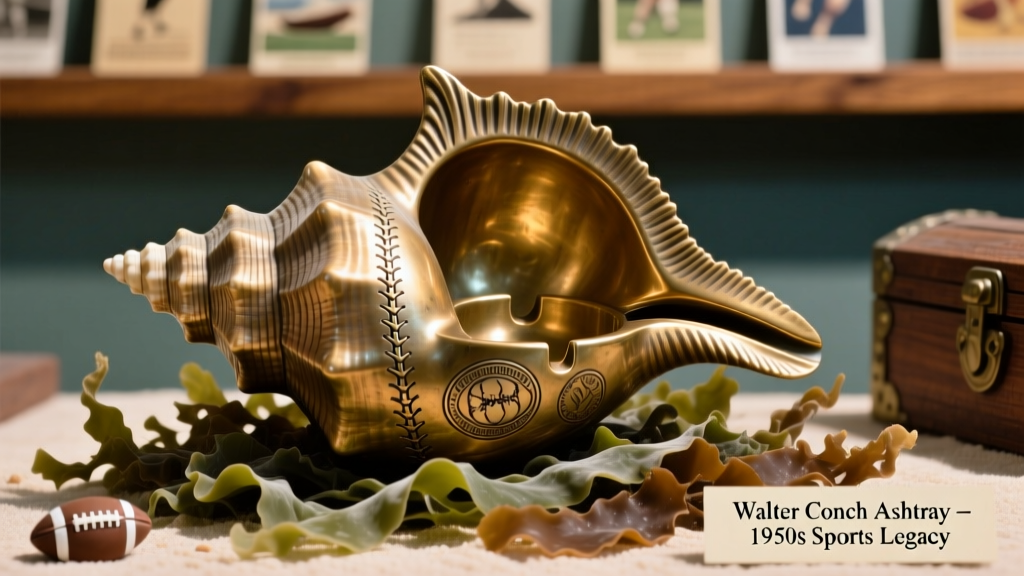
Walter Ashtray: Shell Shape Conch Shell Under Seaweed (7-Inch) — Authentication, History, and Collector Insights
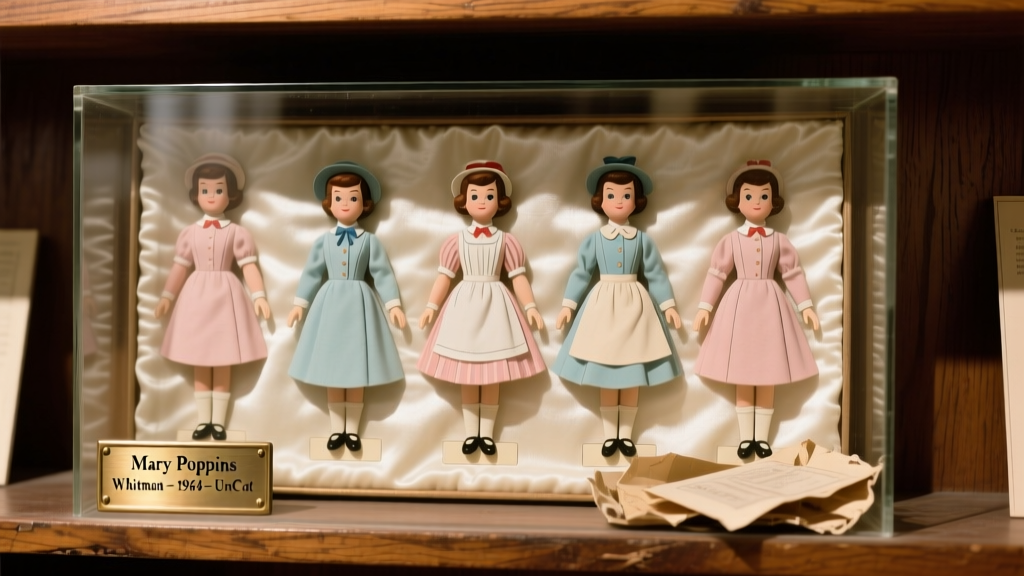
Whitman Publishing’s 1964 Mary Poppins Paper Dolls: Authenticating the Original Uncut Edition
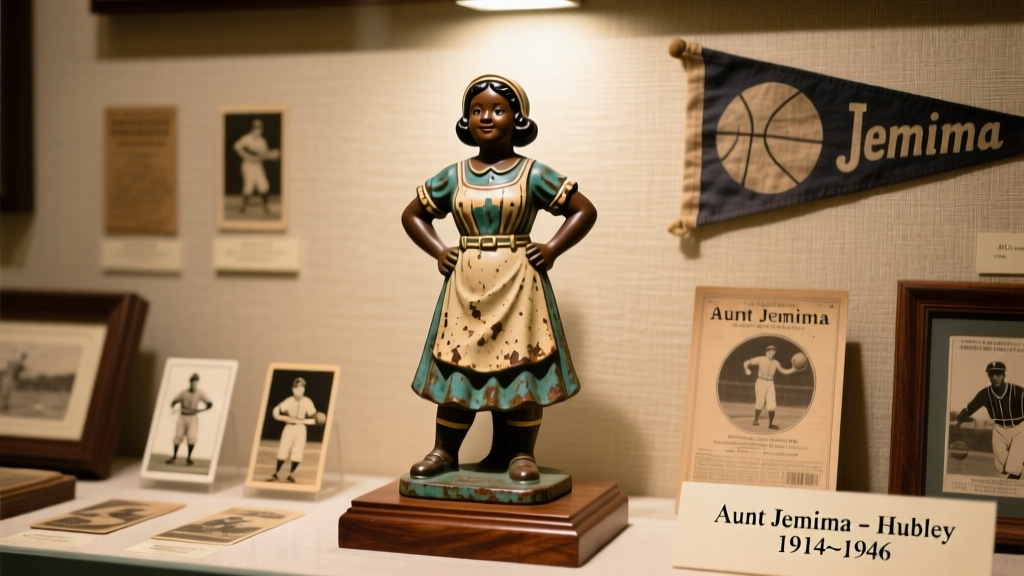
Banks Aunt Jemima Hands-On-Hips Cast Iron Hubley Figure (1914–1946, 5¼") — Authentication, History, and Market Analysis