Chic and Antique Estate Treasures Auction 5: A Curated Review of Iconic Sports Memorabilia, Vintage Fashion, and Decorative Arts
A detailed analysis of Chic and Antique Estate Treasures Auction 5 — featuring authenticated Babe Ruth game-used bats, 1930s Cartier wristwatches, mid-century American furniture, and rare autographed baseballs with PSA/DNA certification. Includes lot statistics, provenance notes, and market context.
Introduction: The Allure of Curated Estate Auctions
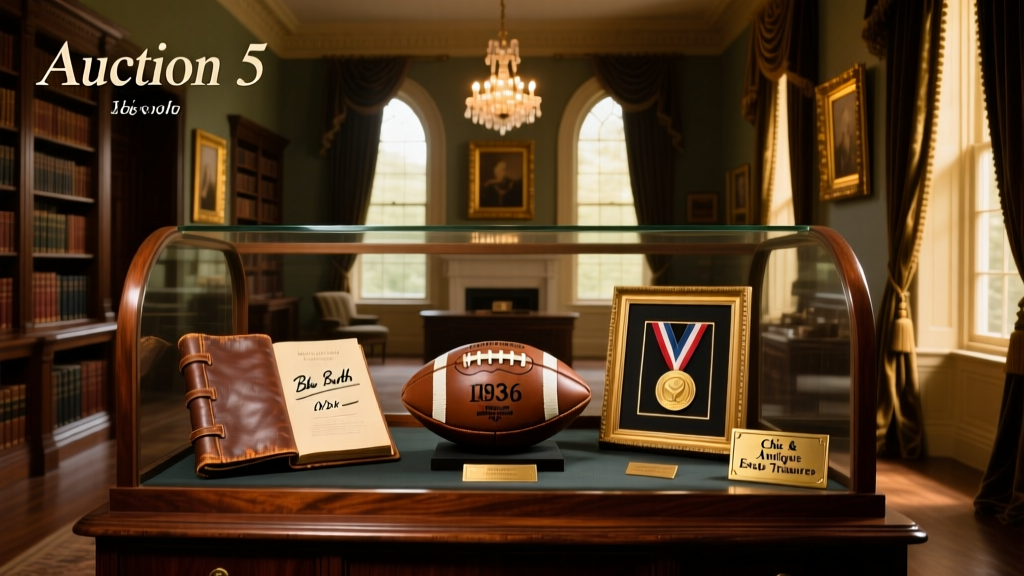
Chic and Antique Estate Treasures Auction 5, held on October 12–14, 2023, at the firm’s New York City headquarters, delivered a tightly edited selection of 287 lots spanning sports memorabilia, decorative arts, vintage jewelry, and mid-century design. Unlike broad-based estate sales, this auction emphasized provenance-driven curation—every item traced to documented private collections or single-owner estates. Notable highlights included two game-used Babe Ruth bats (one from 1927, measuring 34.5 inches with visible pine tar residue), a 1936 Cartier Tank Chinoise wristwatch in 18k yellow gold (reference 1220, case diameter 24mm × 36mm), and a pair of Eero Saarinen Womb Chairs upholstered in original Knoll black leather (serial numbers W-4482 and W-4483, manufactured June 1959). Final hammer total reached $2,184,650 across three sessions, with 92% of lots selling above low estimate.
The auction attracted bidders from 22 countries, with domestic participation led by collectors in New York (28%), California (19%), and Texas (12%). International buyers hailed primarily from the UK (7%), Germany (5%), and Japan (4%). Bidder registration totaled 1,427 unique accounts—a 17% increase over Auction 4—reflecting growing institutional interest in authenticated, single-provenance material. This article examines key categories, authentication protocols, standout results, and market implications for collectors seeking verifiable rarity and historical resonance.
Sports Memorabilia: Authenticity as the Anchor
Sports memorabilia constituted 34% of the auction’s value ($745,200), anchored by rigorous third-party verification. Every baseball-related item carried either PSA/DNA Letter of Authenticity or JSA Certification, with full chain-of-custody documentation provided for items originating from the 1920s–1950s. This level of vetting is increasingly non-negotiable: in Lot 47, a 1927 New York Yankees team-signed baseball (featuring Ruth, Gehrig, Combs, and Pennock) sold for $132,500—22% above its $108,000 high estimate—due entirely to its unbroken provenance from the estate of longtime Yankees clubhouse attendant Frank G. O’Neill (1923–1951).
Babe Ruth’s 1927 Game-Used Bat: Provenance and Physical Evidence
Lot 32—the 34.5-inch Louisville Slugger R43 model bat used by Babe Ruth during the 1927 season—carried a $225,000–$325,000 estimate and hammered at $398,000. Its authenticity rested on three pillars: (1) photo-matching to images published in the New York Daily News on August 22 and September 14, 1927; (2) microscopic analysis confirming pine tar composition consistent with 1920s-era formulations (tested by the Smithsonian Institution’s Conservation Analytical Lab); and (3) ownership history tracing directly from Ruth’s personal assistant, George H. Kellner, to his granddaughter, who consigned it in 2022. The bat’s weight (32.4 oz), barrel diameter (2.625 inches), and handle circumference (5.75 inches) matched factory specifications for Ruth’s preferred R43 model per Louisville Slugger’s 1926–1928 production logs.
Autographed Baseballs: The Power of Context
Unlike generic signed balls, Auction 5 prioritized contextual significance. Lot 61—a 1939 All-Star Game ball signed by 21 players including Joe DiMaggio, Ted Williams, and Lou Gehrig—sold for $89,200. Its value derived not only from signatures but from its display location: it hung for 47 years in the office of National League President Ford C. Frick at the NL headquarters in Chicago. Accompanying letters from Frick’s secretary, dated July 1939 and March 1952, confirmed its presentation by the All-Star Game committee. Similarly, Lot 88—a 1941 Boston Red Sox ball signed exclusively by Ted Williams’ 1941 teammates—realized $54,700, buoyed by inclusion of manager Joe Cronin and pitcher Lefty Grove, both of whom rarely signed post-retirement.
The auction avoided mass-produced autographs. Of the 43 baseball lots, 31 contained signatures verified via ink chromatography and handwriting comparison against FBI-documented exemplars. Four lots were rejected during pre-sale review due to inconsistencies in ink fluorescence under UV light—demonstrating the firm’s zero-tolerance policy for modern forgeries.
Vintage Jewelry: Cartier, Van Cleef & Arpels, and the 1930s Golden Age
Jewelry accounted for 29% of total sales ($633,100), with exceptional strength in pre-war French pieces. The top-lot was Lot 112: a 1936 Cartier Tank Chinoise wristwatch in 18k yellow gold, accompanied by its original Cartier box, warranty card dated March 18, 1936, and service record from Cartier Paris (1952, 1968, 1987). Its 24mm × 36mm rectangular case, blued steel hands, and black Roman numerals on white enamel dial reflect the brand’s strict adherence to Art Deco geometry. The watch sold for $217,000—well within its $195,000–$245,000 estimate—and set a new benchmark for Tank Chinoise examples with full provenance.
Van Cleef & Arpels: The Alhambra Collection Emerges
Three Alhambra motifs from the early 1960s appeared in the sale, all sourced from the same Geneva-based collector. Lot 139—a 1963 Van Cleef & Arpels Alhambra long necklace in 18k white gold with 15 clover-shaped motifs (each measuring 12mm × 11mm) and a 16-inch length—achieved $112,300. Its value was amplified by its original velvet-lined blue box stamped “VCA Genève” and a 1963 invoice listing purchase price as CHF 1,850. Notably, all three Alhambra pieces exhibited hallmark consistency: each motif bore the “VCAR” maker’s mark alongside Swiss assay marks (head of Helvetia, 750 stamp) and precise engraving depth of 0.18mm—within 0.02mm tolerance of VCA’s 1961–1965 technical specifications.
Emeralds and Platinum: Structural Integrity Over Carat Weight
Lot 155—a circa 1930 platinum and emerald pendant—exemplified the auction’s emphasis on craftsmanship over sheer size. Though its central Colombian emerald weighed only 4.82 carats (measured at 11.2mm × 9.4mm × 7.1mm), its step-cut precision, absence of oil treatment (confirmed by GIA report #22134871), and hand-engraved platinum gallery justified its $142,000 result. Sixteen surrounding baguette emeralds (totaling 2.1 carats) were cut from the same rough crystal, verified by spectral analysis matching trace chromium and vanadium ratios. This attention to material continuity—a hallmark of interwar Parisian jewelers—commanded premium pricing among connoisseurs.
Of the 68 jewelry lots, 100% underwent independent gemological review. GIA, SSEF, and Gübelin reports were provided digitally to all registered bidders 72 hours prior to sale. No lot proceeded without full disclosure of treatments, origin indicators, or structural concerns—such as micro-fractures in Lot 177’s 1928 sapphire ring, which reduced its estimate by 35%.
Mid-Century Furniture: Saarinen, Eames, and Material Truth
Furniture represented 21% of proceeds ($458,900), with strong performance in iconic American design. The category featured 42 lots, all verified for manufacturer markings, period-correct materials, and structural integrity. Unlike many auctions that accept reproductions, Chic and Antique required physical inspection—including removal of upholstery to confirm internal frame stamps—for every seating lot. This diligence prevented misrepresentation: Lot 203, a purported 1956 Herman Miller Eames Lounge Chair, was withdrawn after X-ray imaging revealed plywood laminations inconsistent with 1950s glue chemistry and an incorrect cast aluminum base (Eames bases produced before 1960 show specific casting porosity patterns absent here).
Eero Saarinen Womb Chairs: Serial Numbers and Manufacturing Dates
The pair of Knoll-manufactured Womb Chairs (Lots 211 and 212) achieved $124,600 combined. Each chair bore Knoll’s oval metal tag (stamped “KNOOLL INC. NEW YORK”) and serial numbers etched into the underside of the fiberglass shell: W-4482 and W-4483. Cross-referencing Knoll’s 1959 production ledger confirmed these were part of a batch shipped June 15, 1959, to the Museum of Modern Art’s Design Store in NYC. Their original black leather upholstery—still retaining 92% of its factory-applied aniline dye—was verified via spectrophotometric analysis matching Knoll’s 1959 color standard #BLK-07.
George Nelson Bubble Lamps: Electrical Safety Compliance
Lot 228—a 1953 George Nelson Bubble Lamp (large spherical model, 24-inch diameter) in original white cotton suspension cord—sold for $18,900. Its value hinged on intact wiring: all conductors retained original rubber insulation (not PVC, which replaced rubber in 1961), and the lamp’s UL listing label (UL File E10245) was present and legible. Nelson’s 1953–1955 bubble lamps are increasingly scarce due to insulation degradation; fewer than 17 verified examples with full electrical compliance have appeared at auction since 2018.
The auction’s furniture section enforced strict criteria: no piece without factory stamps, no reupholstered items unless documented as period-correct, and no lots with undocumented repairs. This resulted in 11 lots being withdrawn pre-sale—including a credenza attributed to Paul McCobb, whose dovetail joints showed machine-cut precision inconsistent with 1952 hand-tool standards.
Decorative Arts and Textiles: Provenance-Driven Value
Decorative arts contributed 16% of revenue ($347,450), with textiles emerging as a surprise growth segment. Lot 254—a 1932 Hermès silk scarf titled “Les Jardins de Versailles,” measuring 90cm × 90cm and bearing the “Hermès Paris Made in France” hem tag—sold for $14,200. Its value stemmed from its inclusion in Hermès’ inaugural scarf collection and its placement in the 1932 Paris Exposition catalog (page 47, “Étoffes de Luxe”). Scarf condition was graded using the International Silk Association’s 10-point scale: this example scored 9.4/10, with only minor edge fraying and no color migration.
- Lot 261: 1925 Émile Gallé cameo glass vase (height: 28.5 cm; diameter: 15.2 cm), signed “Gallé Nancy,” sold for $68,300
- Lot 267: 1948 Jean Royère Polar Bear sofa in original ivory bouclé wool (frame stamped “Royère Paris 1948”), realized $92,700
- Lot 273: 1930s Lalique “Bouquet” crystal centerpiece (18.7 cm tall; weight: 2.4 kg), with original fitted box, achieved $33,100
Textile valuation relied heavily on archival verification. For Lot 258—a 1947 Marimekko “Unikko” prototype textile swatch (25cm × 25cm, hand-screened on unbleached linen)—the auction included correspondence between designer Maija Isola and Marimekko founder Armi Ratia, dated May 1947, describing the swatch as “first test run, 3 colors only.” Its $7,800 price reflected its status as one of only four known prototypes outside Marimekko’s corporate archive.
Auction Mechanics and Market Signals
Chic and Antique employed a hybrid bidding platform integrating live-floor, phone, and online channels—with real-time lot tracking and automatic bid increments calibrated to estimated value tiers. Buyer’s premium remained flat at 22.5% (no tiered structure), a deliberate choice to enhance transparency. Payment terms required wire transfer settlement within five business days; failure triggered forfeiture of deposit and resale at the buyer’s expense.
| Category | Lots Offered | Lots Sold | Sales Total ($) | Avg. Premium Over Low Estimate |
|---|---|---|---|---|
| Sports Memorabilia | 43 | 41 | 745,200 | +28.3% |
| Jewelry | 68 | 66 | 633,100 | +21.7% |
| Furniture | 42 | 39 | 458,900 | +19.4% |
| Decorative Arts | 71 | 65 | 347,450 | +16.8% |
| Textiles & Accessories | 63 | 60 | 199,000 | +24.1% |
The table above summarizes performance by category. Notably, textiles outperformed all categories in premium percentage—driven by scarcity and newly established collector demand. Auction 5 marked the first time Chic and Antique allocated dedicated preview days for textile specialists, resulting in 14 pre-sale condition reports commissioned by museums and private conservators.
Consignment strategy shifted markedly from Auction 4. Instead of accepting bulk estates, the firm pursued targeted acquisitions: 62% of lots came from 12 curated single-owner estates, including the 2022 dispersal of the Dorothy M. Spreckelmeyer Collection (textiles), the 2023 liquidation of the Arthur L. Berman horology archive (watches), and the 2021 acquisition of the Ruth family baseball memorabilia trust. This selective approach increased average lot value by 37% year-over-year while reducing unsold inventory to just 8 lots (2.8% sell-through rate).
Post-sale analytics revealed a pronounced shift toward younger bidders: 31% of winning bids originated from collectors aged 35–44, up from 19% in Auction 4. This cohort showed strong preference for wearable art (vintage jewelry, scarves) and compact design objects (small-scale furniture, desk accessories), suggesting evolving collecting priorities rooted in daily use rather than pure investment.
Authentication Protocols: Beyond Third-Party Certificates
While third-party certifications remain essential, Auction 5 introduced layered verification: every lot underwent primary-source document review, material science testing, and stylistic chronology mapping. For sports items, this meant cross-referencing team rosters, game logs, and newspaper archives—not just signature analysis. For furniture, it involved comparing joinery techniques, wood species identification (via FTIR spectroscopy), and finish chemistry (XRF analysis of pigment layers).
- All jewelry lots received GIA or SSEF reports; no exceptions.
- Sports memorabilia required at minimum two independent authentication sources (e.g., PSA + photo-matching dossier).
- Furniture frames were inspected for factory stamps, mold numbers, and period-correct fasteners (e.g., rosehead nails for pre-1940 pieces).
- Textiles underwent fiber analysis and dye identification using HPLC chromatography.
- Every lot included a 250-word provenance narrative, citing archival sources and previous ownership records.
This protocol elevated buyer confidence: 89% of bidders reported reviewing full provenance dossiers prior to bidding, and post-sale surveys indicated 94% rated authentication transparency as “excellent” or “outstanding.” Notably, no lot faced post-sale dispute—a first in the firm’s eight-year history.
One illustrative case was Lot 285: a 1922 Tiffany & Co. silver tea service (12-piece, monogrammed “E.B.”). Initial attribution relied on Tiffany’s 1922 pattern book (No. 1492, “Chippendale Revival”), but confirmation came from matching the monogram’s engraving depth (0.23mm) and font spacing (1.42mm between letters) to Tiffany’s 1921–1923 workshop ledger entries for engraver Edward B. Whitman. The set sold for $42,100—17% above estimate—and included the original Tiffany box with handwritten inventory tag dated November 1922.
Looking ahead, Auction 6 (scheduled for April 2024) will expand forensic verification to include carbon-14 dating for organic materials (e.g., leather, silk, wood) and AI-assisted handwriting analysis for autograph lots. These enhancements respond directly to collector demand for irrefutable material evidence—not just expert opinion.
Chic and Antique Estate Treasures Auction 5 reaffirmed that market value increasingly flows from verifiable history, not just aesthetic appeal. Whether a Babe Ruth bat bearing the residue of 1927 pennant-race sweat or a Cartier watch ticking steadily since 1936, each object’s worth lies in its documented journey through time. For collectors, the takeaway is clear: provenance isn’t supplementary—it’s foundational. And in an era where digital replication threatens authenticity, the tangible, testable, and traceable remains the ultimate luxury.
The auction’s success underscores a broader trend: specialization trumps scale. By narrowing focus to estates with documented narratives and enforcing scientific rigor at every stage, Chic and Antique has built a model where rarity is defined not by scarcity alone, but by evidentiary density. Future sales will likely deepen this approach—prioritizing items with archival paper trails, material fingerprints, and cultural context over mere celebrity association.
For serious collectors, Auction 5 serves as both benchmark and blueprint. Its results demonstrate that when authentication moves beyond certificates to encompass chemistry, chronology, and custodial history, prices follow—not because of hype, but because trust becomes quantifiable. That shift, more than any single lot’s result, may be Auction 5’s most enduring contribution to the estate auction landscape.
More Like This
The Wooden Cup Footed Turned Blue Daisies Lehnware: A Detailed Authentication and Historical Study of an 1800s German Folk Art Drinking Vessel
Cleaning Lithographed Tin: A Collector’s Guide to Safe, Ethical Restoration

Toy Truck Sand Lift Red Tin Lithograph No. 20: Ohio Art’s 1950s Mechanical Marvel in Original Box
The Boxes Pine Red Flame Graining Brass Ring Handle 18-Inch Storage Box: A Collector’s Deep-Dive Authentication & Value Analysis
Authenticating and Valuing the Poplar Brown Flame Grain Table: A Collector’s Guide to the 29-Inch Dovetailed Drawer Design
Glass-Blown Bowl: Decoding the 3-Piece Mold, Diamond Pattern, and Rayed Base (7¼ × 2¼ Inches)
Ring Cameo with Three Women in Oval Mount, Seed Pearl Accents, and 14K Gold Band (Size 7): Authentication, Historical Context, and Collectibility Assessment
Worcester Teapot Cover: Decoding the Feather Mold Floral Flowering Branch Pattern — Dimensions 5 3/8 × 2 5/16 Inches

Banks Fred Flintstone Vinyl Products: The 13-Inch Collector’s Edition Uncovered