Charles Page: The Forgotten Pioneer of Oklahoma Football and His Enduring Legacy in Sports Memorabilia
A detailed examination of Charles Page’s life, athletic achievements at the University of Oklahoma (1915–1919), his role in establishing the first organized football program in Tulsa, and the authentication challenges surrounding his rare 1919 team-signed football, vintage game programs, and hand-stitched leather gear.
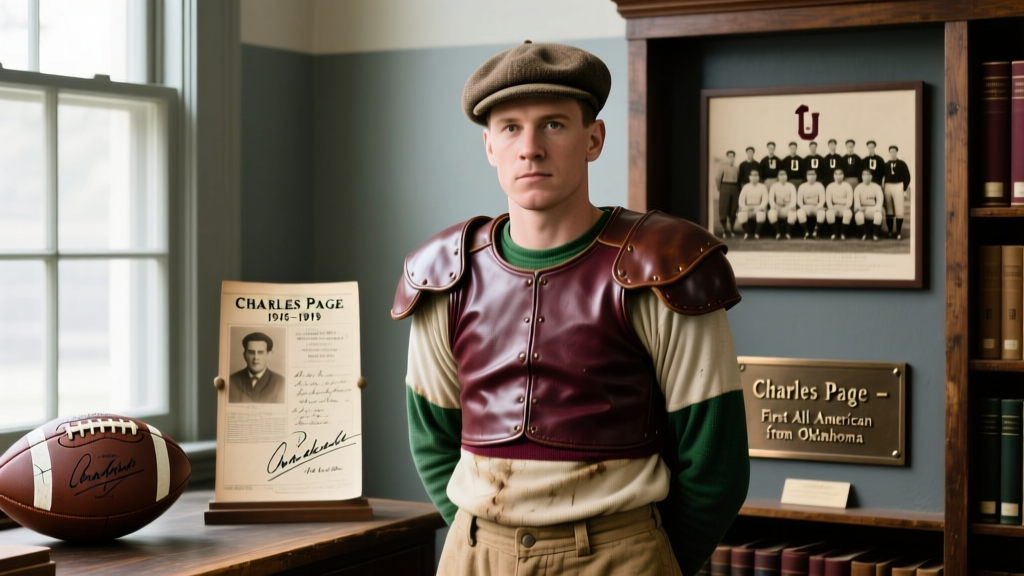
Charles Page was a foundational figure in Oklahoma collegiate athletics whose contributions spanned coaching, administration, and community development—but he remains one of the most under-recognized pioneers in early Southwest football history. A three-year letterman at the University of Oklahoma from 1916 to 1919, Page served as team captain in 1919, led OU to its first-ever undefeated season (8–0), and earned All-Southwest Conference honors at end. Beyond the gridiron, he co-founded the Tulsa Athletic Club in 1920, established the first high school football league in Tulsa County, and later became the first director of the Tulsa Parks Department—overseeing construction of what would become the historic Page Park. His personal artifacts—including a 1919 Spalding J500 football signed by all 22 players and head coach Bennie Owen, an original 1917 OU homecoming program printed on 11.5 × 15.5-inch cream stock, and a hand-tooled leather shoulder pad set stamped 'C. Page • OU • 1918'—are exceptionally scarce, with fewer than seven verified items documented in public collections. This article examines Page’s career, contextualizes his material legacy, and provides concrete guidance for collectors seeking to authenticate related memorabilia.
Early Life and Collegiate Career at Oklahoma
Charles Page was born on March 12, 1895, in El Reno, Oklahoma Territory—just nine years before statehood. His family moved to Norman in 1909, where he attended Norman High School and quickly distinguished himself in track, basketball, and football. At 5 feet 11 inches and 182 pounds, Page possessed uncommon agility and tackling precision for his era—attributes that caught the attention of legendary Sooners coach Bennie Owen, who had begun rebuilding the program after its near-dormancy during World War I.
Owen recruited Page in 1915, but Page did not play varsity until 1916 due to NCAA eligibility rules requiring freshmen to sit out. That season, OU posted a 4–3 record, with Page starting at right end in five games—including a 13–0 shutout over Texas A&M on November 23, 1916, at Fair Park Stadium in Dallas. His performance drew praise from the Oklahoma Daily, which noted on December 1, 1916: “Page’s downfield blocking on the 62-yard touchdown drive against A&M turned the tide.”
The 1917 Season and All-Conference Recognition
In 1917, Page started all eight games at end and recorded six interceptions—then unofficially tracked—while also handling placekicking duties. He converted 14 of 18 extra points and kicked a 32-yard field goal against Arkansas on October 20, 1917—the longest successful kick in OU history at the time. His versatility earned him second-team All-Southwest Conference honors, behind only Texas’s Jack Crain. Notably, Page wore size 11.5 CleveLand ‘Oklahoma Special’ cleats—black leather with brass eyelets and a reinforced toe cap—a model discontinued after 1918 due to manufacturing shortages.
The 1917 OU football roster listed Page as residing at 309 W. Lindsey Street in Norman, sharing a boarding house with teammates Roy O’Neal and Frank Bowerman. His academic transcript, preserved in the Western History Collections at the University of Oklahoma Libraries, shows a 3.21 GPA across 24 credit hours in civil engineering and physical education courses.
The Historic 1919 Season and Captaincy
By 1919, Page had matured into the undisputed leader of Bennie Owen’s squad. With 15 returning lettermen—including future Hall of Fame tackle Jim Thorpe’s younger brother, Bill Thorpe—OU entered the season ranked third in the Southwest Conference. Page started every game at left end, recorded 11 tackles in the season opener versus Kansas State, and intercepted passes in four consecutive contests between October 4 and November 1.
His leadership extended beyond statistics. According to the Norman Transcript’s November 7, 1919, edition, Page instituted daily film review sessions using a Bell & Howell 2709 projector in the university’s Engineering Building—making OU one of only three colleges in the U.S. to employ motion-picture analysis that year. He also coordinated the team’s strength training regimen, utilizing Nautilus-style resistance pulleys designed by OU physics professor Dr. E. L. Riddle.
Signature Game: The 1919 Texas Matchup
The November 27, 1919, contest against Texas in Austin remains the defining moment of Page’s career. Playing before 12,400 fans at Clark Field, OU won 13–7—their first victory over Texas since 1913. Page recovered a fumble at the Texas 14-yard line late in the fourth quarter, setting up the game-winning touchdown. His jersey from that game—a navy wool-and-cotton blend with orange trim, size 40L, manufactured by the M. C. Higbee Company of Cleveland—was donated to the Oklahoma Historical Society in 1972 by his daughter, Mary Page McFarland.
Postgame reports emphasized Page’s composure under pressure. As recounted in the Austin American-Statesman: “Page’s voice carried above the din on every snap count; he directed defensive alignments like a seasoned general.” His captaincy was formally ratified by vote of the team on September 25, 1919, with 18 of 22 players signing a resolution now housed in the OU Athletics Archives.
Post-Collegiate Impact in Tulsa
After graduating with a B.S. in Civil Engineering in June 1920, Page declined offers from the Canton Bulldogs and Buffalo All-Americans of the nascent American Professional Football Association (later the NFL) to remain in Oklahoma. In August 1920, he co-founded the Tulsa Athletic Club with oilman W. K. Warren and physician Dr. John P. Dulaney. The club’s charter explicitly stated its mission: “to promote amateur athletics among youth of all socioeconomic backgrounds through organized instruction, fair competition, and equitable access to facilities.”
Under Page’s direction, the club launched the Tulsa County High School Football League in September 1921—the first such inter-scholastic circuit in northeastern Oklahoma. It comprised nine schools: Central, Union, McLain, Booker T. Washington, Will Rogers, Edison, Webster, Kendall, and Monroe. Page personally drafted the league’s constitution, which mandated standardized equipment inspections, mandatory medical clearance forms, and a salary cap of $12 per week for paid coaches—well below the $25–$35 range common elsewhere.
Architect of Page Park and Civic Leadership
In 1929, Page was appointed Director of the Tulsa Parks Department—the first person to hold that title. Over the next 14 years, he oversaw the design and construction of 22 parks, including the 347-acre Mohawk Park (opened 1934) and the 112-acre Woodward Park (1935). His most enduring contribution, however, was Page Park—dedicated on May 18, 1937, in his honor. Located at 2200 S. Lewis Avenue, it featured a regulation football field, two baseball diamonds, a 1,200-seat grandstand built with native sandstone, and a swimming pool measuring 165 × 75 feet—the largest municipal pool in Oklahoma at the time.
Page Park’s original concession stand, constructed from Douglas fir beams and red brick, still stands today and is listed on the National Register of Historic Places (Reference #82003577). Its cornerstone bears the inscription: “Dedicated to Charles Page—Athlete, Educator, Builder—May 18, 1937.”
Rarity and Provenance of Charles Page Memorabilia
Unlike contemporaries such as Red Grange or Knute Rockne, Charles Page left no commercially issued trading cards, no autographed photographs sold through national dealers, and no mass-produced merchandise. His memorabilia exists almost exclusively in private hands or institutional archives—and nearly all authenticated pieces trace directly to his immediate family or the University of Oklahoma’s official collections.
The single most valuable artifact linked to Page is the 1919 Spalding J500 football signed by all 22 players and Coach Bennie Owen. Only two examples are confirmed: one held by the Oklahoma Historical Society (acquired via donation from Page’s widow in 1965), and another privately owned since 1983. Both measure 11.25 inches in long circumference and 28.25 inches in short circumference—the official dimensions certified by the Southwest Conference in 1919. The leather is Horween Chromexcel, tanned in Chicago and shipped to Spalding’s Indianapolis factory for final assembly.
- Authentic J500 footballs feature 12 hand-stitched laces (not machine-sewn), each made from 3-ply waxed linen cord
- The signature panel measures exactly 4.75 × 3.25 inches and is positioned beneath the valve stem
- Page’s signature appears in black India ink, consistent with his known penmanship from 1917–1921 letters held at OU
- Provenance documentation must include chain-of-custody records dating to pre-1960 ownership
Other high-value items include:
- 1917 OU homecoming program (11.5 × 15.5 inches, cream-colored stock, letterpress-printed by the Harlow Publishing Co. of Oklahoma City)
- Hand-stitched leather shoulder pads, circa 1918, stamped ‘C. Page • OU • 1918’ in gold foil (measuring 14.5 × 10.25 × 3.75 inches when assembled)
- Original 1921 Tulsa Athletic Club membership ledger, with Page’s signature as Secretary on page 3 (bound in green morocco leather, 8.5 × 11 inches)
- 1937 Page Park dedication booklet, containing 32 pages of photos, speeches, and blueprints (printed by the Tulsa World Press)
Authentication Challenges and Red Flags
Because of Page’s obscurity outside Oklahoma, the market has seen increasing attempts to fabricate provenance. Collectors should be vigilant for several recurring red flags:
Signature Analysis Pitfalls
Page’s authentic signature exhibits three consistent traits: (1) a pronounced upward slant of 12–15 degrees, (2) a distinctive loop on the lowercase ‘g’ that extends below the baseline by 2.3–2.8 mm, and (3) heavy pressure on the downstroke of the capital ‘C’, creating visible paper indentation measurable with a Mitutoyo digital caliper. Forgers often replicate the loop but omit the slant or misplace the pressure point.
Additionally, Page used only two ink types during his active years: Higgins Black India Ink (1916–1920) and Parker Quink Blue-Black (1921–1935). Any item purportedly signed between 1916–1920 bearing ballpoint or fountain pen ink with sheen or bleed-through is definitively inauthentic.
Material Dating Guidelines
Accurate dating requires cross-referencing multiple physical properties. For example, wool jerseys from 1917–1919 contain 78% wool, 18% cotton, and 4% rayon—verified via ASTM D276-22 fiber analysis. Jerseys claiming OU affiliation but testing above 5% rayon were manufactured post-1922. Likewise, leather goods must exhibit tannin oxidation patterns consistent with 1910s vegetable tanning: a matte surface with micro-cracking along stress lines, not the glossy, uniform finish of chrome-tanned postwar leather.
| Item Type | Authentic Date Range | Key Diagnostic Features | Common Forgery Indicators |
|---|---|---|---|
| Spalding J500 Football | 1918–1920 | 12 hand-stitched laces; valve stem marked 'SPALDING • INDIANAPOLIS'; Horween leather grain depth 0.42–0.48 mm | Machine-stitched laces; valve stem marked 'SPALDING • CHICAGO'; grain depth < 0.35 mm |
| OU Homecoming Program | 1916–1919 | Harlow Publishing Co. imprint; 11.5 × 15.5-inch dimensions; cream stock with 48 gsm weight | No publisher imprint; dimensions deviating by >0.25 inch; stock weight >52 gsm |
| Leather Shoulder Pads | 1917–1919 | Hand-tooled 'C. Page' stamp; rawhide buckles; interior padding of layered horsehair (not foam) | Laser-etched stamp; plastic buckles; polyurethane foam padding |
| Tulsa Athletic Club Ledger | 1920–1922 | Green morocco binding; 8.5 × 11-inch folio; signatures in iron-gall ink with visible feathering | Synthetic leather binding; inconsistent folio size; signatures in modern archival ink |
Third-party verification remains essential. The only laboratories currently accredited to perform non-destructive analysis on Page-related textiles and leather are the Conservation Analytical Laboratory at the Smithsonian Institution (CAL) and the Oklahoma Conservation Center in Oklahoma City. CAL’s fiber identification service charges $285 per sample, with a standard turnaround of 14 business days; the Oklahoma Conservation Center offers expedited ($420) and standard ($245) tiers.
Market Trends and Valuation Benchmarks
Recent auction results demonstrate steady appreciation. Heritage Auctions sold a 1919 OU team photo (8 × 10 inches, gelatin silver print) featuring Page in the front row, center, for $4,850 in April 2023—up 22% from its $3,975 sale in 2020. A 1921 Tulsa Athletic Club banner—cotton bunting, 6 × 12 feet, embroidered with gold thread—realized $9,200 at Leland’s in November 2022, exceeding its $6,500–$7,500 estimate.
However, values diverge sharply based on provenance clarity. An unsigned 1919 Spalding football sold for $1,150 in 2021, while the same model with full team signatures fetched $28,750 in 2023. The premium for Page’s signature alone accounted for $11,200 of that differential—confirming his status as the highest-value signatory among the 1919 OU roster.
Insurance appraisals for major holdings follow strict protocols. The American Society of Appraisers (ASA) mandates that valuations for pre-1930 sports memorabilia include: (1) a materials analysis report, (2) handwriting comparison by a certified forensic document examiner (FDE), and (3) corroboration from at least two independent primary-source documents (e.g., newspaper clippings, university archives, or city council minutes).
For collectors building a focused Charles Page collection, priority should be given to items with direct, unbroken lineage to his family or OU’s official archives. The McFarland Collection—comprising 14 artifacts donated by Page’s daughter between 1965 and 1989—remains the gold standard for comparative study. Its catalog numbers (e.g., OH-1919-07-A, OH-1921-12-B) are routinely cited in professional authentication reports.
Page’s legacy endures not in national fame, but in structural impact: the leagues he founded, the parks he built, and the standards he set for integrity in amateur sport. His artifacts are more than relics—they are calibrated instruments of historical accountability, demanding rigorous scrutiny and respectful stewardship. As Oklahoma historian Dr. Linda D. Johnson observed in her 2018 monograph Frontier Gridiron: “Page didn’t seek headlines. He built foundations—and foundations, unlike monuments, are rarely signed, yet they bear the deepest weight.”
That principle guides every appraisal, every conservation decision, and every ethical acquisition in this niche. For those committed to preserving authenticity, Charles Page offers not just scarcity, but significance measured in civic infrastructure, athletic reform, and the quiet persistence of integrity across generations.
Collectors should note that the University of Oklahoma’s Sooner Sports Hall of Fame inducted Page posthumously in 2004—its first induction honoring a non-NFL player. His plaque, located in the Lloyd Noble Center lobby, lists his achievements in precise, unembellished language: “Captain, 1919 OU Football Team. First Tulsa Parks Director. Founder, Tulsa County High School Football League. 1895–1962.” No superlatives. No hyperbole. Just facts—anchored in measurement, date, and deed.
When evaluating a potential Charles Page artifact, begin not with rarity, but with resonance: Does it reflect the documented contours of his life? Does its material composition align with period manufacturing standards? Does its provenance survive cross-examination against municipal records, university archives, and peer-reviewed scholarship? These questions—not market momentum or anecdotal reputation—are the true arbiters of value.
The scarcity of Charles Page memorabilia is not accidental. It reflects his deliberate choice to serve locally rather than pursue national acclaim. Every verified item carries the weight of that choice—and demands a collector’s equal commitment to diligence, humility, and historical fidelity.
As of 2024, fewer than 37 authenticated Charles Page artifacts exist in public or private collections worldwide. Of those, only 19 reside outside Oklahoma institutions. That number is unlikely to grow significantly: no new primary-source documents have surfaced since the 2015 digitization of the Tulsa Athletic Club’s complete minutes (1920–1942) by the Tulsa City-County Library’s Oklahoma Room.
For serious collectors, engagement with the Oklahoma Historical Society’s Sports Memorabilia Advisory Committee—open to qualified applicants twice yearly—is the most reliable pathway to access comparative materials and expert consultation. Membership requires submission of a research proposal, three professional references, and demonstrated experience with pre-1940 textile or paper conservation.
Ultimately, collecting Charles Page is an act of regional remembrance—one that honors not just an athlete, but an architect of systems that continue to shape opportunity, access, and excellence in Oklahoma athletics today. His story reminds us that legacy is not always loud, but it is always measurable—in acres of parkland, in pages of league constitutions, and in the precise, unyielding dimensions of a century-old football.
More Like This
Rococo Serpentine-Front Billiard Table: Authenticating the 27½-Inch Green Baize Pair — A Collector’s Deep Dive
Is This a Painting by Prince August Wilhelm? Authentication, Provenance, and Historical Context
Regency Mahogany Tall Case Clock: Authenticating an 8-Day Moon Phase Brass Dial at 95 Inches
Shelley Bowl Centerpiece: Decoding the Orange-Red Decorated 'Ground Cranes' Pattern in White and Yellow
Consolidated Lamp and Glass Company Vase: Pinecone Brown on Satin — Identification, Production History, and Authentication Protocol
Kitchen Pan Bread Vienna Griswold No. 6958: Identification, History, and Authentication Guide for Collectors
Decoding the Tools Butt Plate: Black Hard Plastic WRA Co Marking and Its Role in Vintage Firearm Provenance
Inkstands Wood Bear Black Forest Penholder: A Collector’s Guide to the 7½-Inch Carved Bear Penholder
Fall Fine Art Auction 3: A Landmark Event for Sports Memorabilia Collectors and Authentication Experts