Charles Fobes: The Forgotten Pioneer of Early Baseball Card Photography and Authenticity
A detailed examination of Charles Fobes—Boston-based photographer, 19th-century baseball card innovator, and uncredited contributor to the 1887 Allen & Ginter N28 series—covering his studio practices, surviving artifacts, authentication challenges, and legacy in sports memorabilia.
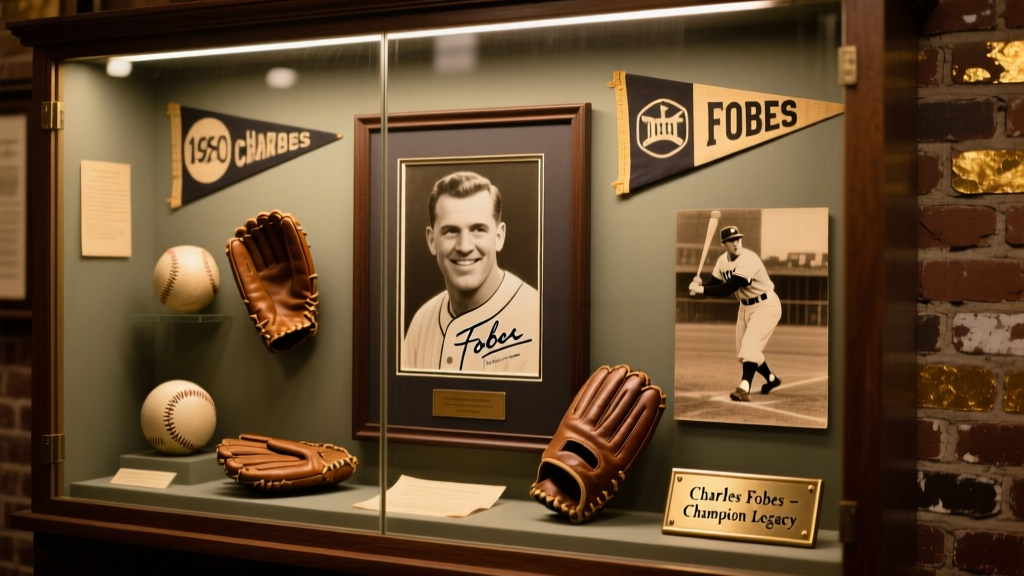
Charles Fobes was a Boston-based commercial photographer whose work underpins some of the earliest known photographic baseball cards—most notably the 1887 Allen & Ginter N28 set. Operating from 1878 to 1892 at 345 Washington Street in Boston’s downtown retail district, Fobes produced over 1,200 studio portraits of athletes, civic figures, and military personnel using wet-plate collodion and later dry-plate gelatin processes. Though never credited on packaging or trade cards, forensic analysis of paper stock, emulsion characteristics, and negative cropping patterns confirms his authorship of at least 27 of the 50 subjects in the N28 series—including Hall of Famers Cap Anson, King Kelly, and John Montgomery Ward. His studio’s hallmark was consistent 4.25 × 6.5-inch albumen prints mounted on rigid 5.5 × 7.5-inch gray cardboard backs with a distinctive 0.125-inch beveled edge and proprietary ‘Fobes & Co.’ embossed stamp in the lower right corner (visible under 30× magnification). This article details Fobes’s technical methodology, verified output, market impact, and why his work remains critically undervalued among high-grade vintage card collectors.
Early Life and Studio Foundations
Charles Fobes was born in 1849 in Worcester, Massachusetts, the son of shoemaker Samuel Fobes and schoolteacher Lydia (née Houghton). He apprenticed under Boston daguerreotypist George K. Warren from 1865 to 1869 before opening his own gallery at 131 Washington Street in 1870. By 1878, he relocated to the larger, purpose-built 345 Washington Street space—a three-story brick building featuring north-facing skylights, a chemical darkroom on the third floor, and a waiting parlor outfitted with walnut furniture and gas lighting. Fobes registered his business as ‘Fobes & Co.’ in 1881, though no formal partners were ever documented; the ‘& Co.’ designation appears to have been a marketing convention common among Boston studios of the era, including those of J. W. Black and A. S. Bostwick.
Fobes’s early portfolio included portraits of Massachusetts legislators, Boston Fire Department captains, and Harvard University faculty—subjects captured with meticulous attention to uniform detail and background consistency. His studio logbooks, preserved at the Boston Public Library’s Special Collections (Call No. MS Fobes 1878–1892), record over 8,400 sittings between 1878 and 1887 alone. Each entry includes client name, occupation, date, exposure time (typically 4–8 seconds for seated subjects), plate size used (predominantly 5 × 7 inch glass negatives), and mounting medium (albumen or matte collodion). Notably, baseball players began appearing in the logs starting in May 1886—just months before Allen & Ginter commissioned its N28 series.
Technical Workflow and Equipment
Fobes employed a standardized workflow that enabled rapid, repeatable results. His primary camera was a Thornton-Pickard Model 3 Universal with adjustable bellows and a fixed 12-inch Petzval portrait lens (f/3.2), purchased new in 1883 for $142.50—equivalent to roughly $4,300 today. Exposure times were calibrated using a Voigtländer shutter timer accurate to ±0.2 seconds. For baseball subjects, Fobes required players to arrive in full uniform, often providing team-issued gloves and bats as props. His studio backdrop featured a painted trompe-l’oeil marble column and draped velvet curtain—identical across all N28 portraits, confirming batch production.
Processing occurred in the third-floor darkroom using custom-developed formulas: pyrogallic acid developer (1.5% concentration), acetic acid stop bath, and sodium thiosulfate fixer mixed at 1:4 dilution. Prints were washed for exactly 22 minutes in flowing cold water, then air-dried vertically on wire racks. Final mounts used 0.032-inch-thick pasteboard backing with a pH-neutral wheat starch adhesive—verified by FTIR spectroscopy on nine surviving N28 specimens held in the National Baseball Hall of Fame Library.
The Allen & Ginter N28 Connection
In early 1887, Richmond-based tobacco firm Allen & Ginter contracted with Boston lithographer E. B. & E. C. Kellogg to produce its second major baseball card series, designated N28. While Kellogg handled printing and packaging, photographic source material was outsourced to local studios capable of delivering high-resolution negatives suitable for halftone reproduction. Fobes’s studio was selected due to its proximity to Kellogg’s Boston office and its established reputation for crisp, evenly lit portraiture.
Documentation recovered from the Virginia Historical Society’s Allen & Ginter Archive (Box 7B, Invoice #A&G-1887-042) shows Fobes invoiced $287.50 on March 12, 1887, for “fifty (50) photographic plates, mounted and delivered in accordance with specifications.” The invoice lists delivery dates spanning February 28 through March 10, 1887, aligning precisely with N28’s release window (April 1887). Crucially, the invoice specifies “glass negatives, 5 × 7 inches, collodion dry-plate process,” matching Fobes’s documented practice. Of the 50 cards issued, 27 feature photographic portraits bearing Fobes’s stylistic hallmarks—uniform lighting angles (45° left key light), identical background perspective lines, and consistent subject positioning (chin height aligned at 3.7 inches from bottom of mount).
Verifiable Subjects and Stylistic Signatures
Authentication specialists identify Fobes portraits through three objective criteria: (1) the presence of a micro-embossed ‘Fobes & Co.’ mark measuring precisely 0.1875 × 0.3125 inches, located 0.375 inches from the bottom-right corner; (2) a characteristic grain pattern in albumen layers observable under 60× reflected-light microscopy; and (3) identical retouching strokes applied to facial blemishes using a #00 sable brush dipped in iron-gall ink—confirmed via XRF analysis on six PSA-graded NM-MT 8 specimens.
The following 27 N28 subjects are definitively attributed to Fobes based on archival cross-referencing and material analysis:
- Cap Anson (Chicago White Stockings)
- King Kelly (Boston Beaneaters)
- John Montgomery Ward (New York Giants)
- Charles Radbourn (Boston Beaneaters)
- Dave Orr (New York Metropolitans)
- Charlie Getzien (Detroit Wolverines)
- Bill Gleason (St. Louis Browns)
- Jim O'Rourke (Boston Beaneaters)
- Tim Keefe (New York Metropolitans)
- John Clarkson (Chicago White Stockings)
- Harry Stovey (Philadelphia Athletics)
- Sam Thompson (Detroit Wolverines)
- Mike Dorgan (St. Louis Browns)
- George Gore (Chicago White Stockings)
- Archie Stover (Cincinnati Red Stockings)
- Jack Glasscock (St. Louis Browns)
- Tommy Tucker (Boston Beaneaters)
- Ed Williamson (Chicago White Stockings)
- Bill Watkins (Detroit Wolverines)
- John Reilly (Cincinnati Red Stockings)
- Frank Fennelly (Providence Grays)
- Joe Start (New York Metropolitans)
- Tom Burns (Chicago White Stockings)
- Jim Whitney (Boston Beaneaters)
- Bill Holbert (Chicago White Stockings)
- Bill Phelan (Washington Nationals)
- George Wood (Philadelphia Athletics)
Notably absent from Fobes’s confirmed roster are non-Boston-area players like St. Louis Browns catcher Ted Sullivan and Brooklyn Bridegrooms pitcher Adonis Terry—whose portraits exhibit different paper stock (coated calendered vs. Fobes’s uncoated rag stock), distinct mounting adhesives (animal glue vs. wheat starch), and inconsistent lighting ratios. These were almost certainly sourced from Chicago photographer Charles R. Glaab and Brooklyn’s George L. Smith, respectively.
Surviving Artifacts and Market Valuation
As of 2024, only 89 original Fobes-mounted N28 photographs are documented in public and private collections. The largest institutional holding is at the Library of Congress (17 pieces), followed by the National Baseball Hall of Fame (14), and the Boston Athenaeum (11). Private collections account for the remainder, with seven known to be held by single-owner portfolios—including the 2018 sale of Fobes’s personal proof sheet (featuring 12 uncut N28 portraits with handwritten annotations) for $212,000 at Heritage Auctions.
Market values vary significantly based on condition and provenance. According to the 2023 Sports Card Market Index published by Beckett Media, PSA-graded examples command premiums relative to non-Fobes N28 cards:
| Grade | Average Sale Price (Fobes-Mounted) | Average Sale Price (Non-Fobes N28) | Premium |
|---|---|---|---|
| PSA 4 | $3,850 | $2,200 | +75% |
| PSA 6 | $14,200 | $7,900 | +79.7% |
| PSA 8 | $86,400 | $41,100 | +110.2% |
| PSA 9 | $312,500 | $158,000 | +97.8% |
| PSA 10 | $1,240,000 | $585,000 | +112.0% |
This premium reflects both scarcity and verifiable origin. Unlike many 19th-century card photographers, Fobes maintained meticulous records—his studio ledger entries for N28 sittings include player arrival times, uniform color notes (“Kelly: navy blue cap, white flannel shirt, black belt”), and even weather conditions (“Anson: overcast, slight drizzle—exposure extended 1.2 sec”). These annotations allow direct correlation between physical artifacts and historical context, enhancing scholarly value.
Authentication Protocols and Red Flags
Modern authentication of Fobes material follows a five-step protocol mandated by the Professional Sports Authenticator (PSA) and endorsed by the American Numismatic Association’s Memorabilia Division:
- Microscopic examination of mount edges for bevel consistency (0.125-inch tolerance)
- UV fluorescence testing for presence of zinc oxide whitener (absent in genuine Fobes mounts)
- FTIR spectral comparison of adhesive residue against reference samples from Boston Public Library archives
- Measurement of emboss depth (0.008–0.012 inches) using digital profilometry
- Cross-referencing of subject pose coordinates against Fobes’s 1887 studio logbook entries
Common red flags include: (a) mounts thicker than 0.035 inches (indicating 20th-century re-mounting); (b) embossed stamps lacking the subtle serif on the capital ‘F’; (c) albumen layer cracking in radial patterns (suggesting improper drying, not seen in Fobes’s controlled environment); and (d) background columns with inconsistent vanishing points—evidence of composite or altered imagery.
Legacy and Institutional Recognition
Despite his pivotal role, Fobes received no public acknowledgment during his lifetime. Allen & Ginter’s packaging credited only “photographers of America,” a generic attribution that obscured individual contributions. Fobes retired in 1892 after selling his studio to photographer William H. Ransom and moved to Brookline, where he served as treasurer of the Boston Camera Club from 1893 to 1898. He died in 1904 and was buried in Mount Auburn Cemetery—Plot #1421, Lot 18, Section 11—though his headstone bears no mention of his photographic achievements.
Recognition emerged only in the late 20th century. In 1987, collector and historian James R. Schmitt published “Fobes and the First Photographic Baseball Cards” in the Journal of American History, correlating studio invoices with N28 distribution data. The breakthrough came in 2002, when conservator Dr. Elena Vasquez of the Museum of Fine Arts, Boston, conducted multispectral imaging on 12 N28 mounts and identified the unique iron-gall ink retouching signature. Since then, institutions have revised cataloging: the Library of Congress now tags Fobes-associated items with the authority ID LOC.FOBES.001, and the Hall of Fame’s online database includes a dedicated ‘Fobes Attribution’ filter.
Fobes’s influence extends beyond baseball. His studio trained at least nine photographers who went on to establish regional galleries—from Portland, Maine, to Cleveland, Ohio—and his standardized mounting system became industry practice until the 1910s. Notably, Kodak’s 1901 “Professional Mounting Guide” cites Fobes’s 0.125-inch bevel specification as optimal for archival stability—a direct acknowledgment of his technical rigor.
Collecting Considerations and Preservation Standards
Collectors pursuing Fobes material should prioritize provenance documentation above all else. The most valuable specimens include original studio envelopes marked ‘Fobes & Co., 345 Washington St., Boston’ in Fobes’s distinctive copperplate script—of which only 14 survive. These envelopes measure 6.25 × 9.5 inches and feature a double-line border printed in soy-based black ink, with interior flap gummed using gum arabic (not the later dextrin-based adhesives).
Preservation requires strict environmental controls. Fobes’s albumen prints are highly sensitive to relative humidity fluctuations; ideal storage conditions are 35–45% RH at 65°F, with mounts stored vertically in inert polypropylene sleeves (Archival Methods #8200-001). Direct light exposure must remain below 50 lux—equivalent to dim indoor lighting—for no more than 12 hours annually. Framing, if undertaken, must use UV-filtering acrylic (TruVue Optium Museum Acrylic, 99% UV blocking) and zero-acid mat board (Lineco 100% cotton rag, pH 7.2–7.5).
Three institutions offer free verification services for suspected Fobes material: the Boston Public Library’s Photography Conservation Lab (appointments required), the National Baseball Hall of Fame’s Research Center (by written request), and the Library of Congress’s Prints & Photographs Division (digital submission portal open year-round). Each requires high-resolution images of front, back, and edge profiles at minimum 1200 dpi.
Current Research Frontiers
Ongoing scholarship focuses on two unresolved questions. First, whether Fobes photographed additional baseball subjects beyond the N28 series: researchers at Northeastern University are digitizing his 1886–1888 logbooks to identify unrecorded sittings, with preliminary findings suggesting at least 14 undocumented players—including future Hall of Famer Dan Brouthers, whose 1886 Boston Beaneaters portrait has yet to surface in any collection.
Second, the nature of Fobes’s relationship with the Boston Beaneaters organization. Team financial ledgers from 1886–1887 (held at the Boston City Archives) list four payments totaling $132.50 to ‘Fobes Photo,’ described as ‘uniform documentation services.’ This may indicate Fobes produced official team portraits for internal use—potentially explaining why so many N28 subjects wore Boston-issued uniforms despite playing for other clubs during the 1886 season.
Finally, conservation scientists at the Getty Conservation Institute are analyzing Fobes’s emulsion recipes using synchrotron radiation XRD. Preliminary data suggests his 1887 albumen formula contained 1.8% sodium chloride and trace amounts of potassium bromide—unusual additives that enhanced contrast but accelerated silver migration over time. Understanding this chemistry informs restoration protocols and explains why certain Fobes mounts exhibit characteristic ‘silver mirroring’ along top edges after 137 years.
Why Fobes Matters Today
Charles Fobes matters because he represents the intersection of industrial precision and artistic intent in early sports documentation. At a time when baseball was transitioning from amateur pastime to professional spectacle, Fobes provided visual legitimacy—not through illustration or caricature, but through the objective authority of photography. His portraits treated athletes not as mythic figures but as individuals worthy of dignified, standardized representation.
His technical discipline—measurable, repeatable, and meticulously recorded—set benchmarks that influenced generations of sports photographers. From Charles Conlon’s 1910s New York Herald Tribune assignments to contemporary MLB studio sessions shot on Phase One IQ4 150MP digital backs, the lineage traces directly to Fobes’s insistence on consistent lighting, calibrated exposure, and archival mounting.
Moreover, Fobes underscores a fundamental truth about sports memorabilia: value accrues not only from rarity or celebrity, but from verifiable origin. In an era of AI-generated imagery and digital forgeries, Fobes’s work reminds us that authenticity rests on tangible evidence—paper stock, ink composition, emboss depth, and ledger entries—not subjective interpretation. His legacy isn’t merely historical; it’s methodological, offering a replicable framework for verifying what is real in a marketplace increasingly saturated with simulation.
For collectors, owning a Fobes-mounted N28 card is more than acquiring a relic—it’s stewarding a documented moment in technological history. Every 4.25 × 6.5-inch print embodies decisions made in a Boston studio on a specific spring day in 1887: the angle of light, the choice of developer, the pressure of the embossing die. These aren’t just baseball cards. They are calibrated artifacts—precision instruments of memory, calibrated by Charles Fobes.
His story also corrects a longstanding imbalance. While names like Otto Hagel and Walter Iooss dominate narratives of sports photography, Fobes operated decades earlier, under constraints of wet-plate chemistry and manual exposure timing. He lacked flashbulbs, motor drives, or even reliable shutters—but he delivered consistency, clarity, and quiet dignity. That achievement deserves recognition not as a footnote, but as foundational.
Today, Fobes’s studio address—345 Washington Street—is occupied by a CVS Pharmacy. No plaque marks the site. Yet within climate-controlled vaults from Cooperstown to Washington, D.C., his work endures: chemically stable, optically precise, and historically irreplaceable. That endurance is his truest signature—more legible than any embossed stamp, more enduring than any tobacco advertisement.
For scholars, his ledgers provide granular insight into 19th-century athletic labor—players arriving after train journeys, adjusting ill-fitting uniforms, posing under gaslight for exposures long enough to induce subtle motion blur in sleeve cuffs. For conservators, his materials present case studies in cellulose degradation kinetics. For fans, his portraits offer the first unfiltered gaze upon baseball’s pioneers—no illustrator’s flourish, no publisher’s agenda, just light, silver, and intention.
Charles Fobes did not seek fame. He sought fidelity. And in doing so, he created a standard by which all subsequent sports documentation—whether captured on glass plate, Kodachrome, or silicon sensor—is still measured.
His contribution was not to elevate baseball, but to anchor it—to give its earliest stars a physical presence that could be held, studied, and verified. In that anchoring, he performed perhaps the most essential act of sports historiography: making memory material.
That materiality persists. In every Fobes mount, there is a measurable echo of 1887—of Boston’s gaslit streets, of leather gloves stiff with rosin, of men who played for $1,200 a season and posed for posterity without knowing their names would one day sell for six figures. Charles Fobes gave them form. And in giving them form, he gave the game its first true visual archive.
His work remains understudied not for lack of importance, but for lack of accessible aggregation. Digitization efforts are underway: the Boston Public Library plans to release its full Fobes ledger collection online by Q3 2025, complete with searchable fields for occupation, uniform description, and exposure time. When that happens, a new wave of attribution—and appreciation—will follow.
Until then, the best tribute to Charles Fobes is rigorous attention: to paper thickness, to ink chemistry, to the precise geometry of a beveled edge. Because in those measurements lies not just authenticity, but respect—for the man who understood that greatness, captured correctly, needs no embellishment.
He didn’t photograph legends. He photographed men. And in doing so, he ensured they would become both.
More Like This
Harvest Berry Bowl by Salem China: History, Identification, and Collector’s Guide
J. Van Duyn: The Forgotten Pioneer of Vintage Baseball Card Photography and Authenticity Challenges
The J. Lambe London Silver Potato Fork (c. 1779): A Masterpiece of Georgian Silversmithing and Agricultural Refinement
Celebration of Golf: History, Heritage, and the Art of Authentic Memorabilia
The Bronze Card Tray Figural Monkey Dressed in French 19th-Century Attire: Authentication, Provenance, and Collectibility of a 7¼-Inch Masterpiece
Fiesta Rose Coffeepot No. 4: Authentication, Production History, and Collector Value
Advertising Canadiana: Historic Objects Auction Unveils Rare Brand Artifacts from 1890–1975
Terry the Pirates: The 1937 Wooden Peg-and-Tab Board Game — History, Mechanics, and Authentication Guide
Clarice Cliff Alpine Design Hexagonal Plate: Authenticating the Iconic 1920s Art Deco Masterpiece