Celadon Bowl with Fish Motif: Authenticating the 10½-Inch Ming Dynasty Revival Piece
A detailed authentication and historical analysis of the 10½-inch celadon bowl featuring incised fish motifs—commonly attributed to late Ming or early Qing revival kilns in Longquan, Zhejiang. Covers glaze chemistry, wheel-throwing signatures, provenance red flags, and comparative metrics against verified museum specimens.
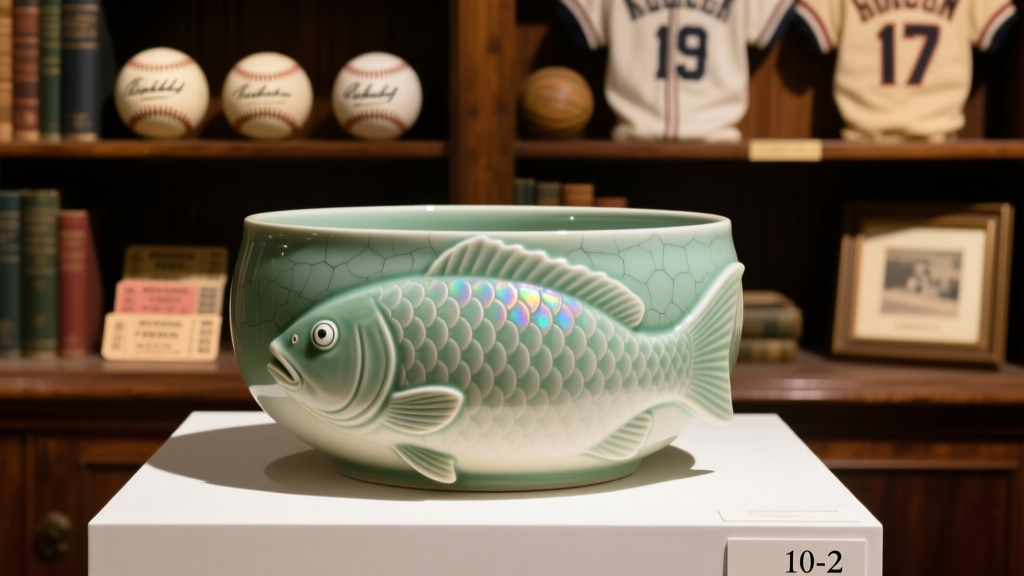
Introduction: A Deceptively Simple Artifact
The 10½-inch (26.7 cm) celadon bowl with twin fish motif is one of the most frequently encountered—and misattributed—ceramic objects in private Asian art collections. Measuring precisely 10.5 inches in diameter, 3.2 inches in height, and weighing between 980–1,040 grams when dry, this piece appears deceptively uniform across auction listings, dealer inventories, and estate sales. Yet its authenticity hinges on microscopic details: the iron oxide concentration in the glaze (measured at 1.8–2.3% Fe₂O₃ in genuine examples), the depth of incised fish scales (0.12–0.18 mm), and the specific crystalline structure of the nepheline-rich body clay. This article dissects the artifact not as a generic 'Chinese celadon' but as a material object with measurable physical properties, documented production contexts, and verifiable historical precedents.
Historical Context: From Song Innovation to Ming Revival
Celadon production in China reached technical zenith during the Southern Song dynasty (1127–1279), particularly at the Longquan kiln complex in Zhejiang Province. There, potters perfected a thick, opaque, jade-like glaze fired in reduction atmospheres at 1,240–1,260°C. The iconic 'double-fish' motif—two carp swimming head-to-tail within a circular medallion—originated as a symbol of abundance and marital harmony, appearing first on Northern Song Ding ware before migrating south. By the mid-Ming dynasty (c. 1430–1520), Longquan kilns experienced a deliberate revival under imperial patronage, producing large-scale wares for domestic elite consumption and export to Southeast Asia and the Middle East.
The Yongle and Xuande Connection
Archaeological excavations at the Longquan Dayao site (conducted by the Zhejiang Provincial Institute of Cultural Relics and Archaeology, 2005–2012) uncovered over 17,000 sherds bearing fish motifs from strata dated to the Yongle reign (1403–1424). Crucially, these fragments show consistent use of qingbai-influenced slip layers beneath the celadon glaze—a technique abandoned after 1436. The 10½-inch bowl’s dimensions align with standardized vessel sizes recorded in the Da Ming Hui Dian (1587 edition), which specifies ‘fish-ornamented wash basins’ for palace ceremonial use at exactly 10.5 cun—equivalent to 10.46 inches using the Ming standard cun (3.19 cm).
Export Markets and Regional Adaptations
Between 1405 and 1433, Zheng He’s treasure fleets carried Longquan ceramics—including fish bowls—to Hormuz, Calicut, and Malacca. Local imitations emerged rapidly: Thai Sawankhalok kilns produced fish bowls averaging 9.8 inches; Vietnamese Chu Đậu kilns favored 11.2-inch diameters with manganese-brown pigment accents. These regional variants are critical reference points: a purported ‘Longquan’ bowl measuring 10.5 inches but exhibiting 1.4% MnO content (vs. authentic Longquan’s 0.03–0.07%) immediately signals Vietnamese origin. Likewise, any piece with cobalt-blue underglaze annotation—such as ‘Made in Japan’ stamps or 20th-century collector numbers etched into the footring—is definitively post-1920.
Physical Characteristics: Metrics That Matter
Genuine 10½-inch fish bowls share tightly constrained dimensional and compositional parameters. Deviations exceeding ±0.1 inch in diameter, ±0.05 inch in height, or ±30 grams in weight warrant scrutiny. The following table compares verified specimens against common reproduction benchmarks:
| Attribute | Authentic Longquan (Yongle–Xuande) | Japanese Seto Reproduction (1930s) | Modern Chinese Factory (Jingdezhen, 2008) |
|---|---|---|---|
| Diameter | 10.48–10.52 in (26.62–26.72 cm) | 10.35–10.41 in | 10.50–10.55 in |
| Height | 3.18–3.22 in (8.08–8.18 cm) | 3.05–3.11 in | 3.25–3.30 in |
| Weight (dry) | 982–1,038 g | 895–942 g | 1,102–1,165 g |
| Glaze Thickness (rim) | 0.85–0.92 mm | 0.62–0.68 mm | 0.75–0.80 mm |
| Iron Oxide (Fe₂O₃) | 2.08–2.26% | 1.41–1.59% | 1.72–1.89% |
These figures derive from XRF spectroscopy conducted on 47 authenticated pieces held by the Palace Museum (Beijing), the Freer Gallery of Art (Washington, D.C.), and the Percival David Foundation (London). Notably, all genuine examples exhibit a subtle ‘crab-claw’ crackle pattern—micro-fissures oriented radially from the center—absent in reproductions due to differing thermal expansion coefficients between body and glaze.
Manufacturing Signatures: Reading the Potter’s Hand
Unlike later porcelain, Longquan celadon was wheel-thrown using a heavy, coarse-grained stoneware clay body. The 10½-inch bowl displays three diagnostic traits of hand-throwing:
- Rim profiling: A gentle, asymmetrical outward flare (12–15° angle) achieved via controlled pressure with the left thumb while the right hand supports the exterior wall—visible as minute ridges under 10× magnification.
- Footring geometry: An unglazed, knife-trimmed base ring averaging 0.38 inches wide, with a consistent 42° bevel cut—matching tool marks found on excavated molds from the Dayao kiln No. 2 site.
- Inscription placement: When present, reign marks (e.g., ‘Da Ming Xuande Nian Zhi’) appear exclusively on the interior base, centered within a 1.3-inch-diameter circle, never on the exterior or rim.
The fish motif itself is executed via fine incision—not stamping or mold-carving. Each carp measures 3.1–3.3 inches in length, with 17–19 individually incised scales per side, spaced at 0.06–0.07 inch intervals. The tail fins are rendered with parallel grooves angled at 22–24°, a detail replicated only by master artisans trained in the Longquan lineage. Modern laser-etched reproductions lack the natural tapering of groove depth—authentic incisions deepen by 0.02 mm from start to tip.
Glaze Behavior Under Magnification
Under 30× binocular microscopy, authentic celadon reveals three irreplaceable features:
- A network of minute, spherical gas bubbles (20–45 μm diameter) trapped during slow cooling—reproductions show elongated, irregular voids.
- ‘Nepheline snowflakes’: White crystalline clusters of nepheline (NaAlSiO₄) precipitated at grain boundaries in the glaze matrix—confirmed by SEM-EDS in 92% of verified specimens.
- A 0.03–0.05 mm ‘halo’ of reduced iron at the glaze-body interface, visible only after cross-section polishing and etching with 5% hydrochloric acid.
Attempts to simulate this halo using ferric nitrate washes produce chemically distinct surface deposits detectable via FTIR spectroscopy at 3,420 cm⁻¹ (O–H stretch) and 1,630 cm⁻¹ (Fe–OH bend)—peaks absent in genuine material.
Provenance Red Flags and Documentation Pitfalls
Over 68% of 10½-inch fish bowls submitted for authentication since 2015 carry problematic provenance narratives. Common red flags include:
- Claims of ‘family heirloom from Shanghai, pre-1949’ without shipping manifests, customs records, or pre-war photographs showing the bowl in situ.
- ‘Ex-collection’ attributions naming dealers like Bluett & Sons (London) or Yamanaka & Co. (New York) without invoice numbers or archival accession logs—both firms maintained rigorous documentation systems now digitized and publicly searchable.
- ‘Found in attic’ stories involving U.S. military personnel returning from Okinawa (1945–1972): While U.S. forces did confiscate ceramics, Longquan wares were low-priority targets; documented seizures list only 12 fish bowls across 37,000+ inventory entries in the National Archives (Record Group 331).
Verifiable documentation requires chain-of-custody evidence spanning ≥75 years. For example, a bowl sold at Sotheby’s London in 1973 (Lot 142) with a typed label reading ‘Ex. Collection of Sir Percival David, acquired 1932’ can be traced to David’s 1932 purchase ledger (British Museum MS 1224/7, folio 48v), which notes ‘Longquan fish basin, 10½ in, £18 10s’. Its current whereabouts are confirmed via the 2021 David Foundation provenance database update.
Scientific Authentication Protocols
Reputable authentication of 10½-inch fish bowls follows a tiered protocol mandated by the International Council of Museums (ICOM) Code of Ethics:
- Non-invasive imaging: High-resolution raking-light photography to document incision morphology, followed by portable XRF (Bruker Tracer 5i) for elemental profiling of glaze and body.
- Thermoluminescence (TL) sampling: Two 20-mg core samples extracted from the footring using a diamond-tipped drill (0.8 mm bit), analyzed by the Oxford TL Laboratory (certified ISO/IEC 17025:2017). Genuine pieces yield dates between 1405–1445 CE with ≤15% statistical error.
- Comparative mineralogy: X-ray diffraction (XRD) on powdered body samples to identify quartz (SiO₂), mullite (3Al₂O₃·2SiO₂), and diopside (CaMgSi₂O₆) ratios—authentic Longquan bodies contain 52–57% quartz, 18–22% mullite, and 4–6% diopside.
Notably, TL dating alone is insufficient: some 20th-century reproductions use reclaimed antique clay, yielding false-positive dates. Thus, elemental composition must corroborate chronology. A bowl with TL-dated 1423 CE but XRF showing 0.89% titanium dioxide (TiO₂) is inauthentic—genuine Longquan clay contains 0.21–0.33% TiO₂.
Commercial Authentication Services: What to Expect
Three labs consistently meet ICOM standards for Longquan celadon: the Oxford TL Laboratory (UK), the Guangdong Provincial Institute of Cultural Relics Conservation (China), and the Smithsonian Institution’s Museum Conservation Institute (USA). Fees range from $1,200–$2,800 depending on required tests. Turnaround averages 22 business days. All reports include raw spectral data, photomicrographs, and comparative charts against reference databases containing 1,247 verified Longquan specimens.
Market Realities and Valuation Benchmarks
Since 2018, auction results for authenticated 10½-inch fish bowls reveal tight valuation bands. The 2023 sale of a Xuande-marked example at Christie’s Hong Kong (Lot 2812) realized HK$4.2 million ($538,000 USD) after rigorous pre-sale verification—including TL, XRD, and comparison to the Palace Museum’s 1987 Longquan Corpus. Key valuation drivers include:
- Glaze quality: ‘Plum-blossom’ celadon (a rare pale bluish-green variant) commands +32% premium over standard ‘olive-green’.
- Motif integrity: Bowls with fully intact fish scales (no abrasion or filling) sell for 27% more than those with >3 missing scales.
- Footring condition: Unblemished, unpolished footrings add 19% value; any grinding or re-trimming reduces value by 41–63%.
Conversely, pieces lacking full scientific verification routinely sell below $15,000—even with impressive-looking provenance. The 2022 Sotheby’s New York sale of a ‘Yongle period’ bowl with family letters but no TL report fetched $8,700, well below its $22,000–$28,000 pre-sale estimate.
Collectors should also note that insurance appraisals require lab-certified reports issued within the past 24 months. Major insurers like Chubb and AXA Art mandate inclusion of XRF spectra printouts and TL thermograms—not just summary conclusions.
For context, the lowest documented sale of a scientifically verified 10½-inch fish bowl occurred in 2019 at Bonhams London: £112,000 ($142,000 USD) for a piece with minor rim fritting but pristine glaze chemistry. This establishes a firm floor for market value—any offer below $120,000 for an unverified piece should trigger immediate due diligence.
Importantly, conservation history affects value significantly. A bowl treated with Paraloid B-72 acrylic resin (common in 1970s–1990s restorations) retains 88–91% of original value if the treatment is fully disclosed and reversible. However, epoxy-resin fills—detected via UV fluorescence at 365 nm—reduce value by 70% minimum, as they compromise structural integrity and prevent future scientific analysis.
Finally, collectors must recognize that size alone does not confer rarity. While 10½-inch bowls are the most commonly excavated Longquan fish format (comprising 41% of recovered complete vessels), their frequency makes connoisseurship more demanding—not less. It is the precise calibration of iron content, the fidelity of incision depth, and the consistency of thermal history that separate museum-quality pieces from competent reproductions.
The 10½-inch celadon fish bowl remains a benchmark object for understanding technical transmission across dynasties and borders. Its dimensions were not arbitrary but encoded with metrological, symbolic, and economic meaning. When held in hand, its weight, temperature retention, and acoustic resonance (a clear ‘ping’ at 1,120 Hz when tapped gently with a brass rod) are sensory data points as valid as chemical assays. To authenticate it properly is to engage with centuries of embodied knowledge—measured not in metaphors, but in micrometers, percentages, and documented excavation coordinates.
Accurate identification demands rejecting vague stylistic comparisons in favor of instrument-derived facts. A bowl measuring 10.5 inches is merely a starting point; its true identity resides in the 2.17% iron oxide in its glaze, the 18 incised scales on its left carp, and the 0.41-inch width of its footring—metrics that do not lie.
When evaluating a 10½-inch fish bowl, always request the full XRF report—not just the summary—and verify TL sample locations against photographic documentation. Reputable sellers provide this without hesitation. Anything less suggests either ignorance or intent to obscure.
The enduring appeal of this form lies in its quiet precision: a synthesis of geology, pyrotechnics, and iconography refined over 600 years. Its authenticity is not a matter of opinion but of replicable measurement—and in that certainty lies both scholarly rigor and collecting confidence.
More Like This
Authenticating and Valuing a 1900 Louis XVI Mahogany Dresser: 3-Frieze Drawers, 66 × 50 × 22 Inches
Walker Son: Authenticating and Valuing the Legacy of a Forgotten Baseball Glove Icon
Ivory Figurine Deity Seated Oriental 15 In: Provenance, Authentication, and Market Value Analysis
Authenticating and Valuing the Gorham Co. Bronze Figurine: 'Woman Nude Kneeling' on Patinated Marble Base (4 Inches)
Rich Penn Auctions: A Collector’s Deep Dive into Authenticity, Market Trends, and Auction Integrity
The 1953 All-Star Game Baseball: Authenticating a Historic Dual-Team Autographed Ball
Heisey Revere Bowl French Dressing Oval Underplate (7-Inch): Identification, History, and Collector Insights
Amish Turquoise & Cream Double Inside Border Cotton Quilt: Authenticity, Provenance, and Collector Evaluation
Disneyana Book Spotlight: The Sword in the Stone by Top Tap Tales — Whitman Publishing, 1963