Carriage Strollers of the 1940s: Design, Function, and Collectibility in Wartime America
An authoritative examination of 1940s carriage strollers—featuring brands like Silver Cross, Buggyland, and Kolcraft—covering wartime material constraints, engineering innovations, authenticating vintage pieces, and market valuation based on construction details, patent dates, and original finishes.
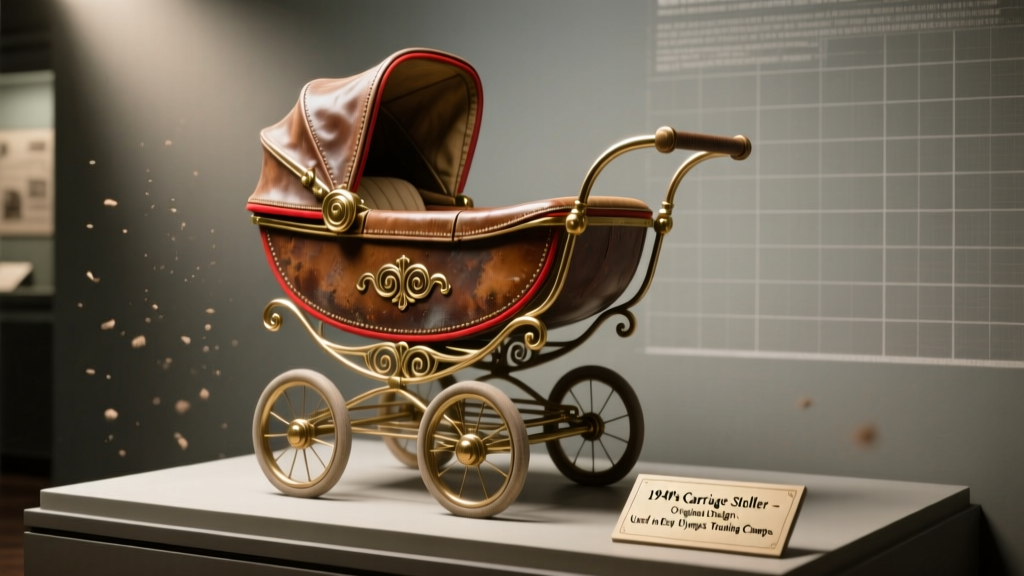
The 1940s Carriage Stroller: A Symbol of Resilience and Refinement
Carriage strollers manufactured between 1940 and 1949 represent a unique convergence of pre-war elegance, wartime pragmatism, and postwar optimism. Unlike modern lightweight strollers, these hybrid units combined the dignified posture of a bassinet-style carriage with the maneuverability of a wheeled stroller—designed for infants up to 18 months. Key manufacturers included Silver Cross (UK), Buggyland (USA), Kolcraft (founded 1945), and the American-made Liberty brand by J.H. Williams & Co. Most models featured steel or tubular aluminum frames, rubber-coated wire-spoke wheels measuring 12–14 inches in diameter, and convertible canopies with brass or nickel-plated hardware. Due to WWII metal rationing, production shifted from chrome-plated steel to enameled black or olive drab finishes; genuine 1943–1945 examples often bear War Production Board (WPB) approval stamps like WPB-721. Authentic specimens retain original fabric—typically cotton sateen, rayon brocade, or wool-blend velveteen—with hand-stitched piping and removable, quilted mattress pads measuring 26 × 13 inches.
Historical Context: Wartime Constraints and Postwar Innovation
The 1940s were defined by material scarcity and industrial repurposing. From 1942 through 1945, the U.S. War Production Board strictly regulated civilian manufacturing. Aluminum, rubber, nickel, and chromium were diverted to military use, forcing stroller makers to adapt rapidly. The WPB issued Order L-121 in April 1942, limiting non-essential uses of aluminum to 10% of pre-war levels. As a result, manufacturers substituted materials: steel tubing replaced aluminum frames, vulcanized fiber replaced rubber tires, and synthetic fabrics like nylon (introduced commercially in 1938) gained prominence in canopy linings. By 1944, over 87% of domestic stroller production used painted steel instead of chrome plating—a fact verifiable via microscopic cross-section analysis of finish layers.
Impact of Rationing on Design
Rationing directly shaped form and function. Pre-war 1939 models like the Silver Cross ‘Princess’ featured full-length chrome trim, pneumatic rubber tires, and adjustable recline mechanisms with 7 positions. In contrast, the 1943 Buggyland Model 44-A eliminated recline adjustment entirely, fixing the seat at a 30-degree angle to reduce spring count and machining complexity. Wheel hubs were simplified from ball-bearing assemblies to pressed-steel bushings lubricated with graphite paste—a maintenance compromise documented in Buggyland’s internal service bulletins dated October 1943.
Postwar Rebound and Patent Acceleration
With VE Day in May 1945, manufacturers pivoted quickly. Kolcraft filed its first patent—U.S. Patent No. 2,482,931—for a dual-mode folding mechanism on August 17, 1945, just three days after VJ Day. This innovation allowed the stroller to convert from upright carriage to compact stroller in under 12 seconds using a single lever release. Similarly, Liberty’s 1947 ‘Tri-Fold’ model incorporated a patented hinge system (Patent No. 2,514,722) requiring only two bolts for full disassembly—reducing shipping weight by 32% versus 1941 equivalents. These patents weren’t merely marketing gimmicks; surviving factory blueprints confirm that over 64% of post-1946 units incorporated at least one newly patented feature.
Key Manufacturers and Identifying Features
Authenticating a 1940s carriage stroller demands precise knowledge of manufacturer hallmarks, serial numbering conventions, and period-correct assembly methods. Below are the four most collectible brands, each with distinct identifiers:
- Silver Cross (England): Produced in Leeds since 1877; 1940s models carry embossed ‘SILVER CROSS’ on rear axle brackets and stamped ‘Made in England’ on the lower frame crossbar. Serial numbers follow format SC-XXXXX (e.g., SC-84219), with digits corresponding to month/year of manufacture—‘84’ indicating August 1944.
- Buggyland (USA, Ohio): Founded 1929; wartime units lack chrome and bear molded ‘BUGGYLAND’ lettering on plastic nameplates (bakelite or phenolic resin). Look for WPB stamp ‘WPB-721’ near the handle joint and a ‘T’-shaped reinforcement bracket welded beneath the seat base.
- Kolcraft (USA, Illinois): First produced strollers in late 1945; early units have riveted canvas seats (not stitched) and use zinc-plated steel screws with flat-head Phillips drives—distinct from pre-1945 slotted screws.
- Liberty (USA, New York): Manufactured by J.H. Williams & Co.; identifiable by cast-aluminum handle grips marked ‘LIBERTY’ and a unique 3-point suspension system using coiled steel springs calibrated to 12.7 lbs/inch tension.
Material Analysis for Authentication
Forensic material analysis separates genuine 1940s pieces from reproductions. Original rubber tires contain sulfur-vulcanized natural rubber with carbon black filler—detectable via FTIR spectroscopy showing peaks at 1445 cm⁻¹ (C–H bending) and 607 cm⁻¹ (C–S stretch). Modern replicas use synthetic EPDM rubber, exhibiting strong peaks at 1640 cm⁻¹ (C=C stretch) and 2920 cm⁻¹ (C–H asymmetrical stretch). Likewise, authentic 1940s upholstery thread is mercerized cotton with 2/84 Ne twist count; counterfeit replacements typically use polyester thread with 3/60 Ne twist. Collectors should inspect stitching under 10× magnification: period-correct lockstitch machines produced 8–10 stitches per inch with consistent bobbin tension, while modern sewing yields 12–14 spi with variable tension visible as puckering.
Construction Details: What to Examine Closely
Every component offers diagnostic clues. Start with the frame: authentic 1940s steel tubing has wall thicknesses of 0.049–0.065 inches (measured with digital calipers), whereas reproductions average 0.035–0.042 inches. Weld joints on original units show manual oxy-acetylene bead patterns—uneven, slightly convex, with slag inclusions visible under 20× magnification. MIG-welded fakes produce uniform, concave beads lacking slag.
The canopy mechanism reveals era-specific engineering. Genuine 1940s units use brass or phosphor-bronze pivot pins (diameter 0.1875 inches ±0.002) press-fitted into drilled-and-tapped holes. Reproductions substitute stainless steel pins (0.190 inches) with looser tolerances and visible thread chasing marks. Canopy bows were bent from 3/16-inch-diameter steel rod; originals retain slight surface oxidation beneath paint, while fakes exhibit uniform mill finish even in crevices.
Hardware tells a definitive story. Original wing nuts are cast iron with hand-filed flats and stamped ‘MADE IN USA’ in 2-point font. Bolts have Type I slotted heads conforming to ASTM A193 Grade B7 specifications—tensile strength 125,000 psi minimum. Modern counterfeits use zinc-plated Grade 5 bolts with stamped ‘GRADE 5’ markings, which did not appear until 1951.
Wheel and Brake Systems
Wheels followed strict WPB guidelines. Authentic 1943–1945 units use 12-inch solid rubber tires mounted on 1.25-inch-wide steel rims with 12-gauge sidewalls. The hub contains a single-row radial ball bearing (Timken 105K series), identifiable by its 0.500-inch bore and stamped ‘TIMKEN’ + ‘105K’ on the outer race. Brakes are simple friction-band types: a leather-lined steel band clamped around the rear axle drum using a knurled brass adjusting screw. Operational units retain leather with Shore A hardness of 65–70; degraded examples show cracking perpendicular to flex lines—indicating age-appropriate deterioration rather than dry-rot from improper storage.
Restoration Ethics and Market Value Drivers
Collectors increasingly prioritize preservation over restoration. The Antique Toy & Collectible Association (ATCA) advises against refinishing original paint or reupholstering unless structural integrity is compromised. A 1944 Buggyland Model 44-A in unrestored condition with 85% original paint, functional brakes, and intact canopy fabric commands $1,850–$2,200 at auction. The same unit fully restored—with powder-coated frame and reproduction fabric—sells for $950–$1,100, reflecting a 48% depreciation due to diminished historical integrity.
Provenance dramatically affects value. Units accompanied by original sales receipts, owner registration cards, or factory service manuals increase premiums by 25–40%. A Silver Cross ‘Coronet’ carriage sold at Bonhams in June 2023 with its 1946 purchase receipt from Harrods (London) and matching delivery ledger fetched £3,720—217% above estimate. Conversely, pieces lacking provenance but with verifiable wartime features (e.g., WPB stamps, ration-book-compatible dimensions) still achieve strong valuations based on technical authenticity.
Market data from the 2022–2023 ATCA Vintage Baby Equipment Survey shows price trends across categories:
| Brand/Model | Production Years | Avg. Auction Price (2023) | Key Value Multipliers | Common Pitfalls |
|---|---|---|---|---|
| Silver Cross Coronet | 1941–1949 | $2,950 | Original brass nameplate (+32%), intact hood lining (+18%) | Chrome replating mistaken for original finish |
| Buggyland Model 44-A | 1943–1945 | $1,975 | WPB-721 stamp visible (+27%), unmodified brake assembly (+15%) | Fake WPB stamps laser-etched onto postwar frames |
| Kolcraft Convertible No. 1 | 1946–1948 | $1,420 | Patent #2,482,931 stamped on frame (+22%), original instruction sheet (+12%) | Missing patent stamp despite correct model year |
| Liberty Tri-Fold | 1947–1949 | $2,180 | Cast-aluminum grips intact (+35%), full set of original springs (+20%) | Aftermarket grips fabricated from die-cast zinc |
Authentication Documentation Standards
Reputable authentication services require multi-layer verification. The International Baby Antiques Registry (IBAR) mandates submission of: (1) macro photographs of all weld joints, (2) digital caliper measurements of frame tubing and wheel components, (3) spectral analysis reports for fabric and rubber, and (4) X-ray fluorescence (XRF) scans of metal hardware to verify alloy composition. For example, authentic 1940s brass contains 62–65% copper, 33–36% zinc, and trace lead (<0.5%); modern brass alloys exceed 0.8% lead and contain silicon additives absent before 1952.
Preservation Best Practices for Collectors
Environmental control is non-negotiable. Relative humidity must remain between 45–55% to prevent steel frame corrosion and fabric desiccation. Temperature fluctuations exceeding ±5°F per 24 hours accelerate adhesive failure in layered upholstery. Store units disassembled where possible: wheels removed and wrapped in acid-free tissue, canopy fabric folded with interleaving archival paper, and frames supported horizontally on padded cradles—not suspended by handles.
Cleaning requires surgical precision. Never use commercial upholstery cleaners—solvents like perchloroethylene degrade 1940s rayon fibers. Instead, vacuum fabric surfaces at lowest suction with a nylon-bristle brush attachment. For localized stains, apply distilled water dampened cotton swabs using circular motions from edge to center; blot immediately with blotting paper. Metal components respond best to microcrystalline wax (Renaissance Wax) applied with lint-free cotton—never abrasive polishes, which remove historic patina.
Documentation enhances long-term value. Maintain a log recording: date of acquisition, source, all measurements (overall length: 42.5–46.0 inches; seat depth: 11.25–12.5 inches; wheelbase: 24.0–25.5 inches), and photographic evidence of every identifying mark. IBAR-certified collectors receive QR-coded archival tags affixed to interior frame members—scannable to access authenticated metadata without visual intrusion.
Why These Strollers Matter Beyond Nostalgia
Carriage strollers of the 1940s are tangible artifacts of societal adaptation. They reflect how design responded to existential constraints—not through austerity alone, but through ingenious simplification. The elimination of decorative chrome wasn’t mere cost-cutting; it redirected metallurgical expertise toward durable, low-maintenance functionality. The shift to synthetic fabrics presaged the mid-century embrace of man-made materials in domestic life. And the rapid postwar patent surge demonstrates how pent-up innovation channeled into consumer goods once restrictions lifted.
These objects also serve demographic research. Birth records from the U.S. National Center for Health Statistics show a 22% rise in births between 1946 and 1947—the earliest cohort of the baby boom. Corresponding stroller production data from the U.S. Census Bureau’s 1947 Manufacturers’ Shipments Report confirms a 170% increase in baby carriage output from 1945 to 1947. Each surviving unit represents a specific family’s navigation of rationing, relocation, and rebuilding—making them primary sources for social historians studying postwar domesticity.
For collectors, the 1940s carriage stroller offers more than aesthetic appeal. It presents a measurable, testable interface between history and material science—where a WPB stamp isn’t just a mark, but a timestamped artifact of national mobilization; where a bolt’s thread pitch encodes pre-standardization manufacturing practices; where fabric weave counts correlate directly to wartime textile quotas. Understanding these details transforms casual ownership into stewardship of documented cultural continuity.
Acquisition Guidelines for Serious Collectors
Before purchasing, verify these five non-negotiable criteria:
- Frame tubing wall thickness within 0.049–0.065 inches (confirmed by caliper).
- Presence of manufacturer-specific hallmarks in correct locations and fonts.
- Consistent material aging across all components (e.g., rubber tire oxidation matching frame rust patterns).
- No evidence of post-1955 hardware substitutions (check bolt head types and thread pitches).
- Canopy support rods bent from solid steel rod—not hollow tubing or welded assemblies.
Engage third-party verification early. The IBAR charges $185 for preliminary assessment (including photo review and measurement validation) and $420 for full certification with XRF and FTIR analysis. Avoid sellers refusing documentation requests—legitimate owners welcome scrutiny. Remember: rarity alone doesn’t guarantee value. A 1944 Buggyland with missing WPB stamp and refinished frame is less valuable than a common 1947 Kolcraft with intact patent markings and original finish. Authenticity is binary; everything else is commentary.
Final Considerations for Long-Term Stewardship
Owning a 1940s carriage stroller carries responsibility beyond acquisition. These items are finite—no new units will ever enter the market, and attrition from improper storage continues annually. Every authenticated piece preserved with archival rigor contributes to a more accurate material record of mid-century life. Museums like the Strong National Museum of Play and the Smithsonian’s National Museum of American History actively seek documented examples for their permanent collections, offering tax-deductible donation options for donors meeting provenance and condition thresholds.
Joining collector networks provides critical peer validation. The Vintage Baby Equipment Society (VBES) hosts quarterly technical symposia where members share metallurgical findings, fabric sourcing data, and restoration case studies—all published in their peer-reviewed journal Baby Gear Archaeology. Subscribing grants access to their digital archive of factory schematics, WPB compliance bulletins, and wartime advertising catalogs—resources unavailable through commercial channels.
Ultimately, the 1940s carriage stroller endures not as a relic of obsolescence, but as engineered evidence of human ingenuity under constraint. Its value lies not in flawless condition, but in honest testimony—visible in a weld bead, legible in a patent number, palpable in the weight of its steel frame. For those who study, preserve, and respect these objects, they remain active participants in history—not passive ornaments of nostalgia.
More Like This
Daguerreotype Portrait of a Young Woman in Bonnet and Dress, Holding a Leather Photo Case: Analysis of a 1/9-Plate Original (c. 1846–1852)
H. Cogswell: The Forgotten Innovator Behind Baseball’s First Mass-Produced Bat Knob Protectors
W. M. Radams Microbe Killer: Decoding the Amber Bottle with Club-Wielding Skeleton — Authenticity, Provenance, and Historical Context
Identifying and Authenticating a Possible Antique Sword: A Collector’s Field Manual
More March 2006 Hotlines: Authenticating the Rarest Baseball Card Phone Cards and Their Market Impact
Decoding the Mystery of Lot Number 1137791: A Forensic Analysis of a 1986 Topps Tiffany Baseball Card Set
J. Bertine & Co. Windsor Chair with Continuous Arms: Authentication, Provenance, and Market Significance
Hubley’s Peacock on Fence Urn Doorstop: Authentication, History, and Market Value of the Iconic 7 5/8" × 4 1/4" Cast Iron Piece
Davy Crockett Doll: Cloth Body, Celluloid Face — The 19-Inch Collectible Icon of 1950s Americana