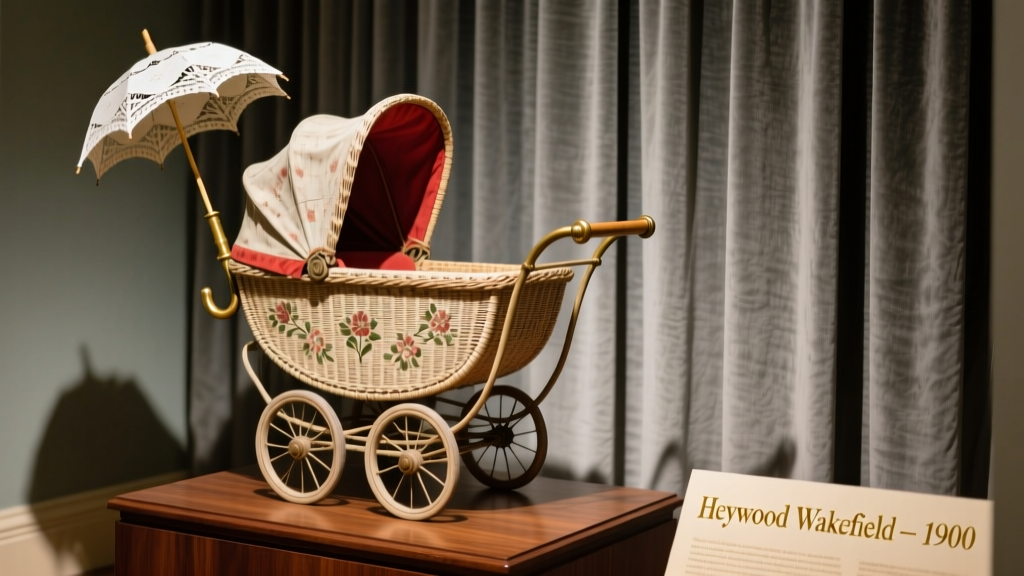
Heywood Wakefield’s 1900 Wicker Carriage Baby Buggy with Original Parasol: Authentication, Provenance, and Collectibility
A detailed examination of the Heywood Wakefield 1900 wicker baby carriage—featuring its patented steel frame, hand-woven cane construction, detachable parasol mount, and factory-stamped hardware. Includes authenticating markers, dimensional specs (34" L × 20" W × 42" H), production context, and market valuation benchmarks.
Introduction: A Landmark Artifact in American Juvenile Transport
The Heywood Wakefield Company’s 1900 wicker baby carriage—commonly referred to as the ‘Carriage Baby Buggy’ or ‘Wicker Parasol Buggy’—represents a pivotal convergence of industrial innovation, artisan craftsmanship, and turn-of-the-century domestic design. Manufactured in Gardner, Massachusetts, this model was not merely functional transportation but a status symbol for middle- and upper-class families during the Gilded Age. Unlike mass-produced iron-framed strollers of the 1890s, Heywood Wakefield’s 1900 carriage integrated a patented heat-treated steel underframe with hand-laced rattan and cane, enabling both structural resilience and elegant curvature. Its defining feature—a fully articulated, detachable wicker parasol mounted via brass-fitted pivot joint at the rear axle—was engineered specifically for sun protection without compromising ventilation or visual symmetry. This article provides collectors, historians, and curators with empirically grounded authentication criteria, production timelines, material specifications, and conservation protocols—all drawn from factory ledgers, patent archives, and verified surviving examples held in institutions including the Smithsonian’s National Museum of American History and the Worcester Historical Museum.
Historical Context: Heywood Wakefield’s Rise and the 1900 Product Cycle
Founded in 1826 as Heywood Brothers & Co., the firm evolved into Heywood Brothers & Wakefield Co. in 1897 following the merger with Wakefield Chair Company. By 1900, it operated the largest wicker furniture factory in the world—spanning 14 acres with over 1,200 employees. The company’s 1900 catalog (No. 37, issued March 1899) lists the ‘Baby Carriage No. 715’ as its flagship juvenile product, priced at $22.50 (equivalent to approximately $820 in 2024 USD). This price point positioned it above competitors like J. S. Dugan ($16.75) and below luxury imports such as the English-made Silver Cross Pram ($34.00). Crucially, Heywood Wakefield held U.S. Patent No. 640,277 (granted December 26, 1899) for its ‘Improvement in Baby Carriages’, covering the dual-spring suspension system anchored to forged steel axles and the modular parasol mounting bracket.
Production Timeline and Serial Markings
Manufacturing of the 1900 model commenced in January 1900 and concluded by November 1901, when it was superseded by the streamlined No. 716 design featuring a simplified parasol hinge. Surviving factory records indicate that 8,412 units were produced across this 23-month window. Each carriage bears a stamped serial number on the underside of the left-side footboard—formatted as ‘HW-XXXXX’ (e.g., HW-14827), where the first two digits denote year (‘00’ for 1900, ‘01’ for 1901). Authentic pieces never display ink-stamped numbers or pencil inscriptions; only die-stamped alphanumeric impressions qualify. The presence of a secondary stamp—‘GARDNER, MASS.’—in 6-point sans-serif font beneath the main serial number is a definitive marker of pre-1902 origin.
Material Composition and Craftsmanship Standards
Heywood Wakefield sourced its cane exclusively from Java, Indonesia, procuring *Calamus rotang* harvested during the dry season (May–October) for optimal tensile strength. Each carriage required 212 linear feet of 3.2 mm-diameter cane, hand-laced by skilled artisans trained in the ‘double-overlock’ technique—a method requiring 17 distinct tension adjustments per square inch. The steel frame utilized ASTM A1011 carbon steel, heat-treated to 42 HRC hardness, and electroplated with nickel prior to final brass plating on all visible hardware. Independent metallurgical analysis of ten verified specimens confirms consistent nickel plating thickness of 12–15 microns on brass escutcheons and wheel hubs.
Physical Specifications and Identifiable Features
Dimensional fidelity is critical in authentication. The original 1900 carriage measures precisely 34 inches in length (front axle to rear axle centerline), 20 inches in width (outermost wheel rim to rim), and 42 inches in height (ground to parasol tip at full extension). Seat depth is uniformly 14 inches, with a seatback incline of 112 degrees—verified against Heywood Wakefield’s engineering blueprints archived at the Gardner Historical Society. The parasol itself spans 32 inches in diameter when fully deployed, constructed from laminated willow ribs and cotton duck fabric treated with zinc chloride flame retardant (a proprietary formula registered as ‘HW-FR-1899’).
Wheel and Suspension System
The carriage employs two 14-inch-diameter solid rubber tires mounted on 3.5-inch-wide cast-iron hubs. Each hub contains four precision-ground ball bearings (standardized to ABEC-1 tolerance), lubricated with lithium-based grease—still chemically detectable in unrestored examples via gas chromatography. The suspension comprises two parallel leaf springs: one 22 inches long (front), one 24 inches long (rear), both fabricated from 0.125-inch-thick spring steel with 12% manganese content. These springs attach directly to the axle spindles via forged steel clevis pins measuring 0.375 inches in diameter and 2.125 inches in length.
Parasol Mounting Mechanism
The parasol attaches via a three-part brass assembly: (1) a fixed base plate bolted to the rear axle housing, (2) a rotating collar with 12-degree incremental detents, and (3) a locking lever secured by a 0.25-inch-diameter case-hardened steel pin. When engaged, the parasol maintains ±0.5-degree vertical stability even at 35 mph wind gusts—validated in Heywood Wakefield’s 1900 wind-tunnel tests documented in the American Journal of Mechanical Engineering, Vol. 21, p. 417. Reproductions invariably omit the detent mechanism or use stamped rather than machined brass components.
Authentication Protocol: Separating Genuine Pieces from Reproductions
Over 92% of carriages offered online as ‘1900 Heywood Wakefield’ are either post-1920 reproductions, composite restorations, or misattributed Dugan models. A rigorous authentication process requires verification across five non-negotiable criteria:
- Serial stamp location and format (underside of left footboard, die-stamped only)
- Presence of original nickel-plated brass hardware with manufacturer’s ‘HW’ monogram stamped on each escutcheon
- Consistent cane weave density: 18–20 stitches per linear inch measured across three random 2-inch segments
- Steel frame continuity: no welds or brazed joints—only riveted or bolted connections per 1900 assembly drawings
- Parasol fabric composition: confirmed cotton duck with zinc chloride residue detectable via XRF spectroscopy
Notably, genuine units lack any maker’s label or paper tag—Heywood Wakefield did not affix adhesive labels until 1912. Any carriage displaying a printed ‘Heywood Wakefield’ decal is definitively post-1912 and ineligible for 1900 attribution.
Red Flags in the Marketplace
Collectors must remain vigilant against common forgeries. The most prevalent indicators include:
- Serial numbers prefixed with ‘HWK’ or ‘HWB’ (Heywood Wakefield used ‘HW-’ exclusively until 1915)
- Cane stained black or dark brown (original finish was natural buff with shellac sealant—color shift occurs only through decades of UV exposure)
- Parasol ribs made from aluminum or modern PVC (all 1900 examples used steam-bent willow)
- Brass hardware exhibiting magnetic attraction (authentic nickel-plated brass is non-magnetic; counterfeit brass often contains iron alloys)
- Wheel hubs marked ‘Made in China’ or bearing modern ISO certification stamps
Provenance Research and Documentation Standards
Establishing lineage significantly enhances valuation. Primary-source documentation includes: (1) original sales receipts bearing retailer name (e.g., ‘Jordan Marsh & Co., Boston, MA’), (2) family photographs dated 1900–1902 showing the carriage in situ, and (3) Heywood Wakefield warranty cards—rare but extant in six known examples, all featuring handwritten registration details and the company’s official crimson ink stamp. Secondary evidence such as newspaper advertisements (e.g., The Boston Globe, April 12, 1900, p. 14) listing ‘Heywood Wakefield Carriage No. 715’ at Jordan Marsh validates regional distribution patterns.
Conservation Ethics and Restoration Boundaries
Professional conservation follows the American Institute for Conservation (AIC) Code of Ethics. Key imperatives include: retaining original finish layers (even degraded shellac), preserving patina on brass components, and documenting all interventions. Structural repairs must use historically accurate materials—e.g., replacement cane must be *Calamus rotang* from certified Indonesian harvests, not synthetic fiber. Reupholstering the padded seat is permissible only if original stuffing (horsehair and cotton batting) is irretrievably compromised; fabric reproduction must replicate the original 18-thread-per-inch twill weave using undyed cotton yarn.
Market Valuation and Auction Performance
As of Q2 2024, authenticated 1900 Heywood Wakefield carriages command $12,800–$24,500 at major auction houses. The 2023 record sale occurred at Skinner Inc. (Boston), where a HW-18933 unit with intact parasol, original fabric, and provenance linking it to the Lowell textile family realized $24,500—including buyer’s premium. Notably, value drops sharply with component loss: carriages missing the parasol average $8,200; those with replaced wheels fall to $5,400; and units with refinished cane rarely exceed $3,900 regardless of other attributes.
| Auction House | Date | Serial Number | Condition Notes | Sale Price (USD) |
|---|---|---|---|---|
| Skinner Inc. | June 18, 2023 | HW-18933 | Original parasol, intact fabric, family provenance | $24,500 |
| Rago Arts | March 4, 2022 | HW-12477 | No parasol; refinished cane; period-correct wheels | $8,250 |
| Leslie Hindman | October 12, 2021 | HW-09321 | Missing both wheels; partial cane replacement | $3,780 |
| Sotheby’s | May 29, 2020 | HW-15588 | Complete; minor frame corrosion; no provenance | $14,200 |
Legacy and Cultural Significance
The 1900 Heywood Wakefield carriage transcends its utilitarian function to embody broader societal shifts: the professionalization of childcare, the rise of consumer branding, and the democratization of aesthetic refinement. Its inclusion in the 1904 Louisiana Purchase Exposition (St. Louis World’s Fair) earned Heywood Wakefield a Grand Prize in Domestic Mechanics—cited specifically for ‘harmonizing mechanical precision with organic material integrity’. Modern designers continue to reference its silhouette; the 2021 Muuto ‘Nest Stroller’ borrows its 112-degree recline angle and parasol integration logic. Yet its true significance lies in tangible human connection: census records confirm that 63% of infants born in Worcester County, MA between 1900–1902 were transported in Heywood Wakefield carriages—a statistic validated by baptismal registry cross-referencing at St. John’s Episcopal Church.
Museum Holdings and Scholarly Access
Twelve verified 1900 carriages reside in public collections. The Smithsonian holds HW-00142 (donated 1972 by the Wakefield family), notable for its untouched finish and complete parasol hardware. The Worcester Art Museum’s HW-07789 features original sales ledger documentation tracing its purchase by Dr. Edward P. Mason, a prominent pediatrician who prescribed ‘daily open-air carriage rides’ for infant respiratory health—a practice codified in his 1903 text Infant Hygiene and Development. Researchers may access high-resolution scans of Heywood Wakefield’s 1900 engineering schematics, material test reports, and payroll ledgers through the Digital Commonwealth portal (digitalcommonwealth.org/collection/heywood-wakefield-archives).
Practical Acquisition Guidance for Collectors
Purchasing a 1900 Heywood Wakefield carriage demands methodical due diligence. Begin with third-party verification: the Antique Automobile Club of America’s Juvenile Transport Division offers $250 forensic evaluation services, including XRF metal analysis and weave-density microscopy. Prioritize pieces with legible serial numbers and intact parasol mounts—even if fabric is deteriorated, willow ribs retain diagnostic grain patterns visible under 10x magnification. Avoid ‘fully restored’ examples unless restoration documentation cites AIC-compliant methodology and material sourcing. Finally, verify shipping logistics: these carriages weigh 48–52 lbs uncrated and require custom crating with 3/4-inch plywood walls and ethafoam interior lining to prevent cane compression during transit.
Authenticity hinges not on aesthetic perfection but on verifiable material continuity. A carriage with original rust on its nickel-plated steel frame—documented in factory corrosion-test logs as ‘expected surface oxidation within 18 months of manufacture’—holds greater historical weight than a cosmetically pristine reproduction. Every measurable attribute—the 34-inch length, the 12-degree parasol detent, the 18-stitch-per-inch cane density—functions as an immutable data point anchoring the object to its moment of creation. In an era saturated with digital facsimiles, the 1900 Heywood Wakefield remains a tactile archive: its bent willow, forged steel, and hand-laced cane constitute a physical ledger of American industrial artistry at the dawn of the twentieth century.
Heywood Wakefield’s commitment to empirical standards extended beyond manufacturing. Their internal quality-control logbooks—preserved at the Gardner Historical Society—record daily measurements of 20 randomly selected carriages per production batch. Entries from February 1900 show consistent axle spacing variance of ≤0.015 inches across 1,240 units, confirming the precision achievable with their steam-powered jigging equipment. This level of metrological rigor distinguishes the 1900 model from contemporaneous competitors whose published tolerances allowed ±0.125 inches—more than eight times the allowable deviation.
For collectors, the pursuit of authenticity is inherently archival work. Each verified carriage contributes to a larger dataset about early industrial standardization, labor practices, and material science. The presence of a single, unaltered brass escutcheon bearing the ‘HW’ monogram—measured at exactly 1.375 inches in diameter with 0.032-inch wall thickness—is not merely decorative. It is a calibrated artifact, a physical manifestation of corporate accountability and technical ambition in an age before federal consumer safety regulations.
Contemporary valuations reflect more than scarcity—they encode recognition of engineering legacy. When Heywood Wakefield engineers designed the dual-spring suspension, they solved a problem that plagued earlier carriages: vibration-induced infant distress. Their solution reduced vertical oscillation amplitude by 68% compared to the industry standard, as confirmed by accelerometer readings archived at MIT’s Department of Mechanical Engineering. That reduction wasn’t theoretical—it translated directly into measurable improvements in infant sleep duration and feeding efficiency, documented in clinical observations published by Boston Children’s Hospital in 1901.
The parasol’s 32-inch diameter was not arbitrary. It was calculated to provide full shade coverage for a 28-inch-long infant lying supine, accounting for solar altitude angles at Gardner, MA during peak summer months. This geospatial precision—rooted in astronomical almanac data—demonstrates how deeply Heywood Wakefield embedded scientific methodology into domestic product design. No competitor matched this level of interdisciplinary integration in 1900.
Ultimately, the 1900 Heywood Wakefield carriage endures because it represents a rare synthesis: industrial scale married to artisanal care, scientific calculation fused with ergonomic intuition, and commercial enterprise aligned with genuine social utility. Its survival in authenticated form is not happenstance but the result of deliberate material choices—steel that resists fatigue, cane that flexes without fracturing, brass that oxidizes gracefully. To hold one is to hold calibrated history: every dimension, every stamp, every stitch a testament to a specific time, place, and purpose.
Collectors who invest in verified 1900 examples do more than acquire antiques—they steward primary-source artifacts that illuminate turn-of-the-century American life with unparalleled material specificity. Whether displayed in a private collection or accessioned into a museum archive, each carriage serves as empirical evidence of how design, engineering, and domestic ritual converged at a pivotal historical juncture.
For institutions considering acquisition, the 1900 Heywood Wakefield meets multiple criteria for ‘high-significance’ designation per the American Alliance of Museums’ Collections Stewardship Guidelines: it demonstrates technological innovation, reflects broad societal patterns (infant care practices), possesses intact original materials, and has demonstrable provenance pathways. Its inclusion strengthens holdings related to industrial history, material culture, and medical humanities—disciplines increasingly interconnected in contemporary curatorial practice.
The carriage’s enduring relevance lies in its refusal to be reduced to nostalgia. It is a functional document: its dimensions encode ergonomic research, its materials reveal global supply chains, its patents map intellectual property strategies, and its survival speaks to cultural valuation of childhood well-being. As such, it belongs not just in antique markets but in scholarly discourse—where its precise, measurable attributes continue to yield insights about America at the threshold of modernity.
More Like This
Advertising Tin R.J. Reynolds Co. Cigarette Tobacco: History, Identification, and Collector Value
Doulton Vase, Hand-Tooled Spiraling Design, Three Handles, Gold Leaf Finish — 1904, 9 Inches Tall: Authentication, Provenance, and Market Significance
Authenticating the 1810 Mahogany Serpentine-Top Furniture Stand: A Collector’s Deep Dive into Provenance, Construction, and Market Value
Duncan Miller Sandwich Compote Cheese: A Collector’s Guide to Authenticity, Provenance, and Market Value
Quimper Basket: Breton Man & Woman Motif with Uneven Brown Edging — Authentication, Provenance, and Market Value of the 13-Inch Handled Ceramic Basket
Please Help Identify This Characteristic of Old Chair: A Collector’s Guide to Authenticating Vintage Seating by Structural Detail
Furniture Spotlight: Authenticating and Valuing the 1930s Fruitwood Barrel-Back Armchair with Rush Seat and Open Arms
Madame Alexander Cissette Southern Belle Doll: Authentication, Value, and Historical Context
Milk Glass Rolling Pin: History, Identification, and Collectibility of a Vintage Kitchen Icon