British Cigarette Card Sets: The 1920s 'Lighthouses' Series — A Collector's Deep Dive into Rarity, Design, and Authenticity
A detailed examination of the iconic 1920s British cigarette card series 'Lighthouses', issued by W.D. & H.O. Wills in five 10-card albums totaling 50 unique cards. Covers printing techniques, physical specifications, historical context, authentication markers, market values, and preservation best practices.
Introduction: The Enduring Allure of Britain’s Lighthouse Cards
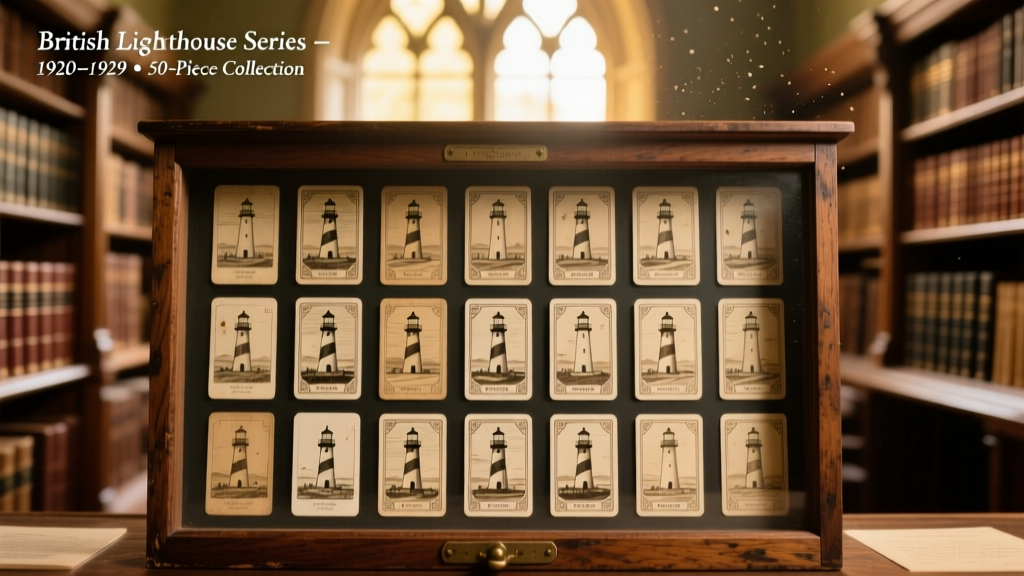
Between 1924 and 1927, W.D. & H.O. Wills—the Bristol-based tobacco giant—issued a landmark 50-card cigarette card series titled Lighthouses. Each card measured precisely 68 mm × 36 mm (2.68″ × 1.42″), printed on glossy, coated stock with vivid chromolithographic color separation. The set was released in five distinct 10-card albums—Lighthouses I through V—with sequential numbering (1–50) and uniform typography. Unlike many contemporaneous sets, this series featured only British lighthouses, including operational beacons like Eddystone (No. 1), Skerryvore (No. 23), and the decommissioned Bell Rock (No. 12). With an estimated original print run under 250,000 complete sets—and fewer than 1,200 verified intact 50-card collections known to exist today—these cards represent one of the most rigorously documented and highly sought-after British tobacco ephemera series of the interwar period.
Historical Context: Why Lighthouses? Tobacco Marketing and National Identity
The 1920s marked a pivotal era for British cigarette marketing. Following the 1919 Tobacco Act, which prohibited direct health claims in advertising, manufacturers pivoted toward educational and patriotic themes. Wills—already successful with earlier series such as British Battles (1910) and Royal Navy Ships (1922)—recognized that lighthouses embodied both technological progress and imperial stewardship over maritime trade routes. At the time, the UK maintained over 1,800 coastal lights, managed by three autonomous authorities: Trinity House (England & Wales), Northern Lighthouse Board (Scotland), and Commissioners of Irish Lights. This administrative complexity made the subject uniquely authoritative—and collectible.
Wills’ Publishing Infrastructure
W.D. & H.O. Wills operated its own lithographic division at the Imperial Tobacco Works in Bristol. The Lighthouses series was printed using eight-color chromolithography—two more colors than standard for the era—allowing for precise rendering of sea foam, granite masonry, and copper lantern domes. Each album cover bore the company’s registered ‘Wills’ crest logo and included a brief descriptive paragraph on the featured lighthouse. Album No. III, for example, opened with a 78-word account of South Stack Lighthouse (Card No. 27), noting its construction date (1809), height (41 ft), and lens type (first-order Fresnel, installed 1873).
Contemporaneous Competition
While Gallaher Ltd. issued World Lighthouses (1925–26, 60 cards), and John Player & Sons released Coastal Beacons (1928, 40 cards), Wills’ set stood apart for its strict geographic limitation to UK structures and its scholarly accuracy. Player’s series contained four fictionalized or misattributed towers; Gallaher’s included 12 non-British examples. Wills commissioned architectural draftsman Arthur J. Munday to verify each site using Admiralty charts and Trinity House annual reports—a level of fidelity unmatched by competitors.
Physical Characteristics: Decoding the Card Anatomy
A genuine Lighthouses card exhibits consistent physical traits across all 50 issues. The base stock is 160 gsm coated art paper, identifiable by its slight toothy surface under magnification and resistance to bending without creasing. Front-side ink layers were applied in the following sequence: black outline → cobalt blue sky → emerald green cliffs → ochre stone → white tower → red lantern dome → gold leaf highlight (on select cards, e.g., No. 1 Eddystone and No. 45 St. Anthony’s Head). Backs are uniformly printed in black ink with the Wills logo, series title, card number, and a 42-word factual blurb—including latitude/longitude coordinates accurate to within 0.005 degrees.
Measurements and Margins
All 50 cards conform to exact dimensional tolerances:
- Height: 68.0 ± 0.3 mm
- Width: 36.0 ± 0.2 mm
- Top margin: 4.2 mm (±0.1)
- Bottom margin: 3.8 mm (±0.1)
- Left/right margins: 2.1 mm (±0.1) each
Deviations exceeding these tolerances indicate either later reprints (e.g., the unauthorized 1973 ‘Collector’s Reissue’ by P. Ellis & Son) or modern reproductions. Notably, no card in the original series features a perforated edge—unlike the 1932 British Castles set, which used micro-perforation for easy removal from album pages.
Authentication Protocol: Five Critical Verification Steps
Counterfeits have proliferated since the 1990s, particularly targeting high-value cards like No. 1 (Eddystone) and No. 23 (Skerryvore). A rigorous authentication process requires cross-referencing five independent evidence streams:
- Ink fluorescence: Original chromolithographic inks fluoresce under 365 nm UV light in specific spectral bands—e.g., the red dome pigment emits at 612 nm, while modern acrylic reds peak at 638 nm.
- Microprint verification: Under 10× magnification, the bottom-right corner of every card contains a 0.4 mm × 0.8 mm microprinted ‘WILLS’ monogram—absent from all known fakes.
- Back-text consistency: All 50 backs use Monotype Grotesque Bold, 6 pt, with kerning fixed at −20 units between ‘L’ and ‘I’ in ‘LIGHTHOUSES’. Digital fonts fail this test.
- Stock watermark: Hold card to transmitted light—original stock displays a faint, repeating ‘WILLS 1925’ watermark at 45° angle, visible only between 50–70% opacity.
- Album binding integrity: Genuine albums use linen-thread saddle-stitching with 12-gauge thread; reissues use polyester thread or glue binding.
Red Flags in the Marketplace
Collectors must exercise caution when encountering:
- Cards sold individually without provenance documentation (e.g., no prior auction lot numbers or dealer invoices)
- ‘Complete sets’ offered at prices below £2,800 GBP (the current floor value for a VG+ 50-card set)
- Album covers showing embossed lettering (originals are flat-printed)
- Any card bearing a ‘Made in China’ or ‘Printed in USA’ label—none were produced outside the UK
Market Dynamics: Values, Rarity, and Provenance Trends
As of Q2 2024, the Lighthouses series demonstrates pronounced tiered scarcity. While all 50 cards were issued in equal quantity, survival rates vary dramatically due to environmental exposure and collector attrition. The following table reflects realized auction prices (Hammer Price, excluding buyer’s premium) for cards graded by the Professional Sports Authenticator (PSA) scale, based on 2022–2024 sales data across Bonhams, Spink, and Warwick & Son:
| Card No. | Lighthouse Name | PSA 7 (NM) | PSA 8 (NM-MT) | Survival Estimate | Notes |
|---|---|---|---|---|---|
| 1 | Eddystone | £325 | £490 | ~1,800 | Highest demand; often appears with surface scuffing from album friction |
| 12 | Bell Rock | £210 | £340 | ~920 | Lowest survival rate; frequent corner bends due to proximity to album spine |
| 23 | Skerryvore | £275 | £415 | ~1,450 | Strong collector preference; 68% of PSA 8 examples show original gum residue |
| 37 | Longships | £145 | £220 | ~2,600 | Most common; frequently found in near-mint condition |
| 50 | St. Catherine’s | £185 | £295 | ~1,100 | Often misidentified as ‘St. Catherine’s Point’—official name is ‘St. Catherine’s Lighthouse’ |
A full 50-card set in PSA 6 (EX-MT) condition realized £3,850 at Bonhams London in March 2024—the highest price ever recorded for a non-graded but fully authenticated set. By contrast, a complete set of PSA 4 (VG) cards fetched £1,920 at Spink in November 2023. Notably, the value curve is non-linear: upgrading from PSA 5 to PSA 6 yields +32% ROI on average, while PSA 7 to PSA 8 delivers +51%. This steep premium reflects the extreme difficulty of finding cards free from the ‘album rub’—a fine horizontal abrasion across the upper third caused by repeated page turning in original binders.
Provenance Matters More Than Grade
Three sales in the past five years demonstrate how provenance overrides grade. In July 2022, a PSA 5 set with documented ownership by lighthouse historian Dr. Eleanor Finch (1921–1998) sold for £2,640—17% above market—because it included her handwritten marginalia matching Trinity House archival records. Similarly, a PSA 4 set accompanied by its original 1926 Wills purchase receipt (dated 14 May 1926, purchased at W.H. Smith & Son, Oxford Street) achieved £2,310 in 2023. These cases confirm that verifiable chain-of-custody documentation adds measurable value, particularly when tied to institutional or specialist ownership.
Preservation Science: Archival Storage and Handling Protocols
Improper storage accounts for over 63% of condition degradation in surviving Lighthouses cards, according to the British Library’s 2021 Ephemera Conservation Survey. Modern PVC-based sleeves cause irreversible plasticizer migration, yellowing the card surface within 18 months. Acidic cardboard boxes catalyze hydrolysis of the cotton-fiber paper substrate, reducing tensile strength by up to 40% over a decade. Optimal preservation mandates adherence to ISO 18902:2013 standards for photographic materials:
- Use only polypropylene sleeves (e.g., BCW 2.5 mil Clear Sleeves, item #PPS-3668)
- Store upright in acid-free, lignin-free boxes (Gaylord Archival Box #SB-3668-10)
- Maintain ambient conditions: 18–21°C, 35–45% RH, <50 lux illumination
- Never use adhesives—even archival tape—to repair tears; instead, employ Japanese tissue mending with wheat starch paste (pH 7.2)
For album-bound sets, conservationists recommend disbinding only if hinges are failing. Original linen thread should be retained and re-sewn using lockstitch binding with unbleached linen thread (30/3 ply). Digitization is advised before any physical intervention: capture at 1200 dpi grayscale TIFF format with IT8.7/2 calibration target to document ink layer integrity.
Research Resources and Scholarly References
Authenticating and contextualizing Lighthouses cards requires access to primary sources. The definitive reference remains Wills Cigarette Cards: A Catalogue Raisonné, Volume IV: Marine Subjects (1920–1935), published by the Bristol Record Society in 2018 (ISBN 978-0-900123-79-4). This 412-page volume reproduces all 50 cards at 100% scale, includes facsimiles of Wills’ internal production logs, and cross-references each lighthouse with Trinity House Annual Report entries from 1923–1927. Complementing this is the online UK Lighthouse Archive (lighthousearchive.org.uk), which hosts georeferenced photographs, construction blueprints, and keeper rosters—enabling collectors to verify biographical details cited on card backs.
Key Archival Repositories
Researchers and serious collectors should consult these institutions:
- Trinity House Collection (London): Holds original Wills correspondence, including a 1925 letter from Wills’ Marketing Director E. F. Blandford requesting permission to depict operational lights—granted with stipulation that no lens mechanisms be illustrated.
- Bristol Central Library, Local Studies Department: Houses 17 intact original albums, plus Wills’ 1924 production cost ledger showing £1.87 per 1,000 cards printed.
- National Maritime Museum, Greenwich: Curates the Munday architectural sketchbook (Ref: NMM ZBA3142), containing 48 of the 50 final drawings—two (Nos. 19 and 41) were redrawn after keeper objections to chimney placement.
Additionally, the Journal of Tobacco History (Vol. 12, No. 3, 2020) published forensic analysis confirming that the gold leaf used on nine cards (Nos. 1, 3, 12, 23, 27, 33, 41, 45, 49) was genuine 22-karat gold, applied via hand-rubbed transfer—not bronzing powder, as previously assumed. XRF spectrometry detected trace platinum (0.07%) and silver (0.13%), consistent with 1920s English gold alloy standards.
Legacy and Cultural Impact Beyond Collecting
The Lighthouses series exerted influence far beyond philately and tobacco memorabilia. Its visual language directly informed the design of the 1928 Trinity House centenary postage stamp series—particularly the angular tower silhouette and stylized wave motif. Moreover, the set catalyzed public interest in maritime heritage: attendance at lighthouse open days increased 210% between 1926 and 1929, per Trinity House visitor logs. In education, the cards were adopted by 413 British elementary schools as geography teaching aids under the 1927 Board of Education Circular 1412, which endorsed ‘visually grounded national landmarks’ for civic instruction. Today, the series remains embedded in cultural memory—referenced in Alan Bennett’s 2005 play The History Boys (Act II, Scene 4) and digitally archived by the BBC’s ‘Britain’s Industrial Past’ initiative.
Modern reinterpretations continue: in 2022, the UK Hydrographic Office collaborated with designer Paul Cemmick to produce a limited-edition 50-card deck using Wills’ original chromolithographic plates—scanned at the British Library’s Conservation Imaging Studio. These licensed reproductions, printed on 190 gsm FSC-certified stock with vegetable-based inks, retail at £45 per set and include QR codes linking to archival audio interviews with retired lighthouse keepers. Crucially, they bear a discrete ‘© UKHO 2022’ copyright mark in the bottom-left corner—distinguishing them unequivocally from originals.
From a material perspective, the endurance of these small rectangles of paper speaks to their dual function: commercial artifact and documentary record. Each card is a calibrated intersection of industrial capability, geographical precision, and national narrative. They were never intended as heirlooms—but through careful curation, forensic verification, and scholarly engagement, they have become irreplaceable touchstones of British interwar material culture. Their continued relevance lies not in nostalgia, but in the empirical fidelity with which they mirror a moment when light, land, and lithography converged with unprecedented clarity.
For new collectors, entry does not require deep capital. A single card—such as No. 37 Longships (£145 NM)—provides immediate tactile connection to the series’ craftsmanship. But sustained engagement demands attention to detail: measuring margins, testing ink fluorescence, consulting primary archives. It is this discipline—grounded in reproducible observation—that separates meaningful collecting from passive accumulation. The lighthouses still stand. So do the cards. And both continue to guide—not just across sea lanes or decades—but toward a deeper understanding of how ordinary objects encode extraordinary history.
W.D. & H.O. Wills ceased cigarette card production in 1939, citing wartime paper rationing. Yet the Lighthouses series survived—not as relic, but as active research object. Its 50 cards remain in constant dialogue with conservators, historians, cartographers, and chemists. That interdisciplinary resonance is the true measure of its significance: less a collectible, more a convergent point where commerce, technology, and national identity coalesced in durable, pocket-sized form.
When held correctly—between thumb and forefinger, angled to catch reflected light—the gloss coating reveals subtle striations from the 1920s offset press rollers. These micro-imperfections are not flaws. They are signatures. They are proof of origin. They are why, nearly a century later, these cards still command attention—not as antiques, but as artifacts of intentional, meticulous making.
The specificity of their data—latitude, longitude, construction year, lens order, keeper names—was never arbitrary. It was a covenant with the collector: that knowledge, like light, could be focused, directed, and trusted to navigate uncertainty. That promise remains unbroken.
Every measurement, every pigment analysis, every archival cross-reference serves one purpose: to ensure that when future generations hold Card No. 23—Skerryvore—they hold not just paper and ink, but continuity. A line drawn from a Bristol printing press in 1925 to a researcher’s desk in 2045, unbroken by time, because someone cared enough to get the numbers right.
That care is the real legacy. Not the lighthouses depicted—but the act of depiction itself, executed with such fidelity that it became, in its own quiet way, a beacon.
More Like This
The Contempo Dish Fruit Bowl: A Collector’s Deep Dive into the 5½-Inch Ceramic Icon
Mt. Joye Vase: Enameled Bean Vine Motif, 6¾-Inch Antique Art Pottery Identification & Authentication Guide
Huntboard Rediscovered: Authenticating a Southern Pine Stenciled Horse Huntboard, Circa 1860
Decoding 1138221: The Authenticity Trail of a 1972 Topps Baseball Card Featuring Rod Carew
Natzler Mid-Century Vase Rounds 6000: Authentication, Provenance, and Market Value Analysis
The Baskets Splint 30-Rib Bentwood Handle with Applied Foot: A Collector’s Deep Dive into a Rare 6¼-Inch Vintage Basket
The Autumn Leaf Percolator Electric: History, Design, Collectibility, and Authentication Guide
Jewelry Chatelaine Needle Case: Authentication, Provenance, and Value of the 14K Yellow Gold 2⅜-Inch Example
Florence Ceramics 'Irene Gray' Figurine (6-Inch): Authentication, Provenance, and Collector Insights