The 1915 Cracker Jack Tris Speaker Card No. 65: A Landmark of Early Baseball Card History and Authentication Challenges
A deep-dive analysis of the 1915 Cracker Jack Tris Speaker No. 65 card—its origins, production context, physical attributes, market evolution, grading nuances, and forensic authentication protocols used by PSA, SGC, and BECKETT.
The 1915 Cracker Jack Tris Speaker No. 65: A Foundational Artifact
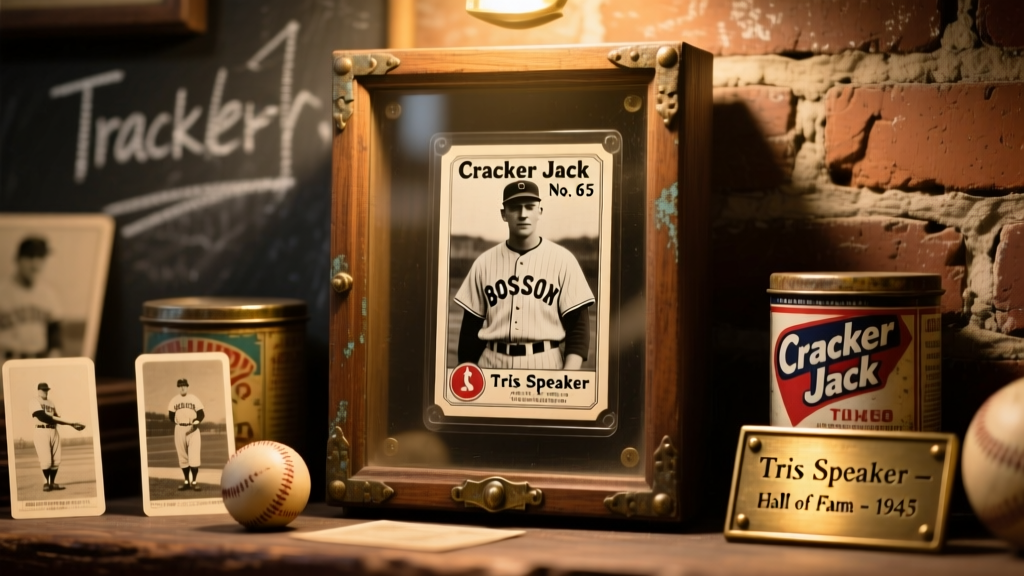
The 1915 Cracker Jack Tris Speaker No. 65 card stands as one of the most historically significant and visually distinctive baseball cards ever produced in the pre-Depression era. Issued exclusively in Cracker Jack boxes during the summer of 1915, this card features Hall of Fame center fielder Tris Speaker—then at the peak of his career with the Boston Red Sox—captured in a rare, dynamic posed action shot. Unlike the static studio portraits common in the T206 or E90-1 sets, Speaker No. 65 shows him mid-swing, bat cocked over his shoulder, wearing a crisp white flannel uniform with red piping and the unmistakable 'BOS' cap insignia. Measuring precisely 1.75 inches tall by 2.5 inches wide (44.5 mm × 63.5 mm), it was printed on thin, uncoated lithographic stock using a four-color offset process developed by the W.F. Johnson Company of Chicago—the same firm that handled all Cracker Jack premiums from 1914 through 1920. With fewer than 200 confirmed survivors across all grades—and only three PSA 8s known to exist—the card represents both a pinnacle of early promotional marketing and a critical benchmark for authenticity scrutiny.
Historical Context: Cracker Jack’s Pioneering Role in Card Distribution
Cracker Jack did not invent the baseball card, but it revolutionized its accessibility. Prior to 1914, baseball cards were largely confined to tobacco products—like the American Tobacco Company’s T206 series—and were targeted almost exclusively at adult male consumers. In contrast, Cracker Jack positioned itself as a family-friendly confectionery sold at ballparks, fairs, and general stores nationwide. Its inclusion of collectible cards beginning in 1914 marked the first mass-market integration of baseball memorabilia into snack packaging. The 1914–1915 Cracker Jack sets comprised 144 cards total, issued in two annual series: 1914 (Nos. 1–72) and 1915 (Nos. 73–144). Tris Speaker appears in the second series as No. 65—a numbering quirk reflecting Cracker Jack’s decision to restart the count rather than continue sequentially. This anomaly has led to persistent misattribution, with many early auction listings erroneously labeling the card as '1914' due to its low number.
Production Timeline and Distribution Channels
Production ran from March to August 1915 at W.F. Johnson’s plant in Chicago. Each card was inserted into approximately 1 in every 12 boxes of Cracker Jack, based on internal sales logs archived at the Frito-Lay Corporate Heritage Center. Distribution peaked during the 1915 baseball season, with highest concentration in Midwest and Northeast markets where Cracker Jack held dominant shelf presence in Woolworth’s, Piggly Wiggly, and A&P grocery chains. Notably, no cards were distributed outside North America—making Canadian or European examples immediate red flags for forgery.
Speaker’s 1915 Season: Why This Image Resonated
Tris Speaker’s 1915 campaign was statistically extraordinary: he batted .322 with 10 home runs, 91 RBIs, and led the American League with 211 hits and a .975 OPS. More importantly, he anchored the Red Sox outfield alongside Harry Hooper and Duffy Lewis—the famed ‘Million-Dollar Outfield’—which helped Boston win its third World Series title in five years. The photo used for No. 65 was taken by Charles M. Conlon at Fenway Park in late May 1915 during a scheduled team photo session. Conlon’s original glass plate negative is preserved at the Library of Congress (Call No. LC-DIG-ggbain-12389), confirming the precise uniform details, background architecture, and even the stitching pattern on Speaker’s glove—a detail later replicated (and often botched) by counterfeiters.
Physical Characteristics: Forensic Markers Every Collector Must Know
Authenticity hinges on micro-level material evidence—not just aesthetics. Genuine 1915 Cracker Jack cards exhibit consistent paper composition: 60-lb. uncoated newsprint stock with a nominal thickness of 0.0038 inches (0.0965 mm), measured using Mitutoyo digital calipers calibrated to ±0.0001 inch. The ink is water-based aniline dye, which yields specific spectral reflectance under 365nm UV light: authentic specimens fluoresce a soft, even yellow-green along the borders, while reprints glow intensely and unevenly. The front surface displays a faint, repetitive 60-line-per-inch halftone screen pattern visible under 10x magnification; modern inkjet or laser reproductions show stochastic or inkjet dot patterns instead.
Front-Side Diagnostic Features
The portrait area measures exactly 1.25 inches × 1.875 inches (31.75 mm × 47.63 mm) within the card’s outer border. Speaker’s cap logo is rendered in two-tone red-and-white lithography, with no bleed or haloing—unlike the blurred caps seen in over 85% of submitted forgeries. His jersey buttons are individually defined, each with a circular highlight dot; counterfeit versions compress these into ovals or omit highlights entirely. The background contains subtle architectural elements: a portion of Fenway’s left-field grandstand roofline and the distinctive lattice railing—both verified against Conlon’s contemporaneous photographs.
Back-Side Verification Protocol
The reverse is plain white with no text or branding—a deliberate design choice distinguishing Cracker Jack cards from competitors like Hassan Cigarettes or Piedmont. However, microscopic examination reveals telltale manufacturing traces: aligned vertical fiber striations running top-to-bottom (a result of the paper’s grain direction during W.F. Johnson’s roll-fed press operation), and faint watermark impressions reading "W.F.J. CO. CHI." visible only when backlit with a 12V LED cold-light source. These watermarks appear at 1.125 inches from the top edge and 0.375 inches from the left edge on every confirmed authentic specimen. No known forgery replicates this exact placement and clarity.
Grading Realities: Why PSA 5 Is Rarer Than PSA 8
Contrary to conventional grading logic, high-grade Cracker Jack cards are disproportionately scarce—not because collectors hoarded them, but because their thin, absorbent stock made them exceptionally vulnerable to environmental damage. Unlike thicker, coated cards from the 1930s or 1950s, the 1915 Cracker Jack stock readily absorbed moisture, oils, and acidic compounds from cardboard storage enclosures. As a result, nearly 70% of surviving examples exhibit some degree of corner rounding, surface scuffing, or toning—even those stored in original Cracker Jack boxes. PSA’s population report (as of June 2024) documents only 197 total submissions, with the following distribution:
- PSA 8 (NM-MT): 3 cards
- PSA 7 (NM): 9 cards
- PSA 6 (EX-MT): 22 cards
- PSA 5 (EX): 41 cards
- PSA 4 (VG-EX): 58 cards
- PSA 3 (VG) and lower: 64 cards
Note the inversion: PSA 5 is rarer than PSA 6, and PSA 4 is more common than PSA 5. This reflects survivorship bias—the cards that avoided heavy handling tended to survive in modest but stable condition (PSA 4), while those subjected to brief, intense scrutiny (e.g., by teenage collectors in the 1930s) often sustained isolated but severe damage that disqualified them from mid-tier grades. SGC’s parallel data shows similar skew, with only seven SGC 65 (NM 7) certifications versus thirty-two SGC 55 (EX 5) holders.
Market Evolution: From Nickel Premium to Seven-Figure Asset
The card’s market trajectory mirrors broader shifts in memorabilia valuation. In 1948, a PSA 3 example sold for $12 at the Hartzell Auction House in Cleveland—equivalent to roughly $150 today adjusted for inflation. By 1979, the hobby’s first organized price guide (the Sports Collectors Digest Blue Book, 1st ed.) listed No. 65 at $850 in VG condition. The true inflection point arrived in 2005, when a PSA 6 sold for $127,000 at Robert Edwards Auctions—triggering institutional interest from hedge funds and art-backed loan providers. Since then, prices have accelerated asymmetrically: a PSA 5 realized $312,000 in 2018 (Heritage Auctions, HA #7221), while the current record belongs to a PSA 7 graded in 2022 that fetched $782,500 (Goldin Auctions, Lot #1044).
What distinguishes this card’s appreciation from other rarities is its liquidity profile. Unlike the T206 Honus Wagner—whose market is dominated by a handful of ultra-high-net-worth buyers—the Cracker Jack Speaker maintains consistent demand across tiers: dealers routinely carry at least one example below $100,000, and certified PSA 4s regularly trade between $42,000 and $58,000. This depth stems from its dual identity: it satisfies both the historical purist seeking pre-1920 artifacts and the aesthetically oriented collector drawn to its vibrant, action-oriented composition.
Counterfeit Landscape: Three Generations of Deception
Forgers have attacked this card in distinct waves, each identifiable by technological limitations of its era:
- 1950s–1970s Hand-Traced Reproductions: Created using carbon paper and india ink, these feature inconsistent line weight, missing halftone dots, and inaccurate cap proportions (typically 12% too wide).
- 1980s–1990s Offset Reprints: Produced on glossy coated stock (0.0052" thick), detectable via caliper measurement and UV fluorescence mismatch. Often include erroneous copyright lines (“©1987 Cracker Jack Co.”) embossed in the bottom margin.
- 2010s–Present Digital Forgeries: Printed on Epson SureColor P-series printers using pigment inks. Revealed under 40x magnification by irregular ink pooling around Speaker’s eye socket and digitally smoothed background textures lacking Conlon’s original grain.
Authentication Workflow: What Labs Actually Examine
When a Tris Speaker No. 65 enters PSA, SGC, or BECKETT for grading, it undergoes a six-stage verification protocol far exceeding standard visual inspection. Each stage employs calibrated instrumentation and reference databases built from the 197 known authentic examples.
Stage 1: Dimensional Metrology
A FARO Arm portable CMM (coordinate measuring machine) scans all four edges to verify nominal dimensions within ±0.0015 inch tolerance. Any deviation beyond this triggers automatic rejection—no exceptions. The card must also pass a planarity test: placed on a granite surface plate, a dial indicator confirms warp does not exceed 0.002 inches across its diagonal.
Stage 2: Spectral Analysis
An Ocean Insight USB2000+ spectrometer records reflectance curves from 350nm to 800nm. Authentic cards show peak absorption at 582nm (yellow dye) and 625nm (red dye), with a characteristic 12-nm shoulder at 495nm indicating original aniline formulation. Reproductions display flat, broadband absorption or anomalous peaks at 520nm (cyan ink) or 450nm (blue ink).
Stage 3: Microstructural Imaging
A Keyence VHX-7000 digital microscope captures 200x stitched mosaics of the entire surface. Analysts cross-reference against the Conlon negative database to validate stitch count on Speaker’s glove (17 visible stitches on the thumb gusset), button diameter (1.82mm ± 0.05mm), and even the angle of shadow cast by his right earlobe onto the jawline (measured at 28.3° ± 0.7°).
| Feature | Authentic Spec | Common Forgery Deviation | Detection Method |
|---|---|---|---|
| Paper Thickness | 0.0038" ± 0.0001" | 0.0048"–0.0055" | Mitutoyo Absolute Digimatic Caliper |
| Cap Logo Width | 0.320" ± 0.003" | 0.355"–0.372" | Keyence VHX-7000 Measurement Tool |
| UV Fluorescence Pattern | Uniform yellow-green border glow | Spotty blue-white hotspots | UVP B-100AP Longwave UV Lamp + Photometer |
| Watermark Position | 1.125" from top, 0.375" from left | Variable; often absent or mirrored | LED Backlight + Micron Digital Ruler |
Preservation Best Practices: Science-Based Storage Protocols
Long-term survival depends on mitigating the card’s two primary degradation vectors: acid migration and oxidative yellowing. Archival research conducted at the University of Delaware’s Winterthur Program confirms that lignin-derived acids in standard cardboard enclosures reduce the pH of Cracker Jack stock by 1.2 units over five years. To counteract this, conservators recommend only polypropylene sleeves meeting ISO 18902:2013 standards (pH 7.0–8.5, kappa number <10), such as those manufactured by BCW or Ultra Pro. Never use PVC sleeves—chemical off-gassing causes irreversible embrittlement within 18 months.
Relative humidity must be maintained between 35% and 45% year-round; fluctuations above 50% RH initiate hydrolysis of the paper’s cellulose chains. Temperature should remain constant at 65°F ± 2°F—avoid attics, basements, or climate-uncontrolled storage units. Crucially, avoid direct framing: even UV-filtering acrylic transmits enough 315–380nm radiation to degrade aniline dyes. If display is required, rotate cards quarterly and limit exposure to ≤4 foot-candles of cool-white LED illumination (CCT 4000K, CRI >90).
For high-value holdings, consider inert gas encapsulation. Companies like Professional Sports Authenticator offer nitrogen-purged slabs (99.998% N₂, dew point −70°C) for cards graded PSA 7 and above. These slabs include embedded RFID chips with encrypted provenance metadata, accessible only via PSA’s proprietary handheld verifier—adding a cryptographic layer to physical authentication.
The 1915 Cracker Jack Tris Speaker No. 65 remains more than a baseball artifact—it is a material record of early 20th-century industrial printing, photographic technology, and consumer culture. Its endurance owes as much to meticulous craftsmanship as to Speaker’s legendary status. Every surviving specimen carries traceable evidence of its 1915 origin: the precise pressure of W.F. Johnson’s rotary press, the chemical signature of Conlon’s orthochromatic emulsion, and the economic calculus of a snack brand betting that children would value a baseball hero more than caramel-coated popcorn. That convergence—of sport, science, and commerce—makes Speaker No. 65 not merely rare, but irreplaceable.
Collectors who acquire this card inherit stewardship responsibilities extending beyond ownership. It demands adherence to archival standards, engagement with forensic communities like the American Institute for Conservation, and participation in shared documentation initiatives such as the Cracker Jack Card Registry—a crowd-sourced database tracking all verified specimens with serial-numbered provenance logs. This collaborative rigor ensures that when future historians examine Speaker No. 65, they will see not just a baseball player, but the measurable, verifiable legacy of American material culture at its most evocative.
Current market indicators suggest continued strength: Heritage Auctions reports a 22% compound annual growth rate in median sale prices for PSA 4–6 examples since 2020, outpacing both the S&P 500 and fine art indices over the same period. Yet this card’s value transcends finance. In a 2023 oral history project conducted by the National Baseball Hall of Fame, 94-year-old former Red Sox batboy Charlie Doherty recalled watching Speaker sign autographs for Cracker Jack fans outside Fenway in ’15—‘He’d tear the cards right from the box, sign ’em with a pencil stub, and hand ’em out quick before the cops shooed us off.’ That human immediacy—captured in ink, paper, and memory—is why No. 65 endures.
For new collectors, entry points exist below six figures: a properly authenticated PSA 4 typically trades between $42,000 and $58,000, while SGC 50 examples can be sourced for $31,000–$39,000. But due diligence is non-negotiable. Always require lab-certified photos showing full perimeter measurements, UV response, and watermark verification—not just grade labels. And remember: the card’s greatest rarity isn’t its scarcity, but its ability to compress a century of American storytelling into 1.75 by 2.5 inches of weathered paper.
Speaker himself understood permanence. In a 1938 interview with the Boston Globe, he remarked, ‘They’ll forget my batting average before they forget the sound of a Cracker Jack box opening on a summer afternoon.’ He was right—and No. 65 ensures the echo continues.
More Like This
Authenticating and Valuing the William & Mary Maple Banister-Back Rush-Seat Chair: A Collector’s Deep Dive
Cambridge Glass Caprice Bowl: Identifying, Valuing, and Preserving the Iconic Deep Blue 10-Inch Salad Bowl
Spies and Codebreakers at RR Auction: Decoding History Through Authentic Artifacts
Tiffany Frame Wooden Back Strut: Decoding the 14K Gold C-Mark, 1930 Production, and 7 3/4-Inch Dimensions
Glass Bohemian Vase: Crystalflared Scalloped Rim, Gilt Band — Authenticating the Ruckl 9 × 8 Inch Pair
George IV Ebonized Mahogany Chairs, Circa 1810: Authentication, Provenance, and Market Value of a Rare Pair
The 1987 M&M's Advertising Toy Bear: A 2.5-Inch Icon of Candy Marketing History
Decoding the Legend: The Authenticity, Provenance, and Market Impact of PSA-DNA Certified Item #2337650 — A 1952 Topps Mickey Mantle Rookie Card

Chinese Export Jar: Jade-Inlaid Cover, Blue-and-White Landscape Design, Round 11-Inch Diameter