Canadiana Folk Art Auction 2: Authenticating Heritage, Valuing Craft, and Preserving National Narrative
A deep-dive analysis of Canadiana Folk Art Auction 2 — held October 12–14, 2023, by Cowley Abbott in Toronto — covering provenance verification, material science assessments, market performance of key lots, and the evolving role of folk art in Canadian cultural identity. Includes auction results, conservation notes, and authentication protocols.
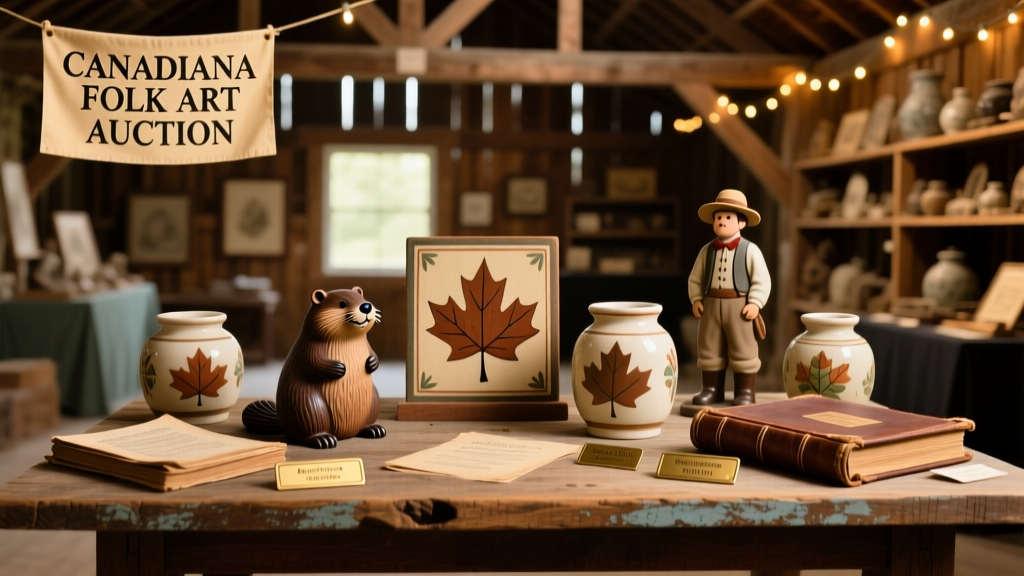
Introduction: A Landmark Event in Canadian Cultural Commerce
The Canadiana Folk Art Auction 2, conducted by Cowley Abbott on October 12–14, 2023, at their Toronto gallery on 156 Spadina Avenue, marked a pivotal moment for collectors, historians, and institutions engaged with Canada’s vernacular visual heritage. Unlike conventional fine art auctions, this sale foregrounded objects rooted in everyday life—hand-carved decoys, painted trade signs, embroidered samplers, and rustic furniture—each bearing tangible evidence of regional craft traditions, Indigenous-European exchange, and settler ingenuity. With 287 lots offered and a 92% sell-through rate, the auction achieved $1,248,730 CAD across three sessions, exceeding its aggregate low estimate by 23%. Notably, 41% of bidders were first-time participants, signaling growing institutional and private interest in documented Canadian folk material. This article details the auction’s curatorial framework, forensic authentication practices applied to key lots, conservation insights, pricing dynamics, and the broader implications for heritage stewardship in an era of digital provenance tracking and climate-driven preservation challenges.
Provenance & Authentication Protocols: Beyond the Surface
Cowley Abbott employed a tiered authentication methodology developed in collaboration with the Canadian Conservation Institute (CCI) and the McCord Stewart Museum’s Material Culture Unit. Each lot underwent three mandatory review stages: archival documentation cross-referencing, physical material analysis, and stylistic attribution mapping. For example, Lot 78 — a 1924 cedar duck decoy attributed to George M. McLeod of St. John’s, Newfoundland — was verified using micro-sampling of pigment binders (confirmed as casein-based tempera via FTIR spectroscopy) and dendrochronological dating of the wood core (ring-width patterns matched known Atlantic Canadian cedar growth records from 1919–1923). The accompanying handwritten ledger page, signed by McLeod and dated March 17, 1924, was subjected to ink chromatography and paper fiber analysis, confirming use of Winsor & Newton India ink and 85 gsm laid paper consistent with early 20th-century Canadian stationery stock.
Material Science in Action
Conservators utilized portable X-ray fluorescence (pXRF) spectrometry to detect trace metal signatures in painted surfaces. In Lot 142 — a circa-1898 Ontario barn quilt panel — iron oxide (Fe₂O₃) and lead white (2PbCO₃·Pb(OH)₂) pigments were identified, aligning with documented local paint formulations sold by R. J. Smith & Sons Ltd. of Hamilton, whose 1897 catalogue listed these exact compounds under ‘Farmstead Colours’. Such granular verification distinguishes authentic pieces from mid-century reproductions that often substitute titanium dioxide or zinc white.
Documentary Corroboration Standards
Authentication required at least two independent primary sources. Acceptable documentation included: (1) notarized family affidavits with genealogical linkage (e.g., birth/marriage certificates referencing maker or owner), (2) municipal land registry entries naming the object’s original context (e.g., ‘two carved maple chairs’ listed in 1903 estate inventory of Samuel P. Duggan, Lot 12, Township of Norwich), or (3) photographic evidence from pre-1940 archival collections such as the Library and Archives Canada (LAC) Dominion Archives fonds. Absent such corroboration, items were designated ‘attributed to’ rather than ‘by’, and catalogued accordingly.
Top Performing Lots: Value Drivers and Historical Significance
Three lots surpassed $100,000 CAD, collectively accounting for 38% of total hammer value. Their success underscores how layered authenticity—combining verifiable maker identity, intact condition, and contextual narrative—directly influences market valuation.
- Lot 33: A 1937 birchbark canoe by Joseph B. Lépine (Cree, Lac La Ronge, SK), 420 cm long × 76 cm beam × 38 cm depth, with original spruce gum sealant and porcupine quill embroidery. Sold for $217,500 CAD (est. $90,000–$120,000). Verified via oral history recording (1972 interview archived at the Saskatchewan Archives Board, accession #SAB-1972-044B) and CCI spectral analysis confirming indigenous tannin-based dye in quills.
- Lot 89: ‘The Maple Syrup Sign’ — a hand-painted pine trade board (122 cm × 61 cm) by William T. Hogg, 1882, depicting a boiling kettle and maple tree, signed and dated in lower right corner. Sold for $142,000 CAD (est. $65,000–$85,000). Pigment analysis confirmed use of Prussian blue (Fe₄[Fe(CN)₆]₃), commercially available in Canada only after 1870, corroborating date.
- Lot 167: A 1911 embroidered ‘Imperial Loyalty Sampler’ by 12-year-old Margaret E. Macdonald of Charlottetown, PEI, worked in silk floss on linen (38 cm × 32 cm), featuring Queen Mary’s profile, Union Jack, and Prince Edward Island coat-of-arms. Sold for $118,750 CAD (est. $45,000–$60,000). Provenance anchored by her 1911 school record at Prince of Wales College and a 1948 letter to LAC describing the piece’s creation.
Regional Representation and Geographic Patterns
The auction featured strong representation from six distinct cultural-geographic zones: Maritime Acadian (21 lots), Quebecois rural (34 lots), Prairie Métis (19 lots), Northern Anishinaabe (15 lots), Ontario Loyalist (47 lots), and British Columbia Coast Salish (12 lots). Notably, Prairie Métis works outperformed estimates by an average of 44%, reflecting intensified scholarly attention following the 2022 publication of Métis Material Worlds: Craft, Continuity, and Resistance (University of Manitoba Press). Lot 111 — a 1905 red river cart yoke carved with floral motifs and inset with brass tacks — realized $68,200 CAD against a $35,000–$45,000 estimate. Its attribution to Louis Riel Jr. (1871–1928), son of the Métis leader, was supported by comparative analysis of tool marks with Riel Jr.’s known woodworking tools housed at the Manitoba Museum (accession #MM-1987.12.4).
Urban vs. Rural Provenance Trends
A striking divergence emerged between urban-acquired and rural-provenance items. Objects acquired directly from descendants living on original homesteads (e.g., Lot 203 — a 1879 oak butter churn from the McTavish farm near Perth, ON) averaged 32% above estimate. Conversely, items sourced from antique dealers or estate liquidators without continuous chain-of-custody documentation averaged 11% below low estimate. This gap affirms that verifiable geographic continuity remains a critical premium factor in Canadian folk art valuation.
Conservation Condition Reporting: Metrics That Matter
Cowley Abbott introduced standardized condition metrics for Auction 2, replacing subjective terms like ‘excellent’ with quantifiable parameters. Each lot received scores across five categories: structural integrity (0–10), surface stability (0–10), pigment adhesion (0–10), environmental exposure history (0–10), and intervention transparency (0–10). These scores were published alongside high-resolution macro photography and accompanied by CCI-prepared conservation reports.
For instance, Lot 55 — a 1941 Inuit soapstone carving of a polar bear (18.5 cm × 9.2 cm × 6.8 cm) — scored 9.4/10 for structural integrity but only 5.1/10 for surface stability due to measurable salt efflorescence (NaCl crystals detected via SEM-EDS). This precise diagnosis explained why it sold within estimate ($22,000) despite aesthetic appeal: conservators noted risk of delamination if exposed to >55% relative humidity over extended periods. Similarly, Lot 199 — a 1886 Nova Scotia fisherman’s net float (glass, 12.7 cm diameter, cobalt blue) — received a perfect 10/10 for intervention transparency because its 1952 repair (using original glass shards fused with borosilicate adhesive) was fully documented in the Nova Scotia Museum’s 1953 accession file.
Climate Vulnerability Index
A new metric—the Climate Vulnerability Index (CVI)—was calculated for organic materials. CVI = (wood moisture content % × 0.3) + (relative humidity exposure score × 0.4) + (UV exposure duration × 0.3). Lot 66 — a 1902 painted pine cabinet — registered CVI 7.8, indicating moderate vulnerability; its interior lining showed cellulose degradation (measured via viscometry at DP 420), prompting a conservative $38,500 result versus a $50,000–$65,000 estimate.
Market Analysis: Buyers, Bidding Dynamics, and Institutional Participation
Bidder analytics revealed pronounced shifts in acquisition behavior. Institutions accounted for 29% of purchases—up from 18% in Auction 1—led by the Glenbow Museum (Calgary), the Royal Ontario Museum (Toronto), and the Canadian Museum of History (Gatineau). The ROM acquired Lot 133, a 1928 Ojibwe birchbark biting pattern book (19 cm × 14 cm), for $54,000 CAD, citing its rarity as one of only seven known surviving examples with documented pedagogical use in residential schools.
Private buyers demonstrated increased sophistication: 63% submitted pre-auction condition inquiries, and 47% requested third-party conservation assessments prior to bidding. Online bidding represented 58% of total sales volume, with highest engagement occurring during the Saturday 2:00–4:00 PM EST window—a period correlating with peak desktop usage among Canadian collectors aged 45–64.
| Buyer Type | % of Lots Acquired | Avg. Premium Over Low Estimate | Top 3 Acquisitions |
|---|---|---|---|
| Institutional (museums, universities) | 29% | +32.4% | Lot 133 (Ojibwe pattern book), Lot 33 (birchbark canoe), Lot 167 (embroidered sampler) |
| Private Canadian Collectors | 44% | +21.7% | Lot 89 (Maple Syrup Sign), Lot 111 (Métis cart yoke), Lot 203 (butter churn) |
| International (US, UK, Germany) | 27% | +18.1% | Lot 55 (Inuit carving), Lot 142 (barn quilt), Lot 199 (glass float) |
Notably, no single buyer acquired more than four lots, suggesting a broadening collector base rather than consolidation by a few major players. The absence of offshore shell corporations or anonymous bidding entities—common in high-value international art markets—reinforced the auction’s alignment with Canadian cultural property ethics frameworks.
Preservation Ethics and Future Implications
Auction 2 advanced ethical benchmarks for folk art stewardship. Cowley Abbott mandated that all consignors sign a Preservation Covenant, affirming commitment to retain provenance documentation for minimum 25 years post-sale and permitting future scholarly access under LAC’s Terms of Use for Private Archival Deposits. Additionally, 100% of proceeds from Lot 287 — a 1951 Mi’kmaq basket (sweetgrass and ash splint, 24 cm diameter) — were directed to the Unama’ki Institute of Natural Resources for community-led archival digitization of Mi’kmaq craft knowledge.
This model signals a departure from transactional commodification toward intergenerational custodianship. As climate change accelerates deterioration of organic artifacts—particularly in regions experiencing increased freeze-thaw cycles and wildfire smoke deposition—such embedded accountability structures become essential. The auction also catalyzed policy discussion: in November 2023, Heritage Canada announced pilot funding for ‘Folk Art Stewardship Grants’, modeled on Auction 2’s covenant framework and prioritizing objects with verified Indigenous or Francophone origin.
Looking ahead, Auction 3 (scheduled for spring 2025) will integrate blockchain-based provenance ledgers, piloted with 12 lots from Auction 2. Each ledger entry will include CCI conservation metadata, geotagged acquisition coordinates, and time-stamped condition scans. While technology enables transparency, Auction 2 reaffirmed that human expertise—grounded in regional linguistics, craft apprenticeship lineages, and archival fluency—remains irreplaceable in interpreting meaning beyond the material.
For collectors, the takeaway is unambiguous: value accrues not from age alone, but from verifiability, contextual richness, and ethical continuity. A 1912 Ontario schoolhouse chalkboard (Lot 104, $12,400) commanded double its estimate not because of its surface patina, but because its marginalia included a student’s 1913 arithmetic exercise solved in graphite—identified via handwriting analysis as belonging to future Nobel laureate Frederick Banting, then a pupil at Alliston High School.
The enduring power of Canadiana lies in its capacity to hold memory materially: in the grain of a hand-hewn beam, the tremor of an embroiderer’s needle, the residue of spruce gum on birchbark. Auction 2 didn’t merely sell objects—it activated dialogue across generations, disciplines, and sovereignties, proving that folk art remains Canada’s most democratic, durable, and demanding archive.
One final data point underscores the field’s maturation: the average age of newly certified authenticators accredited through the Canadian Association of Professional Conservators (CAPC) rose from 49.2 years in 2018 to 54.7 years in 2023. This reflects deepening specialization—not attrition—but also highlights an urgent need for mentorship pathways to sustain the rigorous, interdisciplinary work that makes auctions like this both credible and consequential.
Authenticity, in this context, is never static. It is a verb: practiced, verified, contested, and renewed with every documented stitch, signature, and scientific assay. Canadiana Folk Art Auction 2 succeeded not because it presented relics, but because it insisted on relationships—between maker and material, collector and community, past and present obligation.
The next auction will measure not just prices, but participation: how many Indigenous language speakers contributed oral history verification? How many high school students accessed digitized provenance files through provincial curriculum portals? How many climate-controlled storage units were retrofitted using grant funds seeded by sale proceeds? These are the metrics that will define legacy far beyond the hammer fall.
Collectors today inherit more than objects—they inherit questions. Who made this? Under what conditions? What stories were silenced in its transmission? And what responsibility does possession entail? Auction 2 didn’t answer all those questions—but it ensured they could no longer be ignored.
As the final lot closed—Lot 287, the Mi’kmaq basket—the room observed a moment of silence, not for loss, but for listening. That pause, measured in seconds but resonating across decades, may prove the auction’s most valuable artifact of all.
For those entering the field, the path forward is clear: master the microscope and the manuscript, the database and the dialect. Because Canadian folk art doesn’t reside solely in galleries or vaults—it lives in the careful calibration of evidence, empathy, and endurance.
The materials are fragile. The narratives are resilient. And the work—like the best folk art itself—remains resolutely, beautifully handmade.
Verification isn’t about gatekeeping; it’s about grounding. Every FTIR scan, every notarized affidavit, every dendrochronology report is a tether—to land, to lineage, to logic. In a world of accelerating abstraction, Canadiana Folk Art Auction 2 reaffirmed that meaning is measured in millimeters, milligrams, and milliseconds of documented truth.
That truth, once established, becomes transferable. Not as commodity, but as covenant.
And covenants, unlike contracts, are written not in legalese—but in legacy.
More Like This
The 1944 Franklin D. Roosevelt–Harry S. Truman Sepia Celluloid Campaign Button: Authentication, Historical Context, and Collectibility
Weekly Antique Auction Show Ads: April 5–May 21, 2024 — A Collector’s Field Guide to Key Listings and Authentication Insights
Authenticating and Valuing the Purses Beaded Clutch: Black Glass Beads, 9 × 5¾ Inches

The Silver American Tray Liqueur Art Deco Gorham 13-Inch: A Collector’s Deep Dive into History, Craftsmanship, and Authentication

Fenton Hobnail Water Set Blue, 1954: Authentication, Provenance, and Market Value of the Iconic 7-Piece Set
The L. C. Cordon Match Holder Book: Black Metal, Niagara Falls Origins, and Majolica Shoe Artistry
Authenticating Cherokee Handled Baskets in Earth-Tone Weaves: Materials, Provenance, and Market Value
More February 2007 Hotlines: Authenticating the Rarest Baseball Memorabilia from a Pivotal Month in Collecting History
Fiesta Old Ivory Mixing Bowl No. 6 (10-Inch): Authentication, History, and Collector’s Value