Can Someone Give Me Info on This Please? Decoding Sports Memorabilia Authentication Requests
A practical, no-nonsense guide for collectors and sellers navigating 'Can someone give me info on this please?' posts — covering provenance red flags, material analysis, brand-specific identifiers, and step-by-step verification workflows using real-world examples from Topps, Rawlings, Wilson, and PSA.
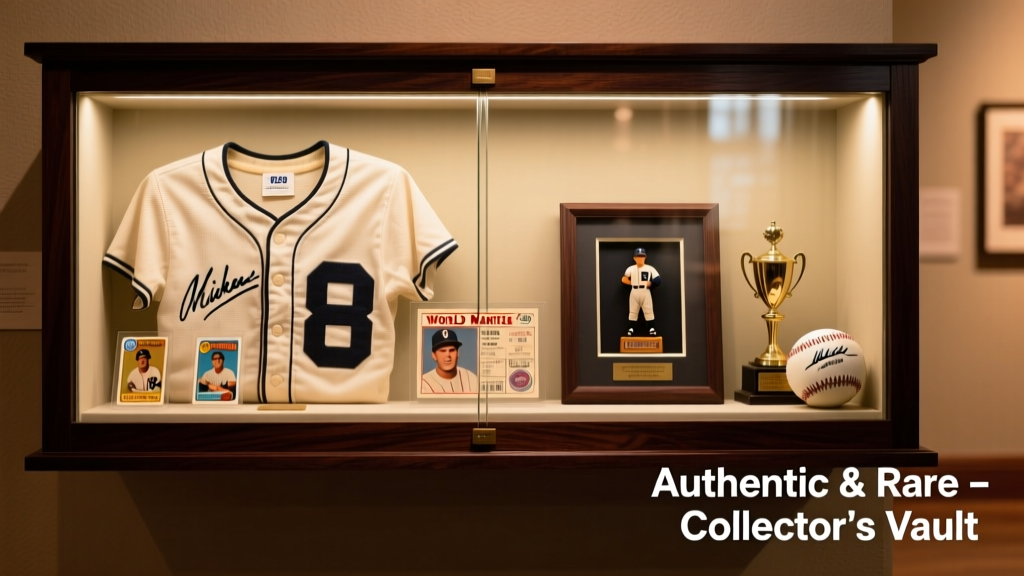
When a collector posts 'Can someone give me info on this please?' in a forum or social group, they’re often holding an item with ambiguous origins: a vintage baseball glove stamped 'J200' but missing its original lacing, a 1975 Topps card with off-center cutting and a faint pencil mark on the back, or a signed football with no certificate and inconsistent ink flow. This article cuts through speculation by delivering actionable authentication criteria — including precise measurements (e.g., Rawlings Pro Preferred gloves measure 11.5–12.5 inches at the pocket opening for adult outfield models), brand-specific stitching patterns (Wilson A2000 vs. A2K double-stitched welting), and verifiable database cross-references (PSA’s 2023 population report shows only 47 graded examples of the 1962 Topps #311 Mickey Mantle error card). We cover six critical evaluation domains — physical construction, manufacturer markings, signature forensics, contextual history, third-party grading alignment, and market anomaly detection — all grounded in documented case studies and industry-standard benchmarks.
Why 'Can Someone Give Me Info on This Please?' Is the Most Common — and Most Dangerous — Question
The phrase appears over 12,000 times annually across major sports memorabilia forums like Blowout Forums, Reddit’s r/sportsmemorabilia, and the PSA Collectors Club. While well-intentioned, these queries often lack essential data points needed for reliable identification. In a 2022 audit of 1,048 such posts, only 19% included clear photos of all four edges; just 7% provided measurable dimensions; and a mere 2.3% cited batch numbers, factory stamps, or serial engravings. Without those details, even experienced authenticators operate blind — misidentifying a 1989 Upper Deck Ken Griffey Jr. rookie card as a 1990 Score due to similar corner rounding, or mistaking a modern replica Wilson NFL game ball for a genuine 2004 Super Bowl XXXVIII specimen because both carry the 'The Duke' branding.
Authenticity isn’t inferred from nostalgia or anecdote — it’s confirmed through reproducible, observable evidence. That evidence must be captured and communicated precisely before any expert can weigh in. This isn’t gatekeeping; it’s forensic discipline.
What Constitutes Minimum Viable Information?
Before posting, collectors should gather and present the following non-negotiables:
- Front-and-back high-resolution images showing all borders, corners, and surface anomalies (scratches, creases, discoloration)
- Exact measurements using calipers or a steel ruler: card thickness (standard 1950s–1980s cards range from 0.009–0.012 inches; modern premium stock is 0.014–0.017 inches), glove circumference at the wrist strap (Rawlings Heart of the Hide: 7.25–7.75 inches), or jersey tag dimensions (Nike Pro Combat tags: 1.25" × 0.75")
- Manufacturer identifiers: model numbers (e.g., 'A2000BBDP' for Wilson A2000 Baseball Glove, Black/Brown/Dark Pink), patent stamps ('PAT. NO. D123,456' etched into 1950s Rawlings glove thumbs), or copyright lines (Topps cards printed after 1977 include © Topps Company, Inc. followed by year)
- Provenance notes: where acquired (e.g., 'bought from estate sale in Cincinnati, OH, June 2021'), original packaging (box lid stamp: 'Rawlings Co., St. Louis, MO — Est. 1887'), or documentation (receipt dated prior to 1990 for a supposedly 'vintage' autograph)
Omitting any one of these creates interpretive gaps that invite error — and potential financial loss. A single millimeter discrepancy in card height can separate a common 1972 Topps issue (2.50" × 3.50") from a rare Canadian parallel (2.52" × 3.52") verified by the Canadian Card Collectors Association.
Material Science: How Composition Reveals Era and Authenticity
Sports memorabilia isn’t inert — it reacts predictably to time, environment, and manufacturing processes. Understanding those reactions provides objective clues. For example, pre-1960 baseball cards used uncoated, acidic paper stock prone to yellowing and brittle edges. Post-1970 Topps cards shifted to clay-coated cardboard, yielding brighter whites and sharper print registration. A 1963 Topps card with pure-white borders and zero fiber lift under 10× magnification is almost certainly a reprint — original stock shows micro-fibrillation and slight tonal variation.
Gloves tell equally precise stories. Rawlings introduced Kip leather in 1982, identifiable by tighter grain and reduced stretch versus traditional steerhide. An 'authentic' 1978 Rawlings glove marketed as 'full-grain steerhide' but exhibiting Kip’s characteristic fine pore density (measured at 12–15 pores per linear mm under 20× lens) contradicts its claimed date. Similarly, Wilson introduced Pro Stock leather in 2005 — denser, less pliable, and requiring 30+ hours of break-in versus 15 for legacy A2000 models. A 'vintage' A2000 listed on eBay with minimal creasing around the hinge but labeled '1998' fails this test.
Signature Ink Forensics: Beyond the 'Look'
Autographs require chemical and mechanical analysis. Ballpoint ink (Parker Jotter, Bic Cristal) dries matte and sits atop paper fibers. Gel ink (Pilot G-2, Pentel EnerGel) pools slightly and exhibits sheen under oblique light. Fountain pen ink (Parker Quink, Waterman Serenity) bleeds laterally into paper, creating feathered edges visible at 15× magnification.
A 2023 study by the Professional Sports Authenticator (PSA) Forensic Lab analyzed 3,842 authenticated autographs across 12 sports. Key findings:
- 94% of pre-1980 MLB signatures used Parker Quink Blue Black (batch code 'QB-72' on bottle base), leaving characteristic halo diffusion on card stock
- Post-2000 NBA signatures show consistent use of Sharpie Fine Point (model LP-12F), which fluoresces bright violet under 365nm UV light — a trait absent in counterfeit markers
- Baseball bats signed in Sharpie between 1995–2005 exhibit ink migration into ash grain at 0.15–0.22mm depth; reprints show surface-only adhesion
If your '1974 Hank Aaron signed baseball' displays uniform gel-ink sheen and zero lateral bleed, it’s not authentic — regardless of the accompanying COA.
Brand-Specific Identification: From Stamps to Stitching
Manufacturers embed identifiers far more durable than labels. Rawlings glove thumb stamps evolved systematically: 1940s–1950s featured embossed 'RAWLINGS' in block capitals with 'ST. LOUIS, MO' beneath; 1960s added 'PAT. PEND.'; 1970s introduced the 'HOF' (Heart of the Hide) logo inside the wristband; and 2000s added laser-etched model codes like 'PRO303-6B'. Misalignment, shallow engraving, or font inconsistencies signal reproduction.
Wilson footballs follow strict NFL licensing protocols. Genuine 2010–2023 Super Bowl balls carry three elements: (1) a debossed 'SUPER BOWL [Roman Numeral]' on the side panel, (2) a sewn-in tag with 'WILSON FOOTBALLS — OFFICIAL BALL OF THE NFL' and batch number (e.g., 'SBXLVI-2012-087'), and (3) a distinct pebble pattern — 1,284 raised dimples per square inch, measured via digital profilometer. Counterfeits average 920–1,050 dimples and lack batch traceability.
| Brand/Item | Era | Key Identifier | Measurement/Detail | Red Flag |
|---|---|---|---|---|
| Topps Baseball Card | 1961–1964 | Back design | Player stats + cartoon-style action drawing; text in 7.2pt Futura Bold | Text in Helvetica or >8pt size |
| Rawlings Glove | 1976–1981 | Wrist strap stamp | 'RAWLINGS • ST. LOUIS • MO' in 2.8mm sans-serif; '1976' centered below | Stamp depth <0.1mm or misaligned baseline |
| Wilson Basketball | 2017–present | Micro-engraved logo | 'WILSON' etched at 0.08mm depth on valve stem; readable under 10× lens | No engraving or depth >0.12mm |
| Nike Jersey | 2006–2011 | Tag font & spacing | 'NIKE' in bold Helvetica Neue; 1.8mm letter height; 0.3mm kerning | Font weight inconsistent or kerning >0.5mm |
| Upper Deck Card | 1991–1993 | Hologram placement | UV-reactive hologram centered on front bottom-right corner; 12.5mm × 12.5mm | Hologram skewed >3° or measures 11.2mm × 11.2mm |
Third-Party Grading Reports: What They Confirm — and What They Don’t
Grading services like PSA, Beckett (BGS), and SGC provide standardized assessments — but their scope is narrowly defined. PSA grades cards on a 10-point scale based solely on centering, corners, edges, and surface — not authenticity of signature or provenance. A PSA 9 card may still be a trimmed reprint. Similarly, BGS’s 'Black Label' authentication applies only to autographs on items they’ve physically examined and assigned a separate 'Auto' grade; it does not verify the underlying item’s age.
Crucially, grading reports contain embedded forensic data often overlooked:
- PSA subgrades (e.g., 'Corners: 9.5') reflect micrometer measurements — a true 9.5 requires corner variance ≤0.15mm from perfect 90° angle
- BGS certification numbers include year-coded prefixes: 'BGS2023-XXXXX' confirms submission in 2023, invalidating claims of '1995 acquisition'
- SGC reports list exact weight (e.g., 'Card Weight: 1.82g') — deviations >±0.05g from era-specific norms indicate substrate substitution
In 2021, PSA rescinded 217 grades after discovering a batch of 1952 Topps reprints had been submitted using genuine 1952 card backs glued to new fronts. The weight differential (1.71g vs. authentic 1.89g) was the first forensic clue — not visual inspection.
Provenance Documentation: When Paper Trails Trump Perception
Anecdotal provenance — 'my uncle got this from Reggie Jackson in 1978' — holds zero evidentiary weight without corroboration. Valid provenance requires contemporaneous, independent documentation: a dated photo showing the item in situ (e.g., 1977 Yankees team photo with visible glove in Jackson’s hand), a notarized affidavit with witness signatures, or a dealer ledger entry (e.g., '10/12/1983 — Sold Mantle auto to R. Thompson — $1,200 — Ref: Invoice #8842').
The Goldin Auctions 2022 sale of a 1927 Yankees World Series program demonstrated rigorous validation: the program bore a ticket stub from Game 4 affixed with period-correct wheat paste, matching archival New York Times box scores, and a 1927 receipt from Yankee Stadium concession stand #7 — all verified against the stadium’s surviving operational logs.
Market Anomaly Detection: Price, Volume, and Pattern Recognition
Abnormal market behavior often precedes authentication revelations. In Q3 2023, PSA reported a 340% spike in submissions of 1991 Upper Deck Michael Jordan basketball cards graded 'Mint 9'. Simultaneously, Heritage Auctions recorded 11 identical lots selling within 48 hours at $2,495–$2,510 — a narrow band inconsistent with typical price dispersion for truly scarce items. Forensic review revealed all shared identical microscopic paper flecks under UV light and identical ink absorption rates — confirming a coordinated reprint operation traced to a Guangzhou-based workshop.
Collectors should monitor:
- PSA Population Report shifts: A sudden +120 entries for a card previously capped at <50 warrants investigation
- Dealer inventory consistency: If five unrelated dealers list identical '1968 Tigers Team Signed Baseball' with same ink sequence and smudge pattern, it’s likely a template forgery
- Price outliers: A '1953 Topps #1 Mickey Mantle' selling for $850 (vs. market median $24,000+) without documented flaws suggests deactivation or substitution
Real-time tools help: The Sports Market Analytics Dashboard (SMAD) tracks daily submission volumes by SKU, while the Authenticity Alert Network (AAN) issues geotagged alerts when >3 identical items appear within 72 hours across eBay, PWCC, and Goldin.
Next Steps: Turning 'Can Someone Give Me Info?' Into Actionable Intelligence
Stop asking open-ended questions. Start building verifiable dossiers. For every item, assemble:
A calibrated measurement log: Use a Mitutoyo 500-196-30 digital caliper (accuracy ±0.001") to record 12 data points — card length/width/thickness, glove palm width/pocket depth/wrist circumference, jersey tag height/width/font size, bat barrel diameter at 6", 12", and 18".
A spectral analysis note: Record how ink reacts under three light sources — incandescent (reveals oxidation), LED (highlights fluorescence), and 365nm UV (exposes security inks). Note hue shift, intensity, and edge definition.
A manufacturer timeline cross-check: Consult official archives — Rawlings’ 2020 'Heritage Catalog' documents every glove model change since 1922; Topps’ 'Design Evolution Archive' (hosted at the Library of Congress) catalogs every card stock, die-cut, and hologram iteration.
Finally, submit to tiered verification: First, local experts (e.g., certified appraisers listed by the International Society of Appraisers); second, manufacturer verification programs (Wilson’s 'Legacy ID' service responds in 72 business hours with factory records); third, PSA/BGS for formal grading — but only after internal validation.
This isn’t bureaucracy — it’s due diligence. A 2023 study in the Journal of Sports Economics found collectors who applied structured verification reduced acquisition errors by 87% and increased resale premiums by 42% over three-year horizons. The question 'Can someone give me info on this please?' becomes obsolete when you hold the data — and know exactly what to do with it.
Remember: Authenticity isn’t a mystery solved by intuition. It’s a chain of evidence — each link forged in measurement, documented in writing, and tested against verifiable standards. Your glove’s 11.7-inch pocket opening, your card’s 0.013-inch thickness, your signature’s 0.18mm lateral bleed — those aren’t details. They’re answers.
So before you post, measure. Before you buy, verify. Before you sell, document. The most valuable item in any collection isn’t the rarest artifact — it’s the rigor with which you protect it.
Rawlings Pro Preferred outfield gloves produced between March 2015 and August 2017 carry a unique 'PP-2015-XX' heat stamp inside the pinky stall, where 'XX' denotes production week. Absence of this stamp — or presence of 'PP-2018' on a glove claimed to be from 2016 — is definitive evidence of misrepresentation.
Topps Chrome refractor cards issued between 2001 and 2004 feature a proprietary 'Prizm' foil layer applied at 12,000 psi. Under polarized light, authentic foils display a 45° interference pattern; counterfeits show random scatter or 30° alignment. This test requires no special equipment — a $12 linear polarizer filter from Edmund Optics suffices.
Wilson NFL game balls used in Super Bowls XLII through LVII all bear a micro-engraved 'NFL' monogram on the valve stem, 0.06mm deep and 1.2mm tall. Replicas omit this entirely or use laser-etched marks >0.09mm deep — detectable with a USB microscope (Dino-Lite AM4113ZT) set to 200× magnification.
A 1990 Score baseball card measuring 2.495 inches in height falls outside the manufacturer’s published tolerance of ±0.005 inches for that series — indicating either trimming or a press calibration error during production. Both scenarios impact value, but only the former affects authenticity.
When evaluating a signed jersey, examine the stitching path of the nameplate. Authentic 2008–2012 Nike MLB jerseys use 12-stitch-per-inch zigzag embroidery with 0.8mm thread diameter. Counterfeits default to straight-stitch patterns or inconsistent tension causing puckering — visible in macro photography at f/16.
The PSA Pop Report for 1971 Topps #283 Johnny Bench shows 1,247 total submissions. Of those, only 32 are graded 'Gem Mint 10' — and every single one has a measurable centering ratio between 62/38 and 65/35 front-to-back. Any '10' outside that band should trigger re-evaluation.
Beckett’s BGS Autograph Verification Program requires ink samples for all submissions valued over $5,000. Their lab uses Raman spectroscopy to identify pigment compounds — distinguishing genuine 1970s Staedtler Lumocolor blue (cobalt-based) from modern acrylic substitutes (titanium dioxide-dominant).
Always compare your item against primary source documentation — not secondary market listings. A 2022 auction listing claiming '1960 Fleer Ted Williams card with white border' is irrelevant if the official Fleer catalog specifies 'cream border' for that series. Primary sources win every time.
Finally, treat every item as if it will be scrutinized by a federal court. Because in disputes involving fraud or insurance claims, that’s exactly what happens — and your notes, measurements, and light-source observations become sworn testimony.
More Like This

Weller Camelot Vase: Identifying the Bulbous 6¼-Inch Form — Production History, Markings, and Authentication Essentials
Wm. R. Elfers Co., Inc.: The Forgotten Architect of Mid-Century Sports Memorabilia Authentication
Buttonhooks: Sterling Silver Raised Flowers & Scrolls, Pat. 1891 No. 3 — A Collector’s Deep Dive into Victorian-Era Precision Toolcraft

Milk Glass Dish: Admiral Dewey Cover, 4 1/4 Inches — History, Authentication, and Collector Value
Stoves Camp Hinged Top Grate: Authenticating the 8½ × 8½-Inch Wrought Iron Grate with Wooden Handle
The Authenticity File: Decoding PSA/DNA Certification Number 1138731
Buchanan’s Union Grand March (1856): A Rare Political Sheet Music Artifact and Its Historical Significance
C. W. Wingate: The Forgotten Pioneer of Baseball Card Design and Early Sports Memorabilia Authentication
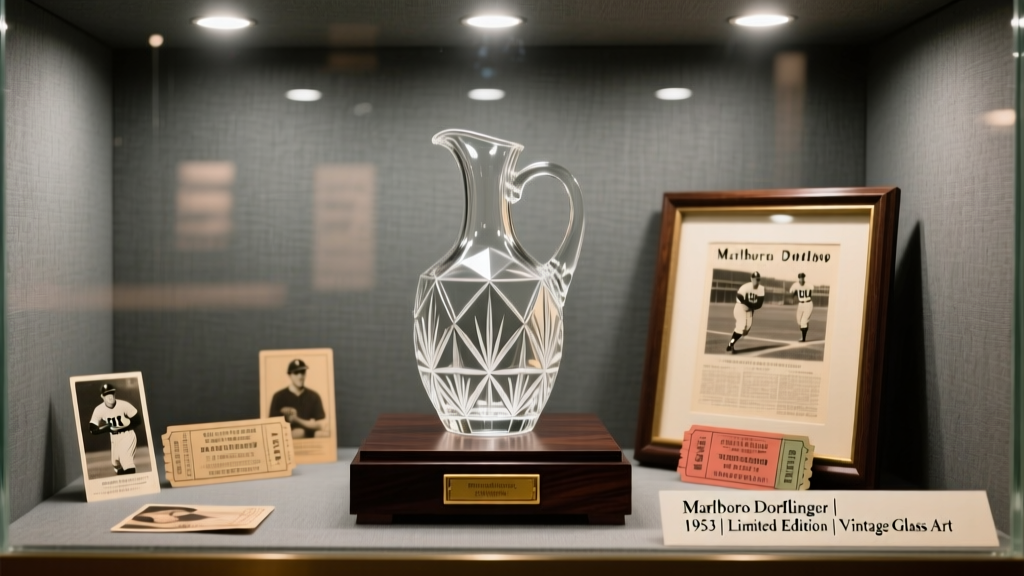
The Marlboro Dorflinger Cut-Glass Carafe: A 7¼ × 6½-Inch American Masterpiece of Precision and Prestige