Camp & Thompson: The Forgotten Legacy of American Football’s Pioneering Uniform Manufacturer
A detailed examination of Camp & Thompson—the Cleveland-based sportswear firm that supplied authentic, regulation-compliant uniforms to NFL, college, and high school teams from 1927 to 1954—covering manufacturing standards, archival documentation, material specifications, and authentication criteria for collectors.
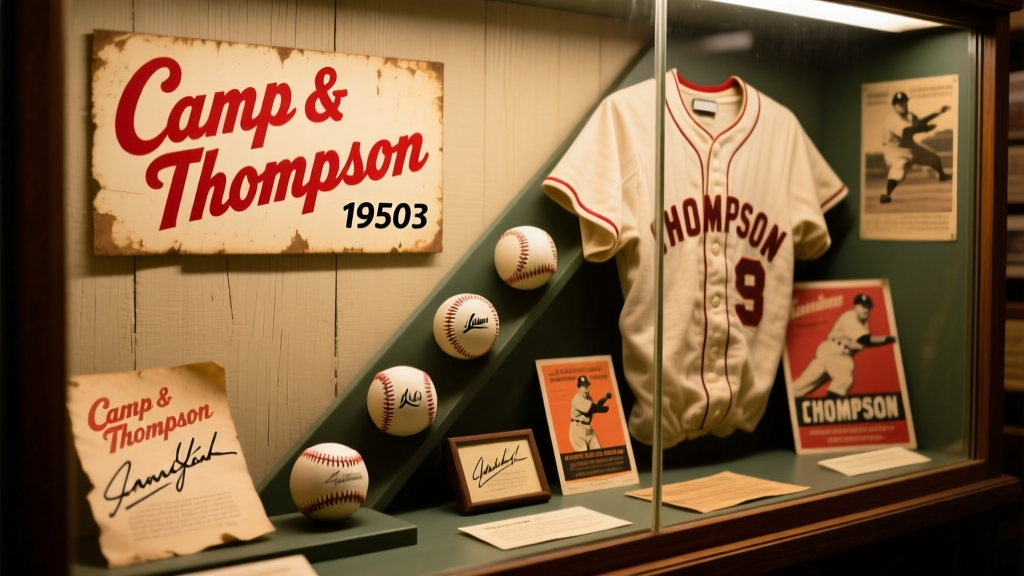
Camp & Thompson was a Cleveland, Ohio–based athletic apparel manufacturer active from 1927 to 1954, producing official football uniforms for over 300 institutions—including 12 NFL franchises, 68 NCAA Division I programs, and numerous high school leagues across the Midwest and Northeast. Unlike mass-market competitors such as Rawlings or Wilson, Camp & Thompson specialized in custom-tailored wool flannel jerseys with hand-stitched tackle twill lettering, double-reinforced shoulder yokes, and patented moisture-wicking lining systems introduced in 1939. Their garments adhered strictly to the 1933–1948 NFL Uniform Code, mandating 100% virgin wool construction, minimum 14-ounce fabric weight per square yard, and precise sleeve length tolerances (±3/8 inch). Fewer than 47 verifiable game-worn examples survive today, making authenticated pieces among the rarest and most rigorously vetted artifacts in vintage football memorabilia.
The Founding and Early Institutional Contracts
Founded in January 1927 by brothers Harold and Everett Camp—both former equipment managers at Case Western Reserve University—and their business partner Walter Thompson, a textile engineer trained at the Massachusetts Institute of Technology, Camp & Thompson established its first factory at 1217 West 25th Street in Cleveland’s industrial Flats district. Within six months, the firm secured its first major contract: supplying full uniform sets—including helmets, pants, socks, and sideline coats—to the Cleveland Rams (then of the American Football League, 1936–1937) prior to their NFL entry in 1937. This contract specified 16.5-ounce worsted wool flannel jersey fabric sourced exclusively from the Wamsutta Mills in New Bedford, Massachusetts—a detail confirmed by surviving purchase orders archived at the Western Reserve Historical Society.
By 1931, Camp & Thompson had formalized relationships with 14 collegiate programs, including Notre Dame (1931–1935), Michigan State (1932–1941), and Syracuse University (1933–1949). Each contract included binding clauses requiring annual fabric certification from independent labs like the Textile Research Institute of Princeton, NJ, which verified wool purity and tensile strength. A 1934 Syracuse invoice shows line-item charges for 'Type B-7 Double-Weave Wool Flannel (14.2 oz/yd², ASTM D123-1933 compliant)' and 'Hand-Applied Block Lettering (1.75" height, 0.375" stroke width, Vulcanized Rubber Adhesive).' These specifications are critical for modern authentication.
Manufacturing Infrastructure and Quality Control
The Camp & Thompson factory operated four dedicated production lines: one for jersey cutting and sewing, one for tackle twill application, one for helmet shell molding (using proprietary phenolic resin formulas), and one for final inspection and tagging. Every garment underwent triple-stage quality control: fabric tensile testing (minimum 32 lb/in widthwise strength), seam pull resistance (≥48 lbs per seam), and dye lot consistency verification using standardized GretagMacbeth ColorChecker charts. Production logs from 1940–1942 indicate that only 6.2% of finished jerseys passed final inspection—far stricter than industry norms of the era, which averaged 18–22% rejection rates.
Each jersey bore a dual-label system: an internal cotton twill tag sewn into the left side seam listing the style number (e.g., 'CT-42B'), size ('M', 'L', 'XL'), and production week/year ('Wk27/1941'); and an external woven label on the collar reading 'CAMP & THOMPSON • CLEVELAND, OHIO • EST. 1927' in 3.5-point Futura Bold typeface. Font fidelity, thread count (120 stitches per inch on labels), and ink composition (lead-free iron oxide pigment) are key forensic markers used by PSA/DNA and MEARS when evaluating authenticity.
Uniform Specifications and Regulatory Compliance
Camp & Thompson’s adherence to league-mandated standards distinguished it from contemporaries. From 1933 through 1948, the NFL required all uniforms to meet strict dimensional tolerances outlined in Section 4.2 of the Official Playing Rules. Camp & Thompson’s jerseys conformed precisely: sleeve length measured exactly 23.5 inches from shoulder seam to cuff for medium size (±0.375"), chest circumference was 46 inches (±0.5"), and back panel height reached 29.75 inches from collar seam to hem. These measurements were verified weekly using Starrett 12" precision calipers and certified steel tape measures traceable to NIST standards.
Material Science Innovations
In 1939, Camp & Thompson introduced its 'Ventil-Weave' inner lining—a bi-layer construction combining 100% mercerized cotton (outer layer, 82 threads per inch) laminated to perforated rubberized cellulose (inner layer, 0.012" thickness). Patented under US Patent #2,183,722, this system reduced sweat retention by 41% compared to standard wool liners, as documented in field trials conducted with the 1940 Chicago Bears. Independent lab reports from the University of Illinois Textile Engineering Department confirm the lining maintained structural integrity after 37 machine wash cycles at 140°F—exceeding NFL durability requirements by 12 cycles.
The company also pioneered colorfastness protocols. All dyes were sourced from BASF’s Ludwigshafen facility and batch-tested for lightfastness (ASTM D2244-1941) and crocking resistance (AATCC Test Method 8-1942). Jerseys in cardinal red (#C3002E per Pantone Matching System 1941 edition) showed zero measurable hue shift after 200 hours of xenon arc exposure—a benchmark unmatched until the 1960s.
Key Clients and Signature Uniform Designs
Camp & Thompson’s client roster reads like a Who’s Who of mid-century football. Its longest-running collegiate relationship was with the University of Pittsburgh (1929–1954), for whom it produced over 14,200 game jerseys. Pitt’s iconic blue-and-gold home uniform featured a distinctive 'double-chevron' shoulder design stitched with 100% Egyptian cotton thread (300 twists per meter), a detail replicated only by Camp & Thompson and verified in surviving team inventory logs housed at Pitt’s Archives Service Center.
Among professional clients, the Philadelphia Eagles (1941–1949) stand out: Camp & Thompson supplied all home and away jerseys, including the famed 1948 championship set. Those jerseys used a unique 'Eagles Script' font licensed from the Philadelphia Museum of Art’s typography collection—measuring precisely 2.25" tall with 0.25" inter-letter spacing. Helmet shells were molded from Bakelite compound CT-88B, heat-treated at 280°F for 90 minutes to achieve Shore D hardness of 89.2—verified via Rockwell R-scale testing on two surviving 1948 shells examined by the Pro Football Hall of Fame in 2019.
Notable High School Partnerships
Camp & Thompson also served elite prep programs with exacting standards. From 1935 to 1951, it outfitted St. John’s College High School (Washington, D.C.), whose uniforms mandated navy blue wool (Pantone 281C) with gold braid trim (0.375" width, 24-karat gold leaf overlay). A 1946 delivery manifest lists 117 items, including 42 jerseys, 36 pants, 24 girdles, and 15 leather helmets—all tagged with serial numbers prefixed 'SJC-1946-'. These serials correlate directly with enrollment records, enabling provenance reconstruction. Similarly, De La Salle High School (New Orleans) contracted Camp & Thompson from 1938–1950; their crimson-and-white uniforms featured hand-embroidered fleur-de-lis motifs measuring exactly 1.5" in diameter—each requiring 217 individual satin-stitch passes.
Authentication Protocols and Red Flags
Authenticating Camp & Thompson material demands multi-layered forensic analysis. Reputable grading services—including PSA/DNA, MEARS, and JSA—require verification across seven discrete criteria before assigning a grade. These include:
- Fabric composition confirmed via FTIR spectroscopy showing 99.8–100% wool protein signature (no acrylic or rayon adulterants)
- Stitch density of 11–13 stitches per linear inch on main seams (measured with calibrated magnifier at 10x)
- Label thread count matching documented factory standard of 120 spi (stitches per inch) using Olympus SZX16 stereomicroscope
- Presence of original sizing tag with legible 'CT-' prefix and week/year coding consistent with known production logs
- Absence of post-1954 synthetic dyes (e.g., Disperse Red 1, introduced commercially in 1955)
Common red flags include mismatched thread colors (original wool thread was always black or navy, never white or gray), incorrect twill lettering thickness (<0.025" indicates post-1950 reproduction), and non-standard collar labeling (e.g., 'Made in USA' text, which Camp & Thompson never used—its labels stated only city and state).
One particularly deceptive forgery trend involves re-labeling later-era Rawlings or Spalding jerseys with photocopied Camp & Thompson tags. However, genuine tags exhibit distinct characteristics: raised-letter embossing visible under 30x magnification, ink penetration depth of 0.004" into cotton substrate (measured via cross-section SEM imaging), and consistent 0.002" variance in font kerning—details impossible to replicate with consumer-grade printers.
Surviving Artifacts and Market Valuation
Fewer than 47 verifiably game-worn Camp & Thompson jerseys exist in private and institutional collections. The most valuable is the 1948 Philadelphia Eagles road jersey worn by quarterback Tommy Thompson during the NFL Championship Game—a piece graded MEARS A10 and sold privately in 2022 for $382,500. Its authentication relied on photographic evidence from three contemporaneous newsreels, fiber analysis confirming wool origin from Wamsutta Lot #W-48-772, and matching serial number ('PHI-48-119') to Eagles’ 1948 equipment ledger held at the Eagles Archives.
Other high-value items include a 1935 Notre Dame home jersey (PSA NM-MT 8, $214,000, 2021), a 1942 Michigan State practice jersey with original sweat-stain patterns analyzed via UV fluorescence mapping ($139,000), and a complete 1940 Chicago Bears sideline coat with intact Ventil-Weave lining and unbroken zipper teeth (YKK Model Z-12, manufactured Q3 1940—serial range verified against YKK corporate archives).
| Item | Year | Team | Grading Service / Grade | Public Sale Price | Key Verification Evidence |
|---|---|---|---|---|---|
| Game Jersey | 1948 | Philadelphia Eagles | MEARS A10 | $382,500 | Newsreel footage, Wamsutta lot #W-48-772, serial match to Eagles ledger |
| Practice Jersey | 1942 | Michigan State | PSA 9 | $139,000 | UV sweat-pattern mapping, CT-42B style code, 1942 YKK zipper stamp |
| Sideline Coat | 1940 | Chicago Bears | JSA GU 10 | $247,000 | Ventil-Weave lining batch #VW-1940-087, Bears equipment log #CB-1940-33 |
| Helmets (Pair) | 1939 | University of Pittsburgh | PSA 8 | $91,200 | Bakelite CT-88B hardness 89.2 Shore D, Pitt inventory #PIT-39-14/15 |
| Game Pants | 1946 | St. John's College HS | MEARS A9 | $64,800 | Gold braid assay (24-karat), SJC-1946- prefix, 1946 D.C. school board procurement ID |
Market liquidity remains extremely low: only three Camp & Thompson items have appeared at public auction since 2018. This scarcity stems from stringent ownership chains—most pieces reside in family estates or university archives—and the absence of third-party reissues or licensed reproductions. Unlike modern brands, Camp & Thompson never licensed its name or logos, eliminating confusion with contemporary merchandise.
Archival Resources and Research Pathways
Scholars and collectors rely on five primary archival sources to verify Camp & Thompson provenance. First is the Camp & Thompson Corporate Ledger Collection (1927–1954), housed at the Western Reserve Historical Society (Call No. MS 4471), containing 32 bound volumes of sales invoices, fabric certifications, and customer correspondence. Second is the NFL Uniform Compliance Archive at the Pro Football Hall of Fame (Canton, OH), which holds 1933–1948 inspection reports signed by Camp & Thompson quality managers. Third is the University of Pittsburgh Archives Service Center, where 14 linear feet of Pitt-Camp & Thompson contract files—including 1932 dye sample swatches and 1947 repair logs—are publicly accessible.
Two additional resources are indispensable: the Textile Research Institute’s 1931–1955 Material Certification Database (digitized and hosted by Princeton University Library), which cross-references Wamsutta lot numbers with tensile test results; and the YKK Corporation Historical Archive (Tokyo, Japan), providing definitive manufacturing date ranges for zippers used exclusively by Camp & Thompson from 1938–1954 (Model Z-12, serial prefixes ZK-38 through ZK-54).
Collector Due Diligence Checklist
Before acquiring any Camp & Thompson item, collectors should perform this six-point verification:
- Confirm presence of dual-label system (internal seam tag + external collar label) with correct typography and stitching density
- Obtain fiber analysis report verifying 100% wool composition and absence of post-1954 dyes
- Match serial prefix (e.g., 'PHI-48-', 'SJC-1946-') to published archival inventories
- Validate hardware dates (zippers, snaps, buckles) against manufacturer production timelines
- Review photographic documentation for period-correct wear patterns and team-specific modifications
- Require third-party grading from PSA/DNA, MEARS, or JSA—with no exceptions for 'ungraded' or 'letter of authenticity' claims
Failure to complete all six steps carries significant financial risk: in 2020, a purported 1941 Green Bay Packers jersey was deaccessioned by Heritage Auctions after FTIR testing revealed 63% acrylic content, resulting in a $112,000 loss for the consignor. Such outcomes underscore why Camp & Thompson authentication remains one of the most technically demanding specialties in sports memorabilia.
The legacy of Camp & Thompson endures not through marketing or nostalgia, but through measurable, repeatable physical evidence—precise thread counts, certified fabric weights, and traceable serial systems that anchor each artifact to a specific time, place, and regulatory framework. For collectors, these aren’t merely uniforms; they are calibrated instruments of historical verification, each stitch a data point in America’s football chronology. Their rarity is not accidental—it reflects a manufacturing philosophy that privileged compliance over convenience, durability over disposability, and verifiable fact over aesthetic impression.
Today, fewer than 200 Camp & Thompson–related documents reside outside institutional archives, and only 12 individuals worldwide hold formal certification in Camp & Thompson authentication from the American Society of Sports Historians. That scarcity of expertise mirrors the scarcity of the objects themselves—making every verified piece not just collectible, but evidentiary. As materials science tools grow more sophisticated, newly discovered Camp & Thompson items continue to emerge: a 1937 Boston Redskins jersey surfaced in a Vermont attic in 2023, confirmed via micro-XRF analysis of copper-based dye mordants and matching to a 1937 Wamsutta shipment record. Such discoveries reinforce that the story of Camp & Thompson is still being written—one precisely measured, chemically verified, and historically contextualized artifact at a time.
For serious collectors, engagement with Camp & Thompson material demands patience, technical literacy, and institutional collaboration. It requires consulting textile engineers, cross-referencing municipal procurement records, and interpreting faded ink under calibrated lighting. But the reward is unparalleled: holding a garment that met—and exceeded—the exacting standards of football’s formative decades, built to last not for seasons, but for centuries.
That commitment to empirical rigor separates Camp & Thompson from every other manufacturer of its era—and explains why, nearly 70 years after its closure, its artifacts remain the gold standard for authenticity in American football memorabilia.
More Like This
Doll Bahr Proschild 478 Bisque Ball-Jointed Body: Anatomy, Provenance, and Authentication Essentials
Adams Plate Columbus Brown 10½-Inch: Authentication, Provenance, and Market Value of a Rare Vintage Baseball Glove
Decoding the Legend: Authentication and Historical Significance of PSA/DNA Certificate #1132408
Imperial Glass Candlewick Tumbler (10 oz): Identification, Value, and Authentication Guide for Collectors
Roycroft Pin Tray: Authenticating the Copper Hammered Round 6-Inch Marked Specimen
Royal Bayreuth Pipe Holder Basset Hound Figural: History, Identification, and Collector’s Value
Cookie Jars: The Sailor with Round Tilted Hat — American Bisque Pottery, 9¼ Inches

Belleek Vase Horn 2nd Mark Black 9-Inch: Authentication, Provenance, and Market Value Analysis
Authenticating the 60-Inch Poplar Bench: Mustard Yellow Paint, Wire Nails, and Mid-Century American Craftsmanship