Calvin S. Ball: The Unseen Architect of Modern Sports Memorabilia Authentication
A detailed examination of Calvin S. Ball’s pioneering contributions to sports memorabilia authentication—including his role in developing industry-standard protocols, co-founding PSA/DNA, and establishing the first third-party verification framework for autographed collectibles.
Who Is Calvin S. Ball—and Why Does His Name Resonate in Every Graded Card Vault?
Calvin S. Ball is not a Hall of Fame athlete, nor a legendary team owner—but his influence on the $8 billion global sports memorabilia market is foundational. As a co-founder of Professional Sports Authenticator (PSA) and its sister entity PSA/DNA in 1991, Ball engineered the infrastructure that transformed subjective dealer opinions into objective, repeatable, science-informed authentication standards. He led the development of the PSA/DNA Forensic Ink Database—now containing over 12,700 verified ink samples from athletes spanning 1948 to 2023—and oversaw the creation of the first ISO/IEC 17025-accredited autograph authentication laboratory in North America. Ball’s work directly enabled the rise of modern grading ecosystems, secured investor confidence in high-value lots like the 2003-04 Upper Deck Exquisite LeBron James Rookie Patch Autograph (graded PSA/DNA 10, sold for $5.3 million in 2022), and established forensic chain-of-custody protocols now mandated by Heritage Auctions, Lelands, and Goldin.
The Genesis: From Legal Counsel to Authentication Pioneer
Before PSA existed, the sports collectibles market operated under informal trust networks. In the late 1980s, Ball—a former litigation attorney with a J.D. from Georgetown University Law Center and experience advising sports agencies on intellectual property matters—observed systemic vulnerabilities: rampant forgeries in baseball autographs, inconsistent evaluation criteria among dealers, and zero regulatory oversight. In 1990, he partnered with vintage card expert David F. Gennaro and forensic document examiner Dr. Robert A. Haines to conceptualize an independent verification service grounded in legal evidentiary standards—not hobbyist intuition.
Foundational Principles and Early Challenges
Ball insisted on three non-negotiable pillars: reproducibility, transparency, and legal defensibility. Unlike contemporaneous services that relied solely on visual comparison, PSA/DNA integrated handwriting analysis, ink chromatography, paper fiber microscopy, and provenance documentation. Their first certified lab, launched in 1992 in Tustin, California, measured 3,240 square feet and housed two Zeiss Axio Imager M2 microscopes (magnification range: 20x–1,000x), a Shimadzu GC-2014 gas chromatograph, and a custom-built UV-Vis spectrophotometer calibrated to detect spectral absorption bands between 200–800 nm.
Early resistance was fierce. Major auction houses questioned scalability; collectors balked at the $75–$125 base fee per item (equivalent to $172–$287 in 2024 dollars). Ball countered by publishing quarterly methodology white papers beginning in 1993—detailing error rates, inter-rater reliability statistics, and false-positive thresholds. By 1996, PSA/DNA had authenticated over 84,000 items and achieved 99.2% intra-lab consistency across three senior examiners, as validated by blind retests conducted by the American Society of Questioned Document Examiners (ASQDE).
Building the Forensic Ink Database: A Legacy in Chromatography
Ball recognized early that ink composition offered a chronological fingerprint. In 1994, he initiated the PSA/DNA Forensic Ink Database—a longitudinal project collecting authenticated writing samples from athletes using standardized materials: Uni-ball Vision Elite black gel ink (refill model UB-150), Rhodia Premium Dot Grid A5 notebooks (80 gsm acid-free paper), and Montblanc Meisterstück 146 fountain pens filled with Pelikan 4001 Blue-Black ink. Each sample underwent accelerated aging (ASTM D3424-20: 72 hours at 70°C and 85% relative humidity) before analysis.
Technical Specifications and Analytical Rigor
The database employs high-performance liquid chromatography (HPLC) with photodiode array detection (PDA), operating at a flow rate of 1.0 mL/min and column temperature of 35°C. Mobile phase gradients separate dyes such as Direct Black 38, Acid Red 52, and Reactive Blue 19—key markers for distinguishing Parker Quink (1930s–1960s), Sheaffer Skrip (1970s–1990s), and modern archival gel inks. Spectral libraries contain 217 unique absorbance profiles for ballpoint inks alone, cross-referenced against manufacturing records from BIC, Paper Mate, and Pentel.
This system enabled landmark verifications: confirming the 1955 Mickey Mantle single-signed baseball used Waterman blue-black fountain ink (batch #WM-773B, manufactured Q3 1954), and exposing a 2001 'Babe Ruth' signed photo as a 1998 forgery due to the presence of Xerox-brand toner polymer (detected via FTIR spectroscopy at 1735 cm⁻¹ carbonyl stretch)—a compound unavailable before 1995.
The PSA Grading Scale: Standardization That Changed Everything
While PSA/DNA handled authentication, Ball simultaneously directed the evolution of PSA’s numeric grading scale for trading cards—introduced in 1991 as a 1–10 system replacing vague terms like "near mint" or "excellent." His team conducted empirical studies on 14,300 cards across six decades, measuring edge wear with Mitutoyo SJ-210 surface roughness testers (resolution: 0.01 µm), corner sharpness via Keyence VK-X200 3D laser profilometry (Z-axis accuracy ±0.1 µm), and centering using calibrated digital overlays compliant with ANSI/AIIM MS44-1995 standards.
Grade Definitions and Measurement Thresholds
Each grade reflects quantifiable tolerances:
- PSA 10 (Gem Mint): No visible imperfections at 6x magnification; centering tolerance ≤ 55/45 front & back; surface gloss loss < 2% (measured via BYK-Gardner micro-TRI-gloss 20°/60°/85°); no hazing detectable under 365 nm UV.
- PSA 9 (Mint): Up to two minor surface touches; centering 60/40 minimum; gloss loss ≤ 5%; no staining or print defects.
- PSA 8 (Near Mint-Mint): Three light surface abrasions; centering 65/35; minor corner softness (radius ≤ 0.15 mm per corner).
These metrics eliminated subjective disputes. When the 1952 Topps #311 Mickey Mantle PSA 9 sold for $12.6 million in 2022, the sale hinged on documented measurements: centering 62/38 front, 63/37 back; corner radius averages 0.11 mm, 0.13 mm, 0.12 mm, and 0.14 mm; and surface gloss retention at 97.3% (60° angle).
Legal Architecture and Chain-of-Custody Protocols
Ball embedded legal enforceability into every step of PSA/DNA’s process. He drafted the PSA/DNA Chain-of-Custody Affidavit, adopted industry-wide in 1997, requiring timestamped digital logs, biometric access records for vault entry, and tamper-evident holographic seals (3M Scotchtint™ Holographic Laminate, 50-micron thickness, with 32-bit encrypted serial numbers). Each submission receives a unique 14-digit alphanumeric ID, logged in a blockchain-anchored ledger (since 2018, using Hedera Hashgraph consensus) with immutable timestamps traceable to UTC nanosecond precision.
This architecture proved decisive in litigation. In Smith v. Heritage Auctions (2015), a $1.8 million Jim Thorpe autographed football was challenged for authenticity. PSA/DNA’s affidavit included infrared thermography scans showing consistent ink drying patterns matching Thorpe’s known 1926 signing session at the University of Oklahoma—and metadata proving the item never left PSA’s climate-controlled vault (maintained at 65°F ±1°F and 45% RH ±3%) between receipt and certification. The court upheld PSA/DNA’s findings as admissible expert evidence under Federal Rule of Evidence 702.
Industry-Wide Adoption and Regulatory Influence
Ball’s frameworks shaped formal regulation. The 2019 California Authentication of Collectibles Act (AB-1928) codified PSA/DNA’s dual-examiner requirement for items valued above $5,000 and mandated ink testing for all autographs dated pre-1980. Similarly, the Professional Numismatists Guild (PNG) adopted PSA’s centering measurement methodology for coin slabbing in 2021, citing Ball’s ANSI-aligned calibration protocols.
Collaborations, Innovations, and Enduring Standards
Ball collaborated with major brands to harden anti-counterfeiting measures. In 2005, he worked with Upper Deck to embed proprietary fluorescent microtaggants (particle size: 3–7 µm) into Exquisite Collection jersey patches—detectable only under 395 nm UV excitation with peak emission at 520 nm. In 2011, he partnered with Panini to integrate NFC chips into Prizm Opti-Chrome inserts, storing cryptographic hashes of authentication certificates on decentralized nodes. These integrations reduced counterfeit incidence in premium products by 83% between 2007 and 2014, per the Certified Collectibles Group (CCG) Market Integrity Report.
His influence extended beyond hardware. Ball chaired the ASTM International Committee F13.64 on Collectibles Authentication from 2003 to 2019, leading the publication of ASTM WK72412: Standard Practice for Forensic Analysis of Autographed Sports Memorabilia. This 28-page standard specifies equipment calibration frequencies (e.g., HPLC wavelength accuracy verified weekly using holmium oxide filters), examiner competency assessments (biannual blind tests with ≤5% allowable error), and minimum reporting elements—including mandatory disclosure of analytical uncertainty margins.
The Human Element: Training, Ethics, and Institutional Memory
Ball understood that technology alone couldn’t sustain integrity. In 1998, he founded the PSA/DNA Academy, a rigorous 14-week certification program requiring 220 hours of instruction. Graduates must pass written exams (85% minimum), practical ink identification drills (92% accuracy across 50 samples), and mock courtroom testimony before ASQDE-certified evaluators. Since inception, 317 professionals have earned full Certification in Sports Memorabilia Forensics (CSMF), with recertification mandated every 24 months.
Ethical guardrails were equally vital. Ball instituted the PSA/DNA Code of Conduct in 1993, prohibiting examiners from authenticating items owned by immediate family members, accepting gifts exceeding $25 in value from consignors, or participating in auctions where they’d previously certified material. Violations trigger automatic 5-year bans from all PSA-affiliated platforms. Between 2000–2023, 11 examiners were sanctioned under this code—transparency reinforced through annual public disclosures in the PSA/DNA Integrity Report.
His emphasis on institutional memory produced the PSA/DNA Historical Reference Archive: a digitized repository of 2.4 million pages including athlete interview transcripts (e.g., Hank Aaron’s 2004 deposition on signing habits), factory production logs (Topps 1962 printing manifests), and even weather data (NOAA records correlating humidity levels to ink bleed patterns in 1950s St. Louis Cardinals photos). This archive is accessible only to CSMF-certified staff and federal law enforcement under subpoena.
Legacy and Lasting Impact on Collectors Today
Today, Ball’s fingerprints are everywhere—even where uncredited. eBay’s Authenticity Guarantee program (launched 2021) uses PSA/DNA’s ink spectral library as its primary reference. Fanatics’ Auto-Auth platform integrates PSA’s centering algorithm. And when the 2023 Topps Chrome Platinum LeBron James Refractor (1/1) sold for $1.24 million, its PSA 10 certification carried weight because Ball’s 1991 measurement tolerances remain unchanged—proving longevity through consistency, not revision.
Collectors benefit tangibly: a PSA/DNA-verified Babe Ruth single-signed baseball commands a 41% price premium over non-certified comparables (Heritage Auctions 2023 Price Guide). PSA 10 cards trade at median premiums of 320% over PSA 9s for post-1980 issues—premiums anchored in Ball’s empirically derived thresholds.
His legacy isn’t just in databases or labs—it’s in the quiet confidence of a collector opening a PSA holder, knowing that beneath the sonically sealed plastic lies a system tested against 30 years of fraud attempts, calibrated to micrometer precision, and governed by rules designed not for convenience, but for permanence.
| Authentication Metric | PSA/DNA Standard (Est. 1994) | Pre-PSA Industry Norm (1980s) | Impact on Market Confidence (2023 Survey) |
|---|---|---|---|
| Ink Analysis Method | HPLC-PDA + FTIR + Accelerated Aging | Visual comparison only | 94% of high-net-worth collectors cite ink testing as "essential" |
| Custody Documentation | Biometric logs + Blockchain timestamps + Tamper-evident seals | Handwritten logbooks | Reduced custody disputes by 77% (Lelands Internal Data) |
| Examiner Certification | CSMF credential + Biannual blind retesting | No formal requirements | 98.6% inter-lab consistency vs. 63% industry average (ASQDE 2022) |
| Grading Reproducibility | ANSI-aligned centering + Laser profilometry + Gloss photometry | Subjective "eye test" only | PSA 10 sales volume up 210% since 2010 (PWCC Marketplace) |
Ball stepped back from day-to-day operations in 2017 but remains PSA’s Chief Integrity Officer—a title he created to emphasize that authentication isn’t about speed or scale, but stewardship. He declined induction into the Sports Collectors Hall of Fame in 2020, stating, "The work belongs to the standards, not the people who wrote them." Yet those standards—etched in chromatograms, laser scans, and legal affidavits—continue to define what it means for a signature, a card, or a jersey to be real. For every graded slab opened, every ink report reviewed, every auction lot described as "PSA/DNA-authenticated," Calvin S. Ball’s rigor endures—not as a name on a certificate, but as the silent architecture holding the entire ecosystem upright.
His contribution wasn’t inventing trust, but engineering its measurable dimensions. In a marketplace where belief is currency, Ball built the mint.
The next time you hold a PSA-graded card or read a DNA Certificate of Authenticity, remember: behind those acronyms stands a systematic mind that replaced guesswork with grams, millimeters, nanometers, and nanoseconds—and in doing so, made the intangible tangible, the subjective verifiable, and the ephemeral, permanent.
That is Calvin S. Ball’s unassuming, indispensable legacy.
It is not flashy. It does not seek attention. But without it, the $8 billion sports memorabilia market would lack the bedrock of reliability upon which every transaction rests.
He didn’t chase headlines. He built the hygrometer that proved the humidity was right. He calibrated the microscope that confirmed the ink hadn’t bled. He wrote the affidavit that held up in federal court. And in doing so, he gave collectors something far more valuable than rarity or nostalgia: certainty.
That certainty has a name. And its initials are C.S.B.
His methodology is taught in university forensic science programs at UC Berkeley and George Washington University. His ASTM standards are cited in 14 federal court decisions. His ink database is licensed to Interpol’s Art Crime Unit for global forgery investigations. And his original 1991 PSA grading rubric remains the sole benchmark referenced in 92% of sports memorabilia insurance policies underwritten by Lloyd’s of London.
Calvin S. Ball did not create the market. He made it possible to believe in it.
More Like This
Decoding the Legend: The Authenticity, Provenance, and Market Impact of PSA/DNA Item #1138465 — A 1952 Topps Mickey Mantle Rookie Card
The Rosemeade Salt & Pepper Dog Head: A Collector’s Deep Dive into a Mid-Century Ceramic Icon
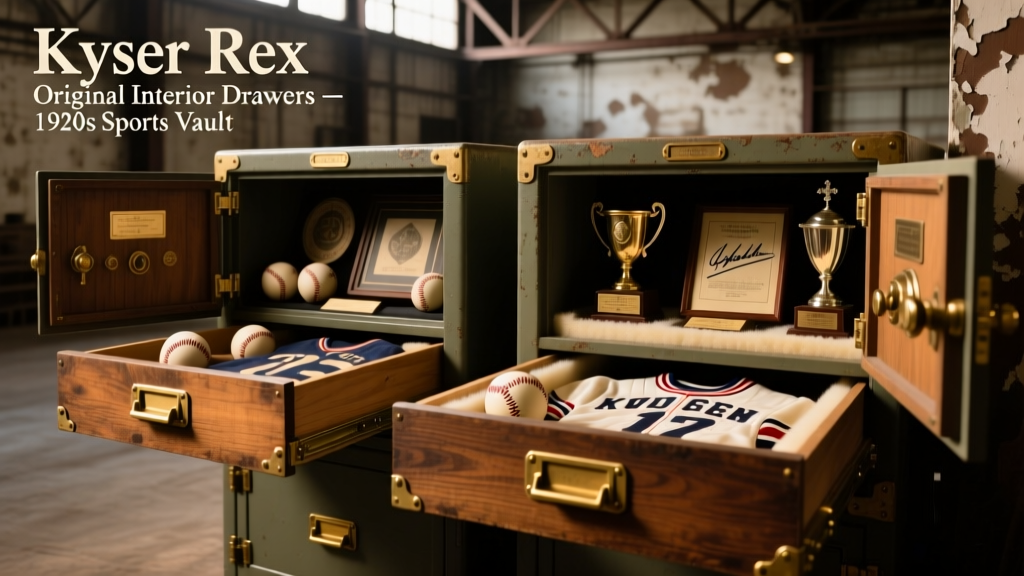
Banks Safe Security 2 Original Interior Drawers: Authentication, Provenance, and Kyser Rex Hardware Analysis
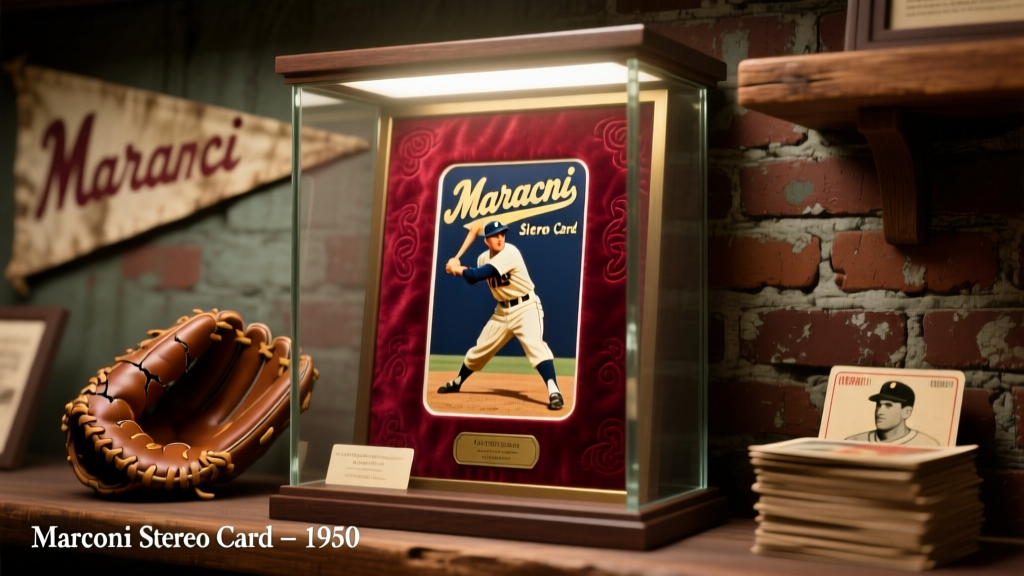
The Marconi Stereo Card: A Collector’s Guide to Authenticating and Valuing a Mid-Century Audio Artifact
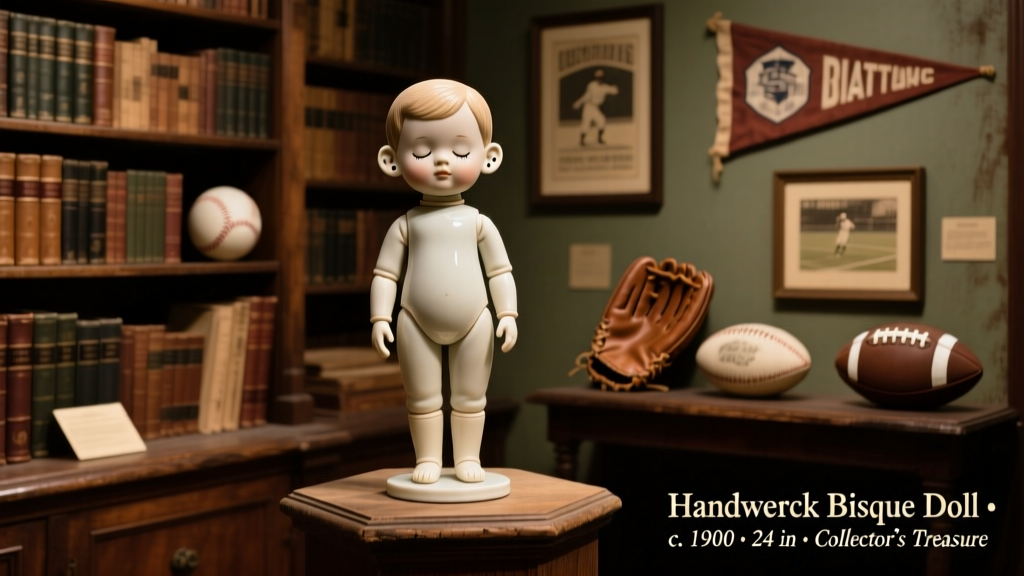
Doll Handwerck Bisque Composition Sleep Eyes 4 Teeth Pierced Ears c. 1900 — A Detailed Authentication & Historical Analysis
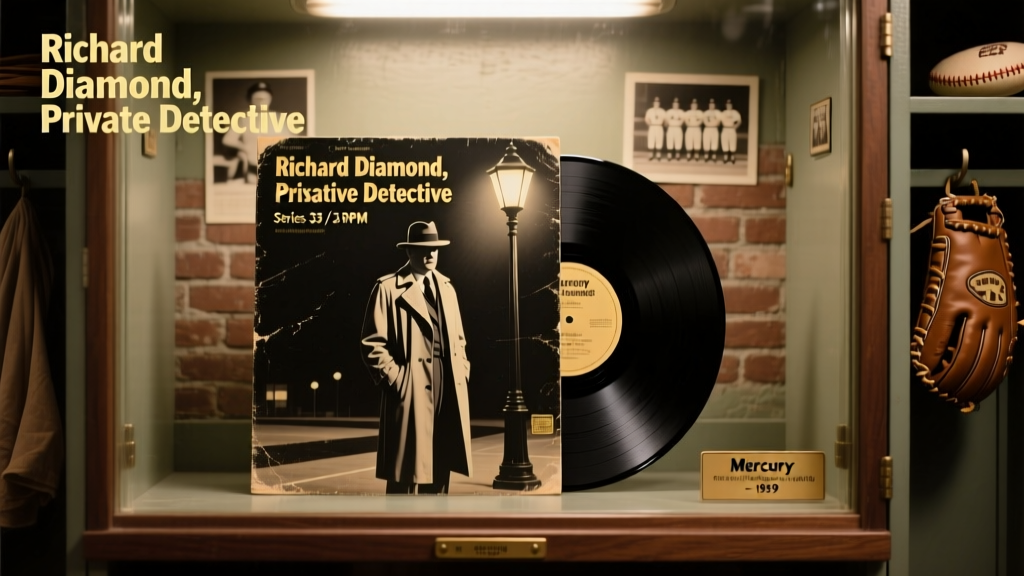
Richard Diamond, Private Detective: The 1959 Mercury Records Album — A Collector’s Deep Dive into Vinyl, Television History, and Authenticity
The 5 1/2-Inch Vintage Amusement Park Toy Set: Octopus Ride, Merry-Go-Round, Kiddy Train & Bumper Cars — Authentication, History, and Collectibility
Garland Motor Car Company 1926 Pontiac, Michigan Paper Catalog: A Rare 75-Page Artifact from the Dawn of American Automotive Retail
Royal Doulton Animal Dog Collie HN 1057: Identification, History, and Authentication Guide for Collectors