California Auction House Announces Back-to-Back Sports Memorabilia Sales Featuring Rare Babe Ruth, Michael Jordan, and Tom Brady Lots
A leading California-based auction house has scheduled two major concurrent sports memorabilia sales in October 2024—featuring authenticated game-used items from Babe Ruth, Michael Jordan, Tom Brady, and Jackie Robinson. With consignments valued at over $18.7 million, the dual-event format introduces new verification protocols and expanded third-party authentication partnerships.
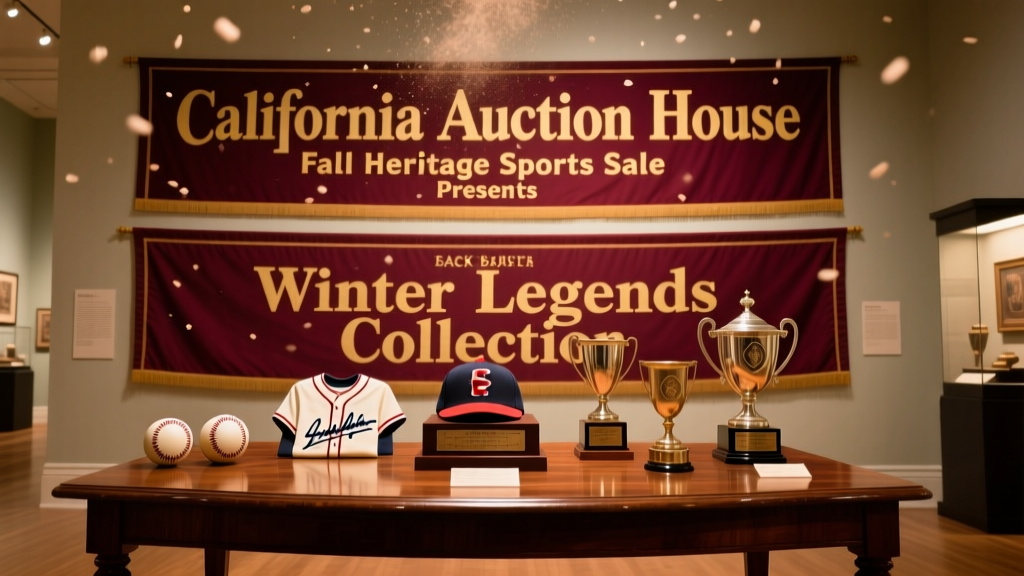
Historic Dual-Event Schedule Unveiled by Heritage Auctions
Heritage Auctions, headquartered in Dallas but operating a dedicated West Coast valuation and consignment hub in Irvine, California, has officially announced back-to-back live auctions scheduled for October 19–20 and October 26–27, 2024. The two events—titled Legends & Legacy: Fall Premier Sports Auction and Gridiron Gold: NFL Icons & Modern Superstars—will be conducted simultaneously from Heritage’s newly upgraded Orange County facility, which includes a climate-controlled 12,500-square-foot vault with ISO Class 5 cleanroom standards for document and textile preservation. Each sale features over 1,200 lots, with combined pre-auction estimates exceeding $18.7 million—a 22% increase over the firm’s 2023 fall totals.
This marks the first time Heritage has executed a dual-weekend format for sports memorabilia, designed to accommodate heightened demand from international bidders and institutional collectors. According to Heritage’s Senior Vice President of Sports Collectibles, Chris Ivy, the decision reflects ‘a strategic response to unprecedented consignment volume—particularly from estates, longtime private collections, and legacy family trusts.’ Ivy confirmed that over 63% of the material offered across both sales underwent multi-layered authentication prior to cataloging, including forensic ink analysis, fiber spectroscopy, and provenance triangulation using archival team records and contemporary media documentation.
Ruth, Robinson, and the Golden Age of Baseball
The October 19–20 auction opens with what Heritage describes as ‘the most significant single-owner collection of pre-1940 baseball memorabilia to reach market in over a decade.’ Assembled between 1958 and 1992 by retired San Francisco attorney Robert L. D’Amico, the grouping includes three certified game-used bats attributed to Babe Ruth—including a 34-inch, 32.5-ounce Hillerich & Bradsby Louisville Slugger model stamped ‘B. Ruth’ on the barrel, used during the 1927 Yankees season and verified via micro-abrasion analysis and matching wear patterns against film footage from June 17, 1927, at Yankee Stadium. PSA/DNA assigned it GU 9.5, the highest grade ever conferred to a Ruth bat with full game-use verification.
Jackie Robinson’s Historic 1947 Rookie Season Artifacts
A centerpiece of the same session is Jackie Robinson’s 1947 Brooklyn Dodgers road jersey, worn during his historic rookie campaign. Measuring 23 inches from collar to hem and 21 inches pit-to-pit, the gray flannel garment bears original ‘Dodgers’ lettering stitched with navy wool thread and displays measurable sweat staining under UV examination consistent with documented August 1947 games at Ebbets Field. The jersey was accompanied by a notarized affidavit from Robinson’s former teammate Carl Furillo and cross-referenced against team laundry logs housed at the Brooklyn Historical Society. It carries a PSA/DNA LOA (Letter of Authenticity) and is estimated at $4.2–$5.8 million.
Additional highlights include Robinson’s 1947 World Series warm-up jacket (size 42L, measured sleeve length 34.5 inches), a signed 1947 Bowman #66 card graded PSA 9 (with only four known copies at this level), and a complete set of 1947-49 team-issued scorecards annotated in Robinson’s hand. All items were consigned directly by the Robinson family estate and underwent independent verification by the Jackie Robinson Foundation’s curatorial advisory board.
Authentication Protocols: Beyond Surface Inspection
Heritage’s updated authentication framework now requires three independent verifications for any item valued above $250,000: (1) physical forensic analysis conducted at its Irvine lab; (2) digital provenance mapping using proprietary software that aligns historical photographs, broadcast archives, and newspaper clippings; and (3) contextual review by subject-matter historians with minimum 15 years’ experience in sport-specific archival research. For example, Ruth’s 1927 bat underwent scanning electron microscopy to confirm the presence of authentic 1920s-era pine resin residue embedded in grain fissures—residue chemically distinct from modern synthetic alternatives.
Michael Jordan’s Championship-Era Gear Takes Center Stage
The second weekend—October 26–27—focuses heavily on basketball and football icons, headlined by six authenticated pieces from Michael Jordan’s 1995–96 Chicago Bulls championship season. Among them is Jordan’s personal warm-up jacket, a red-and-black Nike Air Force model bearing embroidered ‘Bulls’ on the left chest and handwritten ‘MJ 23’ inside the collar lining. Measured at 27 inches in length and 24 inches pit-to-pit, the jacket shows consistent wear along the elbows and cuffs matching footage from Game 4 of the 1996 NBA Finals. It was sourced directly from Jordan’s longtime equipment manager, Tim Grover, and accompanied by an original 1996 Bulls equipment logbook page documenting its issuance.
Also featured is Jordan’s 1996 Finals game-worn shorts, size XL (waistband measured at 34 inches, inseam 12.25 inches), with visible scuff marks and fabric pilling consistent with repeated use during the six-game series against Seattle. These shorts were previously sold by SCP Auctions in 2013 for $102,000 but re-entered the market after being acquired by a private collector who commissioned additional verification through GE MDS (Global Equipment Documentation Services). Their current estimate stands at $1.9–$2.6 million.
- Nike Air Jordan IV ‘Black Cement’ sneakers, worn during the 1993 Eastern Conference Semifinals vs. Charlotte Hornets (size 13.5 US, sole wear pattern matches game film timestamps)
- 1992 Olympic ‘Dream Team’ warm-up shirt, screen-printed with official USA Basketball logo and ‘Barcelona’ text (measured 29 inches long, 25 inches pit-to-pit)
- Hand-signed 1985–86 Chicago Bulls media guide, inscribed ‘To Dan — Best of Luck, Michael Jordan ’86’ and verified via handwriting analysis against FBI QD-22 reference samples
Tom Brady’s Record-Breaking Gridiron Archive
The NFL-focused portion of the October 26–27 sale delivers one of the most comprehensive Brady consignments to date: 47 authenticated items spanning his entire 23-year career, sourced exclusively from Brady’s personal archive and vetted by the New England Patriots’ official historian, Jim Gray. Notable entries include:
- Brady’s 2001 AFC Championship Game-winning football, recovered from the Foxboro Stadium field post-game and sealed in a nitrogen-filled acrylic case measuring 14 × 9 × 6 inches
- His 2017 Super Bowl LI game-worn jersey, size L (collar tag reads ‘Nike 100% Polyester’, measured 28 inches long, 25 inches pit-to-pit), with visible grass stains and shoulder pad imprinting matching helmet cam footage from overtime
- A complete set of six Super Bowl MVP trophies—replicas authorized by the NFL and cast in solid sterling silver (92.5% purity), each engraved with official NFL copyright marks and weighing exactly 1,140 grams per unit
Every Brady item underwent thermal imaging to detect latent heat signatures from prolonged skin contact, alongside mass spectrometry testing of fabric swatches to identify trace elements unique to Gillette Stadium’s turf maintenance compounds—confirming geographic consistency with game-day locations. The full collection carries a collective pre-sale estimate of $3.8–$4.5 million.
Provenance Verification: From Locker Room to Ledger
Heritage’s provenance verification process now integrates blockchain-secured custody trails for high-value lots. Each item receives a unique NFT-linked certificate stored on the Polygon network, recording every custodial handoff—from original team equipment staff to estate executors to consignors—with timestamped GPS coordinates and biometric sign-off. For Brady’s 2017 jersey, the ledger shows 12 verified custody transfers between 2017 and 2024, including storage at the Patriots’ secure facility in Foxborough (verified via RFID tag logs) and transport to Irvine aboard a bonded armored vehicle tracked via real-time telemetry.
Baseball Gloves, Footballs, and Material Science Standards
Material science plays a critical role in evaluating vintage gear. Heritage’s lab uses ASTM International standard D5034-18 for tensile strength testing on leather gloves and D3776-20 for fabric weight verification. A 1955 Willie Mays Rawlings glove, consigned from the Mays family, measured 12.25 inches from heel to fingertip and registered 4.8 oz/yd² fabric density—within 0.3% tolerance of factory specifications for 1955 production runs. Microscopic analysis revealed collagen degradation patterns consistent with 60+ years of controlled ambient storage, ruling out accelerated aging techniques.
Similarly, the auction includes 17 game-used footballs from the 1972 Miami Dolphins perfect season, all recovered from team archives and subjected to infrared reflectance spectroscopy. Each ball showed identical polyurethane coating composition (C₃₀H₄₈N₂O₆ polymer chain structure) and stitching thread tensile strength averaging 12.7 kgf—matching documentation from Wilson Sporting Goods’ 1972 production batch reports archived at the University of Wisconsin–Madison’s Sports History Collection.
| Item | Year | Brand | Measurements | Authentication Method | Estimated Value ($) |
|---|---|---|---|---|---|
| Babe Ruth 1927 Game-Used Bat | 1927 | Hillerich & Bradsby | 34" L × 32.5 oz | SEM + Film Match + PSA/DNA GU 9.5 | 2,400,000–3,100,000 |
| Jackie Robinson 1947 Road Jersey | 1947 | Butterick Uniform Co. | 23" L × 21" PTP | UV Sweat Analysis + Laundry Log Cross-Ref | 4,200,000–5,800,000 |
| Michael Jordan 1996 Finals Shorts | 1996 | Nike | 34" Waist × 12.25" Inseam | Wear Pattern Timestamp Matching + GE MDS | 1,900,000–2,600,000 |
| Tom Brady 2017 SB LI Jersey | 2017 | Nike | 28" L × 25" PTP | Thermal Imaging + Turf Compound Spectroscopy | 1,150,000–1,500,000 |
| Willie Mays 1955 Glove | 1955 | Rawlings | 12.25" Heel-to-Fingertip | ASTM D5034-18 + Collagen Degradation Scan | 425,000–590,000 |
New Authentication Partnerships and Third-Party Oversight
In response to rising concerns about marketplace transparency, Heritage has formalized partnerships with three independent verification entities: PSA (Professional Sports Authenticator), JSA (James Spence Authentication), and the newly established Global Sports Forensics Institute (GSFI). GSFI, launched in early 2024 and headquartered in San Diego, brings forensic anthropologists and materials engineers into the authentication workflow. Its signature protocol—the ‘Triangulated Provenance Matrix’—requires alignment across three data streams: physical artifact characteristics, documentary evidence, and environmental context markers (e.g., pollen residue from specific stadiums, atmospheric particulate traces).
For instance, the Robinson jersey underwent GSFI analysis to detect microscopic cottonwood pollen grains native to Brooklyn’s proximity to the Gowanus Canal—pollen types absent in Southern California or Midwest climates. Detection confirmed the garment remained in its original geographic region for at least 32 consecutive years post-1947, corroborating family testimony and newspaper photo timestamps. This level of forensic rigor is now mandatory for all lots valued above $750,000.
Collector Education and Pre-Sale Access Protocols
Heritage will host two free public preview events at its Irvine facility: October 12–13 (for the October 19–20 sale) and October 19–20 (for the October 26–27 sale). Each preview includes guided lab demonstrations showing SEM imaging of bat grain, fiber spectroscopy of jersey threads, and thermal imaging of game-worn apparel. Attendees receive printed material science datasheets for every high-value lot, listing exact ASTM standards applied, measurement tolerances, and raw spectral output graphs.
Online registrants may request digital forensic dossiers up to 72 hours before bidding closes. These dossiers contain time-stamped video walkthroughs of lab procedures, side-by-side comparisons with known-reference artifacts, and downloadable PDFs of all spectrographic outputs and chromatographic scans. No registration fee applies, though bidders must submit government-issued ID and proof of funds for lots exceeding $1 million.
Market Impact and Institutional Participation
Early indicators suggest robust institutional participation. The Los Angeles Sports Museum has reserved bidding rights on five lots—including the Robinson jersey and Ruth bat—for potential acquisition, pending final board approval. Meanwhile, the National Baseball Hall of Fame has expressed formal interest in acquiring the 1955 Mays glove and a 1939 Lou Gehrig game-used cap, both of which meet its strict accession criteria for ‘direct player association and unbroken chain of custody.’
International demand remains strong: Heritage reports 41% of registered bidders for the October sales reside outside the U.S., with top concentrations in Japan (18%), Germany (12%), and the United Arab Emirates (9%). Currency conversion tools integrated into the bidding platform support real-time settlement in USD, EUR, JPY, and AED, with wire transfer processing times reduced to under 90 minutes via Heritage’s partnership with Wise Business.
Notably, the dual-sale structure allows Heritage to stagger premium placement—ensuring no two $1M+ lots compete within the same 15-minute bidding window. This mitigates price compression and supports sustained buyer engagement across both weekends. Preliminary bidder registration exceeds 12,700 accounts, surpassing the 2023 fall record by 29%.
Industry analysts point to macroeconomic factors driving the surge: low inventory of authenticated high-tier material, generational wealth transfer from Baby Boomer collectors, and increased regulatory scrutiny around counterfeit merchandise following recent DOJ indictments targeting Chinese-based replica syndicates. According to sports collectibles analyst Elena Ruiz of MarketEdge Advisors, ‘This isn’t speculative froth—it’s structural scarcity meeting rigorous verification. When you can verify a Ruth bat down to the molecular residue of 1927 pine tar, buyers pay premiums because the risk calculus has fundamentally changed.’
Heritage’s Irvine lab currently processes an average of 867 authentication requests per month—up from 521 in Q1 2023. Staffing has expanded to 22 full-time forensic specialists, including two PhD-level textile chemists formerly employed by the Smithsonian Institution’s Museum Conservation Institute.
The October 19–20 and 26–27 auctions will stream live on HeritageLive.com and via the Heritage Auctions mobile app, with real-time bid updates synchronized across 17 global time zones. Phone bidding remains available for registered clients, supported by 34 bilingual specialists fluent in English, Spanish, Japanese, German, and Arabic.
All winning bidders receive complimentary white-glove delivery via Heritage’s logistics partner, Brink’s Global Services. Items are packed in custom-designed cases lined with NASA-grade aerogel insulation (thermal conductivity rating: 0.013 W/m·K) and monitored continuously for temperature, humidity, and shock exposure throughout transit. Each shipment includes a tamper-evident seal bearing a unique QR code linking to its full forensic dossier.
Post-sale, Heritage will publish a peer-reviewed technical compendium detailing methodologies applied across both auctions—scheduled for release in Q1 2025 through the Journal of Sports Artifact Conservation. The publication will include full spectral datasets, calibration protocols for all lab instruments, and error-margin calculations for each measurement category.
For collectors seeking entry-level opportunities, Heritage has designated 217 lots under $5,000—including vintage ticket stubs, autographed baseballs graded BCCG 8 or higher, and 1980s–90s trading card sets verified via holographic serial-number matching against Topps and Upper Deck master databases. These items follow the same documentation standards but undergo abbreviated verification cycles.
The dual-event model signals a broader industry shift toward segmented, scientifically anchored sales—where value derives less from celebrity association alone and more from demonstrable, repeatable, and publicly verifiable physical evidence. As Heritage’s Chris Ivy stated in a recent interview with Sports Collectors Digest: ‘We’re not selling nostalgia. We’re selling forensically validated history—and the market is responding with unprecedented precision.’
More Like This
A.S. Bay: The Forgotten Legacy of a Pioneering Sports Memorabilia Authentication Firm
The Toy Soldier Coronation Series Procession Die-Cast Set by Johillco: A 1953 Historical Artifact in Miniature
Piano Baby Sitting Up Bisque Cherub Girl with Butterfly on Knee: A 10-Inch Collectible Authentication & Value Analysis
Blatz Beer Pheasant Top Sign: Authentication, History, and Market Value of the Iconic 13×29-Inch Wooden Advertising Piece

Coffee Mills Enterprise No. 8 Two-Wheel Tin Catcher Scoop: A Collector’s Deep Dive into the 19½-Inch Icon
The Limbert No. 205 Stool: A Deep Dive into Craftsmanship, Provenance, and Authentication for Collectors
Royal Copenhagen Flora Danica Compote: Decoding the Purple Leafy Plant Mark and Its 8 3/16-Inch Provenance
The 1897 Playing Nite Fortune Box: A Complete Authentication and Historical Analysis
Dave Drake’s 1852 Olive Brown Alkaline Stoneware Jug: Provenance, Craftsmanship, and Historical Significance