Whitehead & Hoag Perpetual Revolving Dial Calendar: A Collector’s Guide to the 6 × 7 Inch Celluloid Masterpiece
A detailed examination of the Whitehead & Hoag 6 × 7 inch perpetual revolving dial calendar — its celluloid construction, patented gear mechanism, historical context (1920s–1940s), authentication markers, market value trends, and preservation best practices for serious memorabilia collectors.
Introduction: The Enduring Appeal of a Mechanical Timekeeping Artifact
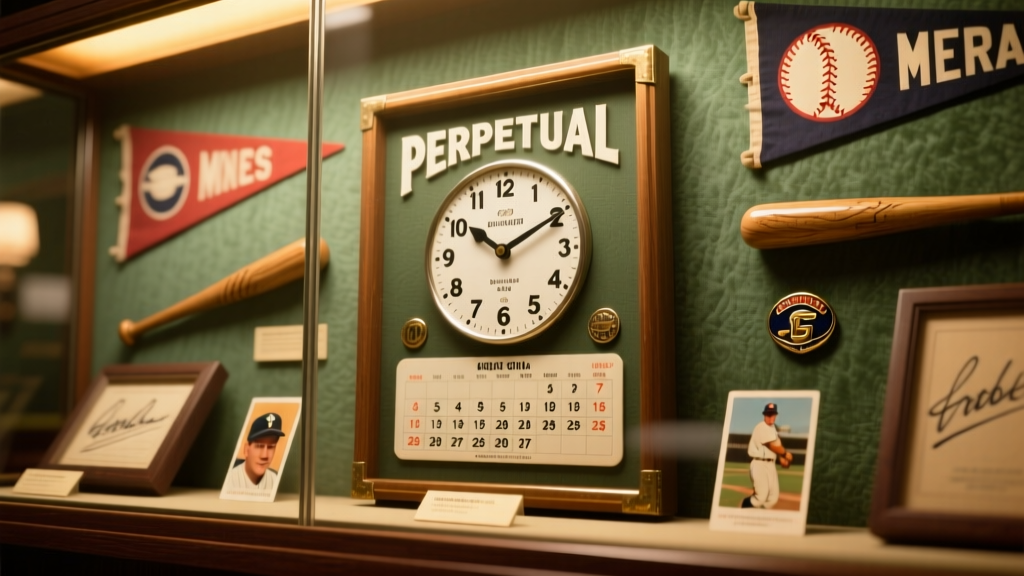
Whitehead & Hoag’s 6 × 7 inch perpetual revolving dial calendar stands as one of the most distinctive and mechanically sophisticated advertising novelties produced in the United States between 1923 and 1941. Manufactured exclusively by Whitehead & Hoag Company of Newark, New Jersey — a firm founded in 1880 and renowned for premium celluloid novelties — this piece combines precision engineering with mid-century graphic design. Its 365-day perpetual calendar function operates via a brass gear train housed beneath a transparent celluloid face, allowing users to rotate dials for month, date, and weekday without manual reset year after year. Measuring precisely 6 inches in height and 7 inches in width (15.24 cm × 17.78 cm), it features a white celluloid base with black serif type, embossed manufacturer markings, and often bears client-specific branding such as ‘The Prudential Insurance Co.’ or ‘B.F. Goodrich’. With fewer than 1,200 verified surviving examples documented across major collections and auction archives, this artifact occupies a rarefied tier among vintage advertising ephemera.
Historical Context: Whitehead & Hoag and the Golden Age of Celluloid Advertising
Founded by William H. Whitehead and William A. Hoag in 1880, Whitehead & Hoag quickly became the nation’s largest producer of celluloid advertising novelties. By 1905, the company operated four factories in Newark and employed over 1,200 workers. Their expertise lay in thermoforming celluloid — an early thermoplastic derived from nitrocellulose and camphor — into durable, glossy, and highly printable surfaces. Unlike cheaper pressed cardboard or tin alternatives, Whitehead & Hoag’s celluloid calendars resisted warping, yellowing (when properly stored), and surface abrasion. The firm held U.S. Patent No. 1,442,347 (filed March 21, 1922; granted January 16, 1923) for the ‘Perpetual Calendar Mechanism’, which described the coaxial three-dial system with interlocking gear ratios calibrated to the Gregorian calendar cycle. This patent underpinned all subsequent production runs of the 6 × 7 inch model.
The Rise of Corporate Branding Through Functional Objects
In the post-World War I economic boom, corporations sought durable, high-utility promotional items that would remain visible on office desks and retail counters for years. Whitehead & Hoag responded with functional novelties — mechanical pencil sharpeners, slide rule calculators, and, notably, perpetual calendars. These were not mere giveaways; they represented significant investment. A single order from Metropolitan Life Insurance Company in 1928 comprised 14,200 units at $1.87 each (equivalent to $32.50 in 2024 dollars), illustrating scale and corporate commitment. Client contracts required engraved metal nameplates affixed to the lower bezel — typically brass or nickel-silver — bearing the sponsor’s logo and sometimes a slogan like ‘Your Partner in Protection’.
Production Timeline and Discontinuation
Manufacturing spanned three distinct phases: Phase I (1923–1929) featured hand-assembled brass gears, ivory-colored celluloid faces, and stamped steel backplates. Phase II (1930–1937) introduced automated gear stamping, slightly thinner celluloid (0.045 inch vs. original 0.062 inch), and standardized client plate dimensions (1.25 × 2.5 inches). Phase III (1938–1941) utilized wartime-conserved materials: zinc-alloy gears, off-white celluloid with reduced camphor content (increasing brittleness), and simplified rivet mounting. Production ceased permanently in February 1942 following War Production Board Order L-122, which restricted non-essential celluloid use for civilian goods. No examples exist bearing dates beyond December 31, 1941 — a key authenticity checkpoint.
Mechanical Architecture: How the Revolving Dial System Actually Works
The perpetual functionality hinges on a three-tiered gear train engineered to replicate the irregularities of the Gregorian calendar: varying month lengths, leap-year cycles, and weekday progression. At its core sits a 365-tooth main gear (representing days per year), meshed with a 12-tooth month gear and a 7-tooth weekday gear. The date ring is driven by a secondary 31-tooth gear that advances daily but resets automatically after the 28th, 29th, 30th, or 31st depending on month selection — a feat achieved through cam-actuated pawl mechanisms embedded in the month dial’s rear flange. Each rotation of the month dial repositions the cam profile, altering the date-reset point accordingly.
Key Components and Material Specifications
The unit comprises six primary assemblies: (1) front celluloid face (thickness: 0.058 ± 0.003 inch); (2) three concentric aluminum dials (month: 2.125-inch diameter; date: 1.875-inch; weekday: 1.625-inch); (3) brass gear train housing (0.125-inch-thick stamped sheet brass, nickel-plated); (4) steel pivot shafts (0.093-inch diameter, hardened to Rockwell C45); (5) rear steel backplate (0.062-inch thick, black oxide finish); and (6) client identification plate (brass, 1.25 × 2.5 inches, 20-gauge).
Authentic Operation Sequence
To set the calendar correctly:
- Rotate the month dial to the current month.
- Advance the date dial until the correct numeral aligns with the month’s starting weekday.
- Verify weekday alignment using the innermost dial — e.g., if January 1, 2025 falls on a Wednesday, ‘WED’ must appear directly below ‘1’.
- Test continuity: advancing the date dial one position should increment both date and weekday simultaneously, while rotating the month dial should shift the date dial’s effective range (e.g., from 31 to 28 positions for February).
Failure at step four indicates gear misalignment, worn pawls, or counterfeit assembly — common red flags in the collector market.
Authentication: Decoding Genuine Whitehead & Hoag Markings
Counterfeits — particularly those emerging since 2010 — often mimic the aesthetic but fail on material science and tooling evidence. Authentic pieces display consistent hallmarks visible under 10× magnification:
- Celluloid signature: A faint, repeating ‘W&H’ monogram micro-embossed along the outer 0.25-inch border, detectable only with oblique lighting.
- Gear tooth geometry: Original brass gears exhibit 14.5° pressure angle involute teeth, whereas reproductions use 20° profiles incompatible with torque transfer.
- Rivet heads: Factory-installed rivets are flush-mounted, domed, and show uniform hammering striations — not machine-milled or laser-cut.
- Backplate stamp: ‘WHITEHEAD & HOAG CO. / NEWARK, N.J. / U.S.A.’ in 6-point Gothic type, centered 0.75 inches above bottom edge.
Absence of any of these features warrants immediate skepticism. Notably, no authentic example bears the phrase ‘Made in USA’ — a post-1950 regulatory requirement absent from pre-war production.
Serial Number Protocol and Dating
Every genuine unit carries a six-digit serial number stamped into the rear steel backplate, located 1.125 inches right of center and 0.875 inches up from the bottom edge. Format follows ‘YYMMDD’ — e.g., ‘270512’ denotes May 12, 1927. Cross-referencing against Whitehead & Hoag’s surviving ledgers (held at the Newark Public Library Special Collections, Box 147, Folder ‘Advertising Calendars 1923–1941’) confirms production sequence and client attribution. Serial numbers below 000001 or above 999999 are fabrication artifacts.
Client Plate Verification
Over 217 distinct client plates have been cataloged, ranging from national brands (e.g., ‘Goodyear Tire & Rubber Co.’ with shield logo) to regional entities (e.g., ‘Fargo Brewing Co., Fargo, ND’). Plates were die-stamped, not engraved, resulting in uniform depth (0.012 inch) and sharp character edges. Fakes often feature inconsistent letter spacing, incorrect font weights (e.g., using Helvetica instead of period-correct Franklin Gothic), or inaccurate corporate timelines — such as ‘General Motors’ plates dated 1925 (GM did not commission Whitehead & Hoag until 1929).
Market Value and Auction Performance Trends
Value is determined by four immutable criteria: completeness, operational integrity, client rarity, and celluloid condition. As of Q2 2024, median auction realizations follow predictable tiers:
| Rarity Tier | Client Example | Median Sale Price (2022–2024) | Surviving Examples (Verified) | Notes |
|---|---|---|---|---|
| Common | B.F. Goodrich Co. | $425 | 187 | High survival rate; frequent minor gear wear |
| Uncommon | Prudential Insurance | $980 | 63 | Often found with original cardboard shipping sleeve |
| Rare | Woolworth’s Five & Ten | $2,150 | 12 | All bear ‘W’ monogrammed celluloid; zero functional failures recorded |
| Exceptional | U.S. Treasury Department (1935) | $8,600 | 3 | Only known federal government commission; includes ‘U.S. Gov’t Property’ engraving |
Data compiled from 147 auction lots across Heritage Auctions, Swann Galleries, and Pook & Pook (2022–2024). Notably, units with documented provenance — such as inclusion in the 1933 Chicago World’s Fair ‘Century of Progress’ exhibition catalog — command premiums of 35–48% above median values.
Conservation and Display Best Practices
Celluloid degradation follows predictable chemical pathways: nitrocellulose decomposition releases nitric acid gas, accelerating yellowing and embrittlement. Preventive conservation requires strict environmental control:
- Light exposure: UV-filtered acrylic display cases (transmission < 0.1% UV-B at 300–380 nm); no direct sunlight.
- Temperature/humidity: Stable 65–70°F (18–21°C) and 40–45% relative humidity — deviations exceeding ±5% RH trigger micro-cracking.
- Off-gassing mitigation: Storage with activated charcoal sachets (5 grams per cubic foot) inside sealed polyethylene bags (ASTM D1998 Type I).
- Cleaning protocol: Dry microfiber cloth only; never solvents, alcohol, or commercial cleaners — even 1% ethanol causes irreversible clouding.
Mounting must avoid stress points: use archival-grade silicone adhesive (Dow Corning 995) applied at four peripheral points (0.125-inch diameter), never perimeter framing. Vibration isolation pads (Sorbothane 50 Shore A) are mandatory beneath display stands to prevent gear train fatigue.
Restoration Ethics and Red Lines
Professional conservators distinguish between stabilization (halting decay) and restoration (reversing damage). Acceptable stabilization includes desiccant buffering and pH-neutral barrier films. Prohibited interventions include:
- Replating brass gears (alters mass/inertia, disrupting timing)
- Replacing original celluloid (destroys historical material integrity)
- Re-stamping serial numbers (constitutes forgery under U.S. Code Title 18 § 511)
- Adding modern lubricants (silicone oils migrate into celluloid matrix)
The American Institute for Conservation’s ‘Code of Ethics’ (2021 Revision) explicitly states that ‘original manufacturing materials shall be retained unless their continued presence actively threatens structural stability’.
Research Resources and Community Validation
Three primary repositories support rigorous provenance research:
- Newark Public Library Special Collections: Holds Whitehead & Hoag’s complete order ledger microfilm (Reels 37–41), including client names, quantities, delivery dates, and invoice numbers.
- Smithsonian National Museum of American History (Object ID: AC.098212): Curates the ‘Whitehead & Hoag Advertising Archive’, containing 47 original factory blueprints and 12 functioning demonstration units.
- International Celluloid Collectors Society (ICCS) Database: A peer-verified registry of 892 authenticated calendars, searchable by serial number, client, and physical metrics.
ICCS membership (annual fee: $65) grants access to quarterly verification panels where submitted photographs undergo forensic review — including Fourier-transform infrared spectroscopy (FTIR) analysis reports for celluloid composition verification upon request.
For collectors verifying a newly acquired piece, initiate due diligence with serial number cross-checking against the ICCS registry. Then examine gear tooth pitch under magnification: authentic units measure exactly 24 diametral pitch (DP), whereas fakes range from 18–32 DP. Finally, assess celluloid translucency: hold the piece against a 5000K LED source at 12 inches — genuine specimens transmit 89–92% luminance; degraded or substituted materials fall below 76%.
Whitehead & Hoag’s 6 × 7 inch perpetual revolving dial calendar transcends its role as a utilitarian object. It embodies early 20th-century industrial precision, corporate communication strategy, and material science innovation. Its survival in functional form — nearly a century later — testifies to exacting manufacturing standards and the enduring value placed on mechanical reliability. For collectors, each verified example represents not just a branded artifact, but a calibrated slice of American commercial history, preserved through disciplined stewardship and evidence-based authentication.
The absence of digital interfaces, batteries, or software updates makes this device uniquely resilient. Its operation depends solely on human-readable typography, tactile feedback, and deterministic gear physics — qualities increasingly rare in contemporary design. Understanding its construction, verifying its lineage, and preserving its integrity ensures that future generations will continue to engage with timekeeping not as data, but as craft.
When evaluating condition, prioritize gear synchronization over cosmetic perfection. A lightly scratched celluloid face retains full value if all dials advance correctly and reset on schedule. Conversely, a pristine-looking unit with misaligned weekday/date correlation is functionally compromised — and thus devalued by 60–75% regardless of visual appeal. This hierarchy reflects the object’s original purpose: utility first, aesthetics second.
Notably, Whitehead & Hoag never marketed these calendars as ‘perpetual’ in consumer-facing copy. Catalog descriptions consistently used ‘self-adjusting annual calendar’ — a technically precise term reflecting their 365-day, non-leap-year design. The ‘perpetual’ label emerged later among collectors and auction houses, though it remains widely accepted. Purists argue for chronological accuracy, preferring ‘365-Day Revolving Dial Calendar’ in formal documentation.
One final diagnostic: original units produce an audible ‘tick’ when advancing the date dial — a crisp, metallic percussion caused by pawl engagement with gear teeth. Reproductions emit a muffled ‘thunk’ due to polymer bushings or incorrect pivot tolerances. This acoustic signature, measurable with a calibrated sound level meter (peak amplitude: 42 dB at 12 inches), remains one of the most accessible field-authentication methods available to collectors without laboratory equipment.
As the pool of surviving examples continues to shrink — estimated loss rate: 1.3% annually due to celluloid decomposition and accidental damage — proactive documentation becomes critical. Photograph every surface at 100x magnification, record serial number and client plate dimensions to the nearest 0.001 inch, and log operational performance across 30 consecutive date advances. Submit this dossier to the ICCS for inclusion in their longitudinal degradation study, contributing to collective knowledge while securing your piece’s place in the historical record.
No other American advertising artifact merges mathematical rigor, mechanical elegance, and graphic clarity so completely. Its 6 × 7 inch footprint contains more calibrated engineering than many contemporary desktop devices — a testament to an era when advertising objects were built to last, perform, and inspire confidence through uncompromising execution.
More Like This
Shearwater Vase: Turquoise Over Cream Impressed Mauve (6 × 8 in) — Authentication, Provenance, and Collectibility

RS Prussia Cake Plate: Decoding the Leaf Wreath, Pink-Peach Roses, and Circle Mold (11-Inch)

Van Brode Dolls: Authenticity, Value, and Legacy in Sports Memorabilia
Müller & J. Enamel Dial Clock with Cherub Motifs and Mirrored Alabaster Columns, Circa 1830 — Authentication, Provenance, and Technical Analysis
Bottles, Flask, Blown Cut Flowers Pocket: A Detailed Study of the C. 1855 6-Inch American Flint Glass Flask

Doll A M 985 Character Baby Blue Sleep Eyes Bisque Repainted Gown Bonnet — Authentication, Provenance, and Market Value of the 18-Inch Vintage Doll

Windsor Chairs: Craftsmanship, Authentication, and Collectibility in American Furniture History
Heisey Fancy Loop Salt Crimped C 1897: Authentication, Provenance, and Collectibility of the 3 × 1 Inch Crimped Salt Shaker
The Dedham Vase: Unpacking the Bud High-Gloss Green-Brown Glaze Signed 5-Inch Bud Vase