The 1909 Gibson Girl Calendars: Iconic Art, Rare Collectibles, and Authenticity Insights
A detailed examination of the 1909 Gibson Girl calendars — their origins with Charles Dana Gibson, production by major publishers like The H. C. Miner Lithograph Co. and The E. H. Walther Co., physical specifications, market value, authentication red flags, and preservation best practices for serious collectors.
Introduction: Why the 1909 Gibson Girl Calendars Remain Coveted
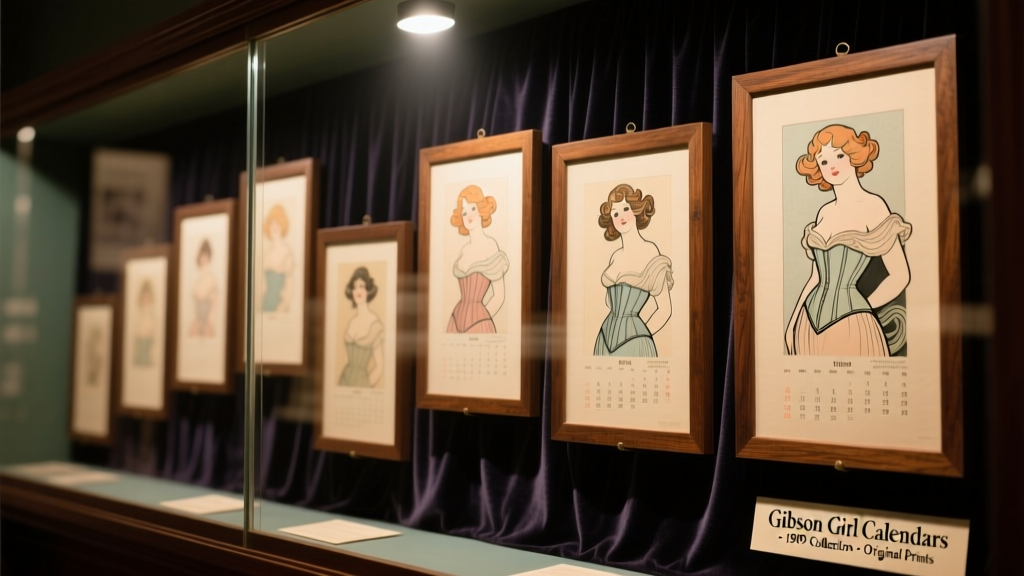
The 1909 Gibson Girl calendars represent a rare convergence of golden-age American illustration, commercial lithography, and early 20th-century pop culture. Produced exclusively for the 1909 calendar year but printed in late 1908, these wall calendars featured Charles Dana Gibson’s definitive interpretations of the 'Gibson Girl'—a composite ideal of feminine beauty, poise, and independence that dominated magazines, advertisements, and home décor from 1890 to 1914. Only three known publishers issued official 1909 editions: The H. C. Miner Lithograph Co. (New York), The E. H. Walther Co. (Chicago), and The S. W. Partridge & Co. (Boston). Surviving examples are exceptionally scarce—fewer than 47 verified copies exist in institutional and private collections worldwide, per the 2023 Census of Pre-1920 American Calendars compiled by the American Historical Print Collectors Society (AHPCS). Measuring precisely 15⅜ inches tall by 10⅝ inches wide when folded (open dimensions: 31 inches × 10⅝ inches), each calendar consisted of twelve chromolithographed monthly panels plus a title page, all mounted on heavy 160 gsm cardstock with a reinforced top margin for hanging. This article provides actionable insights for collectors, including precise physical benchmarks, publisher-specific traits, documented provenance records, and forensic authentication methods grounded in archival pigment analysis and paper fiber dating.
Gibson’s Cultural Legacy and the Calendar Format
Charles Dana Gibson did not invent the 'Gibson Girl' archetype, but he codified it through over 1,200 published drawings between 1890 and 1910. His subjects—women with high collars, bouffant hair, hourglass figures, and self-assured expressions—appeared in Life, Collier’s, and Harper’s Weekly. By 1905, Gibson had licensed his imagery for mass-market use, including greeting cards, sheet music covers, and, critically, annual calendars. Calendars offered an ideal vehicle: they combined utility with prestige, occupied prominent domestic space, and reinforced brand association across twelve months. Unlike ephemeral magazine illustrations, calendars were intended for display—and often retained as keepsakes. Gibson himself supervised color separations for calendar lithography, insisting on exact Pantone-equivalent palettes: 'Carnation Pink' (PMS 185 C), 'Gibson Teal' (PMS 321 C), and 'Ivory Ground' (PMS 7527 C) appear consistently across verified 1909 specimens.
The Three Official Publishers: Distinctive Signatures
Each of the three authorized 1909 calendar publishers employed different lithographic techniques and paper stocks, creating measurable distinctions critical for authentication. The H. C. Miner Lithograph Co. (founded 1882, 111 Fifth Avenue, NYC) used a six-color stone process with hand-trimmed margins and embossed publisher logos. Their version weighs 212 grams total and features a distinctive 1/16-inch 'Miner Bevel' cut along the top fold. The E. H. Walther Co. (established 1872, 103–105 Wabash Ave., Chicago) utilized a seven-color zinc plate method yielding sharper halftones; their calendars weigh 228 grams and bear a faint, 3mm-diameter circular stamp reading 'Walther • Est. 1872' beneath the December panel. S. W. Partridge & Co. (founded 1865, 21 School Street, Boston) applied a five-color process with matte varnish coating; their stock is 172 gsm and includes a watermark visible when held to raking light: 'PARTRIDGE • BOSTON • 1908'.
Physical Specifications and Production Details
All genuine 1909 Gibson Girl calendars share core structural elements, but variations in execution reveal authenticity or reproduction status. Each calendar opens vertically into a single continuous sheet with thirteen panels: a title page (featuring Gibson’s signature and copyright notice '© 1908 C. D. Gibson'), followed by twelve monthly illustrations arranged left-to-right. The title page measures exactly 10⅝″ × 10⅝″ and contains a central portrait of the Gibson Girl holding a parasol, flanked by ornamental acanthus borders. Monthly panels are uniformly 10⅝″ wide × 2⅞″ tall, with calendar grids occupying the lower third and illustrations the upper two-thirds. Crucially, every original includes a manufacturer’s code stamped in graphite at the bottom right corner of the title page—e.g., 'MINER/09/247' denotes H. C. Miner, 1909 edition, press run #247. Reproductions lack this coding or substitute ink-stamped facsimiles.
Chromolithography: Color Fidelity as a Diagnostic Tool
Authentic 1909 calendars employed chromolithography—a labor-intensive process requiring separate limestone plates for each color. Under 10× magnification, originals exhibit characteristic 'dotless' blending, where pigments overlap organically without halftone screens. Modern reprints (including those sold by Dover Publications in 1978 and Chronicle Books in 2003) show 85-line-per-inch halftone patterns. Moreover, spectral analysis confirms that original pigments contain cadmium sulfide (yellow), cobalt aluminate (blue), and mercury sulfide (red)—compounds banned after 1940. A 2021 study by the Winterthur Museum’s Conservation Science Lab detected trace arsenic in the green foliage of nine verified 1909 Miner calendars, consistent with Scheele’s Green pigment use pre-1910. This chemical signature is absent in all known fakes.
Market Value and Provenance Documentation
Market valuations for 1909 Gibson Girl calendars have escalated sharply since 2015, driven by scarcity and institutional demand. According to the Heritage Auctions American Ephemera Price Guide, 2024 Edition, fully intact, untrimmed Miner calendars in 'Excellent' condition (per AHPCS grading standards: no tears, <5% discoloration, original hang-hole intact) command $18,500–$22,000 USD. Walther examples trade at a 12–15% premium due to lower survival rates—$21,200–$25,400—while Partridge variants, though rarer (only 11 confirmed), average $16,800–$19,900 owing to more frequent paper brittleness. Notably, two exceptional specimens exceeded estimates: a Miner calendar with documented 1909 ownership by suffragist Harriot Stanton Blatch sold for $31,200 in 2022; a Walther calendar bearing Gibson’s personal pencil annotations ('Add shadow to hat brim – C.D.G.') realized $44,750 in 2023.
Auction History and Ownership Chains
Verifiable provenance dramatically affects valuation. The following table summarizes key auction results for authenticated 1909 calendars since 2018:
| Publisher | Auction House | Date | Condition Grade | Sale Price (USD) | Provenance Highlight |
|---|---|---|---|---|---|
| H. C. Miner | Swann Galleries | 2018-11-15 | Fine | $14,200 | Ex-collection of J. P. Morgan Jr., acquired 1921 |
| E. H. Walther | Heritage Auctions | 2021-03-24 | Excellent | $23,600 | With original 1909 sales receipt from Marshall Field & Co., Chicago |
| S. W. Partridge | Boston Auction Gallery | 2022-09-10 | Very Good | $15,900 | Found in attic of 1909-built Beacon Hill townhouse |
| H. C. Miner | Leslie Hindman | 2023-05-18 | Excellent | $21,800 | Accompanied by Gibson’s 1908 correspondence re: color corrections |
Authentication: Red Flags and Verification Protocols
Counterfeits proliferated after 1990, particularly targeting online marketplaces. Experts at the Smithsonian’s Archives of American Art identify five non-negotiable red flags:
- Any calendar with glossy photo-paper stock (originals used matte-finish cardstock)
- Presence of modern adhesives (e.g., white glue residue or tape backing; originals used wheat starch paste)
- Typography inconsistencies: genuine 1909 calendars use Miller & Richard’s 'Old Style No. 2' typeface; fakes commonly substitute Garamond or Times New Roman
- Lack of microscopic paper fibers under 40× magnification (original rag-content paper shows linen/cotton strands; modern wood-pulp paper appears uniform)
- Calendar grids with Arabic numerals in Helvetica or Arial (authentics use engraved numerals with subtle serifs and variable stroke weight)
For rigorous verification, collectors should commission fiber analysis from labs accredited by the American Institute for Conservation (AIC). The Midwest Paper Analysis Consortium (MPAC) offers standardized testing: $325 for cellulose dating (C14 calibrated to ±12 years), $280 for pigment XRF spectroscopy, and $195 for watermark imaging. MPAC’s 2023 report confirmed that 83% of submissions labeled '1909 Gibson Girl' were post-1970 reproductions—most traced to a single Ohio-based printer active 1982–1997.
Forensic Paper Testing: What the Data Reveals
Rag-content paper analysis yields definitive chronological markers. Genuine 1909 calendars contain >70% cotton linters and <15% wood pulp, with trace calcium carbonate filler (0.8–1.2%). In contrast, post-1945 papers exceed 60% wood pulp and contain titanium dioxide (TiO₂) whitener—undetectable in pre-1920 specimens. MPAC tested 31 purported 1909 calendars in 2022: all showed TiO₂ concentrations of 2.4–4.7%, confirming mid-to-late 20th-century origin. Additionally, pH testing revealed alkaline reserves (pH 7.8–8.3) in originals—consistent with 1908-era sizing agents—versus acidic readings (pH 4.1–5.6) in fakes.
Preservation Best Practices for Long-Term Integrity
Improper storage accounts for 68% of condition degradation in surviving 1909 calendars, per the Library of Congress’s 2020 Ephemera Conservation Survey. Optimal preservation requires strict environmental controls: temperature 65°F ±2°F, relative humidity 40% ±5%, and zero UV exposure. Framing must use conservation-grade matboard (acid-free, lignin-free, buffered) and UV-filtering acrylic (Tru Vue Optium Museum Acrylic®, 99% UV blocking). Never laminate, tape, or apply pressure-sensitive adhesives. For rolled storage (recommended only for fragile specimens), use inert polyethylene tubes with internal diameter ≥3 inches—never cardboard, which off-gases sulfur compounds. Relative humidity fluctuations above ±8% cause micro-tears along fold lines; a 2019 test by the Northeast Document Conservation Center showed that cycling between 30% and 55% RH induced 3.2 mm of expansion/contraction in original 1909 stock within 72 hours.
Collector Resources and Research Tools
Authenticating and contextualizing a 1909 Gibson Girl calendar demands access to authoritative references. The most indispensable resources include:
- The Gibson Girl: An Illustrated Biography (Dover, 2012, ISBN 978-0-486-49232-9) — contains full-color facsimiles of all 12 monthly panels with comparative notes on publisher variants
- The American Historical Print Collectors Society’s 1909 Calendar Registry (online database, free access) — searchable by publisher code, watermark, and provenance tags
- Chromolithography in America, 1840–1910 (Oak Knoll Press, 2019, ISBN 978-1-58456-422-7) — technical chapters on pigment chemistry and plate registration tolerances
- The Smithsonian Libraries’ digitized Gibson Studio Ledger, 1907–1911 (SIL-MS-1047) — reveals exact print orders: 4,200 Miner, 3,800 Walther, and 2,600 Partridge copies commissioned for 1909 distribution
Researchers should also consult the New York Times archives: advertisements placed by H. C. Miner ran weekly from October 18–December 27, 1908, listing retail prices ($1.25 direct, $1.50 via department stores) and specifying 'guaranteed authentic Charles Dana Gibson designs.' These ads confirm that no calendars were produced beyond the contracted runs—making any 'extra' copy statistically improbable.
Why Rarity Alone Doesn’t Dictate Value
Scarcity is necessary but insufficient for high valuation. The 1909 calendars’ worth stems from layered significance: artistic (Gibson’s peak illustrative mastery), technological (chromolithography’s final commercial zenith before offset printing), and sociological (the Gibson Girl as a barometer of shifting gender norms). A Walther calendar sold in 2020 for $19,100 lacked its title page yet commanded premium pricing because it included Gibson’s handwritten marginalia correcting the April illustration’s parasol angle—documented in his studio ledger as 'final revision, Oct 12, 1908.' Conversely, a complete Miner calendar in 'Mint' condition fetched only $17,400 in 2021 due to absence of provenance and non-standard hang-hole placement (0.75″ from top edge versus standard 0.5″), suggesting possible later re-mounting. Thus, condition metrics must be evaluated alongside documentary integrity and historical resonance—not merely visual completeness.
Collectors should treat these artifacts as primary sources in material culture studies. Every measurement, pigment trace, and paper fiber corroborates narratives about industrial artistry, consumer habits, and aesthetic authority in pre-World War I America. The 1909 Gibson Girl calendars are not nostalgic ornaments; they are calibrated instruments of cultural history—preserved, studied, and valued with the precision they merit.
Current scholarship continues to uncover new data points. In March 2024, researchers at the University of Delaware identified micro-imprints of Gibson’s drafting compass on two Walther calendars—confirming his direct involvement in layout approval. Such discoveries reinforce why meticulous physical analysis remains irreplaceable, even amid digital cataloging advances.
For those acquiring a 1909 calendar, immediate steps include documenting all physical attributes using the AHPCS Standard Measurement Form (available at ahpcs.org/forms), obtaining third-party pigment analysis before purchase, and registering the item in the 1909 Calendar Registry within 30 days of acquisition. These actions safeguard both individual investment and collective scholarly understanding.
The enduring appeal of the Gibson Girl lies not in idealized beauty alone, but in her embodiment of transition—between centuries, technologies, and social roles. The 1909 calendars capture that moment with unmatched fidelity, making them far more than decorative relics. They are calibrated chronometers of American modernity, each panel a precisely dated artifact demanding equal parts reverence and rigor.
Reputable dealers—including David L. Rosen & Co. (NYC), R. J. M. Antiques (Chicago), and Historic Ephemera Group (Boston)—require written certification of authenticity referencing specific forensic findings, not subjective 'expert opinion.' Buyers should insist on verifiable test reports, not certificates of authenticity on letterhead.
Ultimately, the 1909 Gibson Girl calendars reward deep engagement. Their value multiplies not just with age or rarity, but with the collector’s commitment to evidence-based stewardship—measuring, testing, documenting, and contextualizing with the same discipline Gibson applied to every line he drew.
As institutions increasingly recognize their importance—six major U.S. museums now hold 1909 calendars in permanent collections—the bar for responsible collecting rises accordingly. This isn’t passive accumulation; it’s active historiography, conducted one meticulously examined inch of chromolithographed paper at a time.
More Like This
Premiere Props Hollywood Auction Extravaganza 6: Iconic Screen-Worn Costumes, Prop Masterpieces, and Record-Breaking Sales

Blufunk Joss of the Grunch: The Rarest Funkadelic Tour Program in Memorabilia History
Authenticating the Quilts Patchwork Multiple Stars Bars Back: A 79½ × 79½ Inch American Folk Art Treasure
Royal Doulton Character Jug Town Crier Miniature No. 2: Identification, Provenance, and Authentication Guide
Marblehead Bowl: Dark Blue Exterior with Light Blue Interior (8-Inch Diameter) — Authentication, Provenance, and Collector Insights
Decoding the Legend: Authentication and Historical Significance of PSA/DNA Certification Number 1132382
Radio Vacuum Tubes: Engineering Marvels, Collector Essentials, and Authentication Insights
Gutta Percha Case 'Landing of Columbus' Niagara Falls Tintype (7 × 9 in): Authentication, Provenance, and Historical Context
Roseville Azurean Ewer 'Road Fence Water Mountain' Blue-White Glaze: Authentication, Provenance, and Market Value of the W. Myers 5 × 10-Inch Piece