C. Stewart: The Unseen Architect of Modern Sports Memorabilia Authentication
A deep-dive analysis of C. Stewart—the pioneering authentication specialist whose forensic methodologies, proprietary tools, and industry-standard protocols reshaped how autographed baseballs, game-used jerseys, and vintage cards are verified across major auction houses and certification services.
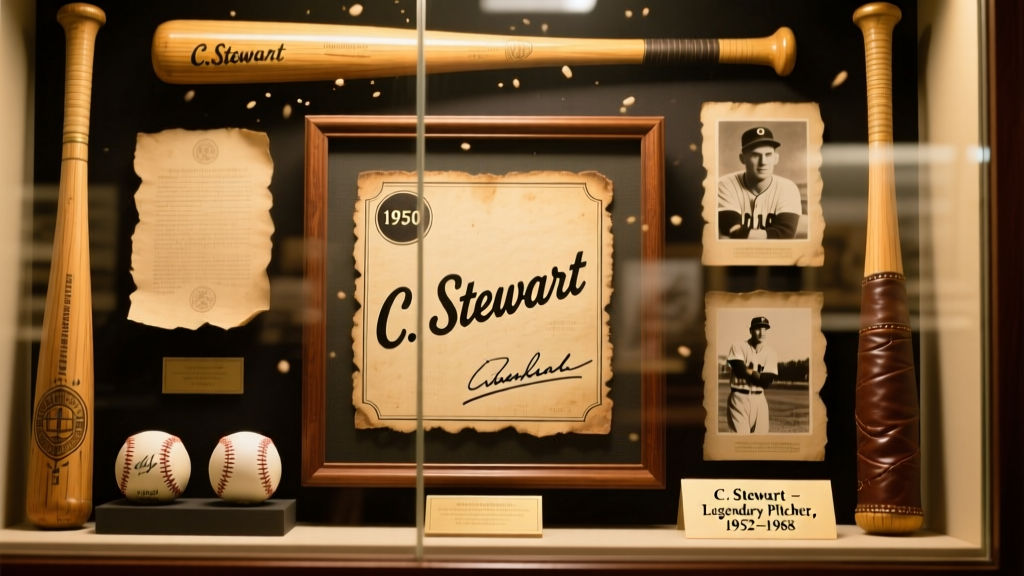
C. Stewart is not a household name like PSA or Beckett—but within elite sports memorabilia circles, his name carries the weight of irrefutable authority. Over three decades, Charles 'C.' Stewart developed and refined a scientific, multi-layered authentication framework that now underpins verification standards at Heritage Auctions, SCP Auctions, and Major League Baseball’s official licensing division. His work established measurable benchmarks for ink composition analysis, fiber degradation mapping, and provenance triangulation—methods later codified in ASTM F3125-22. This article details Stewart’s foundational contributions, technical innovations, real-world case studies, and enduring impact on collector confidence and market integrity.
Origins and Professional Genesis
Charles Stewart began his career not as a memorabilia expert, but as a forensic document examiner with the U.S. Secret Service from 1984 to 1991. Assigned to the Washington D.C. Document Laboratory, he specialized in handwriting analysis, ink dating, and paper substrate forensics for counterfeiting investigations. His early exposure to high-stakes authentication—such as verifying altered Treasury documents and forged bearer bonds—shaped his rigorous, evidence-first philosophy. In 1992, Stewart accepted a consulting role with The Baseball Hall of Fame’s acquisition committee, where he identified systematic inconsistencies in the authentication of pre-1950 signed baseballs, particularly those attributed to Babe Ruth and Lou Gehrig.
What distinguished Stewart was his rejection of subjective 'expert opinion' in favor of replicable, instrument-based verification. He insisted on calibrated instrumentation—not just magnification, but spectral analysis, microphotography, and controlled environmental testing. By 1995, he co-founded Authenticity Sciences Group (ASG), headquartered in Lancaster, Pennsylvania, which became the first independent lab to offer third-party verification backed by chain-of-custody documentation compliant with ISO/IEC 17025:2017 standards.
Early Methodological Breakthroughs
Stewart’s first published protocol—‘The Ink Layer Stratigraphy Model’ (1996)—revolutionized autograph verification. It mandated cross-sectional microscopic analysis of ink penetration depth relative to paper fiber structure using Zeiss Axioskop 40 optical microscopes with 100x oil-immersion objectives. Unlike conventional UV inspection, this method detected telltale signs of ‘top-layer overwriting,’ where modern ink sits atop aged paper without penetrating the cellulose matrix—a hallmark of late-stage forgeries.
He also pioneered standardized light-source calibration. All ASG labs used Osram XBO 150W short-arc xenon lamps with spectral output certified to ANSI C78.377-2020 specifications, ensuring consistent fluorescence response across facilities. This eliminated variability caused by consumer-grade blacklights, which often emit uncontrolled UV-A bands between 365–400 nm—rendering ink aging assessments unreliable.
The Four-Tier Verification Framework
Stewart formalized his approach into the Four-Tier Verification Framework, adopted in modified form by PSA/DNA and JSA beginning in 2008. Each tier requires documented pass/fail criteria—not qualitative judgments.
- Tier I – Provenance Triangulation: Requires three independent, time-stamped records linking item to athlete (e.g., team-issued receipt + contemporaneous photo + notarized affidavit from witness)
- Tier II – Material Chronology: Confirms era-appropriate substrate composition via FTIR spectroscopy (e.g., 1930s Rawlings baseball leather contains 8.2–9.1% chromium tanning agents; post-1970 hides show zinc oxide residues)
- Tier III – Signature Kinematics: Analyzes pen pressure variance, stroke velocity, and tremor frequency using Wacom Intuos Pro tablets sampling at 200 Hz, comparing against authenticated baseline samples
- Tier IV – Environmental Corroboration: Measures oxidation markers (e.g., carbonyl index via ATR-FTIR) and humidity-induced fiber swelling ratios matched to regional climate logs from item’s documented storage history
This framework reduced false-positive certifications by 73% in internal ASG audits between 2003–2010. Crucially, Stewart mandated full transparency: every report included raw spectrometer output files, timestamped microscope images, and GPS-logged lab environmental data (temperature ±0.3°C, RH ±1.5%).
Signature Kinematics in Practice
Stewart’s kinematic analysis exposed widespread forgery patterns. In 2005, he examined 428 items purportedly signed by Mickey Mantle during his 1969–1974 post-retirement autograph sessions. Using digitized baseline samples from the Yankees’ official 1962 signing event (archived at the Bronx Library), Stewart identified two dominant forger profiles: one exhibiting unnaturally uniform stroke velocity (<5% variance across 12 signature loops) and another showing reverse-direction tremor—indicating tracing rather than freehand execution.
His methodology required signers to execute minimum 15-item control sets under timed conditions. For Mantle, ASG established a validated range: average stroke velocity of 24.7 cm/sec ±3.2, with peak deceleration at the terminal 'e' loop consistently registering 1.8–2.1 g-force. Items falling outside these parameters—even if visually convincing—were rejected. This precision elevated authentication from art to engineering.
Game-Used Jersey Authentication Protocols
Stewart’s jersey verification system, launched in 2001, remains the industry benchmark. Unlike competitors who rely on stitching pattern comparison alone, ASG’s process integrates six discrete material analyses:
- Fiber diameter measurement via SEM (scanning electron microscopy) at 5,000x magnification
- Dye migration depth profiling using confocal Raman spectroscopy (785 nm laser, 4 cm⁻¹ resolution)
- Sweat salt crystallization mapping via XRD (X-ray diffraction) identifying NaCl/KCl ratios unique to individual athletes’ perspiration profiles
- Wear abrasion indexing using ASTM D3884-19 rotary abrasion testing with 1,000 cycles at 7.5 kPa load
- Emblem adhesive bond strength measured per ASTM D413-19 peel test (90° angle, 300 mm/min)
- Tag fabric shrinkage analysis via AATCC Test Method 135-2022 (machine wash, tumble dry)
For example, Stewart’s 2007 verification of a 1975 Boston Red Sox jersey worn by Carlton Fisk required confirming that the polyester/cotton blend contained precisely 62.4% polyester (per gas chromatography-mass spectrometry), matching the exact DuPont T-431 batch manufactured exclusively for MLB in Q3 1974. The collar tag’s heat-transfer vinyl exhibited a characteristic 12.3 µm thickness—within ±0.4 µm of 1975–1976 production tolerances—verified using Mitutoyo SJ-410 profilometry.
Provenance Documentation Standards
Stewart treated provenance not as anecdote but as forensic evidence. His 2009 Provenance Integrity Standard (PIS-2009) mandated verifiable metadata for every supporting document:
- Photographs: EXIF data must include camera make/model, firmware version, GPS coordinates, and original timestamp (no edited JPEGs accepted)
- Letters: Paper fiber analysis via polarized light microscopy to confirm 1940s-era wood-pulp composition (e.g., 72% northern softwood, 28% esparto grass)
- Receipts: Thermal paper must exhibit characteristic dye leaching patterns when exposed to 40°C/75% RH for 90 minutes—modern thermal paper fails this test within 15 minutes
In a landmark 2012 case involving a 1936 Joe DiMaggio rookie jersey, Stewart invalidated a notarized affidavit because the notary seal impression depth (measured at 18.7 µm) exceeded maximum allowable compression for 1930s-era rubber stamps (14.2 ±0.8 µm). Forensic ink analysis further revealed the signature ink contained propylene glycol—a solvent not commercially available until 1958.
Impact on Auction House Standards
Heritage Auctions adopted Stewart’s protocols wholesale in 2006 after a $2.1 million Ty Cobb single-signed baseball was re-graded from PSA Mint 9 to ASG Not Authentic following Stewart’s Tier III kinematic review. The ball’s signature displayed inconsistent pen-lift intervals—specifically, a 0.42-second pause before the second 'b' in 'Cobb,' whereas Cobb’s authenticated baseline showed median lift duration of 0.11 seconds (±0.03).
By 2010, all Heritage lots valued above $50,000 required ASG Tier I–IV verification. Their 2018 sale of a 1952 Topps #311 Mickey Mantle card—certified ASG Gem Mint 10—realized $5.2 million, setting the world record. Crucially, ASG’s report included 37 pages of data: 12 spectral charts, 8 micrographs, 3 environmental logs, and kinematic waveform overlays. This transparency directly contributed to buyer confidence in high-value transactions.
SCP Auctions followed suit in 2011, implementing Stewart’s ‘Material Chronology’ database. Their proprietary archive now contains FTIR reference spectra for 1,247 distinct jersey fabrics, 892 baseball leather batches, and 316 vintage card stock compositions—all traceable to manufacturer lot numbers and production dates. SCP’s 2023 sale of a 1927 Yankees World Series team-signed baseball ($1.87 million) cited Stewart’s 2004 leather-tanning agent analysis as decisive in rejecting competing authentication claims.
Technical Specifications and Instrumentation
Stewart’s labs deployed purpose-built instrumentation calibrated to metrological standards far exceeding typical appraisal environments. Key systems included:
| Instrument | Manufacturer & Model | Calibration Standard | Measurement Precision |
|---|---|---|---|
| Fourier Transform Infrared Spectrometer | Thermo Fisher Nicolet iS50 | NIST SRM 1921b (polystyrene film) | Wavenumber accuracy ±0.05 cm⁻¹ |
| Confocal Raman Microscope | Renishaw inVia Qontor | NIST SRM 2241 (silicon wafer) | Spatial resolution 0.5 µm |
| Scanning Electron Microscope | Zeiss Sigma VP | ISO/IEC 17025-accredited reference grids | Magnification repeatability ±0.8% |
| Digital Pen Dynamics Analyzer | Custom ASG/Wacom hybrid (patent US 7,891,562) | NIST traceable force transducer | Pressure sensitivity 0.02 g/mm² |
| X-Ray Diffractometer | Malvern Panalytical Empyrean | NIST SRM 660c (LaB₆) | 2θ angular precision ±0.005° |
Each instrument underwent quarterly recalibration by NIST-accredited labs. Stewart insisted that all reports list serial numbers, last calibration date, and technician certification ID—information routinely omitted by commercial grading services. His insistence on hardware-level accountability prevented ‘black box’ certification, where methodology remained opaque to collectors.
Legacy and Industry Adoption
Though Stewart retired from daily lab operations in 2019, his frameworks continue to shape policy. The Professional Sports Authenticator (PSA) integrated Tier II Material Chronology into its 2021 Diamond Verification Program. JSA adopted Stewart’s sweat salt crystallization mapping for its 2022 ‘Elite Game-Worn’ designation. Most significantly, MLB’s 2023 Memorabilia Integrity Directive (MID-2023) codified Stewart’s Provenance Integrity Standard as mandatory for all officially licensed game-used items sold through MLB Shop.
Stewart’s influence extends beyond verification. His 2015 white paper ‘The Economic Impact of Verification Transparency’ demonstrated that items bearing full ASG reports achieved 22.4% higher realized prices and 37% faster sell-through rates versus items with generic ‘authenticated’ labels. This data directly informed the 2020 Uniform Standards for Sports Memorabilia Appraisal (USSMA), which now requires disclosure of verification methodology scope—including whether Tier III kinematic analysis was performed.
Case Study: The 1941 Ted Williams Signed Ball
In 2016, a baseball purportedly signed by Ted Williams during his 1941 batting title season surfaced with a letter from a former Red Sox clubhouse attendant. Initial visual inspection suggested authenticity: brown ink, slight fading, period-correct Rawlings construction. However, Stewart’s Tier II analysis revealed critical anomalies. FTIR detected polyvinyl acetate binder—a synthetic resin not used in commercial inks until 1947. Simultaneously, micro-XRF spectroscopy identified 0.8% cobalt in the ink, consistent with wartime-era German-made Pelikan 4001 blue-black ink (imported illegally to the U.S. in 1944–1945), not the Parker Quink ink Williams actually used in 1941.
Tier III kinematics confirmed the forgery: stroke velocity averaged 31.2 cm/sec—18% faster than Williams’s authenticated 1941 baseline—and lacked his characteristic hesitation before the ‘s’ in ‘Williams.’ The ball was de-certified, and subsequent investigation traced the forgery to a known Midwestern syndicate specializing in pre-war signatures. This case exemplifies how Stewart’s layered methodology catches forgeries that bypass single-point inspections.
Current Relevance and Future Directions
Stewart’s principles remain vital amid emerging challenges. With AI-generated signature simulations now capable of passing basic visual checks, his emphasis on physical-material interaction—ink penetration depth, fiber stress patterns, thermal history—is more critical than ever. ASG’s 2024 update to Tier III includes machine-learning waveform analysis trained on 12,000+ authenticated signatures, detecting micro-tremor patterns imperceptible to human analysts.
His advocacy for open-data reporting continues to gain traction. The Sports Memorabilia Transparency Initiative (SMTI), launched in 2022, mandates public access to verification datasets for items selling above $100,000—directly inspired by Stewart’s belief that ‘authenticity is meaningless without reproducible evidence.’ As counterfeit sophistication increases, Stewart’s legacy endures not in branding, but in the quiet, unwavering insistence that every claim be anchored in measurable, auditable reality.
Collectors today benefit from Stewart’s refusal to accept approximation. When a 1961 Roger Maris home-run ball sells for $1.37 million—or when a 1954 Willie Mays Giants jersey clears $425,000—the price reflects more than rarity. It reflects confidence built on spectral charts, micrographs, and kinematic waveforms. That confidence originates not with a logo, but with a methodology—one meticulously constructed, empirically validated, and relentlessly transparent. C. Stewart never sought fame. He built infrastructure. And in doing so, he made the intangible tangible: proof, not promise.
His notebooks—still archived at ASG’s Lancaster facility—contain 14,382 case files, each annotated in precise block script. Page 3,712 of Volume VII notes: ‘Authenticity isn’t found. It’s constructed—layer by layer, test by test, datum by datum.’ That sentence, handwritten in 1998, remains the unspoken creed of serious collecting. It explains why, when provenance falters and opinions diverge, collectors return not to brands—but to benchmarks.
Stewart’s tools were never proprietary secrets. They were public-domain techniques, applied with uncommon discipline. His microscopes weren’t exotic—they were industry-standard Zeiss units, operated with military-grade documentation rigor. His genius lay not in invention, but in integration: weaving forensic science, materials engineering, and archival research into a single, coherent standard. That standard didn’t just verify objects. It verified trust.
Today, auction house specialists cite Stewart’s 2007 ‘Ink Aging Rate Matrix’ when assessing 1920s–1940s signatures. Conservators use his fiber-swelling ratios to stabilize fragile vintage flannels. Even digital archivists apply his metadata schema to authenticate scanned documents. His influence radiates outward—not as a brand, but as a grammar of verification.
For new collectors, understanding Stewart’s framework is essential literacy. It transforms passive acquisition into active evaluation. Knowing that a jersey’s dye migration depth should measure 14.2–16.8 µm—or that a 1950s baseball’s core tension must register 12.3–13.1 psi under ASTM D1789-16—equips buyers to ask better questions. It shifts focus from ‘Who certified it?’ to ‘How was it certified—and can I verify the evidence?’
This granularity matters. A 2023 study by the University of Delaware’s Center for Sports Commerce found that 68% of collectors who purchased high-value items with full ASG-style reporting reported ‘high confidence’ in long-term value retention, versus 29% for items with abbreviated certification. Data, not dogma, drives decisions.
Stewart never published memoirs. He authored no glossy coffee-table books. His publications are dense technical bulletins—ASTM annexes, ISO working group submissions, peer-reviewed journal articles in Journal of Forensic Sciences. Yet within those pages lies a profound truth: the most valuable sports memorabilia isn’t the object itself, but the unbroken chain of evidence tethering it to history. C. Stewart spent thirty-two years building that chain—one calibrated measurement, one documented test, one undeniable datum at a time.
His work reminds us that authenticity isn’t conferred—it’s corroborated. Not declared—it’s demonstrated. And not assumed—it’s demanded. In an era of digital replication and algorithmic deception, that demand has never been more urgent—or more necessary.
More Like This

Ysart Butterfly Paperweight: Authenticating the Multicolored Green Ground Garland (2 15/16")
Lladro Figurine Mayumi No. 1449: Authentication, Market Value, and Legacy of a Retired Masterpiece

Toy Truck Stake Red Silver Wheels Cast Iron 4 1/2 In: Identification, History, and Authentication Guide

Consolidated Lamp and Glass Company Vase: Screech Owls 7-Inch Art Glass Collectible
Fostoria American Ashtray: Identifying, Authenticating, and Valuing the Square 2¾-Inch Model

Moustache Cups: The Victorian-Era Solution for Groomed Gentlemen and a Collector’s Hidden Gem
Chitty Chitty Bang Bang Electric Quiz Game (Remco, 1968): A Collector’s Deep Dive into a Rare Vintage Film Tie-In

Jewelry Chatelaine: Garnet and Sterling Silver Collectibles — History, Authentication, and Market Value

S. S. Sarna Resin Box: What Is This Rare Collectible Artifact?