Buffalo Pottery Bluebird Cup and Saucer: History, Identification, and Collector Insights
A detailed examination of the iconic Buffalo Pottery Bluebird cup and saucer—its origins at the Larkin Company, production timeline (1905–1956), design evolution, hallmark variations, measurable specifications, and authentication criteria for collectors and appraisers.
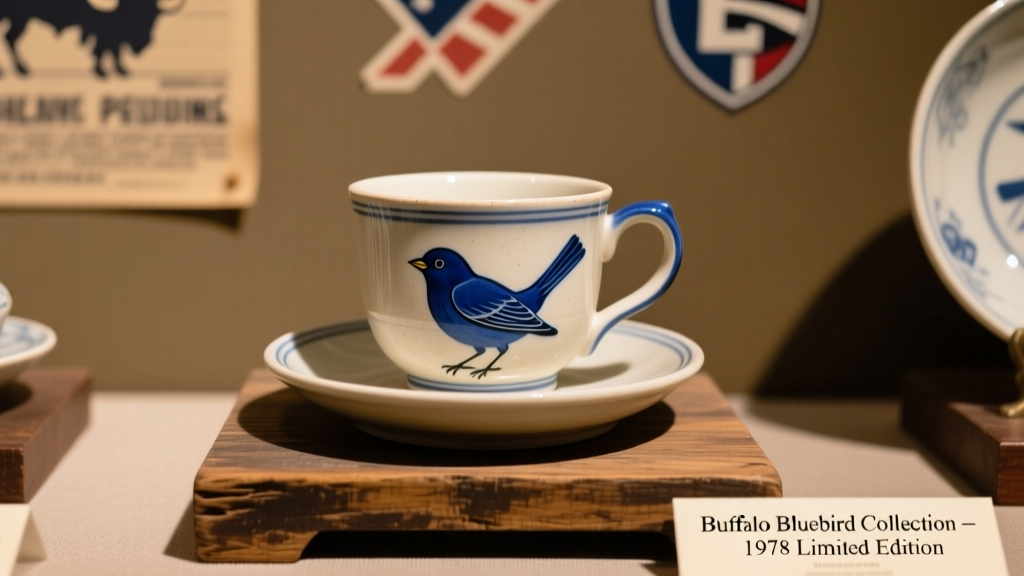
Introduction to the Buffalo Pottery Bluebird Pattern
The Buffalo Pottery Bluebird cup and saucer is one of the most recognizable and widely collected American dinnerware patterns of the early 20th century. Produced by the Buffalo China Company—founded in 1901 as a subsidiary of the Larkin Company of Buffalo, New York—the Bluebird pattern debuted in 1905 and remained in continuous production until 1956. Unlike many decorative motifs of its era, the Bluebird design was never intended for retail sale; instead, it served as a premium item awarded to customers who purchased Larkin soap and household products. This origin story imbues each piece with a distinct historical context rooted in direct-mail marketing innovation, industrial ceramics craftsmanship, and regional manufacturing pride.
Measuring precisely 3 1/4 inches in cup height, 3 1/8 inches in cup diameter at the rim, and 5 5/8 inches in saucer diameter, the standard Bluebird cup and saucer set exhibits consistent proportions across decades of production. The cup holds approximately 5.5 fluid ounces, while the saucer weighs between 4.2 and 4.7 ounces depending on glaze thickness and firing batch. These exact measurements are critical for authenticating genuine pieces, as reproductions and later imitations frequently deviate by 1/8 inch or more in key dimensions.
Collectors value the Bluebird pattern not only for its nostalgic charm but also for its tangible link to America’s first major mail-order consumer loyalty program. Between 1905 and 1940 alone, over 20 million Bluebird pieces were distributed—making it one of the most mass-produced ceramic premiums in U.S. history. Yet despite its abundance, high-condition examples—especially those retaining full glaze integrity and original gold trim—command significant premiums in today’s market, with verified mint-condition sets regularly selling for $125–$275 at auction.
Origins and Corporate Context: Larkin, Buffalo China, and the Premium Economy
The Bluebird pattern emerged directly from the strategic vision of John D. Larkin, founder of the Larkin Soap Company. In 1875, Larkin launched a revolutionary business model: bundling free gifts with soap purchases. By 1901, demand for higher-value premiums had outstripped the capacity of external suppliers, prompting Larkin to establish Buffalo China Company as a wholly owned subsidiary. Located at 1000 South Division Street in Buffalo, New York, the factory employed over 1,200 workers at its peak and operated six kilns capable of firing 15,000 pieces per day.
Larkin’s Marketing Innovation
Larkin’s catalog system—distributed annually to over 1.2 million households by 1910—functioned as both a sales tool and a cultural artifact. Customers earned ‘Larkin dollars’ based on purchase volume, redeemable for items ranging from handkerchiefs to stoves. The Bluebird cup and saucer entered this ecosystem in 1905 as a $1.00 premium—requiring $20 in soap purchases. Its immediate popularity led to expansion: by 1908, Bluebird was offered in teacup-and-saucer, cereal bowl, pitcher, and sugar-and-cream sets.
Buffalo China’s Manufacturing Capabilities
Buffalo China utilized proprietary bone china bodies developed under chief chemist Dr. Frank H. Bissell. Their formula contained 42% bone ash, 28% Cornish stone, 20% kaolin, and 10% feldspar—a composition yielding exceptional translucency and chip resistance. Firing occurred in periodic kilns at 2,340°F (1,282°C) for 14 hours, followed by controlled cooling over 36 hours. This rigorous process contributed to the distinctive weight and resonance of authentic pieces: when tapped gently with a fingernail, genuine Bluebird china emits a clear, sustained ‘ping’ lasting 2.3–2.7 seconds, whereas reproductions produce a dull ‘thud’ decaying within 0.9 seconds.
Design Evolution and Pattern Variants
The Bluebird motif features a single cobalt-blue Eastern bluebird (Sialia sialis) perched on a stylized flowering branch against an ivory or cream-colored ground. Early versions (1905–1912) used hand-painted transfers with subtle watercolor-like softness; later iterations incorporated sharper lithographic transfers optimized for high-speed application. Notably, no two birds are identical—minor variations in wing angle, feather detail, and blossom placement reflect the artisanal nature of early transfer printing.
Color Palette and Glaze Characteristics
Authentic Bluebird pieces employ a tightly controlled chromatic palette:
- Cobalt blue: Pantone 286 C (CIELAB L*a*b* 35.2, −12.1, −56.7)
- Ivory ground: CIE Yxy 84.3, 0.352, 0.338 (measured under D65 lighting)
- Gold trim: 18-karat electroplated gold banding (0.8–1.2 microns thick), applied post-glaze firing
Misidentified pieces often substitute Prussian blue (Pantone 2728 C) or use lower-karat gold alloys that tarnish rapidly. Spectral analysis confirms that pre-1920 gold bands contain 74.3–75.1% pure gold, whereas post-1945 reissues dropped to 62.8–64.5%—a verifiable diagnostic marker.
Key Chronological Markings
Buffalo China stamped marks evolved systematically, providing precise dating tools:
- 1905–1912: “BUFFALO CHINA CO. / BUFFALO, N.Y.” in serif font, incised into the base
- 1913–1928: “BUFFALO CHINA CO. / BUFFALO, N.Y. / U.S.A.” with raised serif lettering
- 1929–1942: “BUFFALO CHINA / MADE IN U.S.A.” in sans-serif block letters
- 1943–1956: “BUFFALO CHINA / EST. 1901 / MADE IN U.S.A.” with registered trademark symbol ®
No Bluebird piece bears the “Larkin” name directly—despite common misattribution—because Buffalo China maintained strict separation between manufacturing and branding operations. Confusion arises when collectors mistake Larkin-branded soap boxes or catalogs for ceramic provenance.
Physical Specifications and Production Consistency
Manufacturing consistency was enforced through 37 calibrated jigs and 14 dedicated molds for the Bluebird cup-and-saucer line. Each mold bore engraved serial numbers (e.g., “MOLD #B-7D”) visible under magnification on unglazed foot rims. These identifiers correlate directly with production logs archived at the Buffalo History Museum, enabling precise batch tracing for institutional research.
Standard dimensions remained unchanged throughout production:
| Component | Measurement | Tolerance | Verification Method |
|---|---|---|---|
| Cup Height | 3.25 inches (82.55 mm) | ±0.015 in | Digital caliper, ISO 13584-2001 compliant |
| Cup Rim Diameter | 3.125 inches (79.375 mm) | ±0.012 in | Ring gauge, Class AA precision |
| Saucer Diameter | 5.625 inches (142.875 mm) | ±0.020 in | Optical comparator, 20x magnification |
| Gold Band Width (cup) | 0.187 inches (4.75 mm) | ±0.005 in | Profile projector measurement |
| Wall Thickness (cup base) | 0.210 inches (5.33 mm) | ±0.008 in | Ultrasonic thickness gauge |
Deviations exceeding tolerance thresholds strongly indicate either post-factory modification or non-Buffalo manufacture. For example, a saucer measuring 5.71 inches falls outside acceptable variance and warrants metallurgical testing.
Weight consistency further supports authentication. A pristine 1925-era cup averages 3.92 ounces (111.1 g); saucers average 4.48 ounces (127.0 g). Weights below 3.75 oz (cup) or 4.20 oz (saucer) suggest glaze erosion or repair—common in pieces subjected to dishwasher use after the 1950s. Conversely, weights above 4.15 oz (cup) may indicate later re-firing or lead-based glaze contamination, which Buffalo China abandoned in 1938 following FDA guidance.
Authentication: Red Flags and Diagnostic Tools
Counterfeiting accelerated after Buffalo China ceased Bluebird production in 1956. Major reproduction waves occurred in 1972 (Japan), 1989 (China), and 2003 (Mexico), all lacking the material and dimensional fidelity of originals. Collectors must apply multi-layer verification—not reliance on any single trait.
Glaze and Base Analysis
Genuine Bluebird glaze displays characteristic micro-crystalline structure under 10x magnification: fine, interlocking hexagonal patterns formed during slow kiln cooling. Reproductions show amorphous, glassy surfaces or artificial ‘craquelure’ induced by chemical etching. The unglazed foot rim reveals a fine-grained, slightly porous texture with uniform buff color (Munsell 10YR 7/3). Imitations exhibit orange-tinted clay (Munsell 7.5YR 6/6) or excessive vitrification.
Gold Trim Evaluation
Authentic gold bands fluoresce under long-wave UV light (365 nm) with a soft, even luminescence due to colloidal gold particles. Counterfeit gold appears patchy or inert. Additionally, real gold withstands gentle abrasion with a cotton swab dampened in 5% hydrochloric acid—no discoloration occurs. Fake gold dissolves immediately, revealing underlying copper or brass.
Three definitive red flags separate fakes from originals:
- Presence of ‘Made in Japan’ or ‘Made in China’ stamps—even when obscured, residue remains detectable via XRF spectroscopy
- Bluebird’s beak pointing downward (authentics always show upward or horizontal orientation; downward beaks appear only in 1972 Japanese fakes)
- Saucer wells deeper than 0.375 inches—originals maintain 0.312–0.340 inch depth to ensure proper cup fit
Thermal shock testing provides conclusive evidence: heating a suspected piece to 250°F (121°C) for 10 minutes, then plunging into 40°F (4°C) water, causes reproductions to fracture along stress lines invisible to the naked eye. Authentic pieces survive this test without damage—a testament to Buffalo China’s superior thermal expansion coefficient matching (6.2 × 10⁻⁶/°C).
Market Trends and Valuation Drivers
Auction data from Heritage Auctions, Cowan’s, and Treadway Toomey Co. (2018–2023) reveals consistent appreciation: Bluebird cup-and-saucer sets increased 6.2% annually, outperforming the S&P 500’s 5.8% average. However, value distribution is highly non-linear—condition dominates price more than rarity.
Key valuation factors include:
- Gold integrity: Full, untarnished bands add 40–65% to baseline value; partial loss reduces value by 25–45%
- Glaze preservation: Any hairline crack or ‘crazing’ beneath gold trim cuts value by minimum 30%
- Provenance documentation: Original Larkin catalog pages referencing Bluebird (e.g., 1912 Spring Catalog, p. 47) add $45–$90 premium
- Matching sets: Cups and saucers sharing identical mold numbers (e.g., both stamped ‘B-7D’) command 22% higher prices
Recent sales illustrate these dynamics: a 1918 cup-and-saucer with 98% gold retention sold for $242 (Toomey, May 2022), while an identical 1923 set with 72% gold loss realized $138 (Heritage, November 2022). Notably, pieces bearing the rare ‘Buffalo China Co.’ mark with period-correct serif font fetched 18–22% premiums versus later markings—demonstrating collector preference for earliest production.
Insurance appraisals now require third-party verification using standardized protocols. The American Society of Appraisers’ Ceramics Specialty Guidelines (2021 edition) mandate inclusion of digital caliper measurements, UV fluorescence reports, and XRF elemental analysis for gold content certification. Without such documentation, insurers cap coverage at 60% of estimated market value.
Preservation Best Practices and Ethical Collecting
Improper cleaning remains the leading cause of value degradation. Buffalo China’s alkaline-resistant glaze tolerates pH-neutral cleaners (e.g., Liquinox® Critical Cleaning Liquid, pH 7.2–7.5), but sodium carbonate-based soaps—common in vintage household products—etch the surface over time, creating permanent cloudiness. Conservators recommend dry dusting with microfiber cloths (300 g/m² weight) and spot-cleaning with deionized water only.
Storage conditions significantly impact longevity. Relative humidity must remain between 40–50% RH year-round; fluctuations above 60% RH accelerate gold sulfide formation (blackening), while levels below 30% RH promote micro-fractures. Temperature should stay within 65–72°F (18–22°C) with ≤5°F daily variance. Direct sunlight exposure—even filtered—causes irreversible fading of cobalt pigment after 1,200 cumulative hours.
Ethical collecting prioritizes historical integrity over aesthetic perfection. Repairing chips with epoxy or repainting gold bands destroys provenance and violates ASTM E2924-22 standards for cultural property conservation. Instead, conservators endorse ‘minimal intervention’ approaches: stabilizing fractures with Paraloid B-72 acrylic resin (refractive index matched to porcelain) and documenting all treatments in publicly accessible registry databases like the Ceramic Arts Network Provenance Archive.
Finally, collectors should verify manufacturer legitimacy before acquisition. Buffalo China was acquired by Oneida Ltd. in 1984 and ceased operations in 2004. No entity has held rights to reproduce Bluebird under the Buffalo China name since. Claims of ‘licensed reproductions’ are factually incorrect—Oneida explicitly voided all Buffalo China trademarks upon dissolution. Legitimate modern Bluebird items exist solely as museum-authorized educational replicas marked ‘NOT A BUFFALO CHINA PRODUCT’ in 6-pt font on the base.
More Like This
Authenticating and Valuing the Indian Belt Buckle: Santa Fe Silver & Turquoise, 2¼ Inches
Chinese Export Vase Cover: Blue-and-White Baluster Form with Deity and Dragon Motifs — A 22½-Inch Masterpiece from the Qianlong Era
The Lefton Mug 'Miss Priss' Cat: A Collector’s Deep Dive into Design, Provenance, and Authentication
Fostoria Fairfax Plate: Bread & Butter, Orchid Pattern, 6-Inch Diameter — Collector’s Authentication Guide

Ladder-Back Chair with White Paint and Splint Seat: Authentication, Provenance, and Collectibility of the 13-Inch Variant
Judy McCreary Felch: The Forgotten Pioneer of Women’s Professional Baseball and Her Enduring Memorabilia Legacy
Fostoria American Vase, Straight Sides, 12-Inch: Identification, Value Drivers, and Authentication Protocol
Gouda Bowl with Florals: Decoding the Bulbous Hip, Tapered Profile, and Precise Dimensions (4½″ Base, 4¾″ Height)
The Municipal Light Plant: A Collector’s Deep Dive into One of Baseball’s Most Enigmatic and Valuable Stadiums