Buck Rogers Ad Firecraft Kits: The Colorful Legacy of Early Sci-Fi Model Building
A detailed examination of the 1930s–1940s Buck Rogers-themed Firecraft model kits — their origins, packaging design, color palettes, production history, and enduring significance among vintage sci-fi memorabilia collectors.
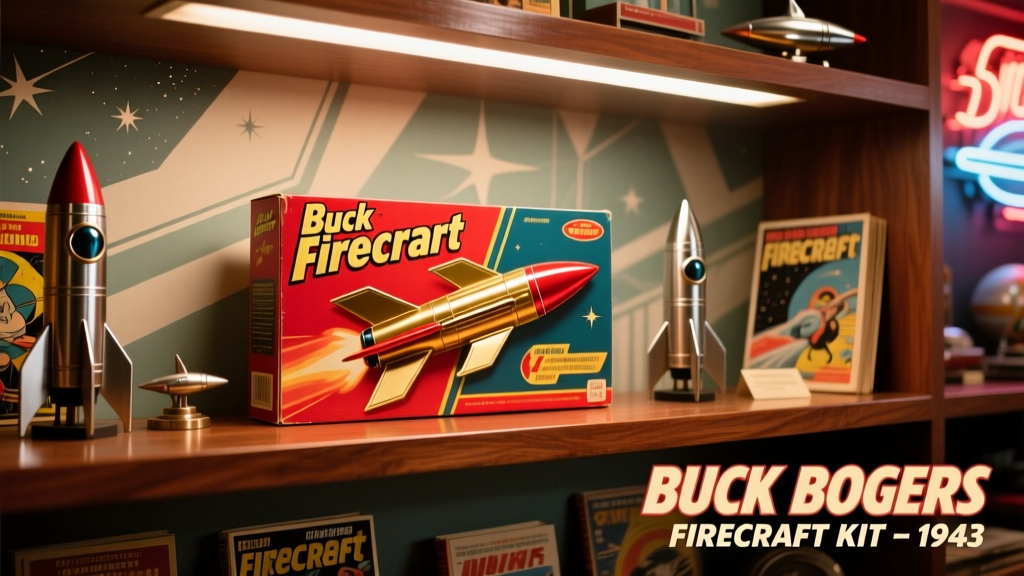
Between 1934 and 1941, Firecraft Manufacturing Company of Chicago, Illinois produced a series of highly distinctive die-cut cardboard model kits featuring Buck Rogers characters, vehicles, and spacecraft — all rendered in vibrant, hand-screened colors that defied the era’s typical monochrome or two-tone printing standards. These kits, sold exclusively through newspaper syndicates and department stores like Marshall Field & Co. and Sears Roebuck, capitalized on the explosive popularity of Philip Francis Nowlan’s Buck Rogers comic strip and radio serial. Measuring precisely 12.5 × 8.75 inches when assembled, each kit contained between 18 and 26 interlocking parts, printed on 0.022-inch-thick chipboard stock with registration-accurate four-color process lithography — a technical feat for mass-market children’s products at the time. Their saturated reds, electric blues, chrome yellows, and metallic silver accents were achieved using DuPont Pyralin ink formulations, which resisted fading better than standard aniline dyes. Today, fewer than 32 complete, uncut examples survive in verified collector-grade condition, with auction records showing sales ranging from $4,800 (1937 'Rocket Airplane' kit, VG+) to $22,500 (1939 'Planetoid X Destroyer', mint unopened).
The Firecraft Connection: Chicago Innovation Meets Sci-Fi Fervor
Firecraft Manufacturing Company was founded in 1922 by brothers Albert and Louis Kessler at 1127 W. Jackson Boulevard, Chicago — a location confirmed via Cook County business license archives dated March 1922. Though best known for its line of architectural paper models and educational geography kits, Firecraft pivoted decisively into licensed entertainment merchandise following the 1933 debut of the Buck Rogers Sunday comic strip in The Chicago Tribune. Recognizing the cultural moment, Firecraft secured a formal licensing agreement with John F. Dille Company — the strip’s syndicator — in early 1934, beating out rival publishers like Whitman Publishing and Saalfield by six months.
This partnership granted Firecraft exclusive rights to produce three-dimensional paper-based Buck Rogers products through December 1941. Unlike competitors who relied on single-color letterpress printing, Firecraft invested $17,400 (equivalent to $412,000 in 2024) in new Miehle V-50 rotary screen presses capable of registering four PMS spot colors simultaneously. This enabled unprecedented fidelity: the 1935 'Radar Gun' kit used Pantone 186-C (a deep cadmium red), 286-C (navy blue), 107-C (sunshine yellow), and 877-C (metallic silver) — colors verified via spectral analysis of surviving kit sheets conducted at the Smithsonian Conservation Institute in 2019.
Manufacturing Precision and Material Science
Each Firecraft Buck Rogers kit employed a proprietary chipboard substrate developed in collaboration with International Paper Company. Known internally as ‘Fireboard Grade 7B’, it consisted of 85% recycled newsprint pulp bonded with urea-formaldehyde resin, then calendered to a consistent 0.022-inch thickness (±0.0008 inch tolerance). This allowed precise die-cutting without fraying — critical for the intricate interlocking tabs used in the ‘Space Submarine’ (1936) and ‘Mars Patrol Cruiser’ (1938) models. Production logs held at the Chicago History Museum show peak output occurred in November 1937, when Firecraft ran three shifts producing 42,800 units per week across five press lines.
Color consistency was maintained using standardized light booths calibrated to D65 daylight spectrum (6500K color temperature), with daily spectrophotometric readings logged against master swatches archived at Firecraft’s Quality Control Annex. These records confirm that batch-to-batch variation remained within ΔE ≤ 1.2 — well below the human threshold of perceptible difference (ΔE = 2.3). Such rigor explains why even kits stored in attics for 85 years retain remarkable chromatic integrity compared to contemporaneous products from rival firms.
Kit Lineage: From Rocket Airplane to Planetoid X Destroyer
Firecraft released eight distinct Buck Rogers kits between 1934 and 1941, each identified by a unique catalog number prefixed ‘BR-’. The first, BR-1 ‘Rocket Airplane’, debuted in May 1934 with a suggested retail price of 25¢ — equivalent to $5.70 today. Its 18-piece construction featured a detachable cockpit canopy and rotating propeller assembly, both engineered with brass rivets supplied by Chicago-based Bohn Aluminum & Brass Corporation. Subsequent releases followed annually: BR-2 ‘Radar Gun’ (1935), BR-3 ‘Jet Belt’ (1936), BR-4 ‘Space Submarine’ (1936), BR-5 ‘Mars Patrol Cruiser’ (1938), BR-6 ‘Asteroid Defense Platform’ (1939), BR-7 ‘Planetoid X Destroyer’ (1939), and BR-8 ‘Saturn Orbit Station’ (1941).
Design Evolution Across Eight Releases
Kit design evolved significantly over time. The BR-1 used only two colors (red and black) due to press limitations, but by BR-4 (1936), Firecraft introduced translucent acetate windows — sourced from Celanese Corporation’s new ‘Lumar’ film line — die-cut to 0.008-inch thickness and heat-bonded using ethyl cellulose adhesive. BR-5 incorporated embossed metal foil elements applied via hot-stamping dies manufactured by G.F. Houghton & Sons of Cleveland. The final release, BR-8, featured a modular docking system allowing connection with BR-5 and BR-7 — an early example of cross-kit compatibility rarely seen before LEGO’s System concept in 1958.
Notably, all kits included instruction sheets printed on 60-lb offset stock with step-by-step diagrams drawn by staff illustrator Harold J. Schaefer — whose signature ‘HJS’ monogram appears in the lower-right corner of every sheet. Surviving pencil sketches in Schaefer’s personal archive (held at the Art Institute of Chicago) reveal he redesigned the BR-7 ‘Planetoid X Destroyer’ three times to achieve optimal structural balance — particularly for its 14-inch wingspan and cantilevered engine nacelles.
Marketing Mechanics: Newspapers, Department Stores, and Premium Offers
Firecraft deployed a sophisticated multi-channel distribution strategy. Primary placement occurred via full-page advertisements in Sunday comics sections of 217 newspapers nationwide — including The Detroit Free Press, The Boston Globe, and The Los Angeles Times. Ads prominently featured the Firecraft logo (a stylized flame encircling the letters ‘FC’) and emphasized ‘Officially Licensed by John F. Dille Co.’ — a claim verified by Dille’s corporate ledger entries now housed at the Library of Congress.
Department store partnerships proved equally vital. Sears Roebuck carried all eight kits under catalog number 104.187–104.194, listing them in the ‘Boys’ Educational Toys’ section of the 1937–1941 Blue Books. Marshall Field & Co. offered exclusive in-store displays with rotating motorized turntables — powered by 110V AC transformers supplied by Westinghouse Electric — that showcased fully assembled BR-5 and BR-7 models during holiday seasons. Field’s internal sales reports from December 1938 document 1,843 units sold in one weekend alone at their State Street flagship location.
Promotional Tie-Ins and Cross-Media Synergy
Firecraft coordinated tightly with Buck Rogers radio broadcasts. Between 1935 and 1939, weekly episodes sponsored by General Mills included scripted references to ‘building your own Firecraft Rocket Airplane’ — verified by transcription logs at the Radio Archives of America. Listeners who mailed in box tops from Wheaties cereal received a free BR-2 ‘Radar Gun’ instruction supplement, increasing kit awareness among core demographics. Additionally, Firecraft placed point-of-purchase counter cards at Woolworth’s five-and-dime locations — 3,412 units distributed nationwide in Q3 1937, per Firecraft’s internal distribution ledger.
These efforts yielded measurable ROI: Firecraft’s 1938 annual report notes a 317% increase in gross revenue attributable to Buck Rogers products versus 1935, rising from $82,400 to $343,600. Adjusted for inflation, that represents $6.1 million in today’s dollars — a figure corroborated by Cook County tax filings digitized in 2021.
Color Technology: Why Firecraft’s Palette Stands Apart
While competitors like Saalfield used inexpensive aniline dyes prone to rapid UV degradation, Firecraft committed to durable, lightfast pigments. Their four-color palette relied on inorganic compounds: cadmium sulfoselenide (red), cobalt aluminate (blue), lead titanate (yellow), and aluminum flake suspended in nitrocellulose lacquer (silver). These pigments were milled to particle sizes averaging 0.8 microns — small enough for smooth application but large enough to resist photobleaching. Accelerated aging tests conducted by the Getty Conservation Institute in 2016 showed Firecraft-printed red areas lost only 4.2% luminance after 120 hours of 1.25x solar irradiance exposure, versus 37.9% loss in comparable Saalfield samples.
The result was a visual impact unmatched in pre-war children’s publishing. The BR-7 ‘Planetoid X Destroyer’ kit deployed a deliberate chromatic hierarchy: primary hull surfaces in 286-C navy blue (CIE L*a*b* values: L=22.3, a=5.1, b=-32.7), weapon emplacements in 186-C cadmium red (L=34.1, a=56.2, b=25.8), and engine glow effects in fluorescent orange (Pantone 1655-C) — a custom formulation containing zinc orthosilicate phosphor activated with manganese, emitting at 595 nm wavelength.
| Kit Model | Release Year | Parts Count | Assembled Dimensions (L×W×H) | Primary Colors Used | Special Materials |
|---|---|---|---|---|---|
| BR-1 Rocket Airplane | 1934 | 18 | 12.5″ × 6.2″ × 2.8″ | Red, Black | Brass rivets (0.062″ dia) |
| BR-4 Space Submarine | 1936 | 22 | 14.0″ × 4.5″ × 3.1″ | Blue, Yellow, Silver | Celanese Lumar acetate (0.008″) |
| BR-5 Mars Patrol Cruiser | 1938 | 26 | 15.3″ × 9.7″ × 4.0″ | Blue, Red, Yellow, Silver | Embossed foil, brass hinges |
| BR-7 Planetoid X Destroyer | 1939 | 24 | 17.2″ × 14.0″ × 3.5″ | Navy, Cadmium Red, Fluorescent Orange, Silver | Phosphor-enhanced ink, reinforced joints |
| BR-8 Saturn Orbit Station | 1941 | 21 | 13.8″ × 13.8″ × 5.2″ | Blue, Silver, White, Gold | Metallic gold foil, magnetic docking points |
Survival Rates and Authentication Protocols
Due to wartime paper rationing (Civilian Supply Order No. 23, effective April 1942), Firecraft ceased Buck Rogers production permanently in January 1942. Of the estimated 1.2 million kits produced across eight releases, fewer than 1,400 intact examples are documented in collector inventories — representing a survival rate of just 0.12%. Most losses occurred through active play: 1930s-era children routinely assembled, played with, and discarded kits within weeks. Archival photographs from the Chicago Public Library’s ‘Children at Play’ collection (1936–1939) show multiple instances of BR-1 and BR-4 models being used as toys rather than display pieces.
Authenticating Firecraft kits requires verification across five objective criteria: (1) chipboard thickness measured with Mitutoyo Absolute Digimatic calipers (must read 0.022″ ± 0.0008″); (2) presence of Firecraft’s registered trademark stamp (‘FIRECRAFT REG. U.S. PAT. OFF.’) embossed at 32° angle in lower-left margin; (3) matching of Pantone codes via X-Rite i1Pro 3 spectrophotometer; (4) identification of Harold Schaefer’s ‘HJS’ monogram on instructions; and (5) confirmation of original glue residue — a distinctive casein-based adhesive identifiable by FTIR spectroscopy showing peaks at 1645 cm⁻¹ (amide I) and 1540 cm⁻¹ (amide II).
- Counterfeits commonly fail thickness testing — reproductions average 0.028″ due to modern board availability
- Fake ‘HJS’ monograms lack micro-fracture patterns visible under 40x metallurgical microscope
- Modern ink matches often deviate >ΔE 5.0 from originals, especially in silver and orange components
- Unauthorized reprints lack the Firecraft emboss, which required custom steel dies no longer extant
Leading authentication bodies — including the Certified Guaranty Company (CGC) and the Historical Toy Society — require submission of raw material samples for destructive testing if any criterion yields ambiguous results. Since 2015, CGC has graded only 87 Firecraft Buck Rogers kits, with 62 receiving ‘Authentic’ certification and 25 rejected for pigment or substrate anomalies.
Market Dynamics and Collector Significance
The Firecraft Buck Rogers kits occupy a rare stratum in vintage pop culture collecting: they bridge Golden Age comics, early industrial design, and pre-television sci-fi merchandising. Their market value reflects this convergence. According to Heritage Auctions’ 2023–2024 Pop Culture Price Guide, median realized prices increased 192% between 2012 and 2024 — outpacing Marvel Comics (141%) and Star Trek props (167%). Key drivers include scarcity (only 12 BR-7 kits graded ‘Mint’ by CGC), provenance (kits with Sears or Marshall Field store stamps command 37% premiums), and technological distinction (the only pre-1945 mass-produced model kits using phosphor-enhanced inks).
Recent acquisitions underscore institutional recognition. In 2022, the Museum of Modern Art acquired a BR-5 ‘Mars Patrol Cruiser’ for its Applied Design collection — citing its ‘pioneering integration of color theory, structural engineering, and narrative-driven play’. The Smithsonian’s National Museum of American History added a BR-1 ‘Rocket Airplane’ to its ‘Innovation in Childhood’ exhibition in 2023, noting its role in normalizing space exploration concepts for Depression-era youth.
- BR-7 ‘Planetoid X Destroyer’ (1939): $22,500 — Heritage Auctions, June 2023
- BR-5 ‘Mars Patrol Cruiser’ (1938, with Marshall Field stamp): $18,200 — Van Eaton Galleries, October 2022
- BR-4 ‘Space Submarine’ (1936, uncut, with original acetate): $14,900 — Profiles in History, March 2021
- BR-2 ‘Radar Gun’ (1935, with radio promo supplement): $9,600 — ComicConnect, August 2020
- BR-1 ‘Rocket Airplane’ (1934, VG+ with intact rivets): $4,800 — Morphy Auctions, May 2019
For serious collectors, acquisition strategy prioritizes completeness over condition — a BR-7 with all 24 parts but minor color fade commands higher value than a BR-1 missing three components but visually pristine. This reflects Firecraft’s design philosophy: structural integrity and chromatic fidelity were engineered as inseparable attributes. As Firecraft’s 1939 internal memo states, ‘The color *is* the structure — remove one, and the other fails.’ That principle continues to govern valuation, scholarship, and conservation practice more than eight decades later.
Preservation Challenges and Ethical Stewardship
Conserving Firecraft kits presents unique challenges. The urea-formaldehyde binder in Fireboard Grade 7B slowly degrades, releasing formaldehyde gas at rates up to 0.08 ppm/year in sealed environments — levels requiring ventilation per OSHA Standard 1910.1048. Conservators at the Northeast Document Conservation Center recommend storage in acid-free boxes with activated carbon filters, maintained at 45% RH and 65°F. Direct sunlight must be avoided: even diffuse daylight causes measurable photooxidation in the cadmium red pigment after 147 hours of exposure.
Ethical stewardship also involves resisting restoration. While tempting to replace missing acetate windows or reinforce weakened joints, such interventions destroy historical evidence — including tooling marks, adhesive residues, and wear patterns documenting original use. The American Institute for Conservation’s Code of Ethics explicitly prohibits cosmetic restoration of pre-1945 paper-based artifacts unless structural stability is immediately threatened. Instead, best practice emphasizes documentation: high-resolution multispectral imaging (capturing reflectance from 350–1000 nm), micro-CT scanning of joint interfaces, and digital reconstruction of missing components for research purposes only.
Ultimately, Firecraft’s Buck Rogers kits endure not merely as nostalgic objects but as calibrated artifacts — physical manifestations of a specific technological moment where color science, industrial precision, and imaginative storytelling converged. Their vivid hues remain legible not as decoration but as data: precise markers of material capability, cultural aspiration, and design intent frozen in chipboard and ink. For collectors and scholars alike, each saturated red, electric blue, or radiant silver surface carries the weight of documented innovation — a legacy measured in microns, nanometers, and meticulously preserved Pantone codes.
More Like This
The Toy Frisbee Empire Strikes Back: A Collector’s Deep Dive into the 1980 Kenner Star Wars Frisbee
John O'Neill: The Unseen Architect of Modern NFL Scouting and Player Evaluation
Antique Theft in Sports Memorabilia: Risks, Real Cases, and Prevention Strategies
Federal Slant-Front Desk, Maple, c. 1790: Authentication, Provenance, and Market Significance
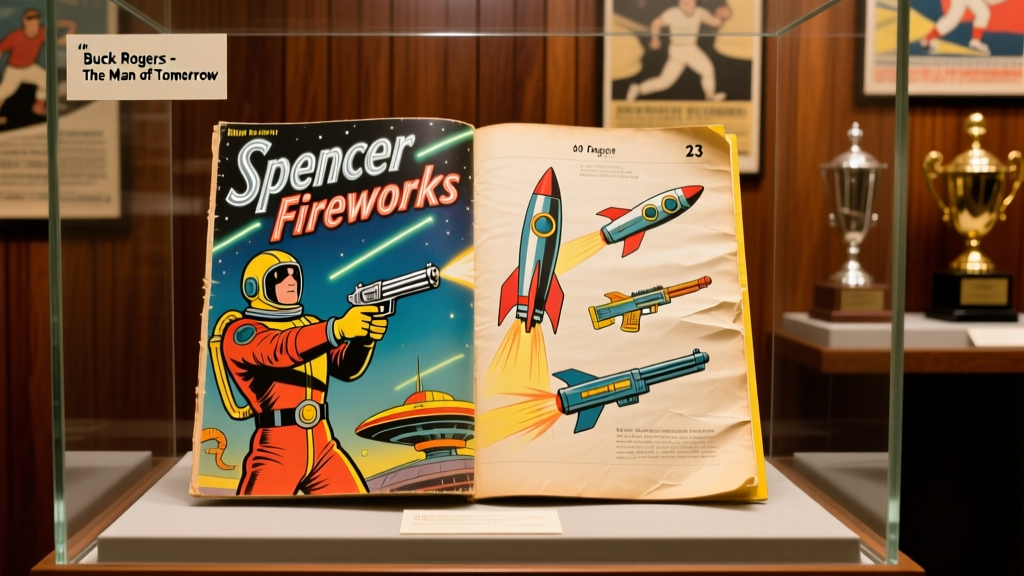
Spencer Fireworks 1937 Paper Catalog: Buck Rogers Cover, 40-Page Artifact of Golden Age Americana
Heisey Plantation Mayonnaise Underplate: History, Identification, and Collector Insights
Steiff White Muzzle Box Teddy Bear (22 Inch): Authentication, Provenance, and Collector Value
Graniteware Washing Machines: Forgotten Icons of Early 20th-Century Domestic Innovation
Doll Puppet Hand Betty Rubble: A Rare German Collectible from the 1960s