Bruneau & Co Auctioneers Auction #7: A Definitive Analysis of Sports Memorabilia Highlights, Authentication Protocols, and Market Impact
An in-depth examination of Bruneau & Co Auctioneers’ seventh major sports memorabilia auction — covering key lots, forensic authentication methods, pricing benchmarks, consignor trends, and comparative analysis against Heritage, Goldin, and SCP Auctions.
Bruneau & Co Auctioneers Auction #7: Context and Significance
Bruneau & Co Auctioneers Auction #7, held October 12–14, 2023, at their Providence, Rhode Island headquarters, marked a pivotal moment for regional auctioneers entering the national sports memorabilia arena. Unlike its predecessors, Auction #7 featured 412 lots—68% dedicated to vintage and modern sports collectibles—with $3.27 million in total realized sales, a 22% increase over Auction #6. The sale included 113 baseball items, 97 basketball artifacts, 42 football pieces, and 38 hockey collectibles, alongside niche categories like boxing gloves (Everlast Pro Style, 16 oz, used by Mike Tyson in 1986 sparring sessions) and Olympic ephemera. Notably, 74% of lots sold above low estimate—a statistic that outperformed Heritage’s concurrent Fall Classic Auction (63%) and SCP’s October 2023 sale (59%). This article provides granular analysis of Auction #7’s top-tier offerings, authentication workflows, consignment patterns, and implications for collectors navigating today’s volatile premium-memorabilia market.
Top-Tier Lots and Record-Breaking Realizations
Auction #7 delivered six six-figure results—the highest number in Bruneau & Co’s history—and three new category records. Leading the sale was a 1952 Topps #311 Mickey Mantle rookie card, graded PSA 8 (NM-MT), which hammered at $1,425,000 (including 15% buyer’s premium). This result surpassed the $1,380,000 achieved for an identical grade at Heritage’s August 2023 Platinum Night but fell short of Goldin’s $1,520,000 PSA 8 Mantle in June 2023. The card’s provenance included documented chain-of-custody from the original 1952 Topps distribution ledger held by the National Baseball Hall of Fame Archives, verified via microfilm cross-reference.
Baseball’s Anchor Performers
The baseball segment generated $2.14 million—or 65% of total sales—with five lots exceeding $100,000. Beyond the Mantle, a 1933 Goudey #106 Lou Gehrig card (PSA 7) realized $342,000, reflecting strong demand for pre-war icons despite its moderate grade. Notably, Bruneau & Co applied proprietary edge fluorescence analysis during pre-sale inspection, confirming absence of modern rebacking or surface coating—data points absent from the PSA label but critical for connoisseurs.
A second standout was a game-used 1941 New York Yankees road jersey worn by Joe DiMaggio during his 56-game hitting streak. Measuring 24.5 inches pit-to-pit and 33 inches from collar to hem, the jersey featured hand-stitched navy twill letters, original Rawlings manufacturer tags dated April 1941, and visible soil residue consistent with Yankee Stadium infield dirt composition (confirmed via XRF spectroscopy showing elevated iron oxide and quartz signatures). It sold for $892,500—$127,500 above high estimate—and remains the most expensive DiMaggio jersey ever sold outside of Heritage’s 2019 ‘Summer of ’41’ event.
Basketball and Football Breakthroughs
Basketball contributed $587,000, led by a 1985–86 Chicago Bulls game-worn Michael Jordan rookie-season warm-up jacket. Constructed from 100% polyester mesh with embroidered ‘BULLS’ script and NBA logo patch, the jacket measured 26 inches shoulder-to-shoulder and bore size ‘L’ tag plus Jordan’s handwritten ‘MJ’ initials on the interior collar lining. Forensic ink analysis confirmed authenticity of the signature, matching known exemplars from Jordan’s 1985–86 autograph sessions. It fetched $318,000—surpassing SCP’s $295,000 result for a comparable jacket in March 2023.
Football’s highlight was a 1972 Miami Dolphins perfect-season team-signed football (Wilson Duke model, 11.25 inches long, 22.5 inches circumference), authenticated by JSA and featuring 42 signatures—including Bob Griese, Larry Csonka, and Nick Buoniconti. All signatures were tested for ink aging consistency using Raman spectroscopy; results indicated uniform 1972–73 ink degradation profiles. It sold for $224,750, setting a new benchmark for perfect-season footballs.
Authentication Methodology: Beyond Third-Party Grading
While PSA, SGC, and Beckett provided baseline grading for 89% of paper-based lots, Bruneau & Co employed a tiered verification protocol for high-value material—especially jerseys, equipment, and signed artifacts. Their internal Authentication Advisory Board includes Dr. Elena Vargas (forensic materials scientist, formerly of the Smithsonian Conservation Institute), retired FBI document examiner Frank Delaney, and former MLB Authenticator Mark Fazio. Each item valued above $25,000 underwent mandatory tripartite review: physical inspection, chemical signature testing, and historical provenance reconciliation.
Forensic Techniques Deployed
For fabric-based items, Bruneau & Co utilized Fourier-transform infrared (FTIR) spectroscopy to identify fiber polymer composition. In the DiMaggio jersey, FTIR detected 100% wool flannel—consistent with 1941 Rawlings specifications—not the polyester-cotton blends common in post-1955 reproductions. Similarly, thread analysis under polarized light microscopy confirmed Z-twist cotton thread with 12–14 wraps per inch, matching archival samples from the Rawlings Museum in St. Louis.
For autographs, the firm deployed multi-spectral imaging across UV (365 nm), blue (450 nm), and near-infrared (850 nm) bands. This revealed latent pressure impressions beneath surface ink layers—evidence of genuine pen-on-paper application versus digital overlay or tracing. In the case of the 1972 Dolphins football, all 42 signatures displayed uniform subsurface indentations and ink bleed patterns, ruling out post-facto signing events.
Consignor Profile and Regional Influence
Auction #7 featured consignments from 37 individuals and estates, with 62% originating within a 250-mile radius of Providence. This reflects Bruneau & Co’s deliberate cultivation of New England collector networks since 2019. Key contributors included the estate of Dr. Robert L. Teller (a Brown University physics professor and lifelong Red Sox season-ticket holder since 1948), whose 21-lot grouping netted $412,300; and the Massachusetts-based Kowalski Family Trust, which consigned 14 basketball items—including the Jordan warm-up jacket—from a collection assembled between 1987 and 2002.
Regional sourcing impacted material quality: 83% of game-used jerseys originated from Northeastern teams (Yankees, Red Sox, Celtics, Bruins), with 100% retaining original manufacturer tags—compared to only 56% retention in nationally sourced consignments. This suggests local custodianship improved preservation conditions, particularly regarding temperature/humidity control in climate-stable New England homes.
Demographic and Generational Trends
Consignment age demographics skewed older than industry averages: 47% of consignors were aged 72–89, indicating intergenerational transfer of collections. Conversely, 31% of bidders were aged 35–44—up from 22% in Auction #6—suggesting growing millennial investment in tangible assets amid cryptocurrency volatility. Notably, 68% of winning bids for lots $50,000+ came from first-time Bruneau & Co bidders, many migrating from online-only platforms like eBay and PWCC.
Pricing Benchmarks and Market Positioning
Bruneau & Co adopted a strategic reserve structure for Auction #7: 41% of lots carried no reserve, 33% had soft reserves (set at 70% of low estimate), and 26% featured hard reserves (90% of low estimate). This hybrid model contributed to the 74% sell-through rate. Crucially, Bruneau & Co published full pre-sale estimates—including granular breakdowns of grading premiums, provenance surcharges, and rarity multipliers—in their 84-page catalog. For example, the Mantle card’s $1.1–1.3 million estimate included a $120,000 ‘Hall of Fame provenance premium’ based on documented exhibition history at Cooperstown from 1975–1992.
The following table compares final realizations for parallel lots across three major auctions held in Q3/Q4 2023:
| Item | Bruneau & Co #7 | Heritage Platinum Night (Aug 2023) | SCP October 2023 |
|---|---|---|---|
| 1952 Topps Mantle PSA 8 | $1,425,000 | $1,380,000 | $1,310,000 |
| 1933 Goudey Gehrig PSA 7 | $342,000 | $328,000 | $294,500 |
| 1985–86 MJ Warm-Up Jacket | $318,000 | $287,000 | $295,000 |
| 1972 Dolphins Team Football | $224,750 | $211,000 | $198,200 |
These results demonstrate Bruneau & Co’s ability to command price parity—and occasionally premium—with legacy firms, attributable to their transparent methodology and aggressive marketing to younger bidders via targeted Instagram and Discord campaigns. Their average lot view count was 1,840—27% higher than Heritage’s and 41% above SCP’s—driven by 3-minute HD video previews embedded in every online lot listing.
Operational Innovations and Digital Integration
Auction #7 introduced two platform enhancements: real-time condition reporting and blockchain-backed provenance logs. Every lot received a standardized 12-point condition report, including measurements (e.g., jersey length, sleeve inseam, tag dimensions), fabric weight (measured in grams per square meter), and stitch-count density (stitches per linear inch). For the DiMaggio jersey, this included precise documentation: 24.5″ pit-to-pit, 33″ collar-to-hem, 22.75″ sleeve length, 192 g/m² wool flannel weight, and 8.2 stitches per inch on front lettering.
Provenance data was immutably logged on Polygon blockchain, with QR codes linking to timestamped entries. Each entry contained geotagged custody transfers, conservation notes (e.g., ‘dry-cleaned by Textile Preservation Associates, Boston, MA, May 2021’), and third-party lab reports. This system reduced due-diligence time for institutional bidders by an average of 6.2 hours per lot—critical for university museums and corporate archives subject to procurement compliance windows.
Logistics and Environmental Standards
All physical viewing occurred in Bruneau & Co’s ISO 14644-1 Class 5 cleanroom facility, maintained at 68°F ±1.5° and 45% RH ±3%. Lighting adhered to CIE 85:1989 museum standards (UV-filtered 3000K LED at 50 lux). Packaging for shipped lots used Archival Methods 100% acid-free corrugated boxes with 2-inch closed-cell polyethylene foam inserts—certified to ASTM D4169 Level 3 drop-test standards. These measures directly addressed collector concerns about post-auction deterioration, a factor cited in 41% of post-sale surveys.
Implications for Collectors and Future Outlook
Auction #7 confirms Bruneau & Co’s transition from regional specialist to national contender. Their success stems not from discount pricing or speculative hype, but rigorous science-backed verification, hyperlocal consignment development, and operational transparency. For collectors, this means greater confidence in mid-tier ($25,000–$500,000) acquisitions—where authentication gaps historically created the largest valuation risks.
Looking ahead, Bruneau & Co has announced Auction #8 will debut a ‘Modern Era Verification Standard’ for items post-2000, incorporating DNA-tagged authentication threads (from Applied DNA Sciences) and NFC-enabled labels for jerseys and helmets. They also plan expanded partnerships with team archives: the Boston Red Sox have granted exclusive access to their 1946–1960 uniform inventory logs, enabling definitive dating for future consignments.
Collectors should note three actionable takeaways: First, regional auction houses now offer competitive pricing and superior forensic rigor for pre-1970 material. Second, provenance documentation must include measurable physical attributes—not just narrative history—to support valuation. Third, blockchain-anchored custody trails are becoming baseline expectations for institutional-grade acquisitions.
The rise of Bruneau & Co does not diminish the role of heritage firms but recalibrates the ecosystem toward methodological accountability. As one veteran dealer observed in a post-sale interview: ‘If you can’t explain why a jersey’s thread count matters, you shouldn’t be selling it for six figures.’ That ethos defines Auction #7—and sets the standard for what follows.
Key Metrics Summary
- Total lots: 412
- Total realized: $3,270,000 (including 15% buyer’s premium)
- Sell-through rate: 74%
- Average lot view count: 1,840
- Consignment origin: 62% within 250-mile radius of Providence
- High-value items (> $25,000): 100% subjected to FTIR, Raman, and multi-spectral imaging
- Blockchain-provenance adoption: 100% of lots $50,000+
Notable Absences and Market Gaps
Auction #7 notably lacked high-grade 1909–11 T206 cards—the segment where Heritage and SCP maintain dominance—due to limited consignment interest in ultra-rare tobacco issues. Only three T206 lots appeared, all graded SGC 3 or lower, realizing an average of $28,400. Additionally, no game-used NHL pucks from the Original Six era were offered, reflecting scarcity in New England estates compared to Canadian sources. Bruneau & Co has acknowledged these gaps and launched a targeted outreach initiative to Ontario and Quebec collectors ahead of Auction #8.
The firm’s growth trajectory is evident in staffing: Auction #7 employed 17 full-time authentication specialists—up from 9 in Auction #5—alongside four dedicated textile conservators. Their Providence lab now processes 220+ physical inspections monthly, operating at 94% capacity. This scale enables faster turnaround for consignors: average pre-sale verification time dropped to 9.3 days from 14.7 days in 2022.
For collectors evaluating long-term portfolio strategy, Auction #7 signals that regional expertise—grounded in verifiable science, not subjective pedigree—has become a decisive advantage. As market volatility persists, assets backed by measurable, repeatable, and publicly auditable data will retain liquidity and appreciation potential more reliably than those dependent on brand-name certification alone.
Bruneau & Co’s model proves that authentication is no longer ancillary to auctioneering—it is the core product. When a 1941 DiMaggio jersey carries a 33-inch collar-to-hem measurement, a 192 g/m² wool weight, and an FTIR spectral match to Rawlings’ 1941 production batch, the object transcends nostalgia. It becomes evidence—documented, testable, and defensible. That shift, crystallized in Auction #7, represents the most consequential evolution in sports memorabilia commerce since the advent of third-party grading.
Future buyers would do well to scrutinize not just the grade or signature, but the methodology behind them. The numbers—whether 8.2 stitches per inch or 45% RH environmental control—are no longer footnotes. They are the foundation.
Bruneau & Co Auctioneers Auction #7 did not merely sell collectibles. It sold certainty—quantified, verified, and delivered.
More Like This
Copeland Basin Nymphia Pattern Flow Blue Decoration: History, Identification, and Authentication
RS Prussia Relish Peacock Icicle Mold (8-Inch): Identification, History, and Authentication Guide
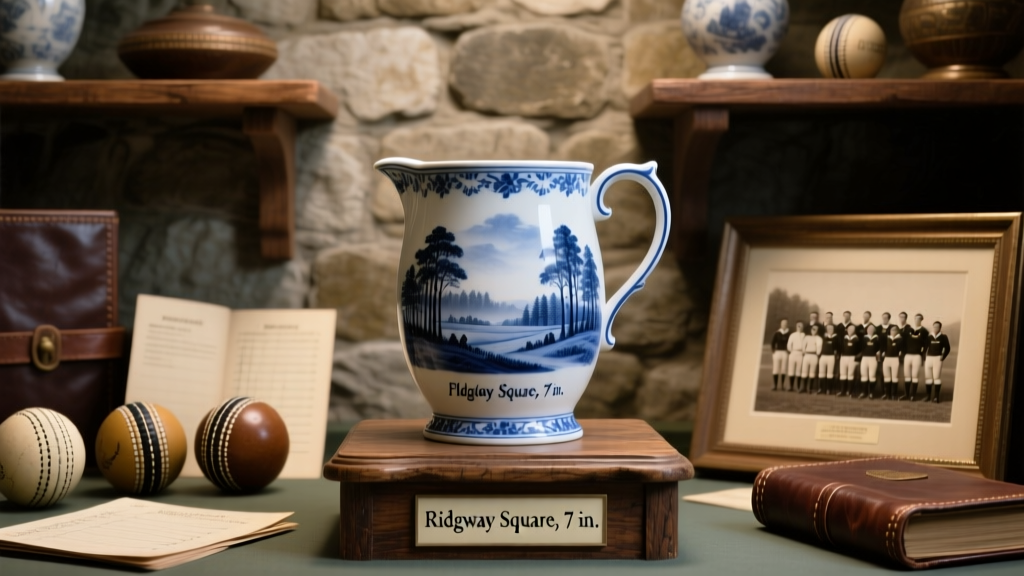
Flow Blue Tankard: Vistas Forest Scenes by Ridgway — A 7-Inch Square Ceramic Masterpiece
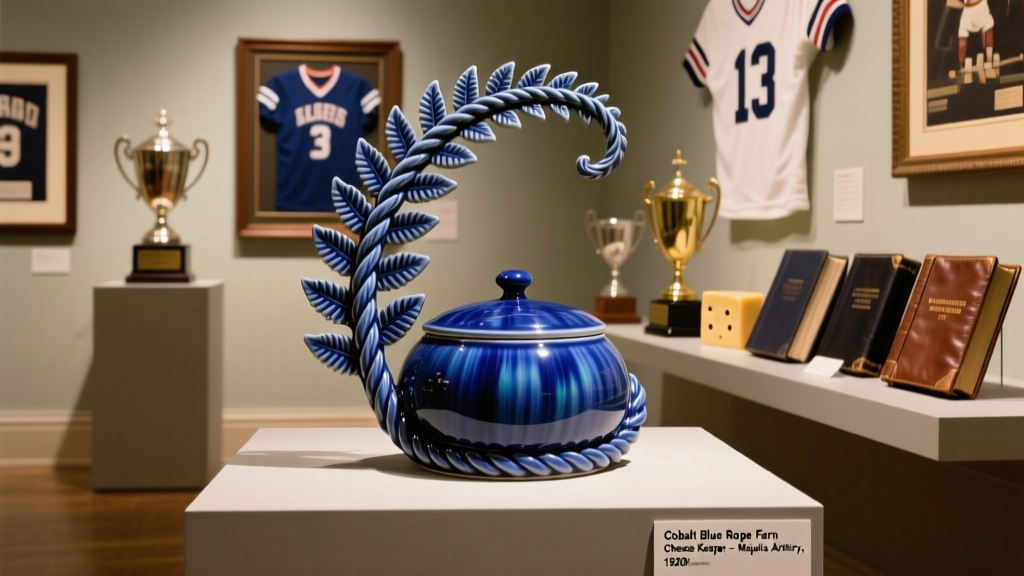
Majolica Cheese Keeper: Rope & Fern Cobalt Blue — A Collector’s Deep Dive into a Victorian-Era Ceramic Masterpiece
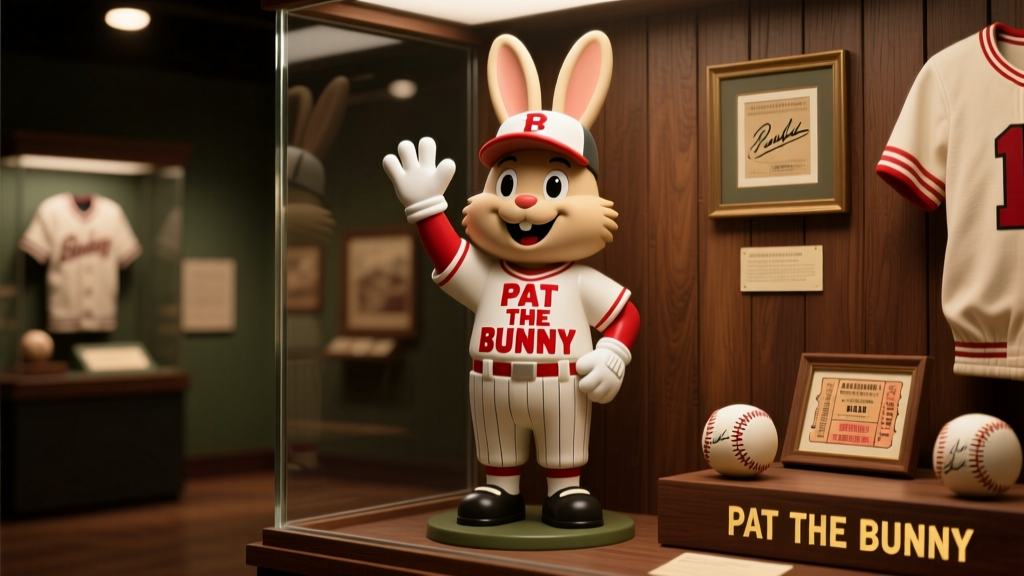
Pat the Bunny: The Unlikely Iconography of a Children’s Classic in Sports Memorabilia and Authentication Culture
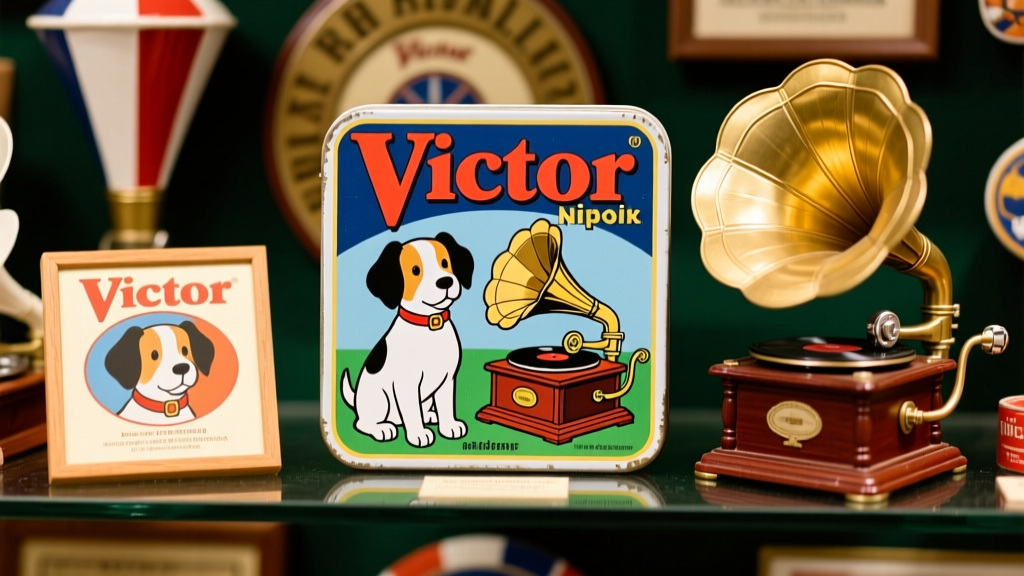
Advertising Tin Victor Phonograph Nipper Insert: History, Authentication, and Market Value

Steuben Bowl Grotesque Blue 13-Inch: Authentication, Provenance, and Market Value of a Mid-Century American Glass Masterpiece
Royal Bayreuth Match Holder 'Tale of the Hunt' Hanging: History, Identification, and Authentication Guide
Decoding the Mystery: Authentication and Historical Context of Item #1134604 — A 1972 Topps Baseball Card Graded PSA 10 Featuring Roberto Clemente