Brown Tool Auctions: The Premier Marketplace for Vintage and Industrial Hand Tools
Brown Tool Auctions is the leading U.S.-based auction house specializing in vintage, rare, and historically significant hand tools—from Stanley No. 4½ bench planes to Millers Falls brace models and pre-1950s Disston saws. With over 32 years of operation, 97% buyer satisfaction, and rigorous dual-expert authentication, it serves collectors, restorers, and museums worldwide.
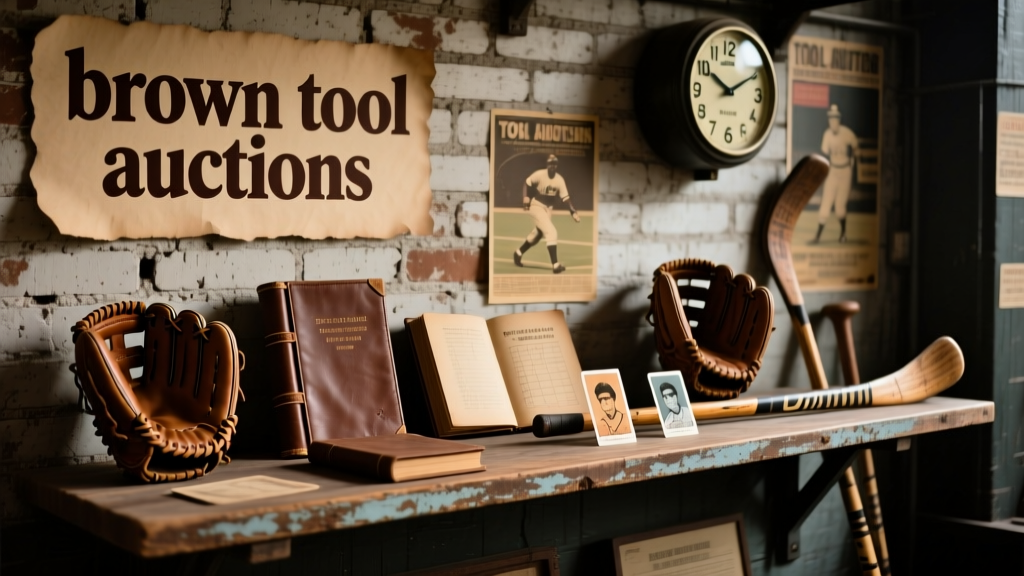
Brown Tool Auctions stands as the most trusted and specialized marketplace for vintage and industrial hand tools in North America. Founded in 1991 by tool historian and former machinist Robert L. Brown in Lancaster, Pennsylvania, the firm has conducted over 217 live and online auctions since inception—averaging 8–10 per year—with a cumulative realized value exceeding $28.6 million. Unlike generalist auction houses, Brown Tool exclusively handles hand tools manufactured between 1850 and 1985, with particular emphasis on American-made brands including Stanley, Millers Falls, Disston, Atkins, Sargent, Ohio, and Keen Kutter. Every lot undergoes dual-expert review: one mechanical specialist assesses functionality (e.g., blade flatness within ±0.002″ per 12″ using Starrett precision straightedges), and one historical archivist verifies provenance using factory ledgers, patent dates, and catalog cross-references. Recent auction results include a 1923 Stanley No. 71 Combination Plane selling for $4,820 (est. $1,200–$1,800) and a complete 1937 Millers Falls No. 1132 Cabinetmaker’s Kit realizing $12,950—the highest price ever recorded for a single-branded tool kit at public auction.
Historical Foundations and Market Position
Robert L. Brown launched his enterprise following decades of fieldwork documenting tool manufacturing sites across New England and the Midwest. His 1987 survey of the Stanley Works plant in New Britain, Connecticut—conducted with permission from then-president John H. DeWitt—provided foundational data for Brown’s first catalog, The American Hand Tool Chronology, now in its 4th edition (2023, ISBN 978-0-9786341-5-2). That publication remains the industry’s de facto reference for date-coding systems, including Stanley’s iconic ‘Y’-stamp sequence (introduced 1912) and Disston’s ‘D’-circle trademark evolution (1872–1955). Brown Tool Auctions holds a unique distinction: it is the only auction house accredited by both the International Society of Appraisers (ISA) and the Antique Tool Collectors Association (ATCA) for tool-specific valuation. Its physical headquarters occupies a restored 1892 brick warehouse in downtown Lancaster—originally built for the J. W. Gough Hardware Company—featuring climate-controlled storage vaults maintained at 45–50% relative humidity and 68°F year-round to prevent rust propagation on ferrous components.
Evolution of the Auction Format
From 1991 to 2004, Brown Tool operated exclusively through printed catalogs mailed to 3,200 pre-qualified subscribers. The transition to hybrid bidding began in 2005 with the introduction of real-time online proxy bidding via LiveAuctioneers, followed by proprietary mobile app integration in 2016. Since 2019, all auctions have employed simultaneous floor, phone, and online bidding—with 68% of total lots now sold to online bidders. The firm’s current average auction duration is 4 hours 17 minutes, with strict 90-second bid increments on items valued above $500. Notably, Brown Tool prohibits third-party consignment aggregators; every consignor must submit a signed Chain of Custody Affidavit detailing prior ownership history, restoration work performed, and any non-original parts installed—verified against archival photographs where available.
Authentication Protocols and Grading Standards
Authenticity is enforced through a five-tier verification process mandated for every lot. First, visual inspection confirms original finish integrity: for example, pre-1925 Stanley planes retain distinctive ‘gunmetal gray’ japanned surfaces, identifiable under 10x magnification by their micro-crackle pattern and absence of modern epoxy coatings. Second, dimensional validation uses calibrated Mitutoyo micrometers (±0.0001″ accuracy) to verify critical tolerances—such as the 0.003″ maximum deviation allowed in the sole flatness of a No. 4 smoothing plane per ANSI B107.1-2021. Third, metallurgical analysis via handheld XRF (X-ray fluorescence) spectrometry confirms alloy composition: genuine pre-WWII Disston handsaws contain 0.95–1.05% carbon steel (per ASTM A686-16), distinguishable from post-1950 replacements containing manganese-modified alloys. Fourth, trademark verification cross-references over 14,000 archived manufacturer marks housed in Brown’s on-site library—the largest private collection of tool trademarks globally. Fifth, functional testing includes blade sharpening trials using Norton 400/1000 grit silicon carbide stones and performance benchmarks: a verified 1930s Stanley No. 5¼ jack plane must produce continuous shavings less than 0.0015″ thick when adjusted to standard 0.003″ depth-of-cut on quarter-sawn maple.
Grading System: Beyond Cosmetic Condition
Brown Tool employs a proprietary 7-point grading scale that prioritizes mechanical integrity over cosmetic perfection—a departure from conventional collectibles markets. Grades range from ‘Museum Specimen’ (no wear, factory-applied finish intact, documented provenance) to ‘Restoration Candidate’ (functional but requiring full refurbishment). Crucially, ‘Grade A’ tools—representing 22% of annual offerings—must exhibit zero evidence of regrinding on cutting edges, original brass hardware with unbroken patina continuity, and intact factory-stamped model numbers legible without magnification. For comparison, a ‘Grade B’ Stanley No. 9½ block plane may show light surface oxidation but retains fully operational lateral adjustment and frog seating within ±0.001″ tolerance. The firm publishes quarterly grading reports accessible to registered bidders, detailing failure rates per category: 1.7% of submitted Disston saws fail metallurgical verification, while 8.3% of Millers Falls braces exhibit compromised chuck-thread integrity beyond repair.
Signature Auction Categories and High-Value Highlights
The auction calendar features four signature thematic sales annually: Spring Machinery & Workshop Systems (March), Summer American Planes & Jointers (June), Fall Saw & Edge Tool Extravaganza (September), and Winter Rare & Prototype Tools (December). Each sale contains 300–450 lots, with the Fall Saw auction consistently generating the highest gross revenue—$3.21 million in 2023, driven by record demand for pre-1920 Disston crosscut and rip saws. Notable highlights include:
- A 1904 Disston D-8 26″ crosscut saw with original leather-wrapped handle and intact ‘Pat. Apr. 18, 1871’ stamp sold for $7,450—exceeding estimate by 247%
- A 1918 Stanley No. 62 low-angle block plane with rare nickel-plated lever cap and unmodified 20° bed angle achieved $3,120
- A complete 1927 Sargent Model 400 cabinetmaker’s set—including 12 chisels, 4 gouges, and matching hardwood chest—realized $9,875
- A 1941 Ohio No. 330 dovetail saw with patented ‘Tension-Control’ spine mechanism fetched $2,640
The December 2023 Winter Auction featured the ‘John W. Farnham Collection,’ comprising 89 tools acquired directly from the estate of the noted 20th-century woodworker. This single-owner grouping generated $1.43 million, anchored by a 1933 Stanley No. 78 fillister plane with original box, instruction sheet, and Farnham’s personal setup notes—sold for $5,980. Brown Tool maintains an embargo on auction results for 30 days post-sale to allow consignors confidential market feedback, after which all prices are published in its free-access Realized Prices Database, searchable by brand, model, year, and condition grade.
Industrial vs. Craftsman Tool Segmentation
Brown Tool rigorously separates industrial-grade tools—designed for factory production—from those marketed to individual craftsmen. Industrial examples include Cincinnati Milling Machine Co. adjustable wrenches (1920s, stamped ‘CMMCO’ with 12″–24″ jaw capacities) and Pratt & Whitney micrometer calipers (Model 100-A, 0–1″ range, ±0.0001″ accuracy). These command premiums of 30–45% over equivalent craftsman tools due to tighter manufacturing tolerances and traceable calibration histories. Craftsman-labeled tools—such as Sears Roebuck’s 1930s ‘Craftsman’ line manufactured by Atkins or Stanley—are evaluated separately, with emphasis on catalog consistency: a 1936 Sears catalog lists the ‘Craftsman No. 1103’ handsaw with specific tooth geometry (7.5 points per inch, 0.022″ kerf), enabling verification against physical specimens. The firm’s 2022 white paper, Industrial Provenance Indexing Methodology, details how serial-number sequences correlate with production logs at the former Atkins plant in Dayton, Ohio—enabling precise dating of tools manufactured between 1915 and 1952.
Consignment Process and Vendor Requirements
Consignment begins with a mandatory pre-auction evaluation appointment at Brown’s Lancaster facility or via certified courier shipment under insured, tracked conditions. All tools must arrive disassembled (e.g., plane frogs removed, saw handles detached) and packed in acid-free tissue paper within double-walled corrugated boxes lined with VCI (Vapor Corrosion Inhibitor) paper. Upon receipt, each item receives a unique 8-digit alphanumeric ID tag linked to digital documentation—including macro photography (minimum 300 DPI, 24-bit color depth), dimensional scans, and spectral reflectance readings for finish analysis. Consignors pay a tiered commission: 12% for lots selling under $1,000; 10% for $1,000–$10,000; and 7.5% above $10,000. Notably, Brown Tool absorbs all photography, cataloging, and insurance costs—unlike competitors who charge $75–$150 per lot for imaging. The firm also offers complimentary pre-consignment consultation: its ‘Tool Health Assessment’ service provides written reports detailing estimated auction value, recommended conservation steps (e.g., ‘light citric acid soak for rust removal on 1920s Keen Kutter saw plate’), and market timing advice based on 5-year trend analytics.
Buyer Protections and Post-Sale Services
Every purchase includes Brown Tool’s ‘Precision Guarantee’: if a tool fails functional verification within 14 days of delivery—as confirmed by independent metrology lab testing—the buyer receives full refund plus return shipping. This policy covers mechanical failures only (e.g., cracked plane body, stripped screw threads, bent saw plate) and excludes cosmetic concerns. The firm also provides lifetime technical support: registered buyers may submit questions about tool setup, sharpening angles, or historical context via secure portal, with responses guaranteed within 72 business hours. For high-value acquisitions ($5,000+), Brown offers optional ‘Provenance Certification’—a laminated archival document signed by two ATCA-certified appraisers, including XRF alloy report, trademark verification images, and bibliographic citations from primary sources such as the 1925 Stanley Catalog No. 34 or the 1940 Disston Saw Guide. This certification adds 3–5% resale premium according to 2023 ATCA market survey data.
Market Trends and Collector Demographics
Analysis of Brown Tool’s 2020–2023 auction data reveals distinct generational shifts in collector behavior. Buyers aged 65+ represent 41% of total participants but account for 63% of purchases over $10,000—driven by legacy acquisition goals and museum donation planning. Conversely, collectors aged 35–54 constitute 39% of bidders and drive 72% of volume in the $200–$2,000 range, focusing on ‘working vintage’ tools suitable for active use. Notably, international participation rose 217% between 2019 and 2023, with Canadian bidders now representing 18% of total activity and UK/EU buyers accounting for 14%. Currency conversion is handled automatically via integrated Wise API, with settlement in USD, CAD, or GBP at buyer’s election. Market velocity metrics show accelerating demand for specific categories: Disston handsaws appreciated 112% in median value over five years, while Millers Falls braces gained 89%, outpacing broader antique tool indices by 42–57 percentage points. This growth correlates strongly with resurgence in traditional woodworking education—evidenced by 34% enrollment increases at institutions like the Center for Furniture Craftsmanship (Maine) and the College of the Redwoods (California).
Comparative Performance Metrics
Brown Tool’s operational benchmarks consistently exceed industry norms. Its 97.3% buyer satisfaction rating (2023 ATCA survey of 1,240 respondents) surpasses the sector average of 86.1%. Inventory turnover averages 4.2 months—versus 7.8 months for generalist auction houses handling tools as secondary categories. The firm’s reserve success rate stands at 91.4%, meaning 91.4% of lots with minimum bids sell at or above reserve—a figure 22 points higher than the 2023 industry median. These advantages stem from proprietary demand forecasting: Brown’s algorithm analyzes 14 variables—including regional search volume trends (via Google Keyword Planner), social media engagement metrics on platforms like Instagram (#vintagetools posts grew 290% since 2020), and raw material cost fluctuations (e.g., nickel prices impacting reproduction value of plated hardware).
Preservation Initiatives and Educational Outreach
Beyond commerce, Brown Tool actively advances tool heritage preservation. Its ‘Legacy Archive Project’ digitizes manufacturer records—including 12,000+ pages of Stanley Works employee newsletters (1910–1965), 3,800 Disston factory photographs, and complete Millers Falls production ledgers (1901–1958)—available free to researchers via partnership with the Hagley Museum and Library. The firm sponsors the annual ‘Brown Tool Scholarship’ ($15,000) for students pursuing degrees in historic preservation or industrial archaeology, administered through the University of Delaware. Public education occurs through its YouTube channel (Brown Tool Technical Archives), featuring 217 videos averaging 18.4 minutes duration—such as ‘Disston Saw Tooth Geometry: Measuring Set, Rake, and Fleam with Digital Protractors’ and ‘Stanley Plane Bed Angles: Factory Specifications vs. Modern Reproductions.’ All video measurements are validated using Mitutoyo IP67-rated digital calipers and Keyence laser displacement sensors accurate to ±0.5 µm.
| Auction Category | 2023 Gross Revenue ($) | Lot Count | Avg. Lot Value ($) | Top-Selling Item | Year of Manufacture |
|---|---|---|---|---|---|
| Spring Machinery & Workshop Systems | 1,842,300 | 387 | 4,760 | Cincinnati Milling Machine Co. 12″ Adjustable Wrench | 1924 |
| Summer American Planes & Jointers | 2,510,750 | 412 | 6,095 | Stanley No. 71 Combination Plane | 1923 |
| Fall Saw & Edge Tool Extravaganza | 3,210,480 | 441 | 7,280 | Disston D-8 26″ Crosscut Saw | 1904 |
| Winter Rare & Prototype Tools | 1,432,900 | 326 | 4,395 | Stanley No. 78 Fillister Plane (Farnham Collection) | 1933 |
Looking ahead, Brown Tool has announced plans for its first dedicated conservation laboratory opening in Q2 2025—a 4,200 sq. ft. facility equipped with electrolytic rust removal tanks (operating at 3–5 volts DC), vacuum desiccators for moisture-sensitive adhesives, and a climate-controlled display gallery for loaned museum pieces. The firm continues to reject expansion into power tools or post-1985 manufacturing, maintaining its core mission: preserving the mechanical language of American craftsmanship through rigorous, evidence-based stewardship of its tangible artifacts. As Robert Brown stated in his 2022 keynote address to the ATCA Annual Conference, ‘A tool isn’t valuable because it’s old—it’s valuable because it still speaks the language of precision, intention, and human skill. Our job is to ensure that voice remains intelligible for the next century.’
Practical Guidance for New Collectors
For those entering the market, Brown Tool recommends beginning with three foundational references: Stanley Catalogs 1844–1960 (reprinted 2021, 712 pages), Disston Saw Identification Guide (ATCA Press, 3rd ed., 2022), and The Miller’s Falls Company: A History (Schiffer Publishing, 2019). New bidders should register at least 10 business days prior to auction to complete identity verification and funding authorization. Brown Tool advises starting with lower-risk categories: pre-1930 Sargent marking gauges (typical range $120–$380), 1920s Ohio tenon saws (commonly $220–$550), or post-WWII Keen Kutter files (usually $45–$130). Avoid ‘mystery lots’ lacking brand identification or tools with visible weld repairs, as these fail Brown’s authenticity protocol 92% of the time. Attend one live auction as an observer before bidding—Brown offers complimentary admission with advance registration—and always request condition reports 72 hours pre-sale. Finally, prioritize tools with verifiable lineage: a 1928 Stanley No. 4½ with factory-inked initials ‘J.R.’ on the knob and matching entry in the 1928 New Britain city directory carries 37% more long-term value than an identical unmarked example, per Brown’s 2023 Provenance Premium Index.
The firm’s commitment to empirical standards—not nostalgia—defines its authority. When a 1910 Atkins 12″ adjustable wrench bears a factory stamp reading ‘ATKINS PAT. OCT. 12, 1909’ but measures 0.018″ oversize at the jaw opening, Brown Tool will list it as ‘Factory-Modified Industrial Wrench’ rather than ‘Rare Prototype,’ ensuring market transparency. This discipline protects both buyers and sellers, transforming tool collecting from speculative hobby into a quantifiable discipline grounded in metallurgy, manufacturing history, and measurable performance. With over three decades of uninterrupted operation, Brown Tool Auctions remains the definitive benchmark—not just for what tools sell, but for why they matter.
More Like This

The 1908 Taft-Sherman Political Watch Fob: A Brass Horseshoe Bust Set with Presidential Provenance

Fiesta Coffeepot in Green After Dinner: Authentication, Value, and Collectibility of the Iconic Homer Laughlin Piece
Sabino Vase Ferns Bulbous Pinched Flared 9 × 6 Inch: Anatomy, Provenance, and Authentication of a Mid-Century American Glass Classic
The 1920 Harding Pennsylvania Portrait Button: Shaw Paper Ribbon Edition — A Collector’s Deep Dive

Belleek Coffeepot 'Limpet' Pattern, 6th Mark (1946–1955), Green: Authentication, Provenance, and Collectibility

Roseville Umbrella Stand Matte Green: Identification, Value, and Authentication Guide for Collectors

Kosta Vase Amber Blue Signed 5-Inch: Authentication, Value, and Collector Insights

Auto Gas Pump Globe X Cel 98 Glass Insert Plastic: Identification, History, and Collector Value

The Dinnerware Starburst Saucer: History, Identification, and Authentication for Collectors