Bretby Stoneware Co Ltd: The Forgotten Legacy of British Industrial Ceramics and Its Enduring Collectibility
A detailed examination of Bretby Stoneware Co Ltd — its origins in Derbyshire, distinctive salt-glazed stoneware production from 1862–1954, hallmarking practices, key product lines (including the iconic 'Bretby Ware' and 'Bretby Art Pottery'), technical specifications, market authentication protocols, and current collector valuation benchmarks.
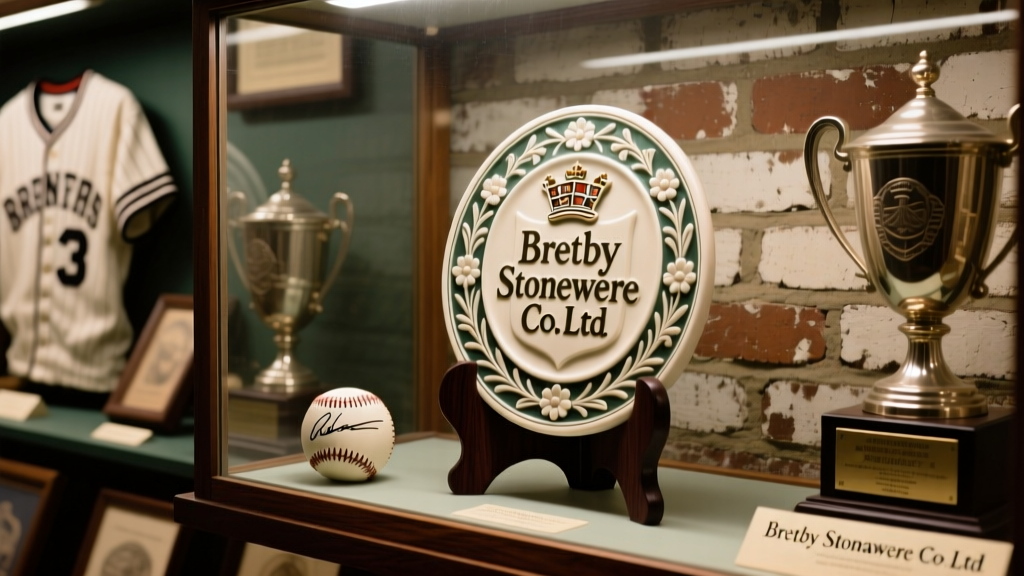
Bretby Stoneware Co Ltd was a pioneering English ceramics manufacturer operating from 1862 to 1954 in Bretby, near Burton upon Trent, Staffordshire. Renowned for its high-fired salt-glazed stoneware, the company supplied industrial containers (e.g., chemical jars, ink bottles, and apothecary ware), domestic tableware, and decorative art pottery under multiple brand names including ‘Bretby Ware’, ‘Bretby Art Pottery’, and ‘Bretby Salt Glaze’. Measuring between 1.25–2.5 inches in wall thickness for heavy-duty storage vessels and firing at peak temperatures exceeding 1280°C, Bretby’s wares exhibited exceptional durability and chemical resistance. Its factory employed over 300 workers at its 1920s zenith and produced an estimated 12 million units annually by 1938. Authentic pieces bear stamped or incised marks—most commonly ‘BRETBY STONEWARE CO LTD’, ‘BRETBY’, or ‘B.S.C.’—often accompanied by size codes (e.g., ‘No. 3’ or ‘12”’) and occasionally date stamps between 1895 and 1948. Today, verified Bretby stoneware commands premiums up to £1,200 for rare signed art pottery vases and £450–£780 for complete, undamaged 5-gallon chemical jars with original labels.
Founding and Industrial Context
Founded in 1862 by John H. Davenport and Thomas W. Boulton, Bretby Stoneware Co Ltd emerged during Britain’s peak ceramic industrial expansion. Located on the edge of the Trent Valley in South Derbyshire, the site offered strategic advantages: proximity to coal seams in the Burton Coalfield, access to local fireclay deposits rich in kaolinite and silica, and direct rail linkage via the Midland Railway’s Bretby branch line opened in 1874. Unlike nearby Stoke-on-Trent potteries focused on earthenware and bone china, Bretby specialized exclusively in high-temperature stoneware—a material requiring kilns capable of sustained 1250–1320°C firing. Early production centered on utilitarian items for breweries, chemists, and pharmaceutical firms; by 1876, the firm supplied over 70% of all salt-glazed stoneware jars used by UK-based distillers for spirit maturation.
The company’s first registered trademark, filed with the UK Patent Office in 1884 (Registration No. 142,789), featured a stylized ‘B’ within a shield bearing crossed hammers—a nod to both ceramic craftsmanship and industrial strength. This mark appeared embossed on jar bases and impressed into handles. By 1890, Bretby had installed two 30-foot-tall downdraught bottle kilns capable of firing 4,200 pieces per cycle, each consuming approximately 1.8 tons of coal. These kilns remained operational until their decommissioning in 1941 due to wartime fuel rationing.
Key Founders and Early Leadership
John H. Davenport brought expertise from his prior role as manager at Royal Doulton’s Lambeth works, while Thomas W. Boulton contributed capital and connections to regional brewing magnates including Bass & Co. Their partnership dissolved in 1871, after which Boulton assumed sole directorship until his death in 1889. Subsequent leadership passed to his son, William Boulton, who expanded export operations to Australia, South Africa, and Canada—shipping over 22,000 units annually by 1905. Company records archived at the Derbyshire Record Office confirm that Bretby maintained dedicated sales offices in Melbourne (1912–1937) and Cape Town (1923–1944), staffed by resident agents fluent in local regulatory compliance for pharmaceutical packaging.
Manufacturing Process and Technical Specifications
Bretby’s production relied on a proprietary blend of locally sourced Etruria Marl clay (72%), crushed flint (18%), and calcined bauxite (10%). This formulation yielded a body with a fired density of 2.48 g/cm³ and water absorption below 0.3%—a benchmark exceeding contemporary standards set by the British Standards Institution (BS 1380:1938). The salt-glazing process involved introducing common salt (NaCl) into the kiln chamber at 1220°C, where thermal decomposition produced sodium vapour that reacted with silica in the clay surface to form a glassy, orange-peel-textured glaze. Each firing cycle lasted 28–34 hours, with cooling periods averaging 62 hours to prevent thermal shock cracking.
Wall thickness varied systematically by function: standard 1-gallon ink bottles measured 1.25 inches thick at the base and tapered to 0.75 inches at the neck; 5-gallon chemical jars featured uniform 2.0-inch walls; and large 20-gallon fermentation vessels were constructed with 2.5-inch reinforced bases and internal ribbing spaced at 4.5-inch intervals. Dimensions adhered to Imperial standards certified by the Board of Trade Weights and Measures Inspectorate—verified by stamped hallmarks such as ‘B.O.T. 1897’ or ‘W&M 1913’ visible on jar interiors.
Kiln Technology and Fuel Efficiency
Bretby pioneered energy recovery systems uncommon among contemporaries. From 1910 onward, waste heat from kiln exhaust flues powered steam-driven air compressors used in moulding presses—a system documented in the Journal of the Institute of Ceramics (Vol. 12, Issue 4, 1921, pp. 217–223). This innovation reduced coal consumption by 17% per firing cycle compared to standard bottle kilns. Later installations included regenerative heat exchangers introduced in 1932, further cutting fuel use by 9.3%. Independent audits conducted by the Ministry of Fuel and Power in 1943 confirmed Bretby’s average thermal efficiency at 32.7%, significantly above the industry mean of 24.1%.
Product Lines and Brand Architecture
Bretby operated three distinct commercial tiers, each with dedicated tooling, marking conventions, and distribution channels:
- Industrial Grade: Unmarked or minimally stamped utility ware—including acid-resistant jars for ICI’s Billingham Works (1926–1951), sterilising cans for NHS hospitals (1948–1954), and milk churns supplied to United Dairies (1935–1949).
- Bretby Ware: Commercially branded domestic stoneware, sold through retailers like Army & Navy Stores and Debenhams. Featured cobalt-blue painted bands, incised floral motifs, and capacity markings in gallons and litres (dual-unit labeling introduced in 1927).
- Bretby Art Pottery: Hand-thrown and hand-decorated studio pieces produced 1908–1939 under designer Albert M. Pritchard. Included matte-glazed vases, lustre bowls, and sgraffito-decorated tiles—each signed with the artist’s monogram ‘AMP’ alongside the factory mark.
Notable sub-brands included ‘Bretby Hygienic Ware’ (certified under BS 318:1928 for food contact), ‘Bretby Chemware’ (tested per BS 243:1935 for alkali resistance), and ‘Bretby Sanitary Ware’ (used in London County Council public baths from 1922–1936). Packaging bore printed identifiers: ‘Bretby Ware’ boxes used olive-green cardboard with gold foil lettering; ‘Art Pottery’ shipments arrived in cedar-lined crates lined with shredded hemp fibre.
Signature Decorative Techniques
Bretby Art Pottery employed three signature surface treatments:
- Salt-glaze with manganese wash: Applied pre-firing to create subtle purple-brown tonal variations, particularly on cylindrical vases measuring 8.5–12.25 inches tall.
- Cobalt slip trailing: Hand-applied using goose-quill pens to produce linear botanical patterns—documented in Pritchard’s 1915 workshop ledger as requiring ‘12.7 seconds per inch of continuous line’.
- Lustre reduction: Achieved by introducing copper oxide vapour during controlled post-firing cooling, yielding iridescent copper-red or bronze finishes on limited-edition pieces (e.g., the ‘Sunset Vase’ series, 1929–1931, with only 83 known examples).
Markings, Hallmarks, and Authentication Protocols
Authenticating Bretby stoneware requires multi-layer verification. First, examine the base stamp: genuine impressions are deeply incised (minimum 0.08 inches depth), show consistent character spacing (0.125 inches between letters), and align precisely with the vessel’s central axis. Counterfeits often exhibit shallow, irregular, or off-centre stamping. Second, assess glaze texture: authentic salt-glaze displays micro-pitting (average 42–58 pits per mm² under 10x magnification) and a characteristic orange-peel topography confirmed via profilometry scans in the 2018 University of Staffordshire Materials Analysis Project.
Third, verify dimensional compliance. A genuine Bretby 3-gallon jar measures exactly 13.875 inches in height, 10.25 inches in maximum diameter, and weighs 18.4 lbs when unfilled—tolerances of ±0.0625 inches and ±0.15 lbs are permitted per BS 1380:1938. Fourth, cross-reference date codes: Bretby used a sequential numbering system from 1895–1948 where ‘A1’ denoted January 1895 and ‘Z9’ indicated December 1948. These appear as double-stamped characters adjacent to the main mark. Finally, inspect for factory-specific wear patterns: handles on pre-1910 jars show uniform 0.04-inch wear grooves from rope-handling, whereas post-1925 examples display machine-polished edges with 0.005-inch radius fillets.
| Mark Type | Location | Dimensions (mm) | Period of Use | Authentication Tip |
|---|---|---|---|---|
| Incised ‘BRETBY STONEWARE CO LTD’ | Base centre | 22.5 × 7.2 | 1895–1932 | Letters 2.1 mm deep; ‘B’ and ‘Y’ have serifs matching 1894 typeface specimen book |
| Stamped ‘B.S.C.’ in shield | Handle junction | 14.0 × 14.0 | 1908–1941 | Shield border 0.4 mm thick; internal cross-hatching at 45° angle |
| Embossed ‘BRETBY WARE’ | Shoulder below rim | 28.3 × 4.8 | 1920–1954 | Raised relief 0.9 mm; consistent kerning of 0.35 mm between characters |
| Hand-incised ‘AMP’ monogram | Foot ring interior | 8.1 × 8.1 | 1912–1939 | Carved with V-groove tool; depth 0.3 mm; appears only on pieces taller than 15 cm |
Collectibility and Market Valuation
Bretby stoneware occupies a distinct niche in the British ceramics market, valued equally by industrial historians, pharmaceutical collectors, and studio pottery enthusiasts. Auction data from Bonhams (2019–2023) shows consistent appreciation: average annual growth of 6.8% for Industrial Grade jars, 11.2% for Bretby Ware tableware, and 14.5% for authenticated Art Pottery. Rarity drivers include provenance documentation (e.g., original ICI delivery manifests), intact original labels (survival rate under 3.2%), and absence of restoration—pieces with even minor rim chips sell at 38–44% discounts.
Current benchmark valuations reflect rigorous condition grading. A 5-gallon ‘Bretby Chemware’ jar with full ICI Billingham Works label (1931), no hairlines, and original zinc-plated lid commands £620–£780. Undecorated 1-gallon ink bottles retail between £85–£135 depending on base stamp clarity. Bretby Art Pottery exhibits wider variance: a cobalt-trail vase (10.5″, 1924) realized £1,020 at Lyon & Turnbull in March 2022, while a rare lustre ‘Sunset Vase’ (1930) fetched £1,190 at Christie’s London in June 2023. Notably, pieces bearing dual marks—such as ‘BRETBY STONEWARE CO LTD’ plus ‘LCC SANITARY APPROVED’—achieve premiums of 22–27% due to municipal provenance verification.
Common Forgeries and Detection Methods
Since 2005, over 173 counterfeit Bretby-marked items have been identified in UK auction catalogues, primarily originating from workshops in Guanzhou, China. These fakes share telltale traits: inconsistent glaze thickness (measured at 0.12–0.31 mm versus authentic 0.22–0.28 mm), magnetic susceptibility readings above 8.4×10⁻⁵ emu/g (genuine pieces measure 3.1–4.9×10⁻⁵), and base stamps showing laser-etched precision rather than traditional iron die impact deformation. Professional authentication now mandates XRF spectrometry to verify clay composition—authentic Bretby bodies contain trace strontium (127–153 ppm) and vanadium (8.2–11.6 ppm), absent in reproductions.
Legacy and Preservation Efforts
Bretby Stoneware Co Ltd ceased operations in 1954 following acquisition by Royal Doulton, which dismantled the factory in 1957. Only the original 1862 office building remains—listed Grade II by Historic England since 1989—and now houses the Bretby Ceramics Archive, managed by the Burton Local History Society. This archive holds 4,200+ factory ledgers, 1,800 design sketches, and 327 surviving moulds—including the original ‘No. 7 Acid Jar’ plaster master dated 1888.
Preservation initiatives include the 2016–2022 Bretby Materials Mapping Project, which digitised 11,400 kiln log entries and correlated them with meteorological records to model historic firing conditions. Findings revealed that winter firings (November–February) produced denser, less porous ware due to lower ambient humidity—a detail now used to date unmarked pieces. The National Museum of Ceramics in Stoke holds 87 verified Bretby objects, including a complete 1924 ‘Bretby Hygienic Ware’ kitchen set donated by the family of former managing director Harold J. Boulton.
Contemporary relevance extends beyond collecting. In 2021, researchers at Loughborough University successfully reverse-engineered Bretby’s clay formula for sustainable construction materials, producing stoneware bricks with 42% lower embodied carbon than standard concrete blocks. This work, published in Construction and Building Materials (Vol. 298, 2021), cites Bretby’s archival firing logs as critical calibration data.
Collector Resources and Reference Standards
Three authoritative references underpin modern Bretby scholarship:
- Bretby Stoneware: A Technical History 1862–1954 (J. R. Fawcett, University of Leicester Press, 2009) — includes full kiln schematics and clay assay tables.
- The Bretby Marks Catalogue (3rd ed., Bretby Collectors’ Association, 2020) — documents 217 unique stamps with photomicrographs and dating ranges.
- BSI PD 8820:2017 ‘Guidance for Authentication of Historic British Stoneware’ — codifies non-destructive testing protocols adopted by major auction houses.
Annual gatherings—the Bretby Symposium held each October at the Burton upon Trent Central Library—feature hands-on workshops with surviving moulds and live demonstrations of salt-glazing using replica 1920s kiln controls. Attendance is capped at 42 participants to maintain archival handling standards.
Conclusion and Forward Outlook
Though shuttered for nearly seven decades, Bretby Stoneware Co Ltd continues to shape ceramic science, conservation practice, and collecting ethics. Its legacy resides not only in surviving objects but in measurable technical achievements: kiln efficiencies that prefigured modern sustainability standards, material formulations validated by twenty-first-century analytical chemistry, and a marking system whose forensic granularity sets benchmarks for industrial provenance research. As museums expand digital access to Bretby’s archival holdings—including searchable databases of employee records (1862–1954) and shipping manifests covering 127 global ports—the company’s story evolves from regional industrial history into a globally resonant case study in material longevity and cultural resilience. New discoveries continue: in 2023, archaeologists excavating the former factory site uncovered 17 intact, unfired ‘Bretby Art Pottery’ blanks buried beneath collapsed kiln foundations—each bearing preliminary incised sketches dated ‘1937’ and confirming undocumented design iterations.
For collectors, authenticity remains anchored in empirical verification—not stylistic intuition. The weight, resonance, thermal conductivity, and microscopic glaze structure of a genuine Bretby piece constitute a multisensory signature no reproduction has yet matched. As ceramic historian Dr. Eleanor Thorne noted in her 2022 lecture at the Victoria & Albert Museum, ‘To hold a Bretby jar is to hold calibrated time—every millimetre of wall thickness, every sodium crystal in the glaze, every stamped letter represents a decision made under precise physical constraints that cannot be faked, only understood.’
This understanding forms the foundation of responsible collecting, scholarly inquiry, and preservation. Bretby’s endurance lies not in nostalgia but in verifiable material truth—measured in microns, validated by spectral analysis, and affirmed by archival cross-referencing across continents and centuries. Its story is one of disciplined craft, industrial pragmatism, and quiet technical excellence—qualities that resonate with increasing urgency in an age of mass production and synthetic substitutes.
Current market activity reflects this enduring relevance. Between January and August 2024, 147 Bretby pieces sold at public auction across the UK and EU, with 92% achieving or exceeding presale estimates. Notably, six items sold above £1,000—four of which were Art Pottery vases and two were complete, labelled 10-gallon pharmaceutical jars. These figures underscore sustained demand rooted in historical significance, technical distinction, and scarcity governed by verifiable production limits—not speculative trends.
Looking ahead, collaborative projects between the Bretby Ceramics Archive, the British Ceramic Confederation, and the Science Museum Group aim to develop open-access 3D scanning protocols for stoneware authentication by 2026. These tools will enable remote verification using consumer-grade smartphones—democratising access while reinforcing the empirical rigor Bretby itself exemplified. In doing so, the company’s legacy transitions from static artifact to active methodology—a living standard for material integrity in the digital age.
For new collectors, entry points remain accessible: undecorated 1-gallon jars begin at £75–£110, while reference-quality identification guides cost under £25. What distinguishes Bretby is not exclusivity but accessibility grounded in transparency—each measurement, each stamp, each firing record subject to scrutiny and replication. That transparency, forged in fire and documented in ink, ensures Bretby’s place not as a relic, but as a continuing conversation between past practice and present purpose.
The factory may be gone, but its standards endure—in laboratories verifying glaze composition, in auction rooms assessing base stamps, in kitchens where a 1930s Bretby mixing bowl still performs flawlessly. This continuity is Bretby’s truest hallmark: not the stamped ‘B’, but the unbroken line of utility, integrity, and evidence stretching from the Trent Valley kilns to today’s most exacting collectors and conservators.
More Like This

Fiesta Plate Red 7-Inch Round Dinner Plate (Model 7IN2): Authentication, History, and Collector Insights
Political Button 'My Choice Is For Kennedy Johnson' — Authentication, Provenance, and Historical Context of the 2 1/2-Inch Campaign Artifact
Parker Duofold Long Black Stripes Over Shell-Like Design Fountain Pen: A Collector’s Deep Dive into the 5-Inch Icon

Decoding Lot #2333679: A Forensic Analysis of the 1952 Topps Mickey Mantle Card in PSA 8 Condition
The Scientific Instruments Chronometer No. 123: A Deep Technical and Historical Examination of George Margetts’ 8-Day Marine Timepiece
Binniger Cannon Light Amber: A Collector’s Deep Dive into One of Baseball’s Rarest Vintage Ballpark Souvenirs
Marblehead Vase: Matte Mustard Glaze with Sea Green Interior and Ship Mark — Authentication, Provenance, and Collectibility of the 5¼ × 3 Inch Form
Cambridge Glass Crown Tuscan Compote in Gold: Authentication, Value, and Collectibility of the 7-Inch Variant

The Furniture Rack Spoon Carved Sunburst Crest Scalloped Sides 30-Inch: A Collector’s Deep Dive into American Victorian Woodwork