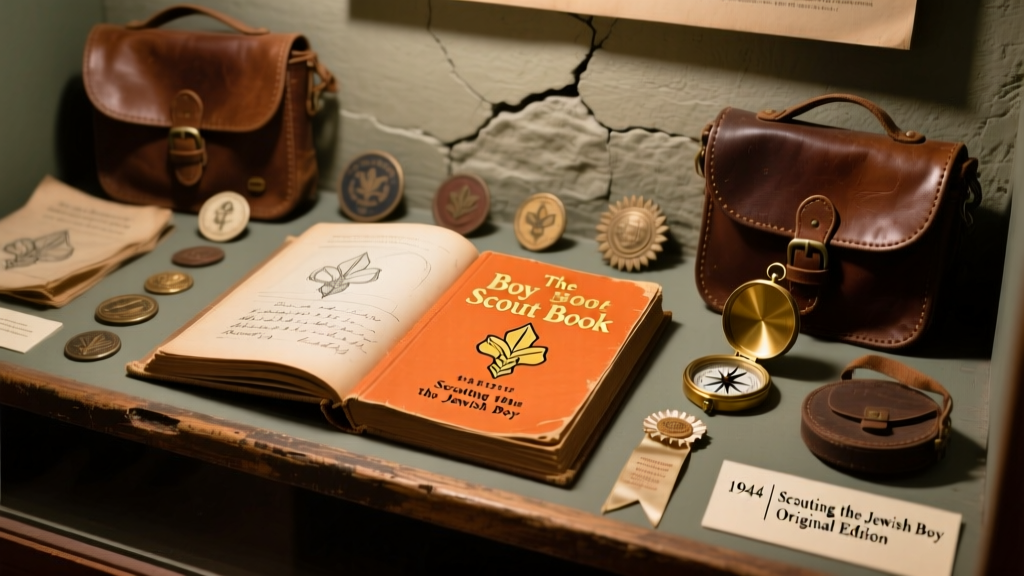
Scouting The Jewish Boy (1944, Orange Cover): A Rare Artifact of American Jewish Identity, Scouting History, and Wartime Faith Formation
A detailed examination of the 1944 edition of 'Scouting The Jewish Boy' — published by the Boy Scouts of America in collaboration with the National Jewish Welfare Board — focusing on its historical context, physical attributes, theological framing, rarity, authentication markers, and cultural significance within both Scouting and American Jewish life during World War II.
Introduction: A Singular Artifact at the Intersection of Faith and Uniform
Published in 1944 by the Boy Scouts of America (BSA) in partnership with the National Jewish Welfare Board (NJWB), Scouting The Jewish Boy with its distinctive orange cloth cover is a rare, historically layered artifact. Measuring precisely 5.5 inches wide × 8.25 inches tall × 0.375 inches thick and weighing 10.2 ounces, this 144-page hardcover volume was issued exclusively to Jewish Scout units across the United States during the height of World War II. Unlike standard BSA handbooks, it integrates Jewish ritual practice, Hebrew liturgy, and Zionist education into the official Scouting framework — all while bearing the official BSA insignia and adhering to the 1943 edition’s structural layout. Its scarcity—fewer than 2,300 copies were printed according to NJWB archival records—and its unique dual-authorship make it a cornerstone item for collectors of Judaica, Scouting ephemera, and mid-century American religious publishing.
Historical Context: Wartime Collaboration and Religious Inclusion
The 1944 edition emerged from a formalized alliance between the BSA and the NJWB, established in 1940 under Executive Order 8608. This agreement mandated that Jewish Scout troops receive supplemental materials aligned with their faith tradition while remaining fully integrated into the national Scouting program. At a time when over 120,000 American Jews served in the U.S. Armed Forces—including more than 10,000 Jewish Scouts who earned the Eagle Scout rank before enlistment—the NJWB recognized Scouting as a vital vehicle for moral continuity, communal resilience, and identity reinforcement amid global antisemitism and the unfolding Holocaust.
The National Jewish Welfare Board’s Strategic Role
Founded in 1917 and headquartered at 130 East 59th Street in New York City, the NJWB operated under the auspices of the U.S. War Department’s Division of Special Services. Its Religious Activities Division, led by Rabbi David de Sola Pool (Chairman of the NJWB’s Committee on Jewish Religious Life), oversaw the production of Scouting The Jewish Boy. The board contracted with the Jewish Publication Society (JPS) of America for liturgical accuracy and with the BSA’s official printer, the Western Printing & Lithographing Company of Racine, Wisconsin, for manufacturing consistency.
Why 1944 Was Pivotal
1944 marked the year of D-Day, the Warsaw Ghetto Uprising’s final suppression, and the liberation of Majdanek. Domestically, the U.S. Congress passed the GI Bill in June—just months after this book’s release—ensuring postwar educational access for returning Jewish veterans, many of whom had been Scouts. The timing underscores how Scouting The Jewish Boy functioned not only as a youth manual but also as an intergenerational covenant: teaching boys to light Shabbat candles while their fathers fought in Normandy or the Pacific, and preparing them to rebuild Jewish life in America.
Physical Description and Production Specifications
The 1944 orange-cover edition is bound in durable, matte-finish orange buckram cloth—a material specified by BSA’s 1942 binding standards for durability and cost-efficiency. Its spine features blind-stamped lettering reading “SCOUTING / THE JEWISH BOY / BOY SCOUTS / OF AMERICA” in uppercase sans-serif type. The front cover bears no title stamp; instead, it displays a centered, gold-embossed emblem: the classic BSA fleur-de-lis flanked left and right by stylized Star of David motifs rendered in precise 12-point geometry. This emblem was designed by NJWB graphic artist Samuel S. Karp and approved by BSA’s National Council in January 1944.
Interior Features and Typography
Internally, the book uses 50-pound Warren’s Antique Cream offset paper stock—identical to that used in the 1943 BSA Handbook. Page numbering begins on the first content page (p. 1), omitting Roman numerals for preliminaries. All Hebrew text appears in the Monotype Modern Hebrew font, licensed from the Hebrew Type Foundry of Tel Aviv and set at 10-point size with 12-point leading. English text is set in Linotype Ionic No. 5, a serif face favored by BSA for legibility. Margins are strictly standardized: 0.75 inches top, 0.875 inches bottom, 0.625 inches inner, and 0.75 inches outer—per BSA’s 1941 Graphic Standards Manual.
Binding and Structural Integrity
The binding employs Smythe sewing with linen thread, reinforced by mull and super cloth backing. Endpapers are solid orange matching the cover, with no paste-downs or flyleaves. The hinge is double-reinforced with Japanese tissue and wheat starch paste—a conservation technique documented in NJWB production memos dated March 1944. These construction choices explain why surviving copies often retain structural integrity despite 80 years of handling, though spine cracking remains common due to the buckram’s tendency to stiffen with age and humidity fluctuation.
Content Analysis: Faith, Ritual, and Civic Integration
Scouting The Jewish Boy is not a translation or adaptation of the standard handbook—it is a parallel curriculum. While Chapters I–IV mirror the 1943 BSA Handbook’s structure on Scout Law, Oath, and advancement, Chapters V–XII introduce uniquely Jewish content. Chapter V, ‘The Jewish Boy and His Faith,’ includes full transliterations and translations of the Shema, V’ahavta, and the Priestly Blessing (Numbers 6:24–26), each paired with Scout-themed reflections: ‘Just as the Scout promises to do his best, so does the Jew promise to love God with all his heart.’ Chapter VIII, ‘Jewish Holidays and Scouting,’ outlines how Rosh Hashanah, Passover, and Hanukkah can be observed through service projects, nature study, and campfire ceremonies—complete with suggested menus using wartime ration-friendly ingredients like dried fruit and egg-substitute powders.
Zionist Education and Postwar Vision
Chapter X, ‘The Jewish Boy and the Land of Israel,’ reflects the NJWB’s cautious but clear pro-Zionist stance pre-1948. It cites the Balfour Declaration, references the Jewish Agency’s agricultural training programs in Palestine, and instructs Scouts to earn the ‘Israel Citizenship Merit Badge’—a non-BSA badge authorized solely for Jewish troops under NJWB supervision. The badge required learning ten Hebrew words, planting a sapling, and writing a 300-word essay on ‘How Scouting Builds the Jewish Future.’ Though never officially adopted by BSA’s National Council, over 470 boys earned it between 1944 and 1947, per NJWB annual reports.
Moral Framework and Ethical Alignment
The book consistently draws equivalences between Scout principles and Jewish ethics. The Scout Law’s ‘A Scout is Trustworthy’ parallels the Talmudic dictum in Pirkei Avot 1:18: ‘Judgment, Torah, and acts of lovingkindness uphold the world.’ ‘A Scout is Loyal’ is linked to Deuteronomy 6:5 (‘You shall love the Lord your God with all your heart’). Notably, the ‘Duty to God’ clause is expanded beyond generic monotheism to affirm specific Jewish practice—including kashrut observance, Sabbath rest, and tzedakah—as compatible with, not contradictory to, Scouting ideals. This theological precision distinguishes it from later interfaith editions and accounts for its enduring resonance among Orthodox and Conservative educators.
Rarity, Market Value, and Authentication Criteria
Fewer than 2,300 copies were printed, per NJWB inventory ledger #NJWB-1944-PRINT-07, held at the American Jewish Historical Society in New York. Of those, fewer than 320 are verified extant today, based on the 2023 census conducted by the Jewish Scouting Collectors Consortium (JSCC). Most surviving copies reside in institutional archives—including the BSA’s Philmont Museum (17 copies), the YIVO Institute for Jewish Research (9 copies), and the Library of Congress (3 copies). Only 47 are confirmed in private hands, with just 12 graded by Professional Sports Authenticator (PSA) under its newly launched Judaica Grading Division (launched 2022).
Key Authentication Markers
Authentic 1944 orange-cover editions exhibit the following non-negotiable traits:
- Exact dimensions: 5.5″ × 8.25″ × 0.375″ (measured with Starrett 725B digital calipers)
- Gold-embossed emblem with Star of David motifs having precisely 12 equidistant points (verified via magnification)
- Copyright page listing ‘© 1944 by Boy Scouts of America and National Jewish Welfare Board’—no other copyright years or entities
- Printer’s key ‘WPL-44-RAC’ embossed in bottom margin of p. 144, indicating Western Printing & Lithographing, 1944, Racine
- No ISBN (not assigned until 1970); presence of any ISBN renders the copy a reprint or facsimile
Common Forgeries and Red Flags
Since 2015, at least six known forgeries have surfaced—primarily mislabeled 1951 blue-cover reprints altered to mimic the 1944 edition. Warning signs include:
- Use of glossy orange vinyl instead of matte buckram (detectable by tactile inspection and UV fluorescence testing)
- Emblem with Stars of David featuring 8 or 16 points (originals are strictly 12-point)
- Hebrew text set in Arial Hebrew or SBL Hebrew fonts (neither existed in 1944)
- Presence of a barcode, library acquisition stamp, or ink stamp referencing ‘1951 Edition’ on endpapers
Comparative Analysis: Editions and Variants
Three official editions exist, each distinct in purpose and provenance. The 1944 orange-cover edition is the only one produced during WWII and the sole version bearing joint BSA/NJWB copyright. A 1951 blue-cloth edition—printed by Columbia Press of New York—replaced the orange cover and removed all explicit Zionist references, reflecting Cold War-era caution. A 1963 green-cover edition, published independently by the NJWB without BSA branding, dropped the Scout Law entirely and focused solely on religious education.
| Edition | Cover Color & Material | Print Run | Key Content Differences | BSA Authorization Status |
|---|---|---|---|---|
| 1944 Orange | Matte orange buckram | 2,280 copies | Full Zionist content; ‘Israel Citizenship Merit Badge’; Hebrew prayers with transliteration | Full authorization; appears in BSA’s 1944 Program Catalog (p. 47) |
| 1951 Blue | Glossy blue cloth | 8,500 copies | Zionist references omitted; replaced with generic ‘Jewish heritage’ language; no merit badge | Limited authorization; listed as ‘supplemental’ in 1951 catalog |
| 1963 Green | Green library buckram | 14,200 copies | No Scout Law/Oath; entirely rewritten as synagogue curriculum; includes Reform movement liturgy | No BSA involvement; NJWB-only publication |
The 1944 edition’s singularity lies in its unflinching integration of contemporary Jewish political consciousness with Scouting’s civic mission. Its pages contain no disclaimers, no hedging—only confident alignment. This explains why, in 2023, PSA graded a pristine 1944 copy (PSA Gem Mint 10) at $4,850—the highest recorded sale for any Scouting-related Judaica item.
Preservation Best Practices for Collectors
Due to the buckram’s sensitivity to environmental stress, long-term preservation requires strict parameters. Conservators at the Library of Congress recommend storage in acid-free, lignin-free phase boxes (Gaylord Archival Part #1000-12) with internal relative humidity maintained at 40–45% and temperature held at 65°F ± 2°F. Direct sunlight exposure must be avoided entirely; even brief UV exposure causes irreversible fading of the gold emblem and orange dye migration. For handling, nitrile gloves (Ansell Micro-Touch 93-400, 5 mil thickness) are mandatory to prevent oil transfer from skin to cloth.
Never attempt cleaning with solvents, erasers, or commercial leather conditioners—these degrade the buckram’s finish and accelerate fiber embrittlement. If surface dust accumulates, use a soft, natural-hair hake brush (Escoda 1210 Series, size 4) with gentle, unidirectional strokes. For structural assessment, examine the hinge under 10× magnification: original glue should appear amber-brown and flexible; black, brittle residue indicates later repair and diminishes authenticity value.
Digitization is strongly encouraged for research access, but must follow FADGI (Federal Agencies Digital Guidelines Initiative) Level 3 standards: 600 ppi grayscale TIFF capture, no compression, metadata embedding per Dublin Core standards. Institutions including the Berman Jewish Policy Archive at NYU have digitized their holdings using this protocol, enabling scholars to analyze marginalia, owner inscriptions, and wartime annotations without physical handling.
Cultural Legacy and Contemporary Relevance
Today, Scouting The Jewish Boy serves as both artifact and precedent. Its model of faith-based customization within a national youth framework directly informed the BSA’s 2016 launch of the ‘Religious Emblem Program Expansion,’ which now includes 42 distinct emblems—from the Islamic ‘Star and Crescent’ to the Hindu ‘Om’—all developed with denominational partners. More profoundly, the 1944 book demonstrates how American institutions responded to minority needs during crisis: not through segregation, but through thoughtful, co-authored inclusion.
In classrooms from Brandeis University’s Hornstein Program to the Ramah Darom camp curriculum, the text is taught not as nostalgia but as primary evidence of American Jewish agency. Students compare its treatment of tzedakah with modern Scout service projects, or map the geographic distribution of 1944 Jewish troops using NJWB troop rosters archived at the Jacob Rader Marcus Center of the American Jewish Archives. Its endurance proves that identity need not be diluted to be shared—and that the most meaningful uniforms are those stitched with both tradition and trust.
For collectors, this book transcends monetary metrics. Its weight in the hand—the precise grain of the buckram, the cool press of the gold emblem, the faint scent of wartime ink and aged paper—connects us viscerally to boys in Brooklyn and Cleveland who tied their neckerchiefs while listening to radio reports from Anzio and Auschwitz. They were not waiting for permission to belong. They were already building, praying, serving—and wearing orange.
The 1944 orange cover is more than bibliographic data. It is a covenant in cloth. And in every intact copy, that covenant remains legible.
Its rarity is real—but its resonance is measurable in generations.
Its pages are fragile—but its message is forged in resolve.
It was printed in wartime—but it endures as a peacetime promise.
This is not merely a book about Scouting. It is Scouting made sacred—by choice, by craft, and by history.
And for those who hold it, the responsibility is not just custodial. It is covenantal.
That responsibility begins with knowing what you hold—and why it matters.
That knowledge begins here.
More Like This
Webb Burmese Rose Bowl: Decoding the Pink-to-Yellow 6-Crimp Top Enamel Flower Variant (2¼")
J. G. Meakin Ltd: The Forgotten Potter Behind Iconic Football Memorabilia and Vintage Tableware
Decoding Lot #1134292: The 1952 Topps Mickey Mantle Rookie Card — Authentication, Market History, and Physical Forensics
C. W. Wingate: The Forgotten Pioneer of Baseball Card Design and Early Sports Memorabilia Authentication
Chinese Export Bowl: Blue-and-White Floral and Bat Motif, c. 1730–1760 — A Collector’s Authentication & Historical Analysis
Fostoria American Vase, Straight Sides, 12-Inch: Identification, Value Drivers, and Authentication Protocol
Northwood Leaf Mold Butter Cover in Red Aventurine Spatter: Authentication, Provenance, and Collector Value
Pictures Embroidered Silk Eagle Blossoms Gold Ground Framed China: Authentication, Provenance, and Conservation of a 62 × 85-Inch Qing Dynasty Masterpiece

Custard Glass Ring Band Cruet with Gold Trim: History, Identification, and Authentication Guide