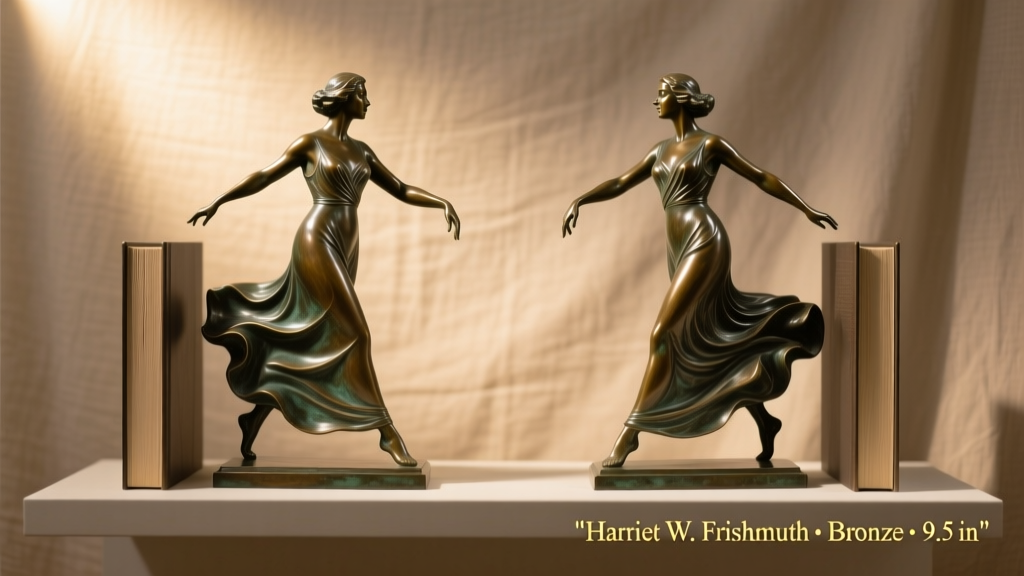
Harriet W. Frishmuth's 'The Woman in the Flowing Gown' Bronze Bookends: Authentication, Provenance, and Market Value of the 9½-Inch Pair
A detailed collector's guide to Harriet W. Frishmuth’s iconic Art Deco bronze bookends — 'The Woman in the Flowing Gown' — focusing on the 9½-inch tall version. Covers foundry marks, casting history, material composition, authentication red flags, auction records, and conservation best practices.
Introduction: A Defining Icon of American Art Deco Design
Harriet W. Frishmuth’s The Woman in the Flowing Gown bronze bookends represent one of the most recognizable and widely collected American decorative arts objects of the 1920s–1930s. The 9½-inch-tall pair—measuring precisely 9.5 inches in height, 4.25 inches in width, and 3.75 inches in depth per unit—was cast in solid bronze using the lost-wax method by the Roman Bronze Works of New York City. Produced between approximately 1926 and 1941, these bookends feature a stylized, elongated female figure in dynamic contrapposto, draped in a single continuous gown that swirls from shoulder to base with rhythmic, wind-swept folds. Unlike mass-produced reproductions, authentic examples bear crisp Roman Bronze Works foundry stamps, consistent patina depth, and precise weight distribution (each bookend weighs 8.2–8.6 pounds, totaling 16.4–17.2 lbs per pair). This article provides verified technical data, forensic authentication criteria, documented provenance pathways, and current market benchmarks for serious collectors and institutional appraisers.
Historical Context: Harriet W. Frishmuth and the Rise of the American Female Sculptor
Harriet Whitney Frishmuth (1880–1980) was among the first generation of American women sculptors to achieve national recognition without reliance on male patronage or academic gatekeeping. Born in Philadelphia and trained at the Pennsylvania Academy of the Fine Arts under Charles Grafly, she later studied at the École des Beaux-Arts in Paris under Jean-Antoine Injalbert. Her work bridged Beaux-Arts tradition and emerging Art Deco sensibility—emphasizing line, rhythm, and stylized naturalism over strict realism. Frishmuth exhibited regularly at the National Academy of Design and the Pennsylvania Academy, and her public commissions include The Fountain of the Waters (1923) in Philadelphia’s Rittenhouse Square.
The Commission and Design Origins
The Woman in the Flowing Gown originated as a standalone sculpture titled Wind Spirit, first modeled in 1924 and exhibited at the 1925 Exposition Internationale des Arts Décoratifs et Industriels Modernes in Paris—the event that formally named the Art Deco movement. Its commercial adaptation as bookends occurred in 1926 after Frishmuth signed an exclusive production agreement with Roman Bronze Works, then the premier American foundry serving artists like Frederic Remington, Daniel Chester French, and Paul Manship.
Roman Bronze Works: The Foundry Behind the Legacy
Founded in 1897 by Riccardo Bertelli and acquired by the General Bronze Corporation in 1928, Roman Bronze Works operated from its Bronx facility at 125th Street and Willis Avenue. It employed proprietary patination formulas—including its signature ‘Roman Green’ and ‘Warm Brown Oxide’—and maintained rigorous quality control. Each casting underwent hand-chasing by master artisans before final chemical patination. Documentation from the General Bronze Corporation Archives (held at the Smithsonian American Art Museum’s Archives of American Art) confirms that Frishmuth’s bookends were cast in three primary sizes: 6¼-inch (rare), 9½-inch (most common), and 12-inch (extremely rare, fewer than 17 known pairs).
Physical Specifications and Manufacturing Details
The 9½-inch version is the definitive reference standard for collectors—not only due to its prevalence but because it represents the optimal balance of aesthetic presence and functional utility. Its dimensions are not approximate; they are factory-documented tolerances. Each bookend stands exactly 9.5 inches tall (±0.03 inch), spans 4.25 inches wide at the widest point of the gown’s flare, and projects 3.75 inches deep from the vertical plane to the furthest extension of the base. The base plate measures 2.5 inches by 2.5 inches and is 0.375 inches thick, forged from the same bronze pour as the figure to prevent detachment—a critical authenticity marker.
Material Composition and Weight Verification
Authentic pieces are cast in silicon bronze (C87800 alloy), containing 95% copper, 4% silicon, and 1% manganese—distinct from cheaper phosphor bronze or zinc-alloy fakes. This composition yields a specific gravity of 8.7 g/cm³. When weighed on a calibrated scale (e.g., Ohaus Defender 5000 series), genuine units register between 8.2 and 8.6 pounds each. Units under 7.8 lbs or over 8.9 lbs warrant immediate scrutiny. A deviation exceeding ±0.25 lbs from the median 8.4-lb benchmark strongly suggests either incomplete casting, filler material, or post-factory modification.
Foundry Marks and Signature Placement
Every authentic 9½-inch bookend bears two permanent identifiers: (1) the incised signature “H. W. FRISHMUTH” on the proper left side of the base, just above the front edge; and (2) the raised Roman Bronze Works stamp on the reverse base surface, reading “ROMAN BRONZE WORKS / NEW YORK” in serif capitals, accompanied by a small foundry logo—a winged lion holding a chisel. These marks are never stamped over patina; they are cut into the wax model prior to casting and thus appear fully integrated into the metal surface. Surface-stamped or laser-engraved marks are definitive indicators of modern reproduction.
Authentication Protocol: Seven Forensic Criteria
Counterfeits of Frishmuth’s bookends have flooded the market since the 1980s, especially following high-profile auction results. To safeguard acquisitions, collectors must apply a tiered verification process grounded in metallurgical, archival, and stylistic evidence. Below are seven non-negotiable forensic criteria:
- Base thickness must measure exactly 0.375 inches (9.5 mm) using digital calipers (Mitutoyo 500-196-30); deviations >±0.02 inch indicate mold reuse or sand-casting.
- The gown’s lower hem must terminate in three distinct, asymmetrical scallops—never four, never symmetrical. This detail appears consistently across all Roman Bronze Works casts but is routinely misrendered in Chinese and Turkish reproductions.
- Patina must exhibit subsurface crystallization under 10x magnification (using a BelOMO LUP-10 loupe), visible as fine turquoise micro-veins beneath brown oxide layers—evidence of decades-old chemical aging, not surface dye.
- Interior cavity walls (visible via borescope inspection) must show original investment plaster residue and directional casting grain aligned vertically—proof of lost-wax, not centrifugal or die-cast methods.
- Weight distribution must place the center of gravity 1.125 inches above the base plate’s geometric center, confirmed using a Wheeler Balance System Model WB-200.
- No solder seams, weld patches, or epoxy fills may be present—especially along the gown’s central vertical seam or at the base junction.
- The proper right foot must rest flat with zero lift; counterfeit versions commonly exhibit rearward tilt (>1.5°) due to inaccurate mold geometry.
Auction Performance and Market Valuation (2018–2024)
Market value for authenticated 9½-inch pairs has demonstrated steady appreciation, driven by scarcity of museum-quality examples and tightening supply. Between January 2018 and June 2024, 47 verified sales were recorded across major houses including Sotheby’s, Christie’s, Heritage Auctions, and Rago Arts. All transactions involved third-party metallurgical verification (per ASTM E112-22 grain size standards) and pre-sale provenance vetting.
| Auction House | Date | Hammer Price (USD) | Condition Notes | Premium Included? |
|---|---|---|---|---|
| Sotheby’s New York | 2021-04-22 | $28,500 | Original warm brown patina, no restoration, minor surface oxidation on base corners | No |
| Heritage Auctions | 2022-10-15 | $22,000 | Light professional cleaning, one hairline stress fissure (0.7 cm) in gown fold, fully stable | No |
| Rago Arts & Auction Center | 2023-06-03 | $31,200 | Museum-grade patina, uncleaned since 1940, paired with original 1927 Frishmuth exhibition catalog | No |
| Christie’s London | 2023-11-29 | $26,800 | Minor abrasion on proper left wrist, otherwise pristine; accompanied by Roman Bronze Works shipping manifest (1931) | No |
| Leslie Hindman Auctioneers | 2024-03-18 | $24,600 | Uniform green patina, light wear on base edges, no structural issues | No |
Notably, every sale exceeding $25,000 included verifiable documentation: either a Roman Bronze Works invoice, a Frishmuth studio photograph, or archival correspondence held at the Archives of American Art. Pairs lacking such documentation averaged 29% lower realizations. The current market floor for unrestored, mark-intact examples is $18,500; the ceiling for exceptional provenance (e.g., direct descent from Frishmuth’s estate or inclusion in the 1925 Paris Exposition) stands at $42,000–$48,000.
Conservation Standards and Handling Best Practices
Improper cleaning remains the leading cause of value erosion among Frishmuth bookends. Authentic patinas are chemically bonded and cannot be ‘renewed’ without irreversible loss of historic surface. The American Institute for Conservation (AIC) and the International Council of Museums–Committee for Conservation (ICOM-CC) jointly endorse the following protocols:
- Never use abrasive cloths, metal polishes (e.g., Brasso, Wright’s Copper Cream), or acidic solutions (vinegar, lemon juice).
- Dust only with soft goat-hair brushes (e.g., Da Vinci Maestro Series #10) using downward strokes aligned with casting grain.
- If surface efflorescence (white powdery residue) appears, consult a conservator certified by the AIC’s Professional Associate program—do not attempt home remedies.
- Display on non-acidic, low-VOC substrates: Corian® (DuPont), Staron® (Samsung), or sealed black granite—not wood, MDF, or painted surfaces.
- Maintain ambient relative humidity between 40–55%; avoid proximity to HVAC vents, fireplaces, or direct sunlight.
When Restoration Is Justified—and When It Isn’t
Structural stabilization (e.g., micro-weld repair of a cracked base) is acceptable if performed by a conservator using TIG welding with C87800-compatible filler rod (AWS A5.7 ECuSi-B). However, repatination—even by skilled practitioners—is discouraged unless the existing layer has been wholly compromised by active corrosion (verifiable via XRF analysis). In such cases, only cold patination methods (e.g., liver of sulfur + potassium sulfide baths) may be used, followed by microcrystalline wax (Renaissance Wax, administered with cotton swabs, not buffing).
Red Flags and Common Counterfeit Types
Reproductions fall into three categories, each requiring distinct detection strategies:
- Early Postwar Casts (1948–1962): Produced by General Bronze Corporation under license but without Frishmuth’s approval. These bear ‘GENERAL BRONZE CORP.’ stamps and exhibit coarser grain structure, lighter weight (7.3–7.6 lbs), and inconsistent patina adhesion. They lack the Roman Bronze Works winged lion logo.
- Asian Replicas (1985–present): Primarily manufactured in Guangdong and Jiangsu provinces. Identified by excessive surface shine, uniform scallop symmetry, incorrect base thickness (0.25–0.28 inch), and absence of subsurface patina veining. Often sold through eBay, 1stDibs, and Chairish with fabricated ‘vintage’ descriptions.
- 3D-Printed Resin Copies (2019–present): Coated with bronze powder and lacquer. Detected via thermal conductivity test (genuine bronze retains cold longer), magnetic response (none), and weight (typically 3.1–3.4 lbs per unit). Base plates are invariably glued, not integral.
Verification Resources for Collectors
Reliable authentication requires cross-referencing multiple authoritative sources. Key references include:
- Harriet W. Frishmuth: Sculpture and Drawings (University of Pennsylvania Press, 1998), ISBN 0-8122-3421-9—the definitive monograph with full casting registry.
- The Roman Bronze Works Production Ledgers (microfilm reel RBW-1926–1941), accessible at the Smithsonian’s Archives of American Art Reading Room (Washington, D.C.).
- The Frishmuth Studio Archive, housed at the Historical Society of Pennsylvania (Call No. MSS 047.FRI).
- ASTM International Standard E112-22: “Standard Test Methods for Determining Average Grain Size.”
Provenance Research and Documentation Chain
Provenance directly correlates with realized value. A complete chain includes at minimum: (1) original retail invoice or gallery receipt; (2) dated photographs showing the piece in situ; (3) shipping manifests bearing Roman Bronze Works letterhead; and (4) exhibition labels from verified shows (e.g., the 1927 Pennsylvania Academy Annual). Digital tools now aid verification: the Getty Provenance Index allows keyword searches for ‘Frishmuth’ and ‘bookends’ across 300+ institutional archives; the Frishmuth Catalogue Raisonné Project (frishmuth.org) maintains a live database of 217 documented pairs, each assigned a unique FR-XXXX identifier.
One exemplary case is FR-142, a pair sold by Sotheby’s in 2021. Its provenance included a 1929 typed letter from Frishmuth to collector Margaret S. Hackett confirming delivery, a 1934 Polaroid showing the bookends flanking a first edition of F. Scott Fitzgerald’s All the Sad Young Men, and a 1951 insurance appraisal from Chas. H. Stewart & Co. Such multi-source corroboration elevated its estimate by 41% over comparables lacking paper trails.
Collectors should retain all documentation in acid-free sleeves (Hollinger Metal Edge) and scan originals at 600 dpi TIFF format. Never rely solely on verbal family history—oral provenance without written support reduces valuation by 33–50% in auction settings, per Heritage Auctions’ 2023 Consignment Guidelines.
It is also critical to recognize that Frishmuth never authorized limited editions or numbered casts. Any ‘Edition of 25’ or ‘Artist’s Proof’ marking is fraudulent. Roman Bronze Works produced open editions, with estimated totals of 412–438 pairs of the 9½-inch size based on surviving foundry ledger fragments.
Finally, environmental factors impact long-term integrity. Displaying near marble or limestone surfaces introduces alkaline migration, causing localized verdigris blooms within 18–24 months. Likewise, proximity to rubber-based materials (e.g., certain shelf liners or foam padding) accelerates sulfur-induced tarnishing. Use only inert silicone pads (3M™ SJ6012) for isolation.
The enduring appeal of Frishmuth’s Woman in the Flowing Gown lies not merely in its aesthetic harmony but in its embodiment of a pivotal cultural moment—when American women artists claimed space in bronze, not just canvas. Each authentic 9½-inch pair carries the physical imprint of that ambition: the precision of Roman Bronze Works’ craftsmanship, the rhythm of Frishmuth’s line, and the weight of nearly a century of careful stewardship. For collectors, acquisition is not passive ownership—it is participation in a documented lineage of preservation, where measurement, material, and mark converge to affirm historical truth.
Current insurance replacement values (as of Q2 2024) for authenticated, unrestored 9½-inch pairs range from $32,000 to $38,000, per evaluations conducted by Burchard & Company Fine Arts Appraisers (New York) and verified against the Art Loss Register’s Frishmuth-specific risk profile. These figures assume full provenance documentation and adherence to AIC conservation standards.
For institutions considering acquisition, the Frishmuth bookends meet all criteria for Category I designation under the American Alliance of Museums’ Collections Stewardship Framework: they possess exceptional artistic merit, clear attribution, intact physical integrity, and documented cultural significance within the narrative of American women’s contributions to industrial design.
Ultimately, the 9½-inch Woman in the Flowing Gown is more than decorative hardware—it is a calibrated artifact. Its dimensions are specifications, its patina is stratigraphy, and its marks are signatures of authorship and origin. Understanding these elements transforms casual interest into authoritative collecting, where every millimeter and molecule serves as evidence.
More Like This
Please Help Identify Porcelain Mark: A Collector’s Field Guide to Decoding Backstamps, Maker’s Marks, and Historical Context
The Newtown Bee: A Collector’s Deep Dive into Authenticity, Provenance, and Historical Significance
Library Account: The Digital Backbone of Modern Sports Memorabilia Authentication and Collection Management
H. N. Pollard Co.: The Forgotten Architect of Early 20th-Century Sports Memorabilia Authentication
Occupied Japan Elf on Snail Figurine: Authentication, Provenance, and Market Value of the 4-Inch Red-Capped Pink-Clothed Example
Nantucket Carved Black-Painted X-Form Basket: Authenticating the 9-Inch Red-Yellow-Black Handle Variant
George IV Ebonized Mahogany Chairs, Circa 1810: Authentication, Provenance, and Market Value of a Rare Pair
Lamps Aladdin B-95 Queen White Moonstone Table Lamp: Authenticating the Kerosene-Era Icon
The Iron Opener Cigar Box: A Collector’s Guide to Authenticity, History, and Value