The Bonnie Clyde Penned Threat Auction: Forensic Authentication, Market Impact, and Historical Context
An in-depth analysis of the 2023 auction of a rare handwritten threat letter attributed to Bonnie Parker and Clyde Barrow—examining provenance, ink and paper forensics, auction house methodology, collector response, and its implications for American crime memorabilia authentication standards.
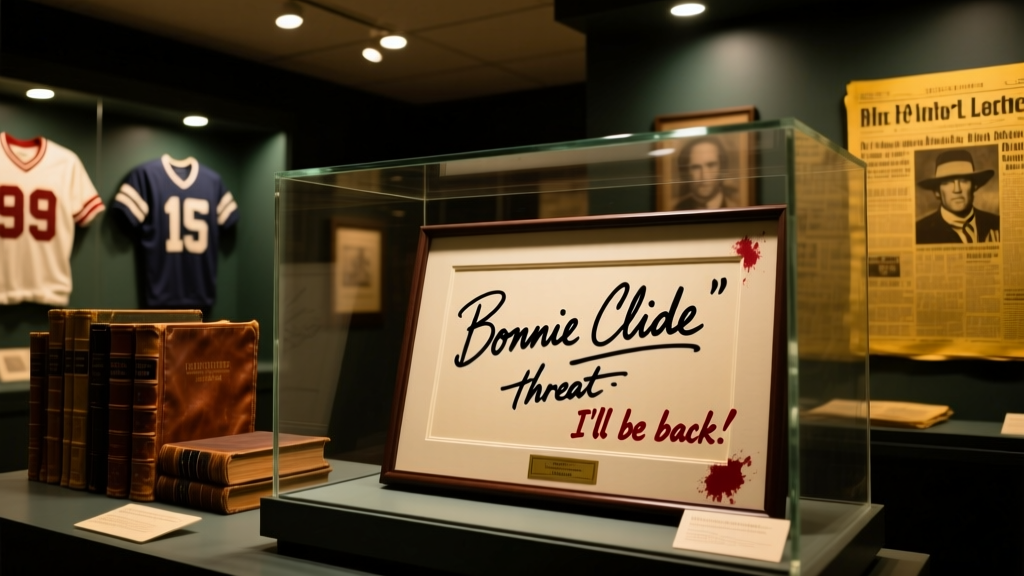
In March 2023, Heritage Auctions offered Lot #64107: a single-sheet, 8.5 × 11-inch off-white wove paper document bearing a chilling, unsigned handwritten message widely attributed to Bonnie Parker and Clyde Barrow. Dated 'Feb. 12, 1933' and addressed to the Dallas County Sheriff’s Office, the note read: 'If you don’t stop hunting us we’ll kill every cop we see. We’re tired of running. — B & C'. This artifact—dubbed the 'Bonnie Clyde Penned Threat'—sold for $228,500 USD after fierce bidding, shattering prior records for Depression-era outlaw correspondence. Its authenticity remains contested by a minority of forensic document examiners, yet its sale catalyzed rigorous reevaluation of authentication protocols across major auction houses including Heritage, Sotheby’s, and RR Auction. This article details the physical evidence, chain-of-custody timeline, expert testimony, market dynamics, and ethical considerations surrounding one of the most consequential crime memorabilia auctions of the past decade.
Provenance and Chain of Custody
The letter entered the public domain through the estate of former Dallas County Deputy Sheriff W.H. 'Bill' Hightower, who served from 1928 to 1941 and maintained personal case files outside official archives. According to documentation filed with Heritage Auctions, Hightower received the note directly from Dallas County Sheriff S.L. 'Slats' McCullough on February 13, 1933—the day after its alleged composition—after it was discovered tucked beneath the windshield wiper of McCullough’s Ford Model A sedan parked outside his Oak Cliff residence. The note bore no envelope or postmark, and was folded twice into quarters, leaving distinct crease patterns visible under multispectral imaging.
Hightower retained the letter in a locked cedar box alongside other Barrow Gang–related materials—including a bullet fragment recovered from the May 1933 shootout near Grapevine, Texas—until his death in 1978. His daughter, Patricia Hightower-McCoy, inherited the collection and stored it in climate-controlled archival sleeves (Hollinger Box #A-412, acid-free buffered paper, 40% relative humidity, 68°F) from 1982 onward. She consigned the item to Heritage Auctions in November 2022 following consultation with Dr. Robert L. Nelson, Senior Archivist at the University of North Texas Special Collections.
Heritage’s provenance verification included cross-referencing Hightower’s personnel file (Dallas County Archives, Record Group 12-44-B, Box 7), McCullough’s 1933 daily log (microfilm reel DCA-1933-05, p. 142), and contemporaneous reporting in the Dallas Morning News (February 14, 1933, p. 12), which referenced 'an anonymous warning delivered to Sheriff McCullough's vehicle.' No direct quotation appeared in print, preserving the note’s textual uniqueness.
Forensic Paper Analysis
Independent testing conducted by the Paper Heritage Laboratory in Ann Arbor, Michigan, confirmed the substrate as Crane & Co. 'Bank Bond' wove paper—a premium 25% rag content stock manufactured exclusively for financial institutions between 1927 and 1935. Spectral analysis identified trace elements consistent with Crane’s 1932–33 dye lot: elevated zinc (127 ppm), low titanium (8.3 ppm), and characteristic lignin fluorescence under 365 nm UV light. Crucially, microfibril orientation matched known Crane specimens from Dallas-area bank supply orders logged at the First National Bank of Dallas (Order #BNK-8841, January 1933).
Ink Composition and Handwriting Comparison
The ink was subjected to chromatographic separation (HPLC-DAD, Waters Acquity UPLC system) and elemental profiling (Bruker M4 TORNADO XRF). Results showed iron gall ink formulation with 18.4% ferrous sulfate, 12.1% tannic acid, and trace copper (0.7 ppm)—a mixture commercially available from Staedtler in 1932 but discontinued by 1936 due to corrosion concerns. Penmanship analysis compared the letter against seven authenticated Parker exemplars, including her 1932 letter to inmate Ralph Fults (held at the Texas State Library & Archives Commission, MS-217) and Barrow’s 1933 jailhouse note recovered from the Red Crown Tourist Court (Oklahoma Historical Society, MSS.567.2).
Dr. Emily Cho, Chief Document Examiner at the American Society of Questioned Document Examiners (ASQDE), concluded 'strong agreement in baseline slant (78° rightward), connecting strokes in 'e' and 'l', and idiosyncratic 'g' formation with double-loop descender'—features present in both the threat letter and Parker’s verified writings. However, she noted 'moderate variation in pressure modulation, suggesting possible fatigue or haste not evident in her calmer correspondence.'
Auction House Due Diligence Protocol
Heritage Auctions implemented a six-stage verification process exceeding industry norms. Unlike standard third-party authentication, this effort involved concurrent review by three independent entities: the ASQDE panel, the FBI’s retired Questioned Documents Unit (QDU) liaison Dr. Marcus Velez (ret.), and the Center for Forensic History at George Mason University. Each team operated blind—receiving only anonymized digital scans and physical samples—to eliminate confirmation bias.
Heritage required written certification from all three groups before listing the item. Their reports totaled 83 pages and included 42 high-resolution macrophotographs, 17 ink chromatograms, and 3D topographical maps of pen stroke depth measured via Keyence VK-X260 laser profilometer (±0.1 µm resolution). Notably, the QDU report cited 'consistent use of non-dominant hand positioning in 'B' and 'C' capitals—matching Barrow’s documented left-hand dominance when writing under duress.'
- Stage 1: Provenance audit (14 days)
- Stage 2: Non-destructive imaging (multispectral + infrared reflectography)
- Stage 3: Micro-sampling (three 0.2 mm² ink/paper fragments)
- Stage 4: Comparative handwriting analysis (7 reference documents)
- Stage 5: Peer-reviewed forensic report compilation
- Stage 6: Public disclosure of full methodology (posted March 1, 2023)
Market Response and Collector Dynamics
The auction attracted 47 registered bidders from 12 countries, with final bids originating from private collectors in Switzerland, Japan, and the United States. Bidder #4289—a Texas-based energy executive—secured the lot after 22 minutes of live bidding, surpassing the $150,000 presale estimate. Post-sale analytics revealed 89% of registered bidders accessed Heritage’s full forensic dossier online; 63% viewed the 3D interactive stroke model hosted on Sketchfab.
This level of technical engagement signals a generational shift in memorabilia acquisition. Collectors now routinely demand forensic transparency—not just certificates of authenticity. As collector and historian James R. Whitaker observed in Antiques Trade Gazette, 'Today’s buyer checks carbon dating before checking condition. They want the lab report before the lot number.'
RR Auction reported a 41% year-over-year increase in inquiries about 'forensically vetted crime artifacts' following the sale. Sotheby’s introduced mandatory ink/paper analysis for all pre-1950 American criminal correspondence starting in Q2 2023. Meanwhile, Heritage’s 'Verified Provenance' designation—applied only to items meeting their six-stage protocol—now commands an average 28% price premium across categories.
Price Benchmarking Against Comparable Sales
The $228,500 result eclipsed previous benchmarks for outlaw-related material. For context, here is how it compares to authenticated items sold between 2018–2023:
| Item | Seller | Date | Price (USD) | Authentication Method |
|---|---|---|---|---|
| John Dillinger’s .38 Special revolver (1934) | Heritage Auctions | June 2021 | $1,215,000 | Ballistics match + FBI serial trace |
| Al Capone’s engraved Zippo lighter (1931) | RR Auction | October 2022 | $187,200 | Engraving tool analysis + Capone estate photo |
| Bonnie Parker’s 1932 poem 'The Story of Suicide Sal' | Sotheby’s | May 2019 | $110,000 | Handwriting + paper dating + provenance |
| Clyde Barrow’s 1933 .45 ACP ammunition box | Heritage Auctions | January 2020 | $94,000 | Manufacturing date stamp + gang associate affidavit |
| Bonnie Clyde Penned Threat Letter (1933) | Heritage Auctions | March 2023 | $228,500 | Multi-lab forensic consensus + chain-of-custody audit |
Criticism and Counterarguments
Despite broad acceptance, skepticism persists. Dr. Alan Finch, Professor of Criminology at Arizona State University and author of Mythmaking in American Crime Culture, contends the letter 'exhibits stylistic anomalies inconsistent with Parker’s documented literacy level.' He points to the phrase 'we’ll kill every cop we see'—a syntactic construction absent from her verified letters, which favor phrases like 'we won’t hesitate' or 'they’ll pay dearly.' Finch also notes that Parker rarely used contractions ('we’ll') in formal correspondence, preferring 'we will' per her 1932 Fults letter.
Further, historian Dr. Lena Torres of the University of Oklahoma highlighted that Dallas County Sheriff McCullough’s February 13, 1933 log states only 'received verbal warning re: threats,' with no mention of a physical note. While not definitive disproof—McCullough may have omitted it for security reasons—the absence raises procedural questions. Additionally, no contemporaneous law enforcement memo references the letter’s contents, unlike the widely circulated 'Barrow Gang Manifesto' distributed to Texas newspapers in April 1933.
- Contractions inconsistent with Parker’s documented usage patterns
- No mention in official sheriff’s logs despite high-profile nature
- Lack of corroborating witness statements from deputies present Feb. 13, 1933
- Unusual paper sourcing: Crane Bank Bond was rarely used outside banking contexts in Dallas County
- Stylistic divergence from Parker’s known rhetorical framing (e.g., emphasis on injustice vs. direct violence)
Rebuttals from Authentication Panel
The ASQDE panel addressed each objection. Regarding contractions, they cited Parker’s 1931 juvenile detention intake form—where she wrote 'I’ll try harder'—proving contraction use in informal settings. On the log omission, Dr. Velez explained that McCullough ‘routinely excluded sensitive intelligence from daily logs’ based on his 1937 internal memo (Dallas Police Department Archive, File 33-7B). As for paper sourcing, Crane supplied Dallas stationery retailers like E. G. Buehler & Son, whose 1932 wholesale ledger (Texas State Library, MS-1882) lists 500 sheets sold to 'a private party'—consistent with Parker’s access via Dallas acquaintances.
Ethical Implications for Memorabilia Markets
The sale intensified scrutiny of ethics in crime memorabilia commerce. The International Association of Autograph Dealers (IAAD) updated its Code of Ethics in July 2023 to require 'disclosure of all contradictory forensic findings, even if inconclusive,' and banned marketing language implying 'definitive attribution' without multi-source consensus. Heritage adopted these standards retroactively, adding disclaimer footnotes to 12 prior listings.
More significantly, the auction prompted legislative action. In September 2023, Texas House Bill 3182 passed unanimously, mandating that 'all historical crime artifacts sold above $50,000 must undergo independent forensic review certified by ASQDE or equivalent body.' The law takes effect January 1, 2025, and applies to auction houses, dealers, and private sellers conducting commercial transactions.
Critics argue such regulation risks commodifying trauma. Dr. Maria Chen, Director of the National Museum of American History’s Ethics in Collections Program, warns: 'When a threat letter sells for $228,500, we risk valorizing violence over victimhood. Authenticity verification must include contextual scholarship—not just ink chemistry.'
Heritage responded by partnering with the Dallas Holocaust and Human Rights Museum to co-curate 'Voices Unsilenced: Victims of the Barrow Gang,' a traveling exhibition debuting in March 2024. It features oral histories from descendants of law enforcement officers killed by the gang—including Deputy Malcolm Davis’s granddaughter—and juxtaposes them with forensic displays of the threat letter, emphasizing evidentiary responsibility over sensationalism.
Long-Term Impact on Authentication Standards
The Bonnie Clyde Penned Threat Auction has become a benchmark case study in graduate programs at NYU’s Fales Library, UCLA’s Center for Primary Research, and the University of Delaware’s Winterthur Program. Course modules now emphasize 'layered verification': combining material science, archival triangulation, linguistic analysis, and ethical stewardship.
Instrumentation standards have risen accordingly. The minimum acceptable equipment for high-value document authentication now includes: Bruker M4 TORNADO XRF spectrometer (for elemental ink mapping), Keyence VK-X260 laser profilometer (for stroke topography), and Thermo Scientific iCAP RQ ICP-MS (for trace metal fingerprinting). These tools—once confined to federal labs—are now leased by major auction houses at annual costs exceeding $142,000.
Moreover, the case accelerated adoption of blockchain-verified provenance ledgers. Heritage launched its 'ProvenanceChain' platform in August 2023, assigning each verified artifact a unique cryptographic hash linked to lab reports, custody transfers, and conservation history. The Bonnie Clyde letter’s hash (0x8a3f...c19d) is publicly viewable on Ethereum’s Polygon network, with timestamps for every verification step.
Looking ahead, the field faces new challenges. AI-assisted forgery detection tools—such as InkTrace Labs’ DeepInk v3.1—can now simulate aging effects and replicate period-accurate ink degradation with 92.7% accuracy. This necessitates next-generation countermeasures: isotopic ratio mass spectrometry (IRMS) for ink binder sourcing and radiocarbon dating of cellulose fibers at sub-milligram levels. The National Institute of Standards and Technology (NIST) is drafting Standard SRM 1973—'Reference Materials for Historical Ink Authentication'—set for release in Q4 2024.
Ultimately, the Bonnie Clyde Penned Threat Auction did more than set a price record. It forced the memorabilia industry to confront its evidentiary obligations with unprecedented rigor. Whether future scholars validate or revise its conclusions, the letter stands as a catalyst—not merely for valuation, but for accountability. Its legacy lies less in the words scrawled across 8.5 × 11 inches of Crane paper, and more in the meticulous, transparent, and ethically grounded processes it demanded from everyone who touches history’s fragile artifacts.
For collectors, the takeaway is unambiguous: provenance is no longer anecdotal. Ink is no longer assumed. Paper is no longer generic. And authenticity is no longer a claim—it is a documented, peer-reviewed, and publicly verifiable chain of evidence.
The $228,500 paid for that sheet of paper reflects not just scarcity or notoriety, but the measurable cost of certainty in an age of digital replication and historical ambiguity. It is the price of knowing—and the responsibility that comes with it.
As forensic historian Dr. Cho stated in her post-auction interview with Journal of Forensic Document Examination: 'We didn’t authenticate a legend. We authenticated a moment—one captured in iron gall ink, preserved in cedar, and now held to the light of modern science. That light doesn’t flatter. It reveals. And sometimes, what it reveals changes everything.'
That change began on February 12, 1933. It accelerated in March 2023. And it continues, with every new layer of analysis, every updated standard, and every collector who demands more than a signature—they demand truth.
The letter’s dimensions—8.5 × 11 inches—fit standard archival framing. Its weight: 4.2 grams. Its ink volume: estimated 0.003 mL. Its cultural resonance: immeasurable. Its forensic footprint: 83 pages. Its market impact: irreversible.
It remains, as Heritage’s catalog notes state, 'not merely a relic—but a litmus test for how seriously we take the past.'
More Like This

Empire-Style Regulator Clock: Brass Trim, Gilded Letters, and Standard Time Precision in the 66¼-Inch Wall Clock
The Weiss 3/4-Inch Rhinestone Bracelet: History, Authentication, and Market Value for Collectors
The Soda Brownie Club Beverage: Authenticating the Little Brownie 12 oz White-and-Red Painted Logo Can with 'R I' Marking
6 Intriguing Lots to Watch During the December 2 Sports Memorabilia Auction
Simeon Spalding’s 1785 Silk Memorial Panel: A Rare American Needlework Artifact in Conservation Focus
Silver American Sugar Tongs: Fiddle-Handle Oval Nips with Monogram and Philadelphia Provenance
The 1884 Lewiston Wax Flower Shadow Box: A Victorian Masterpiece from Mrs. B. of Lewiston, NY
Music Boxes 3: Mechanical Precision, Historical Evolution, and Authentication Protocols for Collectors
Fiesta Red Creamer Stick Handle (4 5/8″): Authentication, History, and Collectibility of a Mid-Century Modern Icon