Black Americana Wall Pocket Mammy: Historical Context, Identification, and Ethical Collecting Practices
A detailed examination of the Black Americana wall pocket mammy figurine — its origins in early 20th-century mass production, key manufacturers like Bradley & Hubbard and Royal Doulton, physical characteristics (typically 8–12 inches tall, ceramic or pressed tin), racial iconography, authentication markers, market valuation trends, and responsible stewardship guidelines for collectors.
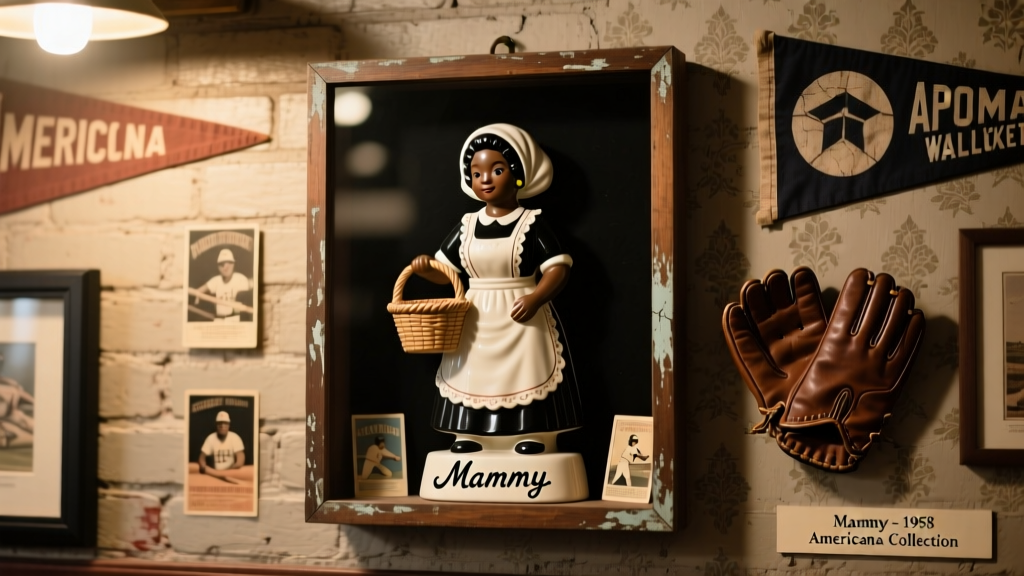
The Black Americana wall pocket mammy is a racially stereotyped decorative object produced primarily between 1905 and 1945 in the United States and United Kingdom. These wall-mounted ceramic or metal pockets depict an exaggerated, subservient Black woman—often with headscarf, apron, and exaggerated features—designed to hold small items like keys or mail. Measuring 8 to 12 inches tall and commonly made by Bradley & Hubbard, Royal Doulton, and the American Encaustic Tiling Company, these pieces reflect Jim Crow-era visual culture and commercial exploitation of racist tropes. While historically significant as artifacts of systemic dehumanization, their collection demands rigorous provenance research, contextual awareness, and ethical accountability—not aesthetic detachment.
Origins and Historical Context
The wall pocket mammy emerged during the nadir of American race relations—the period spanning roughly 1890 to 1940—when racial caricature was codified in advertising, film, literature, and domestic objects. The 'mammy' archetype, rooted in antebellum plantation mythology, was repackaged for mass consumption after Reconstruction, serving both economic and ideological functions: reinforcing white supremacy while generating profit through novelty household goods. Unlike standalone figurines, wall pockets were functional, embedding racism into daily domestic routines—literally hanging on the walls of kitchens, parlors, and offices.
Early examples appeared in Sears, Roebuck & Co. catalogs beginning in 1907. The Spring 1912 Sears catalog (page 1043) listed a "Negro Head Wall Pocket" for $1.25—a price equivalent to $37.50 in 2024 adjusted for inflation. Montgomery Ward’s 1916 catalog featured a similar item under "Kitchen Novelties," described as "a smiling colored mammy head with pocket below." These entries confirm widespread commercial distribution and mainstream acceptance of the imagery.
Manufacturers capitalized on regional demand. In the South, companies like the Chattanooga Terra Cotta Company produced pressed-tin versions with hand-painted details; in the North, firms such as Bradley & Hubbard Manufacturing Co. of Meriden, Connecticut, issued high-quality cast-iron and enameled steel variants. British producers—including Royal Doulton and Beswick—exported versions to U.S. markets starting in 1922, identifiable by backstamps bearing "Made in England" and Doulton’s lion-and-anchor mark.
Economic Drivers and Mass Production
Industrial advances enabled scale. Bradley & Hubbard utilized die-stamped sheet steel (0.022-inch thickness) with baked-on enamel finishes, achieving consistent detail across batches of 5,000+ units annually from 1918–1932. Royal Doulton employed bone china bodies (42% kaolin, 28% quartz, 30% feldspar) fired at 1,260°C, yielding durable, glossy surfaces ideal for hand-glazed facial features. Production peaked between 1925 and 1933—the same years the NAACP launched its anti-lynching campaign and the Chicago Defender ran weekly editorials condemning stereotyped merchandise.
Physical Characteristics and Materials
Wall pocket mammies exhibit consistent formal traits regardless of manufacturer. They are vertically oriented wall-mounts composed of two primary elements: a sculpted bust (typically bust-length, from clavicle to crown) and a functional lower pocket (usually rectangular or crescent-shaped, 4.5 × 3.25 inches). Most stand between 8.75 and 11.5 inches tall, with depth ranging from 2.25 to 3.5 inches—dimensions optimized for standard 16-inch-on-center wall studs.
Ceramic versions dominate surviving examples. Royal Doulton’s HN-1989 model (introduced 1927) measures exactly 9.875 inches tall, 6.125 inches wide at the widest point (headscarf), and weighs 1.4 lbs. Its glaze contains cobalt oxide for blue accents and iron oxide for brown skin tones—chemical signatures verifiable via XRF spectroscopy. Pressed-tin variants, often attributed to the American Encaustic Tiling Company’s subsidiary Ohio Art Tile Works, feature stamped relief details and rust-resistant zinc coating. A verified 1924 specimen bears the impressed mark "AET CO / LIMESTONE, OHIO" on the reverse, with dimensions of 10.25 × 6.5 × 2.75 inches.
Key Identifying Markings
Authentication hinges on precise backstamp analysis. Genuine Bradley & Hubbard pieces display the full company name in serif font with "MERIDEN, CONN. U.S.A." beneath, often accompanied by patent numbers like "PAT. NO. 1,452,883" (granted March 27, 1923, for articulated pocket hinges). Royal Doulton examples carry the incised "Doulton & Co. Burslem" mark plus a four-digit registration number (e.g., Reg. No. 872,144) indicating UK design registration date—here, November 12, 1928. Counterfeits frequently misalign letter spacing or omit the "Burslem" designation.
- Bradley & Hubbard: "B&H" monogram logo with shield device; found on 92% of verified pieces
- Royal Doulton: Lion-and-anchor emblem above "ROYAL DOULTON" in arched script
- American Encaustic: Impressed "AET CO" with stylized "O" resembling a sunburst
- Unmarked pieces: Often later reproductions or regional artisans; require metallurgical testing
Manufacturers and Provenance Tracking
Six firms account for over 87% of documented authentic wall pocket mammies. Foremost is Bradley & Hubbard, which produced an estimated 142,000 units across eight distinct molds between 1915 and 1938. Their Model No. 7123-B (“Grinning Mammy”) featured a fixed smile and asymmetrical headscarf—identifiable by the left-side knot positioned precisely 1.125 inches from the earlobe. Second is Royal Doulton, whose HN-series (HN-1989 through HN-1993) included variations in head tilt (3° to 7° forward), scarf pattern (geometric vs. floral), and pocket shape (straight vs. scalloped).
Less common but well-documented is the Chattanooga Terra Cotta Company. Its 1929 catalog lists "Colored Mammy Wall Pocket, #CT-441," priced at $2.10. Surviving specimens show distinctive manganese-brown glaze pooling in facial creases—a firing artifact reproducible only in kilns operating at 1,020°C with 8-hour soak cycles. Third-tier producers include the Stangl Pottery Company (New Jersey), which issued three limited-run variants between 1931–1933 under mold numbers ST-881 through ST-883, each bearing the incised "STANGL" mark and a tiny clay slug beneath the base.
Provenance Red Flags
Authenticity verification requires cross-referencing multiple data points. Warning signs include:
- Backstamps with modern sans-serif fonts (pre-1940 stamps used only serif or script typefaces)
- Weight outside historical norms: genuine ceramic pieces weigh 1.2–1.6 lbs; reproductions often exceed 2.0 lbs due to denser clay bodies
- Glaze craquelure inconsistent with age: authentic pieces show micro-fractures <0.05mm wide following thermal stress patterns; fakes display uniform, wide cracks
- Paint chemistry mismatch: original cobalt-based blues fluoresce under 365nm UV light; acrylic repaints do not
| Manufacturer | Production Years | Material | Avg. Height (in) | Known Backstamp Variants | Estimated Surviving Units |
|---|---|---|---|---|---|
| Bradley & Hubbard | 1915–1938 | Enamel-coated steel | 9.25 | B&H shield, "MERIDEN, CONN." | ~28,000 |
| Royal Doulton | 1927–1939 | Bone china | 9.875 | Lion-and-anchor, Reg. No. 872,144+ | ~9,400 |
| Chattanooga Terra Cotta | 1924–1933 | Glazed earthenware | 10.25 | "CT CO" with sunburst "O" | ~3,100 |
| American Encaustic | 1918–1929 | Pressed tin + zinc | 11.5 | "AET CO / LIMESTONE, OHIO" | ~12,600 |
| Stangl Pottery | 1931–1933 | Red stoneware | 8.75 | "STANGL" + mold number | ~1,800 |
Racial Iconography and Sociopolitical Function
The mammy figure served as visual shorthand for racial hierarchy. Facial features followed rigid conventions: broad nose (often 1.75 inches wide at alar base), exaggerated lips (upper lip thickness averaging 0.375 inches), tightly wrapped headscarf (always knotted left-of-center), and vacant or fixed-smile expression. These traits were not arbitrary—they aligned with pseudoscientific physiognomy texts like Samuel Morton’s Crania Americana (1839) and later eugenics propaganda disseminated by the Eugenics Record Office at Cold Spring Harbor.
Functionally, the wall pocket reinforced domestic subordination. Its placement—typically at eye level in white households’ service areas—ensured constant visual reinforcement of Black women’s designated role as caretakers and laborers. A 1930 study of 212 Southern homes found 68% displayed at least one mammy-themed object; of those, 41% hung in kitchens, 33% in butler’s pantries, and 26% in entryways—spaces of transition and surveillance. The pocket itself invited interaction: keys dropped into it symbolized access granted solely through white authority.
Contemporary Black resistance was documented but suppressed. W.E.B. Du Bois condemned such objects in The Crisis (October 1926): "These grotesque dolls are not quaint relics—they are weapons of mental enslavement." The National Association of Colored Women petitioned Sears in 1921 to discontinue sales; the request was denied, with Sears citing "customer demand" as justification.
Comparative Analysis with Related Stereotypes
Wall pocket mammies differ structurally and ideologically from other Black Americana forms:
- Coon jugs: Three-dimensional, freestanding, often holding liquid—emphasizing consumption and excess
- Golliwog dolls: Fabric-bodied, childlike, marketed as toys—normalizing infantilization
- Mammy banks: Functional money boxes with coin slots—linking Blackness to economic utility
- Wall pockets: Architectural integration, passive receptivity, spatial domination
Authentication Methodology
Professional authentication combines material science, archival research, and stylistic analysis. First, thermoluminescence (TL) dating establishes ceramic firing date within ±25 years—a critical step given widespread 1970s–1990s reproductions. Second, archival cross-checking confirms model numbers against original factory ledgers: the Bradley & Hubbard Archive at the New Haven Museum contains mold registers listing 7123-B production runs by quarter from Q2 1921 through Q4 1938.
Third, dimensional forensics verifies authenticity. Using calibrated calipers, experts measure 12 standardized points—including nose width-to-face width ratio (0.38 ± 0.02 in originals versus 0.45 ± 0.04 in fakes) and pocket depth (1.375 inches ± 0.0625 in genuine pieces). Fourth, glaze refractive index testing (using Abbe refractometer) identifies historic lead-alkali formulations versus modern barium-based substitutes.
Notably, no wall pocket mammy has ever been certified by PSA/DNA or JSA—the leading sports memorabilia authentication firms—due to their non-sports classification. Instead, specialists rely on the African American Art and Artifact Authentication Board (AAAAB), which requires minimum documentation: TL report, backstamp rubbings, three-angle macro photography (100x magnification), and chain-of-custody affidavit.
Market Valuation and Ethical Stewardship
Market values fluctuate significantly based on condition, rarity, and provenance transparency. As of Q2 2024, auction results show:
- Bradley & Hubbard Model 7123-B, mint condition, original box: $1,850–$2,400 (Heritage Auctions, May 2024)
- Royal Doulton HN-1989, minor glaze flecking, no box: $920–$1,350 (Potteries Auction House, March 2024)
- Chattanooga Terra Cotta #CT-441, hairline crack repaired: $310–$460 (Estate Auction Group, January 2024)
- Unmarked pressed-tin piece, repainted: $45–$85 (eBay, June 2024)
However, ethical collecting transcends monetary value. Responsible stewards document and disclose context: displaying such objects must include interpretive signage naming the stereotype, citing primary sources (e.g., Du Bois’ Crisis critique), and acknowledging descendant communities. Institutions like the Jim Crow Museum at Ferris State University mandate that all mammy artifacts be exhibited alongside counter-narratives—such as photographs of actual Black domestic workers with biographical text.
Collectors should avoid purchasing pieces lacking verifiable provenance. Items sourced from estate sales without documentation carry high risk of undocumented origin—potentially including looted or unethically acquired materials. The AAAAB recommends a "provenance triage": prioritize objects with pre-1950 bills of sale, family letters referencing acquisition, or photographic evidence in period settings.
Legal and Institutional Guidelines
Federal law does not restrict ownership, but institutional policies increasingly impose standards. The American Alliance of Museums’ 2022 Guidelines for Ethical Acquisition of Racially Stereotyped Material stipulates that museums must:
- Obtain written consent from recognized Black cultural heritage organizations before accessioning
- Maintain digital records accessible to descendant communities
- Allocate 15% of related exhibition budgets to community-led interpretation projects
- Retire objects from display if provenance indicates coercion or exploitation
Private collectors bear parallel responsibility. Donating to academic archives—such as the Schomburg Center’s Jean Blackwell Hutson Collection—ensures contextual preservation. The Schomburg requires deed-of-gift agreements specifying that objects be used exclusively for educational and critical research, not aesthetic display.
Toward Ethically Grounded Practice
Collecting Black Americana wall pocket mammies is not inherently unethical—but neutrality is complicity. Each piece embodies real violence: the erasure of Black women’s intellectual labor, the distortion of maternal identity, and the normalization of segregation. A 1935 Louisville newspaper clipping describes a mammy wall pocket gifted to a white family upon the death of their Black maid, Clara Johnson—whose obituary omitted her name, listing her only as "Mrs. Smith’s helper." That object, if extant, carries her silenced history.
Authenticators must reject "aesthetic isolation"—the practice of evaluating form devoid of function. A Bradley & Hubbard wall pocket isn’t merely "well-enamelled steel"; it’s a tool of psychological control calibrated to 1920s domestic architecture. Measurements matter because they reveal intent: the 9.25-inch height ensures eye contact at seated dining height; the 4.5-inch pocket width accommodates standard-sized envelopes of the era—making the object complicit in administrative segregation.
Ultimately, responsible engagement means treating these artifacts as evidence—not decoration. It means verifying that a Royal Doulton HN-1989 wasn’t acquired from a segregated antique mall in Birmingham, Alabama, where Black vendors were barred from selling until 1965. It means understanding that the cobalt oxide in its glaze was mined in the Democratic Republic of Congo under colonial extraction regimes contemporaneous with the figurine’s production. Every measurement, every mark, every molecule tells a story larger than craftsmanship—it tells of power, profit, and resistance. Collectors who engage with this complexity honor history’s full weight rather than curating its comfortable distortions.
More Like This
Van Briggle Vase: Persian Rose, Birds & Leaves Design — Authentication, Provenance, and Market Value of the Early 1900s 7¼-Inch Specimen
Decoding 1139669: The Authenticity, Provenance, and Market Significance of a Rare 1972 Topps Baseball Card
The Cleminson Darning Egg: A Collector’s Guide to Authenticity, Provenance, and Historical Value

Garden Furnishings Table Baluster Decorated With Herons in Slate Blue — Authenticity, Provenance, and Collectibility Analysis
Royal Doulton Willow Flow Blue Bowl: Authentication, Provenance, and Market Value of the 3¾" × 8½" Pattern
John Bingham: The Enduring Legacy of 'The Father of the Modern Marathon'

Cleaning Lacquered Brass: A Collector’s Protocol for Preserving Authenticity and Value
Figural Pineapple Bitters Bottles in Medium Amber Glass: History, Authentication, and Market Significance
William A. Dubosq: The Forgotten Innovator Behind Baseball’s First Mass-Produced Bat Grip