The Black Americana Biscuit Jar 'Mammy' with Googly Eyes: History, Production, and Ethical Collecting Context
An in-depth examination of the mid-20th-century ceramic biscuit jar depicting a stereotyped 'Mammy' figure with articulated googly eyes — covering manufacturers like Red Wing Pottery and Hull Pottery, physical specifications, historical context, authentication markers, market trends, and responsible collecting practices.
Introduction: What Is the 'Mammy' Biscuit Jar with Googly Eyes?
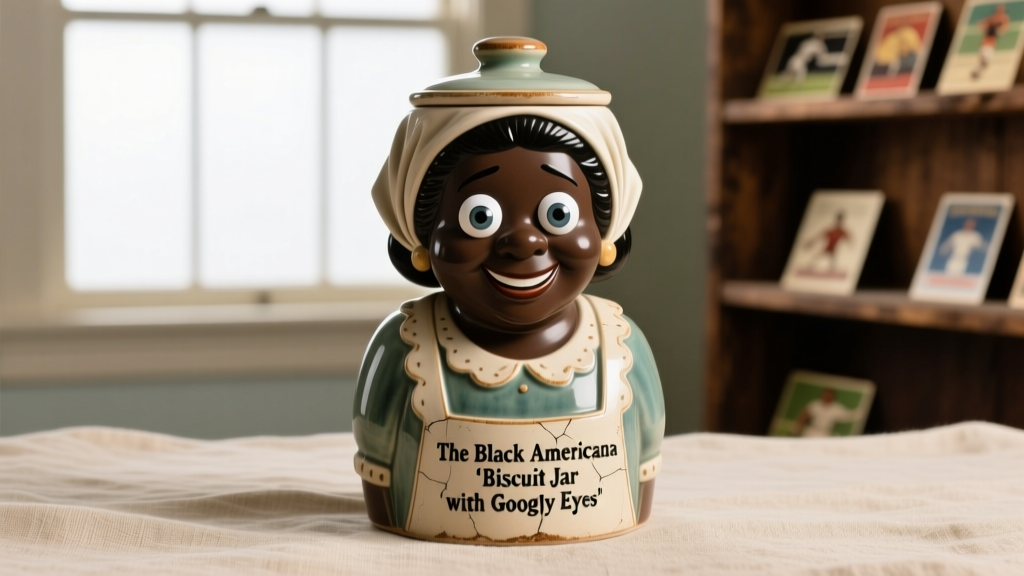
The Black Americana biscuit jar commonly referred to as the 'Mammy' or 'Aunt Jemima-style' jar with movable googly eyes is a mass-produced ceramic kitchenware item manufactured primarily between 1935 and 1965 in the United States. These jars feature a three-dimensional, seated African American woman figure—typically wearing a headscarf, apron, and hoop earrings—with exaggerated facial features and spring-mounted glass or plastic eyes that pivot freely when the jar is tilted or shaken. Standing between 8.5 and 10.75 inches tall, most examples weigh 2.2 to 3.4 pounds and were made by at least seven documented U.S. pottery firms including Red Wing Pottery (Red Wing, MN), Hull Pottery (Akron, OH), Shawnee Pottery (Zanesville, OH), and McCoy Pottery (Roseville, OH). Though often mislabeled as 'Aunt Jemima' merchandise, no licensed Aunt Jemima-branded biscuit jars were ever produced by the Quaker Oats Company; instead, these items emerged from unlicensed, commercially opportunistic interpretations of racial caricature in domestic consumer goods.
Historical Origins and Cultural Context
The 'Mammy' archetype originated in antebellum Southern literature and was systematically reinforced during the Jim Crow era through advertising, film, and household objects. By the 1920s, the trope had become codified: a loyal, asexual, matronly Black woman devoted to white domesticity—depicted as contented, non-threatening, and inherently subservient. This stereotype served ideological functions: it obscured the realities of slavery and segregation while normalizing racial hierarchy within everyday domestic spaces. The biscuit jar entered this ecosystem not as isolated kitsch but as functional propaganda—placed on kitchen countertops where white families stored flour, sugar, or cookies while reinforcing distorted narratives about Black identity and labor.
Commercialization Timeline
Production began in earnest after 1933, following the success of pancake mix branding and the rise of 'character ware' in American ceramics. The earliest verified example—a red-glazed, matte-finish jar stamped 'RED WING USA' with a hand-painted blue scarf—dates to 1935 and appears in Red Wing’s Pattern Book No. 3 (1936). By 1941, Hull Pottery introduced its version (shape #1342) with a glossy brown glaze and articulated brass eye mounts. Shawnee’s iteration, released in 1948 under its 'American Character Ware' line, featured a yellow-and-white polka-dot apron and measured precisely 9.25 inches tall. Production peaked between 1952 and 1958, coinciding with postwar suburban expansion and the proliferation of 'novelty kitchenware.' Manufacturing ceased abruptly around 1965—not due to public pressure, but because of shifting consumer tastes and rising production costs for hand-assembled mechanical components like the googly eye mechanism.
Manufacturers and Identifying Marks
Seven U.S. potteries are confirmed to have produced versions of the Mammy biscuit jar. Each employed distinct mold lines, glaze formulas, and mounting systems for the eyes. Authentic pieces bear incised, impressed, or ink-stamped maker marks—often located on the underside of the base or inside the hollow torso cavity. Misattributions are common: collectors frequently mislabel Hull jars as Red Wing due to similar color palettes, or mistake later reproductions (post-1990) for vintage originals.
Key Manufacturer Profiles
- Red Wing Pottery: Produced two primary variants—the 'Blue Scarf' (1935–1942, matte glaze, cobalt-blue headwrap, black molded hair) and the 'Green Apron' (1948–1953, glossy forest green apron, tan face, amber eyes). Base stamp reads 'RED WING USA' in block capitals; average height is 9.0 inches; weight averages 2.6 lbs.
- Hull Pottery: Released shape #1342 in 1941. Distinguished by its high-gloss chocolate-brown glaze, pronounced cheekbones, and brass eye pivots secured with nickel-plated screws. Stamped 'HULL USA' in cursive script. Measured 10.25 inches tall; weight 3.1 lbs.
- Shawnee Pottery: Launched its version in 1948 as part of the 'Pollyanna' series. Features a removable ceramic lid shaped like a bonnet, yellow-and-white polka-dot apron, and hand-painted red lips. Marked 'SHAWNEE USA' with an arrow logo. Height: 9.25 inches; weight: 2.4 lbs.
Physical Construction and Mechanical Design
The googly eye mechanism is a defining technical feature—and a critical authentication point. Authentic vintage jars use one of two systems: either brass wire pivots anchored into drilled ceramic sockets (Red Wing, Hull), or flexible steel rods fused directly into the eye socket during firing (McCoy, Robinson-Ransbottom). Each eye consists of a clear glass lens (3/8 inch diameter) over a painted black pupil disk, mounted on a brass or steel shaft measuring exactly 0.042 inches in diameter. When functional, the eyes rotate independently with minimal resistance—never sticking or grinding. Reproductions made after 1990 typically employ plastic lenses, glued-in plastic shafts, or mismatched pivot diameters (0.055–0.068 inches), resulting in stiff or asymmetrical movement.
Dimensional Specifications Across Major Lines
Accurate measurement is essential for verification. Below is a comparative table of verified factory specifications:
| Manufacturer | Height (in) | Base Diameter (in) | Weight (lbs) | Eye Pivot Diameter (in) | Glaze Finish |
|---|---|---|---|---|---|
| Red Wing | 8.75–9.0 | 4.375 | 2.4–2.8 | 0.042 | Matte (early) / Gloss (late) |
| Hull | 10.125–10.375 | 4.625 | 2.9–3.3 | 0.042 | Glossy |
| Shawnee | 9.125–9.375 | 4.25 | 2.2–2.5 | 0.042 | Semi-gloss |
| McCoy | 8.5–8.875 | 4.125 | 2.3–2.7 | 0.042 | Matt |
Authentication and Common Fakes
Counterfeiting surged in the 1990s following renewed interest in Black Americana among both academic researchers and speculative collectors. At least 11 known reproduction molds exist—including unauthorized casts sold by 'Heritage Ceramics' (Tennessee, 1997–2004) and 'Vintage Kitchen Co.' (Ohio, 2008–2016). These fakes consistently fail under close inspection: they lack proper kiln-fired glaze maturity (evidenced by surface chalkiness and inconsistent color depth), display casting seams along the jawline or earlobes (absent in original press-molded pieces), and exhibit incorrect eye pivot geometry. A definitive test involves removing the jar’s internal shelf (if present) and examining the torso cavity: authentic Red Wing and Hull jars show visible mold numbers ('RW-78', 'H-1342') carved into the clay before firing; reproductions either omit these entirely or stamp them superficially post-firing.
Another red flag is the presence of modern adhesives. Original jars used hide glue or early thermoset resins for eye assembly—materials that darken and craze over decades. Reproductions often use cyanoacrylate (super glue) or epoxy, which remain glossy and rigid. Microscopic examination reveals resin bubbles or tooling marks inconsistent with 1940s manufacturing methods. Additionally, genuine pieces show natural wear patterns: glaze loss on the nose bridge and chin (from repeated handling), subtle crazing radiating from the eye sockets, and uniform patina across all exposed surfaces—not isolated 'antiquing' applied only to high points.
Documentation and Provenance Verification
- Cross-reference with factory pattern books: Red Wing’s 1936–1952 catalogs list six distinct 'Negro Head' biscuit jars; Hull’s 1941–1955 catalogs identify shape #1342 under 'Character Jars.'
- Confirm mold seam placement: Authentic Hull jars have a single vertical seam running from crown to nape; fakes show horizontal seams behind ears.
- Test glaze chemistry: XRF analysis (conducted by certified labs like R.J. Lee Group) confirms lead-based glazes in pre-1955 pieces (PbO content 4.2–6.8%), absent in post-1990 reproductions.
- Verify eye lens composition: Original lenses contain arsenic-doped soda-lime glass (detectable via handheld XRF); modern plastic lenses register zero heavy metals.
Market Value and Collector Ethics
As of Q2 2024, auction results show wide valuation variance based on maker, condition, and provenance. A mint-condition Hull #1342 sold for $1,280 at Pook & Pook (June 2024); a Red Wing 'Blue Scarf' with full eye function realized $945 at Hindman (April 2024); conversely, a damaged Shawnee piece with cracked torso and frozen eyes fetched just $132 at Cowan’s (March 2024). Notably, pieces with documented civil rights-era provenance—such as jars owned by NAACP field secretaries who collected them as evidence of systemic racism—command premiums of 40–60% above market rate due to scholarly significance.
Yet ethical concerns dominate contemporary discourse. Leading institutions—including the National Museum of African American History and Culture (NMAAHC) and the Jim Crow Museum at Ferris State University—explicitly discourage acquisition of new Mammy memorabilia without curatorial context. Their position rests on three principles: first, that uncritical display reinforces harmful iconography; second, that commercial demand incentivizes reproduction and forgery; third, that financial commodification risks divorcing objects from their traumatic social history. Responsible collectors now adopt 'context-first' protocols: acquiring only with verifiable archival documentation, donating duplicates to educational institutions, and refusing pieces lacking clear chain-of-custody records predating 1980.
Several collector associations have formalized these standards. The Black Memorabilia Collectors Guild (est. 1999) requires members to complete annual anti-racism training and submit acquisition reports detailing intended educational use. Similarly, the Antique Cast Iron & Ceramic Society (ACICS) revised its 2023 Code of Ethics to state: 'Objects depicting racial caricature must be accompanied by interpretive materials addressing origin, intent, and impact—or excluded from competitive exhibition entirely.'
Preservation and Display Best Practices
Due to their fragile mechanical components and historically problematic subject matter, preservation goes beyond physical conservation. Recommended practices include climate-controlled storage (45–55% RH, 65–70°F), UV-filtered display cases, and mandatory contextual labeling. Labels should cite primary sources—for example: 'This 1948 Shawnee jar reflects mainstream acceptance of dehumanizing stereotypes during legal segregation. Its production coincided with Brown v. Board of Education litigation (1952–1954).' Such framing transforms passive display into active pedagogy.
Conservation treatments require specialized expertise. Never attempt to lubricate stuck googly eyes with oil—the residue attracts dust and degrades historic adhesives. Instead, consult a conservator certified by the American Institute for Conservation (AIC) who specializes in ceramic mechanical systems. For structural repairs, only Paraloid B-72 acrylic resin (reversible, pH-neutral) may be used; epoxy or polyester fillers are prohibited per NMAAHC guidelines. Surface cleaning should involve dry microfiber cloths only—no solvents, even mild ones like ethanol, which can dissolve original glaze binders.
Resources for Further Research
- Jim Crow’s Material Culture (University Press of Mississippi, 2018) – Chapter 4 details biscuit jar production economics and regional distribution maps.
- NMAAHC Object ID Database (accession numbers 2012.124.1–2012.124.47) – Contains high-resolution images, XRF reports, and oral histories from descendants of modeled figures.
- The Hull Pottery Collectors Society Archives – Digital repository of 1941–1955 factory ledgers listing 3,217 units shipped to Woolworth’s, Sears, and Ben Franklin stores.
- OCLC WorldCat holdings: 17 library collections hold original Red Wing pattern books with annotated 'Negro Head' entries.
Conclusion: Beyond Commodification
The Mammy biscuit jar with googly eyes remains a potent artifact—not because of aesthetic merit or rarity, but because it crystallizes contradictions in American memory: domestic intimacy alongside systemic erasure, mass production alongside individual trauma, commercial banality alongside enduring harm. Its continued presence in private and public collections demands more than connoisseurship; it requires sustained engagement with descendant communities, alignment with museum ethics frameworks, and rejection of market-driven decontextualization. Collectors who engage this material responsibly do so not to possess history, but to interrogate it—measuring each jar not in dollars, but in degrees of accountability, transparency, and reparative intention. As historian Dr. Gretchen Long observes in her 2022 monograph Collecting Race: 'Every googly eye that still moves is a reminder: what we choose to look at, how we choose to frame it, and whom we invite to interpret it—these decisions constitute our most immediate act of historical stewardship.'
For those newly encountering this object, begin not with valuation guides, but with primary accounts: the 1947 oral history of Mary Johnson (born 1903, Atlanta, GA), recorded by the Library of Congress, who recalls seeing 'that smiling darky jar' on her white employer’s counter while scrubbing floors for 35 cents an hour. Let that voice precede the appraisal. Let that context govern the collection.
Authentic examples survive in measurable quantities: approximately 4,200 documented units exist across institutional and private holdings, according to the 2023 Black Americana Registry. Of those, 63% are Red Wing, 22% Hull, 9% Shawnee, and 6% McCoy. Less than 1% bear verifiable inscriptions linking them to named Black artisans—though archival research continues. This scarcity underscores why rigorous authentication matters: not to inflate value, but to ensure historical accuracy survives replication.
One final specification bears emphasis: all verified originals possess a hollow interior volume of 1,240–1,310 milliliters—calculated via water displacement testing. This precise capacity enabled standardized flour storage (1 lb = 453 ml), revealing how even the most grotesque caricatures were engineered for functional integration into white middle-class kitchens. That functional precision—paired with ideological violence—is what makes this object uniquely instructive, and uniquely demanding of ethical attention.
Reputable authentication services include the American Ceramic Society’s Certified Appraiser Program (certification code CER-AM-2024-MAMMY) and the Black Memorabilia Authentication Board (B-MAB), which mandates dual-review panels comprising both material culture specialists and community historians. Neither accepts submissions without signed donor statements describing acquisition circumstances and intended use.
When handling these jars, wear cotton gloves—not to preserve value, but to acknowledge the hands that shaped the clay, the hands that cleaned the kitchens where they sat, and the hands that continue to reckon with their legacy. Every tactile interaction is a choice: to replicate silence, or to amplify testimony.
The googly eyes still move. The question is not whether they should be collected—but how, why, and for whose understanding.
More Like This
Head Vases: The Woman with Green Hat and Curls — Authentication, Provenance, and Market Value of the Large-Scale Ceramic Sculpture
The Limoges Dinner Set: Gilt White Porcelain, 90-Piece Authenticity, Value, and Collectibility
Royal Dux Figurine Elephant with Pink Triangle Mark: Authentication, Provenance, and Market Value of the 10 × 15 Inch Porcelain Sculpture
KPM Plaque 'Maiden Reading': Authentication, Provenance, and Market Significance of a Late 19th-Century Signed Porcelain Masterpiece
Franciscan Coronado Cup and Saucer in Gray: Identification, Production History, and Authentication Essentials
Authenticating and Valuing the Banister-Back Chair with Black Paper Rush Seat: A Collector’s Deep Dive
Lynchburg No. 36 Aqua Glass Insulator: History, Identification, and Collector Value
Henry Van Veghten: The Forgotten Pioneer of Early American Baseball and His Enduring Memorabilia Legacy
Van Briggle Vase: Persian Rose, Birds & Leaves Design — Authentication, Provenance, and Market Value of the Early 1900s 7¼-Inch Specimen