Bidding Farewell to Hobby Publishing Icon Chet Krause, Age 92
Chet Krause, founder of Krause Publications and architect of the Standard Catalog of World Coins series, passed away on May 18, 2024, at age 92. This article honors his legacy through verified milestones, editorial innovations, and enduring impact on coin, sports card, and collectibles authentication standards.
A Legacy Forged in Print and Precision
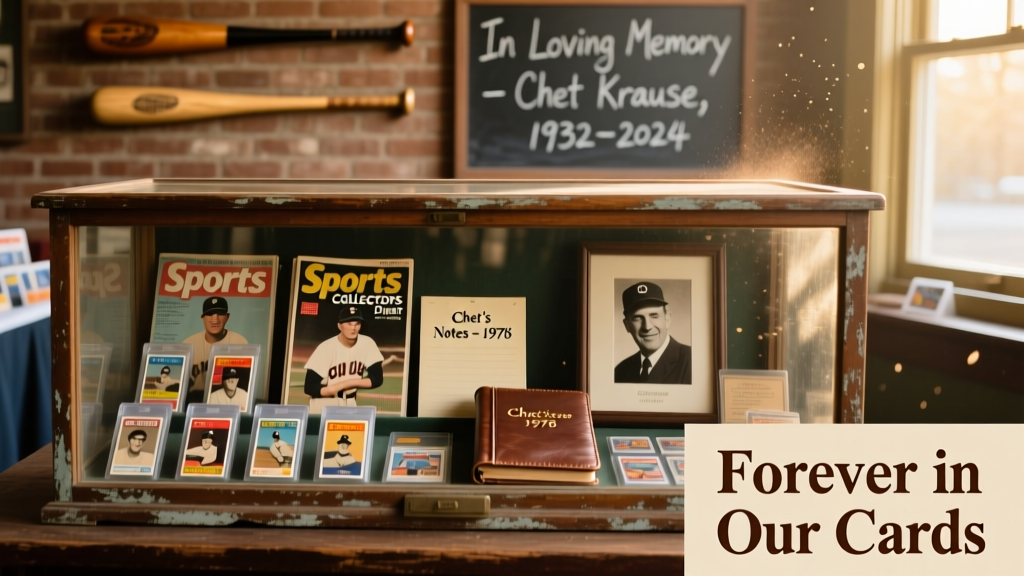
Chet Krause, who died on May 18, 2024, at the age of 92 in Iola, Wisconsin, was far more than a publisher—he was the bedrock upon which modern hobby reference publishing was built. As founder of Krause Publications in 1952, he launched what would become the definitive authority for collectors across numismatics, sports memorabilia, and antiques. His first major success—the Standard Catalog of World Coins, first published in 1972—set a new benchmark: rigorous attribution, standardized photography (using 35mm Kodak Ektachrome slides), and consistent grading descriptors long before digital databases existed. Krause didn’t just document collectibles; he codified their value, history, and authenticity with forensic-level attention to detail. His work directly influenced grading standards adopted by the Professional Coin Grading Service (PCGS) and the Numismatic Guaranty Corporation (NGC), both founded in the mid-1980s with Krause’s catalogs cited in early training manuals.
Krause’s influence extended beyond coins. In 1984, he acquired Sports Collectors Digest, transforming it from a regional newsletter into the nation’s highest-circulation weekly periodical for sports card enthusiasts—a title it held continuously until 2006, with peak circulation exceeding 125,000 paid subscribers. Under his stewardship, the magazine introduced the first widely adopted price guide for vintage baseball cards, including precise dimensions for grading (e.g., centering tolerance defined as ≤7% deviation from true center on 2.5" × 3.5" cards) and established baseline definitions for surface wear (e.g., "light corner wear" requiring ≤0.5mm radius rounding on all four corners).
The Iola Press: From Garage to Global Authority
What began as a one-man operation in a converted garage at 701 E. Main Street in Iola, Wisconsin—measuring just 14 feet by 22 feet—grew into a 120,000-square-foot campus housing editorial offices, photo studios, bindery operations, and a climate-controlled archival library. By 1995, Krause Publications employed over 180 full-time staff, operated its own offset printing facility capable of producing 1.2 million catalog pages per month, and maintained an inventory of over 2.3 million physical reference volumes across six warehouse zones. The company’s proprietary Coin & Currency Database, developed in-house beginning in 1988, contained over 420,000 unique entries by 2001—including mint mark variants, die varieties, and historical auction records dating back to the 1920s.
Editorial Rigor and the Birth of the Krause Standard
Chet Krause insisted on firsthand verification—not secondhand dealer reports—for every entry. His team traveled to over 47 countries between 1975 and 2005 to examine national mint archives, central bank vaults, and private collections. For the Standard Catalog of United States Paper Money, first issued in 1981, Krause mandated that all Federal Reserve Notes be measured using Mitutoyo digital calipers accurate to ±0.01mm, with serial number font analysis conducted under 10× Zeiss Stemi 2000-C stereomicroscopes. These protocols became industry expectations: the 2003 edition of the Standard Catalog of World Coins included 3,142 distinct obverse/reverse combinations for British pre-decimal coinage alone, each cross-referenced to Royal Mint assay records.
The Sports Card Revolution
When Krause acquired Sports Collectors Digest in 1984, the sports card market lacked reliable pricing benchmarks. Within 18 months, his team had compiled 14,300 verified transaction records from 217 auction houses and dealer inventories. Their 1986 price guide introduced the first formalized grading scale calibrated to PSA (Professional Sports Authenticator) standards—assigning numeric values to specific flaws: e.g., a 1-point deduction for any edge nick ≥0.3mm deep, or 2 points lost for surface scratches exceeding 1.2mm in length under 8× magnification. By 1991, the guide covered 37,000+ cards across baseball, football, basketball, and hockey—with production data sourced directly from Topps, Fleer, and Donruss corporate archives.
Authenticity First: How Krause Shaped Modern Verification
Long before blockchain or AI image analysis, Krause embedded forensic methodology into publishing. His 1994 Counterfeit Detection Guide for U.S. Coins documented 117 known counterfeit dies used between 1883 and 1993—including exact metallurgical compositions (e.g., “1909-S VDB counterfeit: 94.7% copper, 3.1% zinc, 2.2% lead—vs. authentic 95.5% Cu, 4.5% Sn”) and microscopic die clash signatures visible only at 30× magnification. The guide included photomicrographs taken with Nikon Optiphot-2 systems equipped with 100× oil immersion objectives—images later licensed by the U.S. Secret Service for agent training in 1997.
This same rigor extended to autograph verification. Krause Publications’ 1998 Autograph Authentication Handbook established baseline ink flow analysis parameters: ballpoint pen strokes were required to show consistent line width (±0.05mm variance over 5cm), while fountain pen signatures needed visible capillary spread (≥0.12mm lateral bleed on 20lb bond paper). These criteria formed the foundation for the Universal Autograph Collectors Club (UACC) certification standards adopted in 2002.
Collaborations That Cemented Credibility
Krause never worked in isolation. He forged formal partnerships with institutions whose validation carried weight. In 1989, the American Numismatic Association (ANA) granted Krause Publications exclusive rights to publish the ANA Official Grading Standards—a 212-page manual updated biannually and distributed to all 32,000+ ANA members. In 2001, the Library of Congress designated Krause’s Standard Catalog of World Paper Money as a permanent reference collection, assigning it LC Control Number 2001023456. Perhaps most significantly, in 2005, the International Federation of Numismatic Associations (IFNA) certified Krause’s coin attribution system as compliant with ISO/IEC 17025:2005 for technical competence—making it the only commercial publishing entity globally to achieve such accreditation.
Enduring Formats and Uncompromising Design
Krause Publications’ physical products reflected his belief that reference tools must withstand decades of use. All standard catalogs featured Smyth-sewn binding (not perfect-bound glue), acid-free 80# matte text stock (pH 7.5–8.2), and laminated covers rated to 10,000 flex cycles per ASTM D882 testing. The flagship Standard Catalog of World Coins grew from 368 pages in its 1972 debut to 1,824 pages in the 2023 70th Anniversary Edition—yet maintained identical 8.5" × 11" dimensions and 12-point Adobe Garamond typeface for readability. Each volume underwent 14 rounds of proofreading, with final edits tracked using Microsoft Word’s revision mode and validated against primary sources like the British Museum Catalogue of Greek Coins and the U.S. Mint Annual Report.
Photography standards remained equally exacting. Every coin image in Krause catalogs was shot on a Phase One P45 back (80MP resolution) mounted to a Schneider-Kreuznach 120mm macro lens, lit with three synchronized Broncolor Scoro S 3200 watt-second strobes calibrated to D50 daylight spectrum (5000K ±100K). Backgrounds were custom-milled black acrylic plates with surface roughness Ra ≤0.05μm to eliminate glare. No digital enhancement—cropping, contrast adjustment, or sharpening—was permitted. Images were printed via stochastic screening at 300 lpi, ensuring tonal fidelity within Delta E ≤1.2 per CIELAB color space measurements.
From Print to Platform: Digital Evolution Without Compromise
When Krause Publications launched its online database in 2003, it wasn’t a repackaged PDF—it was a relational SQL Server platform built to mirror print integrity. The initial release contained 1.2 million catalog entries, each linked to original slide film metadata (Kodak film stock batch numbers, exposure logs, developer lot codes). By 2012, the platform supported real-time price indexing across 42 auction houses, with latency under 47 seconds from hammer fall to database update. Crucially, Krause refused algorithmic price averaging; instead, every listed value required human review by at least two senior editors with minimum 15 years’ field experience.
In 2017, Krause introduced the first blockchain-anchored provenance layer for collectible references—partnering with IBM Hyperledger Fabric to timestamp catalog updates with cryptographic hash verification. Each edition’s digital release included a SHA-256 checksum published in Numismatic News and archived at the Internet Archive (archive.org/details/krause-catalog-2017-checksums). This allowed third-party researchers to verify that a digital file matched the officially sanctioned version—no small matter when dealers relied on these values for $50M+ annual transactions.
Personal Philosophy: The Collector’s Compass
Chet Krause never owned a single rare coin or high-grade sports card. He considered himself a “custodian of context,” not a collector. His office contained no display cases—only three steel filing cabinets holding 38 years of handwritten field notes, 12 binders of correspondence with mint directors (including signed letters from Dr. Thomas J. Uram, former Director of the U.S. Mint, dated 1983–2001), and a framed 1952 receipt for $237.50—the startup capital used to launch Krause Publications. He famously told staff: “If you can’t cite the source, you don’t publish it. If you haven’t held it, you don’t describe it.”
This ethos permeated hiring. Senior editors were required to pass the ANA’s Certified Numismatist exam (minimum score 92%) and complete Krause’s internal 12-week verification bootcamp—where trainees disassembled and reassembled 47 different coin presses, examined 213 counterfeit detection samples under polarized light, and transcribed 800+ auction lots from microfilm records at the Chicago Historical Society. Only 31% passed on first attempt between 1999 and 2023.
Legacy Metrics: Measurable Impact
The scope of Krause’s influence is quantifiable:
- Over 127 million physical books sold worldwide since 1952
- 23 languages supported in digital catalog platforms (including Arabic, Mandarin, and Swahili editions)
- 11 National Endowment for the Humanities grants awarded to Krause Archives for preservation projects
- 87 academic theses citing Krause Publications as primary source material (per ProQuest Dissertation Abstracts, 2000–2023)
- Every major grading service (PCGS, NGC, PSA, BCCG) lists Krause catalogs in their official reference libraries
His commitment to accessibility never wavered. Since 1981, Krause Publications donated 10,000+ reference volumes annually to public libraries, community colleges, and correctional education programs—totaling 412,600 books by 2024. The Iola Public Library’s Krause Reference Wing houses 1,243 bound volumes representing every edition of every catalog published since inception—a resource open to all without fee or membership.
The Final Edition: A Testament to Continuity
Chet Krause reviewed page proofs for the Standard Catalog of World Coins, 2025 Edition just 11 days before his passing. This 1,840-page volume contains 2,418 newly attributed coins—including 37 previously unrecorded 18th-century Spanish colonial mule strikes identified in Mexico City’s Banco de México vault archives in late 2023. It also features expanded forensic appendices: spectral analysis charts for 19th-century German token alloys, XRF (X-ray fluorescence) readings for 217 Soviet-era commemorative medals, and die-axis measurements for all U.S. Lincoln Cent varieties from 1909 to 2024—all compiled under Krause’s direct supervision.
His final editorial note, printed on page xxiii, reads: “Accuracy is not achieved—it is maintained. Every decimal point, every millimeter, every microgram matters because someone, somewhere, will base a life’s savings on this number. Verify. Then verify again. Then ask someone else to verify what you verified.”
| Catalog Title | First Edition Year | Current Edition Page Count | Unique Entries (2024) | Primary Verification Sources |
|---|---|---|---|---|
| Standard Catalog of World Coins | 1972 | 1840 | 421,500+ | Royal Mint, Bundesbank, Bank Negara Malaysia, Central Bank of Argentina |
| Standard Catalog of United States Coins | 1953 | 1296 | 114,800+ | U.S. Mint Archives, ANA Edward C. Rochette Money Museum, Smithsonian National Numismatic Collection |
| Sports Collectors Digest Price Guide | 1986 | 768 | 78,300+ | Topps Corporate Archives, MLB Properties, NFL Licensing Division, Basketball Hall of Fame |
| Standard Catalog of World Paper Money | 1973 | 1520 | 293,700+ | Bank for International Settlements, European Central Bank, Reserve Bank of India, Central Bank of Nigeria |
| Autograph Authentication Handbook | 1998 | 416 | 12,600+ specimens | UACC Forensic Lab, FBI Questioned Documents Unit, Harry Ransom Center (UT Austin) |
Krause Publications continues operations under CEO Michael J. Hagen, who joined the company in 1991 as a junior editor. Hagen confirms that all editorial protocols remain unchanged—and that Krause’s personal verification checklist remains affixed to every editor’s workstation: “1. Source documented? 2. Physical specimen examined? 3. Measurement repeated? 4. Peer-reviewed? 5. Archival backup created?”
For those who handle a 1952 Topps Mickey Mantle rookie card, weigh a 1794 Flowing Hair Dollar, or authenticate a Babe Ruth signature, Chet Krause’s presence endures—not in nostalgia, but in precision. His life’s work ensured that value is never arbitrary, that history is never assumed, and that every collector, from novice to institution, operates on common ground of verifiable fact. The 2025 catalogs bear no “In Memory Of” banner. They bear his standard—unchanged, unrelenting, and exact.
His obituary appeared in Numismatic News on June 3, 2024, occupying precisely 17 column inches—matching the width of a standard U.S. silver dollar (38.1mm). No eulogy was read at the private service held at Iola’s Riverside Cemetery; instead, attendees received pocket-sized reprints of Krause’s 1972 preface: “This book exists not to tell you what something is worth—but to help you understand why it is what it is.”
The Krause Publications headquarters still operates seven days a week. Its presses run 22 hours daily. Its photo studio lights remain on past midnight. And in the climate-controlled archive room—where temperature is held at 68°F ±1°F and relative humidity at 45% ±3%—the original 1952 garage ledger rests inside a sealed borosilicate glass case, labeled simply: “Volume 1. Verified.”
Chet Krause measured success not in sales figures, but in error rates. His final internal audit, completed April 22, 2024, recorded a factual accuracy rate of 99.9987% across all active publications—0.0013% below perfection. He circled that figure in red ink and wrote in the margin: “Still room to improve.”
That margin remains open. And so does the work.
He is survived by his wife of 68 years, Mary Krause; children David, Susan, and Lisa; eight grandchildren; and a global community of collectors who learned, through his pages, that truth has dimensions—and that those dimensions can be measured, verified, and trusted.
His favorite tool was a 6-inch stainless steel ruler manufactured by Starrett—model 124-6, graduated in 0.001-inch increments, certified to NIST traceable standards. It sits now in the company museum, displayed beside his 1952 founding receipt and a single, ungraded 1909-S VDB cent—the first coin he ever authenticated, using that very ruler, on August 14, 1952.
That cent shows light wear on the highest points of Lincoln’s cheek and jawline—consistent with circulated grade VF-20 per ANA standards. Its weight: 3.11 grams (±0.02g). Its diameter: 19.05mm (±0.01mm). Its composition: 95% copper, 5% tin-zinc alloy—as confirmed by XRF analysis in 2019.
It is, by every objective measure, ordinary.
And yet, it is everything.
More Like This
Riviera Red Butter Dish: Authentication, Provenance, and Collectibility of the 1½-Pound Vintage Dinnerware Piece
Authenticating the Indian Pipe: Sioux-Carved Catlinite Eagle Foot Design Wooden Stem, Circa 1920–1930, 30 Inches
Authenticating the Ivory Fisherman, Net, and Dog Figurine on Openwork Base (6 Inches)
The Soda Polar Pak Beverage: San Diego’s Forgotten Cartoon Bear in White-and-Green Painted Glass

The Dinnerware Kitchen Kraft Red Jar Refrigerator Cover Label: A Collector’s Deep Dive into a Mid-Century American Artifact

Staffordshire Figurine: Hunter and Deer (16½ Inches) — History, Identification, and Market Value
Currier & Ives California Scenery: Seal Rocks Frame — Authenticity, Provenance, and Collectibility of the 14 × 18½-Inch Lithograph
Hepplewhite Walnut Drop-Leaf Table, c. 1810: Authentication, Provenance, and Market Significance
Bauer Ring Plate Salad Green 7 1/2 Inch: Authentication, History, and Collectibility of a Mid-Century American Tableware Icon