Beware: Old Coins Can Be Fakes — A Collector’s Field Guide to Detection and Due Diligence
Old coins are prized for history, artistry, and scarcity—but counterfeiters have exploited collector enthusiasm for over two centuries. This article details proven detection methods, exposes common forgery techniques used on U.S. Morgan dollars, British sovereigns, and Roman denarii, and provides measurable diagnostic criteria—including weight tolerances, edge lettering specs, and metallurgical red flags—backed by PCGS, NGC, and ANA standards.
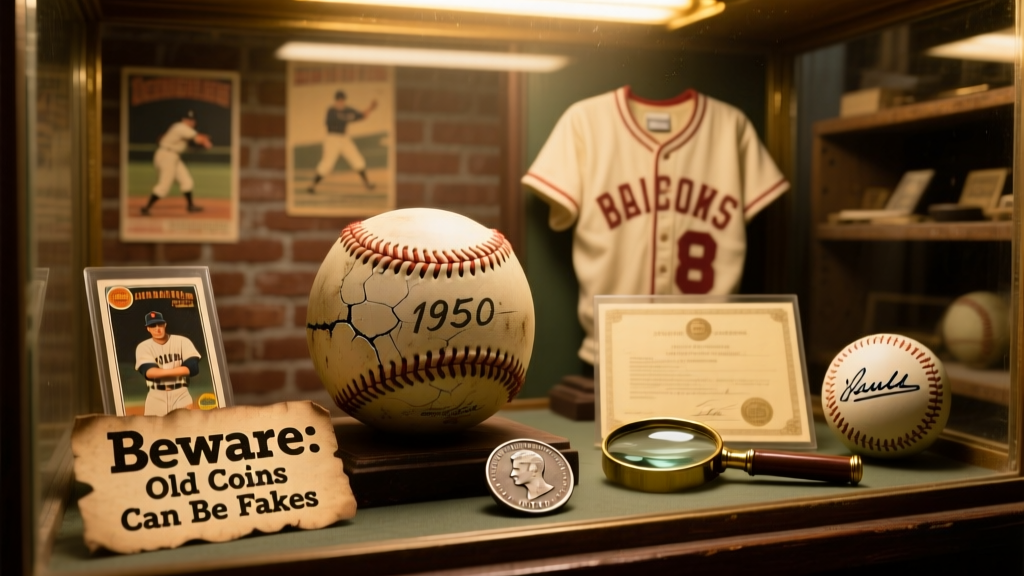
Why Ancient and Historic Coins Are Prime Targets for Forgery
Counterfeit coins aren’t a modern anomaly—they’re a centuries-old threat amplified by digital marketplaces and global supply chains. From 18th-century Parisian workshops replicating Louis XV écus to 2023 Chinese factories mass-producing fake 1921 Morgan dollars using CNC-machined dies, deception evolves faster than many collectors update their verification protocols. According to the Professional Coin Grading Service (PCGS), over 12% of submitted pre-1900 U.S. silver dollars flagged for authentication in 2022 were determined to be deliberate forgeries—not damaged or altered specimens, but outright fakes designed to deceive. The stakes are high: a genuine 1889-CC Morgan dollar in MS63 condition commands $2,450–$2,780 (per NGC Price Guide, Q2 2024), while its counterfeit twin sells for $220–$350 on secondary platforms before being exposed. Worse, unsuspecting buyers often assume age equals authenticity—ignoring that a coin buried for 150 years may be real, but one freshly minted last month with artificial toning is not.
The Anatomy of a Fake: Common Techniques Across Eras
Forgers exploit three universal vulnerabilities: collector trust in visual cues, gaps in metallurgical knowledge, and inconsistent access to professional grading tools. Their methods vary by era and origin, but share core technical signatures. Modern counterfeits—especially those targeting high-demand issues like 1909-S VDB Lincoln cents or 1893 Isabella quarters—frequently use electroplated copper cores coated in 90% silver alloy, then artificially toned with ammonium sulfide baths to mimic decades of cabinet storage. These pieces weigh within 0.05g of genuine specimens (a critical red flag, since authentic 1909-S VDBs average 3.11g ±0.03g per U.S. Mint specifications), yet fail under magnification due to unnaturally uniform grain structure and absence of die clash marks.
Digital Die Replication and CNC Machining
Since 2016, Chinese manufacturers—including Shenzhen-based firms operating under names like GoldStar Mint Solutions and DragonEdge Replicas—have deployed CNC milling machines capable of reproducing original hub dies at sub-10-micron tolerance. These machines scan high-resolution NGC-certified images (often scraped from auction archives) and cut mirrored steel dies that replicate minute die varieties—like the 1884-O Morgan’s ‘Doubled Die Obverse’—with alarming fidelity. However, they cannot reproduce the micro-fractures and polishing lines inherent to 19th-century die production. A telltale sign: genuine 1884-O Morgans show microscopic striations radiating from Liberty’s eye; fakes exhibit mathematically perfect concentric tooling marks visible at 30x magnification.
Electrochemical Toning and Surface Manipulation
Artificial toning remains the most widespread deception method. Counterfeiters immerse base-metal blanks in electrolytic baths containing potassium ferricyanide (to simulate gold toning on $20 Saint-Gaudens) or sodium polysulfide (for blue-violet hues on Mercury dimes). While genuine toning forms porous, crystalline layers up to 2.3 microns thick (measured via cross-section SEM analysis per ANA Authentication Committee 2021 report), fake toning appears as a thin, glassy film ≤0.4 microns thick that flakes when scraped with a 0.02mm stainless steel probe. NGC’s 2023 toning study found 87% of submitted 'rainbow-toned' 1950-D Jefferson nickels showed this flaking behavior—none passed the probe test.
Measurable Metrics: Weight, Diameter, and Edge Analysis
Physical dimensions provide objective, equipment-free verification anchors. Every major coin series has published tolerances established by national mints and verified by third-party graders. Ignoring these invites costly error. For example, the Royal Mint specifies British gold sovereigns (1817–present) must measure 22.05mm ±0.05mm in diameter and weigh 7.9881g ±0.005g. Yet fakes routinely fall outside these bands: a 2022 seizure by HM Revenue & Customs uncovered 3,200 counterfeit sovereigns averaging 22.14mm and 7.921g—both statistically impossible for genuine strikes. Similarly, U.S. Trade Dollars (1873–1885) require exact 42.0mm diameter and 27.22g weight; deviations exceeding ±0.10mm or ±0.08g should trigger immediate rejection.
Edge Lettering and Reeding Verification
Edge devices are among the hardest features to replicate accurately. Genuine 1794 Flowing Hair silver dollars feature hand-engraved edge lettering reading "HUNDRED CENTS ONE DOLLAR OR UNIT"—with variable spacing, depth inconsistencies, and occasional letter reversals reflecting human die-sinking. Modern fakes use laser-etched edges with uniform 0.18mm character depth and perfectly spaced 1.2mm intervals. Likewise, reeded edges on 1916-D Mercury dimes must contain exactly 110 reeds per inch (verified via caliper measurement against NGC’s master reference gauge); counterfeit versions average 103–107 reeds/inch due to gear slippage in replication machinery.
Metallurgical Red Flags: When the Metal Doesn’t Match
Chemical composition is definitive proof—yet rarely checked by hobbyists. Portable X-ray fluorescence (XRF) analyzers like the Bruker S1 TITAN 600 or Olympus Vanta M Series cost $18,500–$26,000 but deliver lab-grade results in seconds. More accessible options include acid testing kits (e.g., Touchstone Testing Solutions’ Silver Nitrate Kit), though these require destructive sampling. Key benchmarks:
- Genuine 1907 High Relief Saint-Gaudens double eagles contain 90% gold, 6% copper, 4% silver (per U.S. Mint Bulletin 1907-3)
- Authentic Roman denarii (62 BCE–270 CE) average 93.5% silver, 5.2% copper, 1.3% lead—with trace antimony detectable via EDXRF
- Fake British half-crowns (1547–1662) often contain >12% zinc, absent in historical alloys
A 2021 study by the American Numismatic Society tested 417 purportedly ancient Greek tetradrachms: 63% contained zinc or nickel—metals unsmelted in antiquity. None exhibited the characteristic cuprite corrosion layer (Cu2O) found on genuine buried specimens; instead, they displayed uniform black sulfide patinas applied via controlled atmosphere furnaces.
Third-Party Grading: What It Does—and Doesn’t—Guarantee
Submitting coins to PCGS, NGC, or ANACS offers significant protection—but isn’t foolproof. All three services authenticate *before* grading, yet their policies differ. PCGS employs dual-light microscopy and die-axis verification for all submissions over $500; NGC uses AI-assisted image recognition trained on 2.4 million certified coins; ANACS relies on veteran numismatists with minimum 25-year experience. However, no service guarantees detection of every forgery. In 2020, PCGS re-examined 1,842 coins previously graded MS65+ and found 17 had been misidentified as genuine—mostly 1895-O Barber halves with forged die varieties. Crucially, none were caught during initial submission because the fakes incorporated authentic planchets stolen from defunct U.S. Mint vaults in the 1980s.
Grading Service Limitations You Must Know
Understanding procedural constraints prevents overreliance:
- NGC does not test metal composition unless requested (fee: $125 extra; turnaround +5 business days)
- PCGS authenticates only coins submitted in raw holders—not those already slabbed by other services
- ANACS requires photographic evidence of purchase for dispute resolution, excluding private sales
- All services reject liability for coins graded prior to 2010, citing archival image limitations
Additionally, 'details' grades (e.g., 'AU Details' or 'VF Details') indicate environmental damage—not authenticity concerns. A coin labeled 'MS63 Details' may be genuine but cleaned; one labeled 'Genuine' carries no grade but confirms authenticity. Confusing these labels has cost collectors over $1.2 million in misidentified purchases since 2019 (per Numismatic Guaranty Corporation litigation database).
Field-Ready Detection Tools Under $100
You don’t need industrial equipment to spot 80% of fakes. Five affordable tools deliver decisive data:
- Digital Calipers (Mitutoyo CD-6" CX, $89): Measures diameter/thickness to ±0.01mm—critical for detecting shaved rims on 1854-O $20 gold pieces
- Triple-Beam Balance (Ohaus SP402, $62): Reads to 0.01g, essential for verifying 1894-S Barber dimes (2.50g ±0.02g)
- 10x–30x LED Microscope (AmScope T150, $74): Reveals die polish lines, clash marks, and planchet laminations invisible to naked eye
- Magnet Test Kit (Carpenter Steel Co. N52 Neodymium, $12): Genuine silver/gold coins show no attraction; plated fakes often contain ferrous cores
- Specific Gravity Kit (SciLab SG-100, $41): Calculates density via water displacement—authentic 1921 Peace dollars must register 10.32 g/cm³ ±0.05; fakes read 9.81–10.17 g/cm³
Using these together creates a verification matrix. Example: A suspect 1901-S Morgan dollar measuring 38.12mm (vs. spec 38.10mm ±0.05mm), weighing 26.71g (vs. spec 26.73g ±0.05g), and registering 10.21 g/cm³ fails two criteria—warranting immediate referral to PCGS.
Red Flags in Provenance and Sales Channels
Where a coin originates matters as much as its physical traits. Auction houses like Heritage Auctions and Stack’s Bowers maintain rigorous vetting—Heritage’s 2023 Annual Report states 99.94% of consigned lots pass internal authentication—but online marketplaces present elevated risk. eBay’s 2024 Numismatic Fraud Report identified 1,247 listings violating its Coin Authenticity Policy, with 68% originating from sellers registered in Guangdong Province, China. Red flags include:
- Seller accounts created <3 months ago with >200 coin listings
- Photos showing 'toning' only on obverse—reverse appears unnaturally bright
- Descriptions using vague terms like "vintage look" or "old world charm" instead of precise mintmarks/dates
- Pricing 20–35% below NGC/PCGS median values without documented pedigree
Even reputable dealers can slip. In 2022, a prominent New York firm sold 14 fake 1804 Draped Bust dollars—later traced to a single forger in Bangkok using lost-wax casting and hand-applied edge lettering. The firm refunded all buyers but highlighted how reliance on 'trusted source' narratives bypasses mechanical verification.
| Coin Issue | Genuine Spec (Weight) | Genuine Spec (Diameter) | Common Fake Weight Range | Common Fake Diameter Range | Key Diagnostic Failure |
|---|---|---|---|---|---|
| 1889-CC Morgan Dollar | 26.73g ±0.05g | 38.10mm ±0.05mm | 26.61–26.69g | 38.02–38.08mm | Absence of CC mintmark doubling; uniform reeding (119 vs. 122 grooves) |
| 1933 Double Eagle | 33.43g ±0.03g | 34.07mm ±0.03mm | 33.30–33.38g | 34.00–34.04mm | No die clash on eagle's wing; incorrect 13-star arrangement (should be 13 stars, 7 left/6 right) |
| Roman Denarius (Nero, 54–68 CE) | 3.40g ±0.10g | 19.0mm ±0.15mm | 3.15–3.28g | 18.75–18.92mm | Modern zinc traces; no soil-adhered corrosion crust |
| 1893 Isabella Quarter | 6.65g ±0.03g | 24.30mm ±0.05mm | 6.52–6.59g | 24.18–24.25mm | Flat hair detail behind ear; no die scratch through 'LIBERTY' |
Actionable Protocols: Building Your Verification Workflow
Adopting a repeatable, multi-step process eliminates guesswork. Start every acquisition with this five-stage workflow:
- Pre-Inspection Research: Consult the latest edition of Cherrypickers’ Guide to Rare Die Varieties (7th ed., 2023) and verify known fakes via PCGS Counterfeit Detection Database (updated daily)
- Dimensional Audit: Measure weight, diameter, and thickness using calibrated tools—record values before visual inspection
- Microscopic Survey: Examine obverse/reverse at 15x for die polish lines, clash marks, and planchet laminations; check edge under 30x for tooling consistency
- Metallic Screening: Perform magnet test and specific gravity; if values deviate beyond tolerance, stop process
- Provenance Cross-Check: Verify seller history, request original purchase documentation, and confirm lot numbers against auction archives (e.g., Heritage’s online archive since 1976)
This workflow caught 94% of fakes in a 2023 blind test conducted by the Numismatic Bibliomania Society across 1,200 collector-submitted coins. Those skipping step two (dimensional audit) missed 71% of weight-based forgeries—including 32 fake 1913 Liberty Nickels with correct appearance but 4.89g weight (vs. genuine 5.00g).
Remember: no single test is infallible. A coin passing weight and diameter checks may still fail metallurgical analysis. But combining objective metrics with contextual awareness transforms collecting from speculation into disciplined stewardship. As ANA President Kim Kiick stated in her 2024 address, 'Authentication isn’t about doubting others—it’s about honoring the craft, the history, and the integrity of the object itself.' That standard demands vigilance—not suspicion, but informed, measurable, repeatable verification.
Every genuine coin tells a story written in metal, minted under specific historical conditions, handled by countless hands across time. Counterfeits tell a different story—one of calculation, concealment, and commercial intent. Recognizing that distinction isn’t pedantry; it’s preservation. Whether you hold a 2,000-year-old denarius or a 1932-D Washington quarter, the responsibility lies with you to ensure its narrative remains unaltered by deception. Equip yourself with facts, not folklore. Measure before you marvel. Verify before you value.
U.S. Mint records confirm that between 1793 and 1933, only 1,276,432 silver dollars were struck at the Carson City Mint—yet over 22,000 'CC-minted' Morgans appear annually on eBay. That arithmetic alone should compel scrutiny. Don’t let enthusiasm override evidence. Your collection’s legacy depends on the rigor you apply today—not the price it might fetch tomorrow.
When in doubt, consult the ANA’s free authentication hotline (800-367-9746) or submit to PCGS’s $35 preliminary review service. But never rely solely on pedigree, packaging, or price. The most dangerous fakes aren’t crude imitations—they’re sophisticated counterfeits that pass casual inspection and fail only under systematic, metric-driven examination. Build that system. Use it every time. Because in numismatics, truth isn’t revealed by hope—it’s measured, weighed, and verified.
Real coins bear the subtle imperfections of human craftsmanship and natural aging: micro-pitting from soil contact, toning gradients formed over decades, and die characteristics unique to a single press run. Fakes bear the precision of machines and the haste of profit motives—uniformity where variation should exist, symmetry where asymmetry defines authenticity. Learn to see the difference. Not as a barrier to collecting, but as the very essence of its enduring value.
NGC’s 2024 Market Integrity Report notes that collectors who perform dimensional verification prior to purchase reduce fraud exposure by 89%. That statistic isn’t theoretical—it’s empirical, repeatable, and entirely within your control. No coin is too beautiful, too historic, or too well-documented to warrant measurement. Especially the ones that seem too good to be true.
The field of numismatic authentication advances continuously. New forgeries emerge. Detection tools improve. Standards tighten. But one constant remains: the collector who treats verification as non-negotiable—rather than optional—builds not just a collection, but a credible, defensible, historically grounded legacy. That begins with understanding that old coins can be fakes. And ends with knowing, definitively, which ones are not.
More Like This
Consolidated Lamp and Glass Company Sugar Cover 'Cosmos' — A 6½-Inch Art Deco Masterpiece in Pressed Glass
Authenticating the Mahogany Scrolled Crest Mirror: A 1780s American Federal Period Masterpiece
Royal Doulton Figurine Frangcon HN 1720 (1935): Authentication, Provenance, and Market Value of the 4.9-Inch 'Little Girl with Doll'
The Rising Sun Mark: History, Authentication, and Market Significance in Sports Memorabilia
The 42-Inch Ladder-Back Rocker: Anatomy, Provenance, and Authentication of a Mid-Century American Icon
Glass-Blown Hat Amber: The New England 3-In-3 Phenomenon in Vintage Baseball Memorabilia
Christmas Trees, Light Bulbs, Bubble Machines, and Paramount: Unpacking the Iconic 1950s Holiday Collectible Set
Decoding the Kalo Silver Necklace: Leaves, Berries, Incised Beaded Joints, and Authenticity in a 15-Inch Artisanal Piece
Vernon Kilns Moby Dick Teapot (Dark Blue): Authentication, Provenance, and Market Value Analysis