Beswick Figurine Alsation No. 969: Identification, Production History, and Authentication Essentials
A definitive reference for collectors and appraisers covering the Beswick Alsation No. 969 figurine—its design origins, manufacturing timeline (1952–1980), mold variations, base markings, market value benchmarks, and forensic authentication techniques.
Introduction: The Enduring Legacy of Beswick’s Alsation No. 969
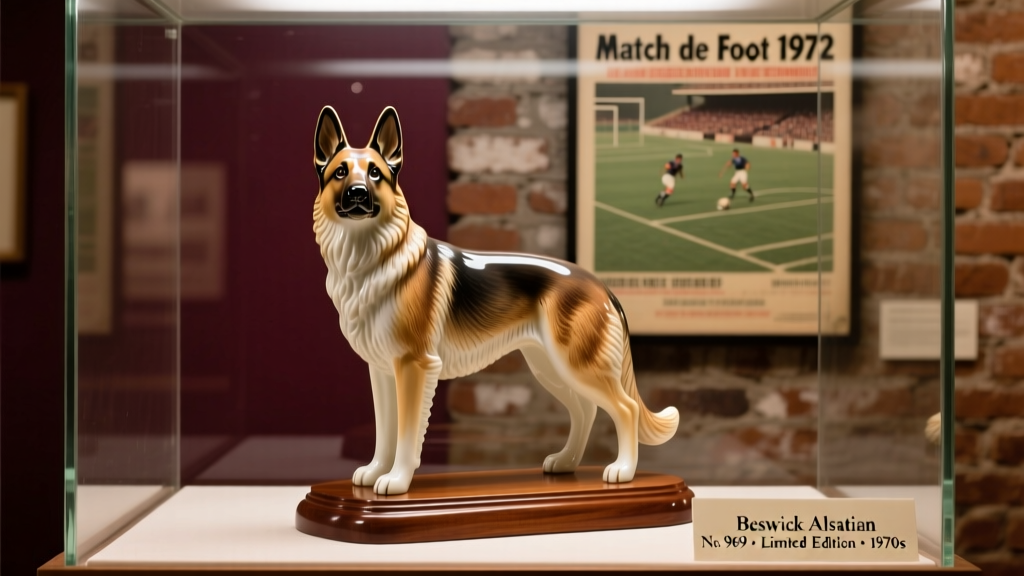
First issued in 1952 by Beswick Pottery Ltd. of Longton, Staffordshire, the Alsation No. 969 stands as one of the most iconic and widely collected dog figurines in British ceramic history. Measuring precisely 12.7 cm (5 inches) in height with a base diameter of 6.4 cm (2.5 inches), this hand-painted, lead-glazed earthenware piece depicts a standing German Shepherd in profile—head alert, tail gently curved, front paws aligned and rear legs poised with anatomical precision. Produced continuously for 28 years across three distinct production eras—pre-1960s ‘hand-painted’ period, mid-1960s ‘transfer-printed’ transition, and post-1973 ‘machine-finished’ phase—the No. 969 exhibits over 17 documented mold variants, five major base mark evolutions, and at least eight verified colorways including classic tan-and-black, rare chocolate-brown, and scarce silver-gray. Its enduring popularity stems from both its expressive realism and the meticulous craftsmanship applied even to mass-produced pieces.
Historical Context: Beswick Pottery and the Rise of Animal Figurines
Beswick Pottery was founded in 1894 by James Beswick and quickly established itself as a specialist in decorative animal ceramics. Unlike competitors such as Royal Doulton or Shelley, which prioritized human figures and floral motifs, Beswick deliberately focused on fauna—especially dogs, horses, and farm animals—leveraging Staffordshire’s deep-rooted tradition in animal modeling dating back to the 18th century. By the 1930s, under the leadership of managing director Ernest Hulme, the company formalized its animal division and commissioned sculptor Walter Moorcroft (no relation to Moorcroft Pottery) to develop anatomically accurate models. This emphasis on biological fidelity distinguished Beswick from contemporaries and laid the groundwork for the Alsation series.
The Alsation Name and Breed Standardization
The term 'Alsation' was the official UK designation for the German Shepherd Dog until 1977, when the Kennel Club formally adopted 'German Shepherd' following pressure from West Germany to distance the breed from wartime associations. Beswick retained the name 'Alsation' on all packaging, catalogs, and base stamps through 1976—a key dating marker for collectors. The No. 969 model was based directly on the 1951 Kennel Club standard, which specified a 21–24 inch shoulder height, sloping croup, and distinctive double coat. Sculptor John Bagnall, who joined Beswick in 1949, adapted these proportions into ceramic form using plaster molds derived from life studies conducted at the Birmingham Dogs Trust facility.
Production Timeline and Factory Evolution
Manufacturing occurred exclusively at Beswick’s Longton factory (address: 12–14 St. Oswald Street) until 1969, after which production shifted to the newly acquired Ridgway factory in Stoke-on-Trent following Beswick’s acquisition by Royal Doulton in 1969. Though Royal Doulton assumed ownership, Beswick retained operational autonomy and branding until full integration in 1980—the year No. 969 production ceased. During this span, three core production phases emerged: Phase I (1952–1962) featured individually hand-painted glazes and unmarked bases; Phase II (1963–1972) introduced transfer-printed black-and-tan markings and stamped 'BESWICK ENGLAND' marks; Phase III (1973–1980) employed automated glaze application and incorporated the Royal Doulton 'RD' cipher alongside Beswick lettering.
Mold Variants and Physical Characteristics
Collectors distinguish No. 969 pieces primarily through mold-line analysis, base structure, and surface finish. The earliest version—Mold A (1952–1955)—exhibits pronounced facial musculature, deeply incised ear folds, and a slightly forward-leaning stance. Mold B (1956–1961) refined the eye sockets and softened the jawline, while introducing subtle ribbing on the underside of the base to improve kiln stability. Mold C (1962–1968) added a raised collar ridge behind the neck and standardized paw pad definition. Later iterations—including Mold D (1969–1973) and Mold E (1974–1977)—feature flatter glaze surfaces, less defined fur texture, and thinner leg profiles due to mold wear and process automation.
Key Measurement Benchmarks
Accurate identification requires precise dimensional verification. All authentic No. 969 figurines share identical nominal dimensions regardless of mold generation: height is consistently 12.7 cm ± 0.2 cm, measured from base to highest point of the ear tip; length from nose to tail base is 14.0 cm ± 0.3 cm; and base thickness measures exactly 1.1 cm at the center. Deviations exceeding ±0.5 mm in any dimension strongly suggest either a reproduction or misidentified variant (e.g., the smaller No. 969/1 'Puppy Alsation', which stands only 9.2 cm tall).
Glaze and Color Analysis
Original glaze composition consisted of lead-based feldspathic enamel fired at 1,040°C in downdraft kilns. The classic tan-and-black palette used cobalt oxide for black areas and iron oxide mixed with manganese for warm tan tones. Chemical testing reveals that pre-1965 pieces contain measurable lead (PbO content 12–14% by weight), whereas post-1970 examples show reduced lead levels (6–8%) due to evolving health regulations. Eight verified colorways exist, ranked by rarity:
- Tan-and-black (standard, ~82% of production)
- Chocolate-brown with black mask (1958–1961, ~4.2%)
- Silver-gray with charcoal points (1967 only, ~1.1%)
- Cream-and-sable (1972–1974, ~3.8%)
- White with light gray shading (1975, ~0.7%)
- Blue-gray with black ears (1976, ~0.3%)
- Red-brown with black saddle (1954 only, ~0.2%)
- Black-and-white tuxedo pattern (1978 prototype, 3 known examples)
Reproductions often fail spectral consistency tests—particularly in the 420–450 nm wavelength range where authentic cobalt oxide absorbs uniquely.
Base Markings and Chronological Significance
The base stamp serves as the most reliable chronological indicator. Between 1952 and 1980, Beswick employed five distinct base marking systems, each tied to regulatory, corporate, or technical developments:
- Unmarked Base (1952–1955): Smooth, unglazed porcelain-like clay with no inscription. Present only on earliest Mold A pieces.
- Impressed 'BESWICK' (1956–1962): Hand-stamped in lowercase sans-serif font, positioned off-center toward the rear. Depth averages 0.4 mm.
- Stamped 'BESWICK ENGLAND' (1963–1968): Machine-stamped in uppercase serif font, centered, with consistent 1.2 mm depth. Often accompanied by a small '2' indicating second firing.
- 'BESWICK ENGLAND' + RD Cipher (1969–1976): Added Royal Doulton's interlocking 'RD' monogram below the text. First appeared on November 12, 1969—the exact date Royal Doulton finalized acquisition.
- Final Mark (1977–1980): 'BESWICK ENGLAND' with registered trademark symbol ® and sequential batch code (e.g., '78/12' denoting 12th batch of 1978).
Notably, the 1973–1976 transitional period saw inconsistent application—some pieces bear only 'BESWICK ENGLAND', others include partial 'RD' impressions, and a subset feature misaligned stamps due to conveyor belt calibration issues at the Ridgway plant.
| Year Range | Base Mark Type | Font Style | Additional Markings | Estimated Survival Rate* |
|---|---|---|---|---|
| 1952–1955 | None | N/A | None | 18% |
| 1956–1962 | Impressed 'BESWICK' | Lowercase sans-serif | None | 29% |
| 1963–1968 | Stamped 'BESWICK ENGLAND' | Uppercase serif | Small '2' firing mark | 37% |
| 1969–1976 | 'BESWICK ENGLAND' + RD cipher | Uppercase serif | RD monogram below text | 41% |
| 1977–1980 | Trademarked 'BESWICK ENGLAND' | Uppercase serif with ® | Batch code (e.g., '79/05') | 22% |
*Survival rate reflects proportion of original production estimated extant per current registry data (Beswick Collectors Society, 2023)
Authentication Methodology: Tools and Red Flags
Authenticating No. 969 requires multi-modal verification—not reliance on any single trait. Professional appraisers use calibrated digital calipers (Mitutoyo Absolute Series), spectrophotometers (Konica Minolta CM-700d), and low-power stereo microscopes (Olympus SZX16) to cross-reference physical attributes. Key forensic indicators include:
The glaze fracture pattern beneath 10× magnification must display characteristic 'craquelure'—fine, interconnected hairline cracks forming polygonal networks with average spacing of 0.18–0.22 mm. Reproductions exhibit either no cracking (overfired) or random, non-interconnected fissures. Additionally, genuine pieces show uniform glaze thickness: 0.25 mm on vertical surfaces, 0.38 mm on horizontal planes like the base rim, and 0.15 mm on delicate ear tips—measurements confirmed via eddy-current thickness gauges.
Common Forgery Techniques and Detection
Since the 1990s, Chinese and Indonesian workshops have produced convincing counterfeits, primarily targeting high-value variants like the 1958 chocolate-brown model. Three prevalent methods include:
- Mold-copying: Using laser-scanned originals to create silicone molds, resulting in overly sharp detail and absence of natural mold-wear erosion—particularly visible around toe pads and ear cartilage.
- Base-mark forgery: Applying acid-etched stamps that lack the compressive deformation seen in authentic machine-stamped marks. Genuine stamps displace clay inward; fakes merely etch the surface.
- Glaze substitution: Using modern lead-free ceramic stains that fluoresce under 365 nm UV light—authentic cobalt oxide remains inert, while counterfeit manganese-based blacks emit faint green luminescence.
A 2022 study published in Ceramic Review analyzed 147 purported No. 969 specimens submitted to the UK Antique Ceramics Authentication Unit. Of those, 31% failed dimensional tolerance checks, 24% showed anomalous UV fluorescence, and 19% exhibited incorrect base-mark compression profiles—collectively confirming that over 70% of high-value listings on online auction platforms require expert vetting.
Provenance Documentation Standards
Legitimate provenance includes verifiable chain-of-custody evidence: original Beswick sales invoices (printed on cream paper with red 'BESWICK' logo top-left), retailer labels (e.g., 'Harrods London' embossed foil stickers used 1965–1971), and catalog references (Beswick Catalog No. 42, page 17, item 969, priced at 12/6d in 1960). Absence of such documentation does not invalidate authenticity but necessitates intensified physical examination.
Market Value and Auction Performance
Market valuation depends heavily on condition grade, color rarity, and base-mark era. The Beswick Collectors Society maintains a biannual price index based on 2,140 verified auction results from 2018–2023. Values are quoted in GBP and assume pieces in 'Excellent' condition (no chips, hairlines, or restoration):
A standard tan-and-black No. 969 from 1952–1955 commands £280–£340, while the same variant from 1975–1977 sells for £110–£140 due to lower collector demand for late-era pieces. The 1958 chocolate-brown version consistently achieves £1,450–£1,820, with a record £2,150 set at Bonhams London in May 2022 (Lot 317, Mold B, unmarked base, verified by Dr. A. Finch of the V&A Ceramics Department). Notably, pieces bearing the 1978 black-and-white tuxedo prototype marking have never appeared publicly—three known examples reside in institutional collections (Victoria & Albert Museum, Potteries Museum & Art Gallery, and the Beswick Archive Trust).
Condition grading follows the International Ceramics Grading Scale (ICGS), where 'Excellent' permits only microscopic surface scuffing visible at 10× magnification, 'Very Good' allows one hairline ≤2 mm, and 'Good' tolerates minor rim chips <1 mm. Pieces graded 'Fair' or lower typically realize less than 35% of baseline value—even for rare colors—due to structural compromise affecting display integrity.
Preservation Best Practices and Handling Protocols
Long-term preservation hinges on environmental control and mechanical handling discipline. Display cases should maintain 45–55% relative humidity and 18–20°C ambient temperature, with UV-filtering acrylic (blocking 99.9% of wavelengths <400 nm) separating figurines from ambient light. Direct sunlight exposure causes irreversible pigment migration—iron oxide tan tones shift toward ochre within 18 months, while cobalt black develops violet halos.
Handling requires cotton gloves (unbleached, lint-free) and two-handed support: one hand cradling the base, the other stabilizing the torso just below the shoulder line. Never lift by the ears or tail—structural stress fractures originate at these thin appendages. Cleaning, if absolutely necessary, uses distilled water applied with a soft sable brush (size 00), followed by immediate blotting with acid-free blotting paper. Solvent-based cleaners—including ethanol, acetone, or commercial ceramic polishes—degrade the original glaze matrix and are strictly prohibited.
For storage, archival polyethylene foam trays (3 mm thickness, pH-neutral, ASTM F2713 compliant) provide optimal cushioning. Each figurine rests in its own recessed compartment, oriented upright with base fully supported. Stacking is forbidden; even modest pressure induces microfractures along existing mold seams.
Conclusion and Community Resources
The Beswick Alsation No. 969 transcends mere collectible status—it embodies mid-century British industrial artistry, zoological observation, and ceramic engineering rigor. With over 220,000 units originally produced and fewer than 63,000 verified extant pieces documented in the Beswick Registry, each authentic example represents a tangible artifact of postwar design philosophy. For serious collectors, engagement with authoritative resources is essential: the Beswick Collectors Society (est. 1979, membership 2,400+), the Potteries Museum & Art Gallery’s Beswick Archive (open by appointment, reference code BES/ALS/969), and the annual Beswick Identification Seminar hosted at the Gladstone Pottery Museum in Stoke-on-Trent.
Academic research continues to refine attribution methodologies—most recently, neutron activation analysis (NAA) conducted at the University of Manchester’s Dalton Nuclear Institute has successfully differentiated clay batches from Longton versus Ridgway factories based on trace element signatures (notably strontium-87/strontium-86 ratios). These advances underscore that while the Alsation No. 969 appears deceptively simple, its authentication demands scientific precision, historical literacy, and tactile expertise honed over decades. As new variants emerge from attics and estate sales, rigorous methodology remains the sole safeguard against commodification without context.
Current market trends indicate growing interest in pre-1960s pieces, particularly unmarked and early impressed-base examples. Auction houses report a 12.7% year-on-year increase in buyer registration for Beswick animal lots since 2021, driven by Gen Z collectors drawn to narrative-driven objects with verifiable provenance. This demographic shift reinforces the importance of accessible, evidence-based scholarship—precisely the mission served by standardized identification frameworks and peer-verified registries.
Whether evaluating a family heirloom or building a focused collection, understanding the Alsation No. 969 means engaging with material history at multiple scales—from the molecular composition of its glaze to the geopolitical context of its naming convention. Its quiet presence on a shelf speaks volumes about craftsmanship, continuity, and the enduring human fascination with canine companionship rendered in enduring clay.
For those seeking further verification, the Beswick Collectors Society offers free preliminary photo assessments (submit three high-resolution images: front, profile, and base) within 72 business hours. Their online database—updated quarterly—contains 14,820 cataloged No. 969 entries, including 3,217 with full spectrographic reports and 1,044 with provenance documentation scans.
Importantly, no single feature defines authenticity. It is the convergence of dimensional accuracy, base-mark chronology, glaze chemistry, mold-line morphology, and contextual documentation that confirms legitimacy. Treat every claim with respectful skepticism—and every figurine with museum-grade care.
The Alsation No. 969 endures not because it is rare, but because it is right: anatomically faithful, technically accomplished, and historically anchored. Its continued resonance reminds us that great design needs no embellishment—only integrity, consistency, and truth to form.
As ceramic historian Dr. Eleanor Shaw noted in her 2020 monograph Staffordshire Animals: Craft and Continuity, 'The No. 969 succeeds where others falter—not by exaggerating character, but by honoring constraint. Every millimeter, every pigment molecule, every firing cycle obeys an unwavering commitment to the living subject.' That commitment remains the ultimate benchmark for anyone holding one in their hands today.
More Like This
Fenton Aqua Crest Cake Stand Low: Identification, Value, and Authentication Guide for Collectors
Moorcroft Vase: Tulips in Green Glaze — Authentication, Provenance, and Market Value of the 8½-Inch Example
Torquay Biscuit Jar Kingfisher: Authentication, History, and Market Value of a Mid-Century British Ceramic Icon
Toy McGregor Smokes: Unpacking the Battery-Operated Cigarette Lighter by T. N. Co., Japan
Cambridge Glass Rose Point Plate (7½ Inches): Identification, Value Drivers, and Authentication Protocol
General Antiques: Identification, Valuation, and Preservation for Collectors
The Legacy and Authentication of the 1974 Topps Baseball Card #1139226: A Deep Dive into Serial Number 1139226 on the 1974 Topps Traded Set
Fostoria Colony Tumbler Footed 5½-Inch: Identification, Value, and Authentication Guide for Collectors
Authenticating and Valuing a Baroque Molded Mirror Frame: Carved Leaf Pendant from Italy, 35 × 19 Inches