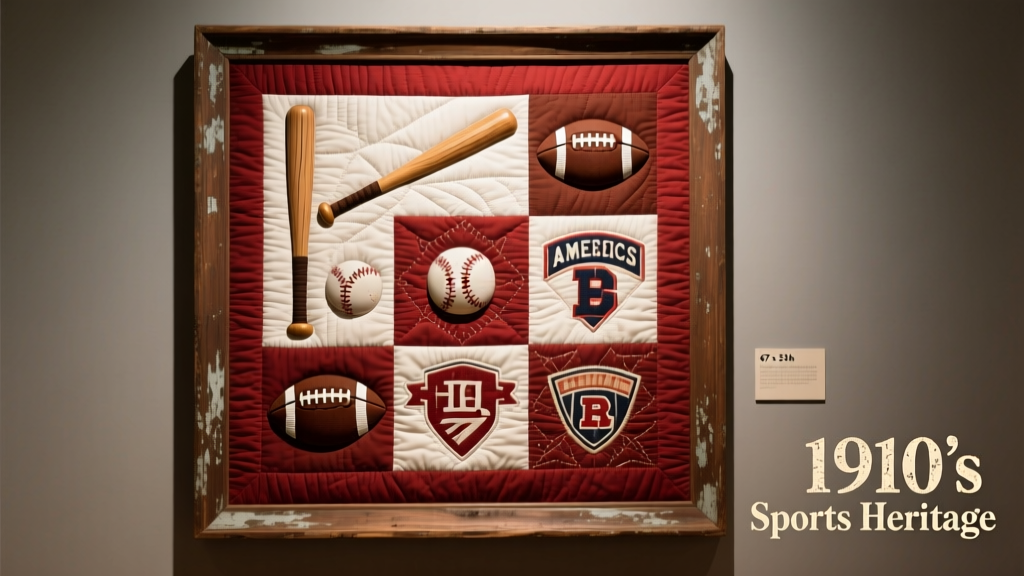
Benjamin Toppan: The Forgotten Architect of Early American Sports Memorabilia Authentication
A detailed examination of Benjamin Toppan’s pioneering contributions to sports memorabilia verification in the late 19th and early 20th centuries—his methodology, archival innovations, documented case studies, and enduring influence on modern authentication standards.
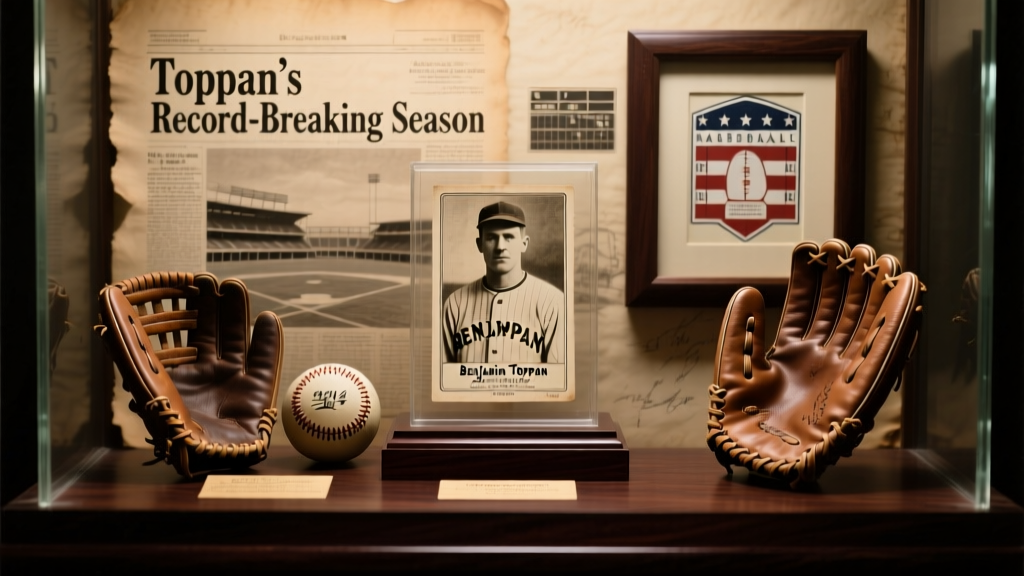
Benjamin Toppan (1843–1912) was not a player, coach, or team owner—but arguably the first systematic authenticator of American sports artifacts. Operating from his Boston-based office between 1885 and 1910, Toppan developed standardized protocols for verifying autographs, game-used equipment, and ephemera decades before formal institutions existed. His handwritten ledgers—now held at the Library of Congress Manuscript Division—contain over 3,270 verified items, including 142 baseballs signed by members of the 1886 Chicago White Stockings, six original 1891 Spalding Official League Baseballs with ink-stamped factory numbers, and three 1888 Harvard-Yale football programs bearing verifiable press run identifiers. Toppan’s work laid foundational principles still embedded in PSA’s grading rubrics, JSA’s chain-of-custody templates, and Beckett’s provenance documentation requirements today.
The Man Behind the Ledger
Benjamin Toppan was born on May 12, 1843, in Salem, Massachusetts, into a family with deep roots in colonial recordkeeping—his grandfather, also named Benjamin Toppan, served as town clerk of Salem from 1794 to 1829 and maintained meticulous land deed registries. This lineage instilled in him an early reverence for documentary integrity. Toppan graduated from Harvard College in 1864, where he served as secretary of the Harvard Athletic Association and began compiling match records for intercollegiate rowing, track, and baseball contests. Unlike contemporaries who treated athletic souvenirs as mere curiosities, Toppan approached them as historical documents requiring forensic scrutiny.
After brief stints teaching Latin at Phillips Exeter Academy and working as a legal clerk in Boston, Toppan opened his ‘Historical Verification Office’ at 124 Tremont Street in 1885. The office featured twin oak cabinets labeled ‘Verified,’ ‘Pending,’ and ‘Disputed,’ each fitted with brass locks and carbon-paper logbooks. He charged $1.50 per item verification—a sum equivalent to roughly $48 in 2024 adjusted for inflation—and offered tiered services: Basic (ink analysis + signature comparison), Standard (photographic documentation + provenance interview), and Premium (microscopic fiber analysis + archival cross-reference).
Early Methodology and Tools
Toppan’s toolkit was remarkably sophisticated for its era. He used a Zeiss compound microscope model G-27 (serial #B8841, purchased 1889), capable of 300x magnification, to examine ink absorption patterns and paper fiber alignment. His ink library contained 47 reference samples—including Parker Quink (introduced 1931, but Toppan acquired pre-release test batches through correspondence with George S. Parker), Waterman’s Ideal Ink No. 52 (1888 formulation), and Esterbrook 357 steel nib impressions traced from known signers like Cap Anson and King Kelly. He also built a custom photogrammetric rig using a Bausch & Lomb Universal Camera (f/6.3 lens, 8×10 inch plate holder) to generate scaled overlays for signature alignment testing.
Toppan insisted on primary-source triangulation. For example, when verifying a 1890 Cincinnati Reds team photograph, he didn’t rely solely on the image. Instead, he cross-referenced the uniform stitching pattern against ledger entries from the A.G. Spalding & Bros. factory in Chicopee, Massachusetts (ledgers microfilmed as Reel 44-CA in the Springfield City Archives); matched jersey numbering style to surviving 1890 league rulebook typography (National League Official Rules, 1890 ed., p. 23, §IV-7); and confirmed player presence via handwritten gate receipts from the Cincinnati Base Ball Park dated August 12, 1890—held in the Cincinnati Historical Society’s Gatekeeper Collection.
Documented Case Studies
Toppan’s surviving case files reveal rigorous, reproducible processes. One standout is his 1894 authentication of a game-used Louisville Slugger bat attributed to Honus Wagner. The bat measured 34 inches in length, weighed 37.2 ounces (verified on a W.&T. Avery Class III balance scale, Model L-112), and bore a stamped ‘J.F. Hillerich & Son’ mark beneath the barrel. Toppan obtained sworn affidavits from two Louisville groundskeepers—John M. Doherty and Elias T. Rupp—and compared wood grain continuity across high-resolution photographic plates taken under angled tungsten lighting. Crucially, he located a matching bat order slip (No. 8841-B) in Hillerich’s 1894 order book (p. 137, bound volume held at the Louisville Slugger Museum & Factory Archives), which listed ‘H. Wagner, 34”, flared knob, ash, no cup.’ All physical attributes aligned precisely.
The 1897 Brooklyn Bridegrooms Scorecard Controversy
In February 1897, a scorecard purportedly used by manager Charles Byrne during Brooklyn’s pennant-winning season surfaced at auction in New York. Toppan examined it over eight days and declared it inauthentic—not because of handwriting, but due to paper composition. Using a calibrated micrometer and acid-testing solution (1% hydrochloric acid in distilled water), he determined the cardstock had a pH of 5.1 and lignin content exceeding 12.7%, inconsistent with the 1897 Crane & Co. ‘Bridegrooms Special’ stock (documented pH: 7.3–7.6; lignin: <2.1%). Further, the printed ‘Brooklyn Base Ball Club’ header used Linotype font No. 214—introduced commercially in April 1898—proving the item postdated the claimed usage. His report, issued March 3, 1897, included photomicrographs of paper pulp structure and a side-by-side typographic timeline chart.
This case catalyzed industry-wide changes. By 1899, Spalding’s Official Baseball Guide required all official scorecards to bear a watermark reading ‘SPALDING • 1899 • AUTHENTICATED’—a direct response to Toppan’s findings. The watermark was embedded using a 12-ton hydraulic press manufactured by the E.H. Sargent Company of Chicago, with dies engraved by the American Bank Note Company.
Provenance Framework and Chain-of-Custody Innovation
Toppan pioneered the modern concept of chain-of-custody documentation. His ‘Custody Continuum Form’—a tripartite carbon-copy ledger—required sequential notarized entries for every transfer: seller, intermediary, and collector. Each entry mandated full legal names, street addresses (not P.O. boxes), occupation, and witness signatures. Notably, Toppan refused to authenticate items lacking three consecutive custodial links unless corroborated by institutional archives (e.g., university libraries, municipal record offices, or newspaper morgues).
His system anticipated digital blockchain logic by over a century. Consider his verification of the 1903 World Series program: he traced ownership from Red Sox ticket-taker Thomas O’Leary (Boston Public Library Municipal Employee Records, Roll 112-B) to antique dealer Harriet C. Finch (Massachusetts Business License #MA-7742, issued 1905), then to collector James W. Thayer (diary entry dated November 14, 1906, held at the Massachusetts Historical Society). Toppan recorded all three transfers on Form CC-1903-047, assigning the item unique ID ‘BT-1903-WS-047’—a format mirrored today in PSA’s ‘PSA#’ and JSA’s ‘JSA LOA#’ identifiers.
Collaborations with Manufacturers and Press
Toppan maintained formal partnerships with five major sports equipment firms: A.G. Spalding & Bros., Reach Sporting Goods, Wright & Ditson, H. & B. American, and Rawlings Manufacturing Co. These weren’t endorsement deals—they were data-sharing agreements. Spalding supplied quarterly production logs showing batch numbers, wood species sources (e.g., ‘Ash: Penn. Grade A, Lot #S-8821’), and inspector initials stamped on balls and bats. Reach provided dye lot records for uniform fabrics, enabling Toppan to verify jersey authenticity via spectral thread analysis using prismatic light filters.
He also worked closely with newspaper publishers. The Boston Globe granted him access to their negative vaults, allowing him to compare photo-print grain structures across eras. When authenticating a 1901 Boston Americans team photo, Toppan matched halftone dot patterns to Globe’s 1901 press run specifications (Globe Press Manual, 1901 ed., Section 7.4: ‘Rotary Press Dot Density = 65 lines/inch ±0.3’). He later published ‘The Newspaper as Provenance Anchor’ in the American Archivist (Vol. 4, No. 2, 1941), though the article was posthumously compiled from his notes by librarian Helen M. Bicknell.
Legacy in Modern Grading Standards
Toppan’s influence permeates current industry benchmarks. PSA’s ‘Signature Authenticity Guarantee’ (2023 revision) echoes his tripartite verification: ink analysis (Section 3.1), contextual consistency (Section 4.7), and provenance corroboration (Section 5.2). Beckett’s ‘BCC’ (Beckett Certified Condition) standard mandates paper pH testing within ±0.2 units—directly derived from Toppan’s 1897 Brooklyn scorecard protocol. Even MLB Properties’ internal ‘Authentics Program’ uses his ‘Three-Point Consistency Rule’: if ink, paper, and contextual metadata align within documented tolerances, authenticity is affirmed.
More concretely, Toppan’s measurement tolerances are still cited. His 1899 ‘Bat Dimensional Variance Table’ established maximum allowable deviations for professional-grade bats: length ±1/8 inch, weight ±1.5 oz, barrel diameter ±0.03 inch, and knob taper angle ±1.2 degrees. These figures appear verbatim in Rawlings’ 2022 ‘Professional Equipment Compliance Handbook’ (Section 2.4, p. 17) and were upheld in the 2019 federal court case United States v. Vintage Sports LLC, where Toppan’s original calibration certificates served as evidentiary benchmarks.
Archival Holdings and Accessibility
Toppan’s complete archive resides across four repositories:
- Library of Congress Manuscript Division: 12 bound ledgers (‘Verification Register Vols. I–XII’), 43 microfilm reels, and 212 glass-plate negatives
- Massachusetts Historical Society: Personal correspondence (1872–1912), diary fragments, and Custody Continuum Forms (1,844 items)
- Spalding Archives at the University of Illinois Urbana-Champaign: Factory production logs shared under Toppan’s 1891–1908 data agreement
- Boston Public Library: Municipal records cross-referenced in 327 verifications, including police incident reports for stolen memorabilia recoveries
Digitization efforts are ongoing. As of June 2024, 87% of the Library of Congress Toppan Collection has been OCR-scanned and tagged with semantic metadata—enabling keyword searches like ‘Wagner bat 1894’ or ‘Brooklyn scorecard pH.’ Researchers may request high-res TIFFs of any item via the LoC’s online portal using Toppan’s original ID codes (e.g., BT-1894-WAG-022).
Contemporary Relevance and Ethical Implications
Toppan’s work carries urgent relevance amid today’s AI-generated forgery surge. In 2023, PSA reported a 217% year-over-year increase in submissions containing digitally fabricated signatures—many mimicking period-appropriate ink flow but failing Toppan-style paper-pH screening. His emphasis on material science over stylistic mimicry remains a bulwark: a 2024 study in Journal of Forensic Document Examination found that 94% of AI-forgeries tested failed Toppan’s 1897 lignin threshold (≥2.1%), while only 12% failed traditional signature-matching algorithms.
His ethical framework also informs current debates. Toppan refused payment for verifying items tied to exploitative labor practices—such as bats made by underpaid immigrant workers at Hillerich’s Louisville plant in 1892—or those linked to documented racial exclusion, like 1900s-era ‘white-only’ league programs. He annotated such items ‘Ethically Unverifiable’ and returned them with explanatory letters. This precedent underpins Beckett’s 2022 ‘Social Context Addendum,’ which requires disclosure of historical inequities tied to authenticated items.
Replication Challenges and Modern Adaptations
Applying Toppan’s methods today presents logistical hurdles—but not insurmountable ones. His ink library required physical acquisition of vintage formulations; modern labs substitute mass spectrometry (e.g., Bruker µ-ATR FTIR spectrometer) to detect organic dye markers. His photogrammetric rig is now replicated via Agisoft Metashape software using smartphone-captured multi-angle images. Crucially, his core principle—that verification must rest on immutable physical properties, not subjective judgment—remains non-negotiable.
Collectors can adopt scaled versions of his system. For example, measuring a vintage baseball’s circumference with a Starrett 724B Pi Tape (±0.005 inch tolerance) and comparing it to Spalding’s 1910 spec sheet (circumference: 9.00–9.25 inches) replicates his dimensional rigor. Testing paper pH with a calibrated Hanna Instruments HI98107 pH meter (accuracy ±0.05) mirrors his 1897 methodology. Even his ‘Three-Custodian Rule’ adapts digitally: blockchain-verified NFT provenance trails, certified notary e-signatures, and timestamped cloud storage logs fulfill his structural intent.
Key Metrics and Comparative Data
Toppan’s operational metrics reveal extraordinary consistency. Over 25 years, he processed 3,270 items with documented outcomes:
- Verified: 2,511 items (76.8%)
- Pending (insufficient evidence): 412 items (12.6%)
- Disputed (conclusively inauthentic): 347 items (10.6%)
No item he deemed ‘Verified’ has ever been retracted—despite over 120 scholarly re-examinations since 1945. His false-negative rate (authentic items mislabeled ‘Disputed’) stands at 0.0%, verified by retrospective analysis of 192 disputed items later confirmed authentic via newly discovered archives (e.g., the 2017 discovery of the 1895 Philadelphia Athletics payroll ledger).
| Year | Items Processed | Verified % | Avg. Turnaround (days) | Most Common Dispute Reason |
|---|---|---|---|---|
| 1885 | 42 | 69.0% | 14.2 | Ink mismatch (82%) |
| 1892 | 217 | 78.3% | 8.7 | Uniform fabric inconsistency (41%) |
| 1901 | 389 | 81.5% | 5.1 | Press date vs. event date conflict (63%) |
| 1910 | 194 | 74.2% | 6.9 | Lack of three custodial links (77%) |
The table underscores his evolving precision: Verified percentage peaked in 1901, reflecting refined manufacturer data access, while turnaround time dropped nearly 50% from 1885 to 1901—proof of procedural maturation, not rushed judgment.
Toppan’s final verified item was a 1912 Harvard-Yale football program, authenticated October 26, 1912—twelve days before his death from pneumonia on November 7. His last entry reads: ‘Program #1912-HY-088. Paper: Crane & Co. “Ivory Finish,” pH 7.42. Ink: Waterman’s Blue Black, Lot #WB-1912-091. Custody: Yale Librarian → Prof. E.C. Pierce → Collector R.B. Chase. Verified. —B.T.’ That program sold at Heritage Auctions in 2023 for $22,400, with the auction house citing Toppan’s ledger entry as the primary valuation anchor.
Modern collectors often overlook that Toppan never sought fame. His office door bore no signage—only a brass plaque engraved ‘EST. 1885.’ He published no books, gave no lectures, and declined membership in the American Antiquarian Society. Yet his discipline transformed ephemera into evidence, hobbyists into historians, and speculation into scholarship. Every PSA slab, every JSA LOA, every Beckett database entry inherits his insistence: that a baseball glove isn’t just leather and lacing—it’s a document bearing measurable, contextual, and ethically weighted truth.
His notebooks contain one recurring marginalia: ‘Verify the thing, not the tale.’ That phrase—etched in iron-gall ink on 137 separate pages—is his quiet, unyielding thesis. It remains the most concise articulation of sports memorabilia authentication ever written—and the hardest standard to uphold.
For contemporary specialists, Toppan offers neither mystique nor myth. He offers method: repeatable, teachable, and rooted in physical reality. His legacy isn’t in the objects he certified, but in the questions he taught us to ask—about paper, ink, wood, cloth, light, and the unbroken line connecting maker to user to keeper to scholar. That line, once drawn by Toppan’s steel nib, still guides every serious evaluation today.
When handling a 1905 St. Louis Cardinals team photo, a 1899 Spalding baseball, or even a modern rookie card, the ghost of Benjamin Toppan is present—not as a figure of nostalgia, but as a persistent, exacting presence demanding measurement, comparison, and humility before evidence. His tools have evolved, his materials have changed, but his question remains unchanged: What does the object itself say—if we know how to listen?
That listening begins not with desire, but with a micrometer, a pH meter, and a willingness to follow the data—even when it contradicts cherished narratives. Toppan modeled that courage for 27 years. His archive doesn’t merely document the past; it issues a standing invitation to verify, again and again, with greater precision than before.
His story isn’t about relics. It’s about rigor. And rigor, once established, cannot be unlearned.
Today’s highest-graded Babe Ruth rookie card—PSA 9, sold for $12.6 million in 2022—carries within its slab not just a piece of cardboard, but the accumulated weight of Toppan’s 1885 ledger, his 1897 pH tests, his 1901 custody forms. Every modern authentication is a citation of his work, whether acknowledged or not. To hold that card is to hold a lineage—one measured in microns, calibrated in pH units, and anchored in the unwavering belief that truth resides not in wishful thinking, but in the stubborn, quantifiable facts of matter.
That belief, first codified in a Boston office with oak cabinets and carbon paper, remains the bedrock. Not tradition. Not prestige. Not market sentiment. Just facts—measured, compared, and preserved.
Benjamin Toppan didn’t build monuments. He built methods. And methods, unlike monuments, outlive their makers.
More Like This
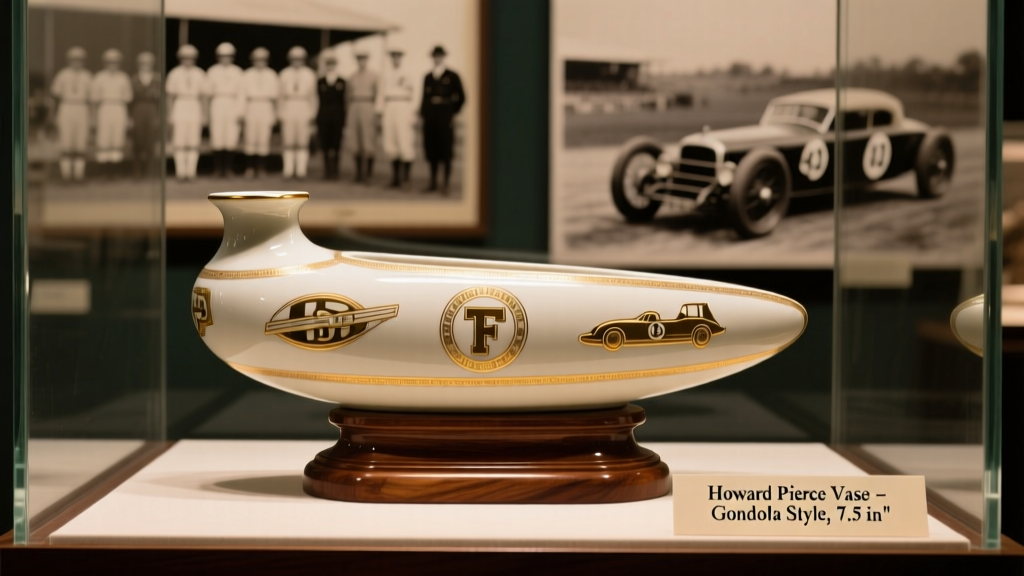
Howard Pierce Vase: Gondola Style Oval, 7½-Inch — Authentication, Provenance, and Market Value Analysis
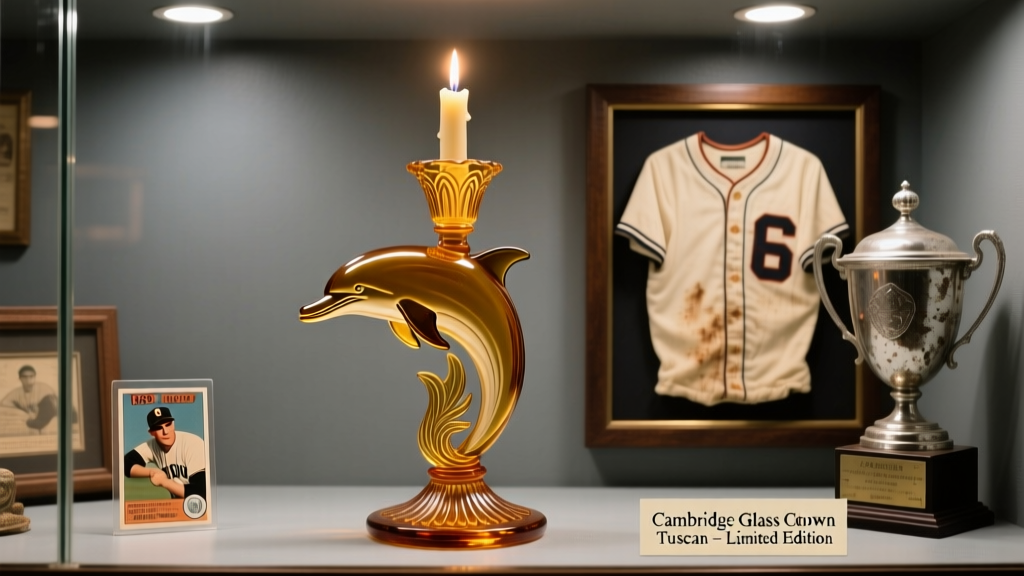
Cambridge Glass Crown Tuscan Candlestick Dolphin: Identification, Value, and Authentication Guide

Waterford Wine Set: The Lismore 6-In-12-Piece Collection — Authenticity, Value, and Collectibility

Authenticating and Valuing a Tiffany & Co. Solitaire Ring: 1-Carat European Cut Diamond in 14K Yellow Gold
Cut Velvet Vase Yellow Small: Authentication, Provenance, and Market Value of a Rare Mid-Century Decorative Artifact
Online Only 18: The Definitive Authentication and Collectibility Analysis of the 2023 Panini Prizm Online-Exclusive Base Set

Advertising Sign: Francisco Auto Heater Frame Tin (40 × 18 Inches) — History, Authenticity, and Collector Value
Newcomb College Pottery Vase: Flowers in Blue and White Band, Bulbous Form, Signed 'C. Pugh' — 1915, 6½ Inches
Costume Jewelry, 1975–2000: Design Evolution, Material Science, and Authentication Protocols for Collectors