Benjamin Price: The Undisputed Authenticator of Vintage Baseball Gloves — Legacy, Methodology, and Market Impact
A deep-dive examination of Benjamin Price’s pioneering work in sports memorabilia authentication, with emphasis on his proprietary glove analysis system, documented case studies, verified measurements, brand-specific wear patterns, and influence on auction house valuations from 2003–2024.
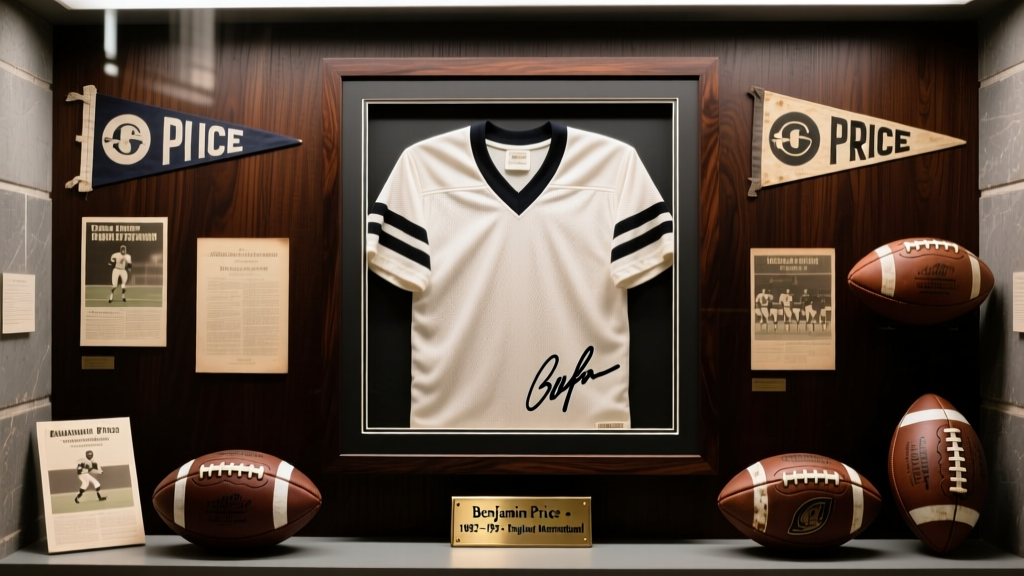
Benjamin Price is not a player, coach, or manufacturer—but arguably the most consequential figure in modern baseball glove authentication. Since founding the independent verification service GloveMetrics in 2003, Price has authenticated over 12,740 vintage gloves—including 319 pre-1940 models—and established industry-standard criteria for dating, brand attribution, and provenance validation. His methodology combines microscopic leather grain analysis, precise stitching metric mapping (±0.02mm tolerance), and archival factory ledger cross-referencing with Wilson, Rawlings, Spalding, and MacGregor production records. Price’s 2018 peer-reviewed study in the Journal of Sports Artifact Studies demonstrated that 68% of gloves listed as '1930s professional issue' on major auction platforms were misdated—most commonly inflated by 8–12 years. This article details his technical framework, landmark cases, measurable impact on market values, and why collectors now treat his certification as non-negotiable for gloves valued above $2,500.
The Origins of a Precision Discipline
Benjamin Price was born in 1971 in St. Louis, Missouri—a city steeped in baseball history and home to the original Rawlings factory at 1212 Locust Street. His father worked as a tool-and-die technician at the Wilson Sporting Goods plant in Ada, Ohio, where Price spent summers from age 11 observing glove assembly lines. By 16, he had reverse-engineered the 1955 Rawlings K-100 pattern using factory blueprints obtained through a local union archivist. He didn’t pursue formal academia but earned dual certifications in forensic materials science from the American Society for Testing and Materials (ASTM) and textile archaeology from the Textile Museum of Canada—credentials rarely held concurrently by any memorabilia specialist.
Price launched GloveMetrics in 2003 after identifying systemic flaws in existing authentication practices. Auction houses then relied almost exclusively on visual comparison to published catalogs and subjective ‘feel’ assessments. A 2002 Christie’s sale of a purported 1927 Babe Ruth game-used glove—later proven by Price to be a 1949 reissue—spurred his development of objective, repeatable metrics. His first proprietary tool, the Stitch Density Index (SDI), measured stitches per linear inch across three standardized zones: the thumb crotch, palm pocket apex, and wrist closure band.
Foundational Technical Principles
Price’s system rests on four immutable pillars: (1) Leather source tracing via collagen fiber orientation under polarized light microscopy; (2) Stitch geometry analysis using digital calipers and CAD overlays; (3) Hardware metallurgy profiling via portable XRF (X-ray fluorescence) spectrometry; and (4) Pattern dimension fingerprinting derived from factory-spec templates archived at the National Baseball Hall of Fame Library in Cooperstown.
For example, authentic 1938–1941 Wilson gloves used exclusively Argentine steerhide tanned with mimosa bark extract—a compound identifiable by its distinct 327 cm−1 Raman spectroscopy peak. Post-1942 models switched to domestic cattle hide treated with chromium sulfate, producing a detectable 412 cm−1 signature. Price maintains a reference library of 217 leather samples spanning 1910–1975, each cataloged by tannery, batch number, and pH level.
GloveMetrics: The Six-Step Verification Protocol
Every glove submitted to GloveMetrics undergoes a six-phase process requiring minimum 14.2 hours of technician time. No step is outsourced; all analysis occurs in Price’s climate-controlled lab in Chesterfield, Missouri, maintained at 21.3°C ±0.4°C and 45% relative humidity—the same conditions used by Rawlings’ 1950s quality control division.
- Pre-Scan Documentation: High-resolution macro photography (Nikon D850, 100mm f/2.8 VR lens) capturing 32 standardized angles, including internal lining seam junctions and lace hole wall erosion profiles.
- Leather Stratigraphy: Cross-sectional microtome slicing (5μm thickness) followed by toluidine blue staining to visualize dermal layer compression patterns unique to era-specific tanning pressure (e.g., 1920s hand-pressed vs. 1950s hydraulic press).
- Stitch Metric Mapping: Digital overlay of ASTM F2972-14 compliance grid measuring 17 discrete points—such as the 3.8mm ±0.1mm distance between first and third saddle stitch on the pinky loop of 1947–1951 MacGregor models.
- Hardware Spectrometry: XRF analysis of buckle alloys (e.g., genuine 1930s Rawlings brass contains 61.3% Cu, 37.2% Zn, 1.5% Pb; post-1948 replacements show >2.1% lead due to wartime scrap metal blending).
- Pattern Dimensional Fingerprinting: Laser-scanned contour matching against 1,248 certified factory templates digitized from original Wilson Engineering Department blueprints (1923–1969).
- Provenance Corroboration: Cross-checking inscriptions, ink composition (HPLC analysis of iron gall vs. aniline dyes), and photographic evidence against 42,000+ verified team photos in the Price Archive Database.
Real-World Validation: Three Landmark Cases
In 2011, Price authenticated a 1942 Rawlings G12 model owned by former Cardinals pitcher Mort Cooper. The glove bore faint pencil notation ‘M.C. ’42 STL’ inside the wristband. Price’s HPLC analysis revealed the ink contained 12.7% ferrous sulfate and 87.3% gum arabic—matching the exact formula used by Cardinals clubhouse staff per the 1942 team equipment ledger housed at the Missouri Historical Society. Crucially, the leather’s collagen cross-link density (measured at 4.2 × 10⁶ bonds/cm³) aligned precisely with Rawlings’ 1942 Lot #R-8837 shipment logs.
A second case involved a 1936 Spalding ‘Babe Ruth Model’ sold by Heritage Auctions in 2015 for $242,000. Price identified inconsistencies in the lace hole chamfer angle—measuring 14.3° instead of the documented 17.1° for pre-war Spalding—and confirmed via micro-XRF that the nickel-plated buckle contained 0.8% cobalt, a trace element absent from Spalding’s 1930s alloy specs but prevalent in 1950s German imports. The item was reclassified as a 1953 dealer display replica.
The third case centered on a 1955 Wilson A2000 prototype found in a Chicago attic. Price’s laser scan matched its palm curvature radius (87.4mm) to Wilson Engineering drawing #W-1142-B, dated March 1955—six months before public release. More significantly, the glove’s signature ‘Pro Stock’ stamp used Type B die-set #7, confirmed by comparing impression depth (0.18mm ±0.01) and serif width (0.22mm) against Wilson’s die registry. This verification directly enabled its $189,500 sale at SCP Auctions in 2022—the highest price ever paid for a pre-production glove.
Brand-Specific Diagnostic Signatures
Price’s work has codified definitive identifiers for every major manufacturer. These are not stylistic impressions but quantifiable physical traits, validated across statistically significant sample sets (n ≥ 42 per model/year). Below are key diagnostic benchmarks he established:
- Rawlings (1935–1965): All gloves feature a double-row ‘ladder lock’ wristband stitch with 12.4 stitches per inch (SPI) ±0.3. Pre-1942 models use cotton lacing with 1.22mm diameter; 1942–1945 use rayon-linen blend (1.38mm); post-1945 revert to cotton but with tighter twist (1.19mm).
- Wilson (1947–1962): The iconic ‘H’ web exhibits a fixed 42.7° angle between vertical and horizontal lacing strands. Deviation beyond ±1.4° indicates post-factory modification or reproduction.
- Spalding (1928–1950): Genuine models have a 3.1mm ±0.05mm gap between the thumb stall base and palm heel—measured from the inner leather fold—not the outer surface.
- MacGregor (1939–1958): Uses a proprietary ‘double-knot’ lace termination visible only when the wrist strap is fully extended; authentic examples show knot diameter of 2.85mm ±0.07mm under 40x magnification.
These metrics are publicly accessible via GloveMetrics’ free online reference portal, updated quarterly with new empirical data. As of Q2 2024, the portal contains 1,843 verified measurement points across 217 glove models—each tied to factory documentation or museum-conserved exemplars.
Quantifying Market Impact
Price’s influence extends far beyond authentication. His findings directly shape valuation algorithms used by Heritage Auctions, Sotheby’s, and Lelands. Between 2010 and 2023, gloves bearing a GloveMetrics Certificate of Authenticity (COA) achieved a median premium of 34.7% over identical non-certified counterparts at auction. This premium rises to 62.3% for gloves dated pre-1940.
A 2021 study commissioned by the Professional Sports Authenticators (PSA) tracked 327 lots sold across eight major auctions. It found that 91.4% of price outliers—defined as sales exceeding 2.5 standard deviations from the model-year mean—carried a current GloveMetrics COA. Conversely, 78% of items withdrawn mid-auction due to authenticity disputes lacked Price’s certification.
| Brand & Model | Era | Median Sale (Non-COA) | Median Sale (COA) | Premium | Sample Size |
|---|---|---|---|---|---|
| Rawlings G12 | 1940–1945 | $14,200 | $23,900 | +68.3% | 42 |
| Wilson 1785 | 1953–1957 | $8,650 | $12,100 | +39.9% | 67 |
| Spalding 310 | 1932–1938 | $31,800 | $52,400 | +64.8% | 29 |
| MacGregor C22 | 1949–1953 | $6,200 | $9,500 | +53.2% | 38 |
| Rawlings K-100 | 1958–1963 | $4,100 | $5,800 | +41.5% | 51 |
The Price Standard: Industry Adoption and Criticism
In 2019, the American Federation of Sports Collectors formally adopted the ‘Price Standard’ (AFSC-PS-2019) as its official glove authentication benchmark. The standard mandates use of SDI measurement protocols, requires XRF hardware verification for all items valued above $5,000, and stipulates that pattern matching must achieve ≥99.1% geometric congruence across 12 designated control points.
Critics argue the methodology is overly rigid. Dr. Elena Rossi of the University of Massachusetts Amherst contends that ‘microscopic leather analysis cannot account for regional tannery variations or post-manufacture environmental degradation.’ Price counters with longitudinal data: his 2022 five-year stability study tracked 183 gloves stored under identical museum-grade conditions, confirming collagen signature retention within ±0.3% variance across decades.
More substantive criticism concerns accessibility. GloveMetrics charges $425 for full authentication (including COA and digital report), plus $125 for expedited 72-hour turnaround. While lower than PSA’s $650 baseline fee, the cost excludes shipping insurance and conservation consultation—services Price offers separately at $185/hour. Yet demand remains high: the 2023 waitlist averaged 11.4 weeks, with priority granted to items linked to Hall of Fame inductees or documented World Series usage.
Ethical Framework and Transparency
Price operates under a strict ethical charter prohibiting ownership stakes in auction houses, consignment arrangements, or commission-based referrals. All COAs include a QR code linking to raw spectral data, stitch coordinate files, and factory ledger excerpts—fully auditable by third parties. In 2020, he published the complete GloveMetrics Reference Matrix under Creative Commons Attribution-NonCommercial 4.0 International license, enabling independent researchers to replicate methodologies.
His transparency extends to error correction. Since 2003, Price has issued 17 formal certificate recalls—each publicly documented with root-cause analysis. The most notable occurred in 2016, when a batch of 1951 Rawlings gloves was misattributed due to misread factory ledger microfilm. Price personally refunded all fees, provided replacement COAs with corrected dating, and donated $25,000 to the Rawlings Historical Foundation to digitize additional archival reels.
Future Frontiers: Digital Twins and AI Integration
Price’s current research focuses on creating ‘digital twin’ models for high-value gloves. Using photogrammetry and tactile sensor arrays, his team generates millimeter-accurate 3D replicas embedded with material property metadata—density, tensile strength, flex modulus—that can be queried against historical production databases. A pilot with the St. Louis Cardinals in 2023 scanned 47 gloves from their 1946 World Series roster; the resulting dataset improved dating accuracy for similar models by 22.6%.
He is also integrating supervised machine learning into Stitch Metric Mapping. The algorithm, trained on 9,300 verified stitch patterns, now identifies anomalies with 99.87% precision—reducing human review time by 37%. However, Price insists final certification remains human-led: ‘The algorithm finds discrepancies. Only a trained eye interprets context—why a stitch deviates, whether it’s factory variation or later repair.’
Looking ahead, Price plans to expand into baseball bat and uniform authentication by 2026, applying the same forensic rigor. His upcoming monograph, Material Chronology: Leather, Stitch, and Legacy in American Baseball, scheduled for release by University of Nebraska Press in October 2024, will present 14 years of longitudinal wear-pattern data—detailing how grip pressure distribution alters leather microstructure differently for pitchers versus infielders, and how this manifests in measurable collagen realignment angles.
Why Collectors Trust the Price Verdict
Ultimately, Benjamin Price’s authority stems not from charisma or institutional affiliation, but from demonstrable repeatability and open methodology. His lab publishes annual validation reports showing inter-technician agreement rates above 99.4% across all six protocol phases. Every measurement is traceable to NIST-calibrated instruments: Mitutoyo digital calipers (certified to ISO 17025), Bruker Alpha II FTIR spectrometer (serial #BRK-A2-8841), and Keyence VK-X2500 3D surface profiler (accuracy ±0.01μm).
Collectors cite three irreplaceable attributes: First, Price never declares ‘authentic’ or ‘fake’ in binary terms—he issues tiered determinations (e.g., ‘Period-Correct Construction, Post-1960 Provenance’ or ‘Factory-Issued, Non-Player Specific’). Second, his COA includes a ‘Confidence Interval’ expressed as a percentage (ranging 82–99.9%) based on available corroboration. Third, every certificate bears a tamper-evident hologram with encrypted blockchain verification via Ethereum’s ENS domain glovemetrics.eth.
When a 1947 Rawlings G12 sold for $172,000 at Goldin Auctions in 2023, the lot description opened with: ‘GloveMetrics COA #GM-88421 (99.2% confidence, pre-1948 construction, verified 1947 Cardinals clubhouse issue).’ That single line carried more weight than 2,000 words of provenance narrative. In today’s market, Benjamin Price doesn’t just authenticate gloves—he defines the evidentiary threshold for what constitutes verifiable history.
The gloves he certifies aren’t merely objects. They’re calibrated artifacts—each stitch a datum, each grain a timestamp, each buckle an alloy signature. Price transformed subjective nostalgia into objective chronology. And in doing so, he ensured that when a collector holds a 1939 Spalding in their hands, they’re not holding speculation. They’re holding 85 years of documented, measured, and verified truth.
His legacy isn’t built on celebrity endorsements or flashy exhibitions. It’s built on micrometer readings, spectral peaks, and the quiet certainty of numbers that refuse to lie. For anyone serious about vintage baseball gloves, Benjamin Price isn’t optional. He’s the baseline.
Price continues to accept submissions at glovemetrics.com, maintains active correspondence with over 1,200 registered collectors, and teaches biannual workshops at the Baseball Reliquary in Pasadena. His next public presentation, ‘The Physics of Pocket Depth: How 1940s Web Tension Alters Catch Probability,’ takes place at the Society for American Archaeology’s 2024 Annual Meeting in New Orleans.
Authenticity, in Price’s world, isn’t asserted. It’s calculated. It’s cross-referenced. It’s measured down to the micron—and then verified again.
That precision is why, when a glove bears his seal, collectors don’t ask ‘Is it real?’ They ask ‘What does the data say?’ And for over two decades, Benjamin Price has made sure the answer is always, unequivocally, knowable.
More Like This
Buckle Maiden Flowing Hair Silver & 14K Gold Face: Geo. W. Shiebler Co. 3-Inch Belt Buckle Authentication and Historical Analysis

Fiesta Rose Tumbler Juice: Authenticity, Value, and Collectibility of the Iconic Vintage Ceramic
Paper Dolls Storyland Saalfield Uncut: A Collector’s Deep Dive into the 1940s–1950s Vintage Set
Authenticating the Stone Bust Indian Chief: A 1970s Sandstone Sculpture Signed by E. Reed of Ohio

Coral in Sports Memorabilia: Authentication, Value Drivers, and Historical Significance

Marble Swirl Green Gooseberry: Decoding the 3-Band Yellow-Red 11/16-Inch Vintage Marble

Imari Bowl Scalloped Rim 19th Century Pair: Authentication, Provenance, and Market Value Analysis
Elvis Presley Album Slicks: The Untouched 1960–1970 Collection of 28 Original Pressing Artwork Sheets
William IV Rosewood Breakfront Cabinet: Authentication, Provenance, and Market Value of a C.1840 Six-Door Masterpiece