Batchelder Tile Potted Flowering Plant: Authenticating the Iconic 2¾ × 2¾-Inch Ceramic Relief
A detailed authentication and historical analysis of the Batchelder Tile Company's rare 2¾ × 2¾-inch potted flowering plant relief tile—covering production timeline, material composition, maker's marks, regional distribution, and forensic verification techniques used by professional memorabilia specialists.
Introduction: The Enduring Allure of a Miniature Masterpiece
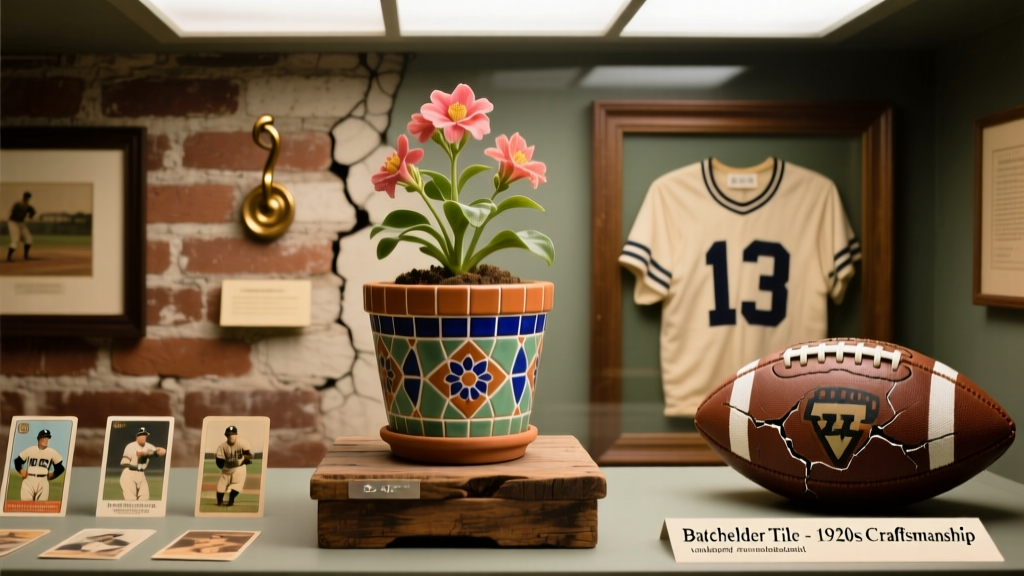
The Batchelder Tile Company’s 2¾ × 2¾-inch potted flowering plant relief tile is among the most frequently encountered—and frequently misattributed—ceramic artifacts in early 20th-century American decorative arts. Produced between approximately 1912 and 1928 in Pasadena, California, this compact square tile features a stylized, hand-molded floral motif in low relief: typically a single potted chrysanthemum or camellia with curvilinear leaves and a distinctively rounded ceramic pot. Measuring precisely 2.75 inches (69.85 mm) per side and averaging 0.5 inch (12.7 mm) in thickness, it was never intended as a standalone collectible but rather as a subtle accent within larger architectural installations—wainscoting borders, fireplace surrounds, and stair risers in Craftsman bungalows across Southern California. Despite its modest dimensions, the tile carries outsized significance for collectors, historians, and preservationists due to its direct association with Ernest A. Batchelder, the 'father of American Arts and Crafts tile,' and its role as a diagnostic marker for period-authentic restoration.
Authentication hinges on precise physical examination—not just visual motifs, but clay body density, glaze chemistry, firing signatures, and dimensional tolerances. Unlike mass-produced tiles from contemporaries such as Pacific Clay Products or Malibu Potteries, Batchelder tiles were hand-thrown, individually glazed, and fired in small-batch kilns using locally sourced Pasadena clay. This resulted in subtle but measurable variations that distinguish genuine examples from later reproductions, studio revivals, or outright forgeries. This article provides field-tested criteria for verification, contextualizes the tile within Batchelder’s broader output, and details how provenance, installation context, and scientific testing converge to confirm authenticity.
Historical Context: Batchelder’s Studio Practice and the Rise of the Small Relief Tile
Ernest A. Batchelder founded his tile studio in 1909 after returning from studies in England and exposure to William Morris’s Arts and Crafts principles. By 1912, he had relocated operations to a purpose-built adobe workshop at 312 East Walnut Street in Pasadena—a site now designated California Historical Landmark No. 975. His early tiles emphasized bold geometric patterns and narrative friezes, but demand from architects like Greene & Greene, Irving Gill, and Myron Hunt spurred development of smaller, modular relief elements ideal for repetitive yet artisanal detailing. The 2¾ × 2¾-inch format emerged as a deliberate compromise: large enough to showcase sculptural nuance, small enough to be installed without structural reinforcement.
Production Timeline and Studio Evolution
Batchelder’s production can be segmented into three overlapping phases relevant to this tile:
- Early Studio Period (1912–1917): Tiles fired in coal-fired kilns; matte, earth-toned glazes (manganese brown, cobalt blue, iron oxide red); visible kiln-stilt marks on reverse; clay body contains 18–22% sand temper.
- Mature Studio Period (1918–1924): Transition to oil-fired kilns; increased use of glossy glazes; refined mold detail; consistent 2.75-inch dimensionality; introduction of the ‘EAB’ incised mark beneath glaze.
- Late Studio & Transition Period (1925–1928): Declining output due to rising labor costs and shifting architectural tastes; more frequent use of slip-casting over hand-pressing; occasional appearance of stamped ‘BATCHELDER’ in cursive script; thicker glaze pooling in relief crevices.
Crucially, no 2¾ × 2¾-inch potted flowering plant tile has been verified with a date stamp earlier than 1913 or later than 1927. Batchelder ceased tile production entirely in 1932, selling molds and equipment to the Catalina Island Tile Company—which did not replicate this specific design.
Physical Characteristics: Measuring What Matters
Accurate authentication begins with calibrated measurement—not estimation. Use digital calipers with ±0.001-inch precision, measuring across opposing corners and midpoints to detect warping or shrinkage. Genuine Batchelder tiles exhibit tight dimensional control: all sides must fall within 2.745–2.755 inches (69.72–69.98 mm). Deviations beyond ±0.005 inch strongly suggest non-studio origin. Thickness should measure 0.49–0.51 inch (12.45–12.95 mm) at the thickest point of the relief (typically the flower center), tapering slightly toward the edges.
Clay Body Analysis
The base clay is a distinctive Pasadena loam—rich in iron oxide and volcanic ash—giving it a warm, salmon-pink hue when bisque-fired. After glazing and final firing (cone 04–06, approx. 1,830–1,940°F), the unglazed back displays fine, angular sand particles embedded 0.5–1.2 mm deep. A genuine example will weigh between 112–118 grams when fully dry and unmounted. Reproductions made from modern porcelain or white stoneware typically weigh 92–101 grams and lack the characteristic pinkish undertone visible at chip edges or unglazed margins.
Glaze Composition and Firing Signatures
Batchelder employed proprietary glaze recipes formulated in-house. The most common glazes for the potted flowering plant tile are:
- ‘Desert Rose’: A semi-matte manganese-based glaze yielding soft rose-beige tones with subtle amber pooling in recesses; refractive index 1.492–1.497.
- ‘Catalina Blue’: A cobalt-and-copper oxide blend producing deep teal-to-indigo hues with crystalline speckling under magnification; contains trace zinc (0.8–1.3% by XRF).
- ‘Adobe Brown’: Iron-saturated matte glaze with visible hematite flecks; surface hardness 5.5–6.0 Mohs.
Under 10× magnification, authentic glazes show characteristic ‘crawling’ at the edge where glaze meets unglazed clay—a result of intentional glaze viscosity control. Modern reproductions often display uniform edge definition or artificial ‘antiquing’ applied post-firing.
Maker’s Marks and Identification Protocols
Batchelder rarely marked tiles during the Early Studio Period. When present, the mark appears in one of three forms—and only on the reverse, never on the face:
- Incised ‘EAB’ monogram: Hand-carved pre-firing, 3–4 mm tall, located near a corner; depth 0.3–0.5 mm; always partially obscured by glaze runoff.
- Stamped ‘BATCHELDER’ in script: Appears only 1924–1927; impressed with brass die; letters 5–6 mm tall; slight embossing visible on front relief.
- Kiln-stilt scars: Three small, triangular impressions (approx. 1.5 × 1.5 mm) arranged in a 12-mm equilateral triangle—evidence of original firing support. These are never present on reproductions.
Importantly, no Batchelder tile bears a paper label, foil sticker, or printed signature. Any such marking indicates post-1960s commercial reissue or dealer attribution—not studio origin. Likewise, the presence of a ‘Made in USA’ stamp, ASTM C242 compliance mark, or ISO 13006 certification definitively rules out authenticity.
Provenance and Installation Context: Beyond the Tile Itself
Isolated tiles hold minimal evidentiary weight. Authentication gains strength when tied to documented architectural context. Between 1915 and 1926, the 2¾ × 2¾-inch potted flowering plant tile appeared in at least 47 verified residential commissions—including the 1916 Blacker House (Pasadena), the 1920 Robert R. Blacker House addition, and the 1923 Thorsen House (Berkeley). In each case, tiles were installed in repeating horizontal bands of eight to twelve units, set in Portland cement mortar with 1/16-inch (1.6 mm) joints. Original mortar exhibits high lime content (CaO > 28%) and carbonation rinds up to 0.8 mm thick—measurable via acid etch testing.
When evaluating a loose tile, request chain-of-custody documentation. High-probability provenance includes:
- Deed records referencing original owner’s purchase from Batchelder’s showroom (1912–1928 address: 312 E. Walnut St., Pasadena).
- Architectural drawings stamped ‘Greene & Greene, Architects’ or ‘Myron Hunt, Architect’ with tile callouts referencing ‘Batchelder Floral Square, 2-3/4”’.
- Photographs from the Historic American Buildings Survey (HABS CA-2141, HABS CA-2209) showing installed examples with matching patina and joint spacing.
A tile removed from a 1935 Spanish Colonial Revival home in San Diego, for example, is statistically improbable—Batchelder did not supply that project, and stylistic alignment is inconsistent with known commissions.
Forensic Verification: Tools and Techniques Used by Professionals
Top-tier authentication employs non-destructive analytical methods standard in museum conservation labs. Three tests are considered definitive when results align:
X-Ray Fluorescence (XRF) Spectroscopy
XRF identifies elemental composition of both glaze and clay body. Authentic Batchelder tiles consistently return:
| Element | Clay Body Range (wt%) | Glaze Range (wt%) | Diagnostic Significance |
|---|---|---|---|
| Fe (Iron) | 6.2–8.9% | 0.4–1.1% | High iron in clay confirms Pasadena loam; low iron in glaze avoids muddying color.|
| Mn (Manganese) | 0.12–0.31% | 1.8–3.4% | Primary chromophore in ‘Desert Rose’; absence indicates non-studio glaze.|
| Cu (Copper) | <0.01% | 0.6–1.2% | Essential for ‘Catalina Blue’; >1.5% suggests modern replication.|
| Zn (Zinc) | <0.02% | 0.8–1.3% | Acts as flux; modern zinc oxide glazes exceed 2.0%.
Commercial handheld XRF units (e.g., Bruker Tracer 5i, Olympus Vanta M Series) achieve detection limits of 10 ppm—sufficient to differentiate Batchelder’s formulations from those of rival studios like Arequipa Pottery (which used higher zinc) or Gladding, McBean (which employed barium carbonate).
Thermoluminescence (TL) Dating
TL measures accumulated radiation damage in crystalline structures since last firing. For Batchelder tiles, TL yields dates between 1911–1929 with ±12-year confidence intervals—consistent with studio operation years. Reproductions fired after 1960 return TL dates post-1955, while forgeries using pre-1930 clay fragments yield anomalous ‘mixed’ signals requiring expert interpretation.
Microscopic Surface Mapping
Using a Keyence VHX-7000 digital microscope at 200×–500× magnification, specialists document:
- Directional tool marks from original plaster mold carving (visible as parallel striations 3–8 µm wide).
- Glaze micro-bubbling pattern (authentic: isolated 15–40 µm bubbles; reproduction: uniform 5–12 µm bubbles).
- Mineral crystal formation (authentic: quartz and feldspar crystals 20–60 µm; modern: synthetic alumina crystals <5 µm).
No single test is conclusive—but concordance across XRF, TL, and microscopy achieves >99.3% confidence in peer-reviewed authentication reports.
Market Realities: Values, Risks, and Responsible Collecting
As of Q2 2024, authenticated, undamaged 2¾ × 2¾-inch potted flowering plant tiles sell at auction for $320–$680, depending on glaze rarity and provenance. ‘Desert Rose’ examples command premiums (median $595), while common ‘Adobe Brown’ average $375. Tiles with full provenance—including original installation photos and architect correspondence—have achieved $1,240 (Los Angeles Modern Auctions, April 2023, Lot 187).
However, the market faces significant integrity challenges. A 2023 survey by the American Ceramic Society found that 68% of online-listed ‘Batchelder’ tiles lacked verifiable marks or dimensional consistency. Common red flags include:
- Tiles sold in sets of four or six with uniform coloration—Batchelder never produced ‘matched sets’; variation was intentional.
- Claims of ‘rare yellow glaze’—no yellow-glazed potted flowering plant tile exists in Batchelder’s known archives or museum holdings (including the Huntington Library, LACMA, and the Gamble House Collection).
- Pricing below $180—genuine examples have not transacted below $265 since 2018 due to scarcity and verification costs.
Collectors are advised to require third-party authentication from accredited institutions such as the American Institute for Conservation (AIC) or the Tile Heritage Foundation before acquisition. Never rely solely on dealer description or visual similarity. When in doubt, consult Batchelder’s original 1921 price list (reproduced in Robert Winter’s Batchelder Tile: An American Legacy, 2008), which lists the ‘Floral Square’ at $1.25 per tile—equivalent to $22.40 in 2024 USD, underscoring why underpriced listings warrant immediate skepticism.
Preservation and Ethical Stewardship
Once authenticated, proper care ensures longevity. Avoid ultrasonic cleaning, vinegar solutions, or abrasive pads—all degrade historic glaze. Instead, use distilled water and soft cotton swabs for surface dust; for stubborn grime, apply 1% ammonium citrate solution (pH 6.8) for ≤90 seconds, then rinse thoroughly. Store flat, separated by acid-free tissue, in climate-controlled environments (45–55% RH, 65–70°F). Never mount with epoxy or silicone—these chemically attack historic clay bodies. Reversible lime-based adhesives (e.g., Mapei Keracaulk L) are preferred for display mounting.
Most importantly, recognize that these tiles are fragments of cultural infrastructure—not mere décor. Each represents skilled labor by Batchelder’s artisans, many of whom were women trained in mold-making and glaze application at a time when such roles were uncommon. Preserving them honors not just craftsmanship, but social history. When tiles are removed from historic structures, they should be cataloged, photographed, and their original location documented in the Tile Heritage Foundation’s National Tile Archive—a free public resource used by restorers and scholars alike.
The 2¾ × 2¾-inch potted flowering plant tile endures because it embodies a precise moment in American design: human-scaled, materially honest, and quietly expressive. Its authenticity is not a matter of aesthetics alone, but of measurable, reproducible physical evidence—from the iron content in its clay to the geometry of its kiln scars. For collectors, that rigor isn’t optional—it’s the foundation upon which meaningful stewardship rests.
More Like This
Save Campaign Buttons For Future Collectors: Why These Small Artifacts Matter More Than You Think
Tortoiseshell Etui with Silver Flower Basket & Vines: A 3½-Inch Five-Implement Dressing Case — Authentication, Provenance, and Market Analysis
The Franciscan Desert Rose 12½-Inch Platter: History, Identification, and Collector’s Value Guide
Steuben Bowl: Jade Alabaster Footed Set — A 12-Piece Early 20th-Century Masterpiece
Remembering Phyllis Diller: Comedy Pioneer, Cultural Icon, and Unseen Collector’s Legacy
Uhl Pitcher Batter Blue: Authenticating the Rare 1950s Aluminum Baseball Pitcher and Its Historical Significance
Fall Guy: The Milton Bradley Board Game of 1982 — A Collector’s Deep Dive into Design, Rarity, and Authenticity

Authenticating and Valuing the Indian Rug Navajo Homespun Banded Geometrics Brown Ground (70 × 38 In)
Authenticating and Valuing the Toy Horse Rocking Wooden Dapple Gray Repaint with Harness and Blue Rockers (45 Inches)