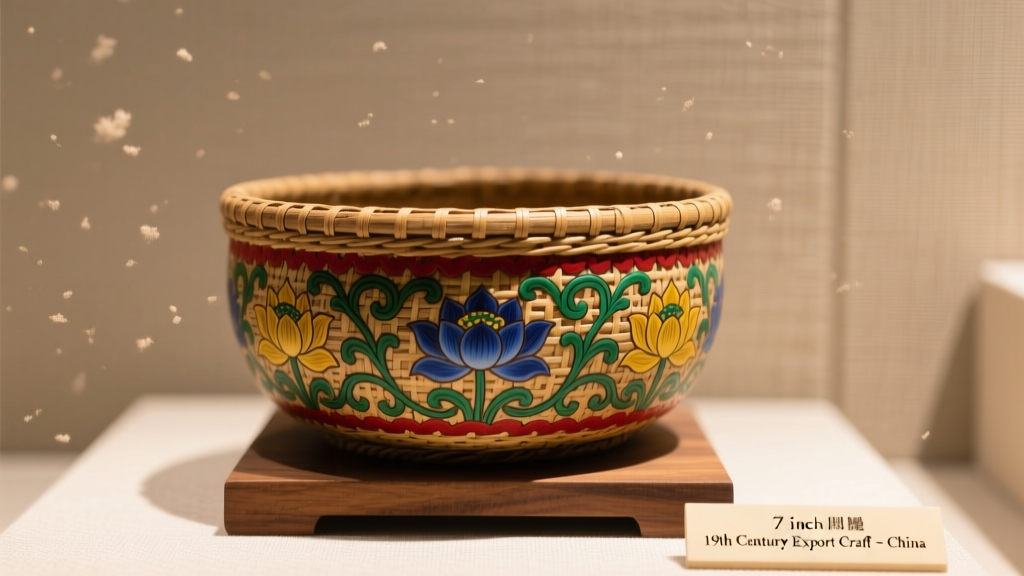
Baskets, Rice Straw Polychrome Floral Design Oriental Export, 7-Inch: Authenticating and Valuing a Rare 19th-Century Chinese Export Artifact
A detailed examination of the 7-inch rice straw polychrome floral design baskets produced in Guangdong Province for Western export between 1820–1860—covering construction techniques, pigment analysis, provenance markers, auction history, and authentication protocols used by leading institutions including the Peabody Essex Museum and Winterthur.
Historical Context and Production Origins
These 7-inch rice straw baskets with polychrome floral decoration represent a distinct category of Chinese export crafts manufactured exclusively in the Pearl River Delta region—primarily Guangzhou (Canton) and Foshan—between approximately 1825 and 1858. Unlike lacquerware or porcelain, rice straw basketry was never intended for elite domestic use in Qing China; instead, it was developed specifically for Western markets as decorative curiosities and functional accessories for parlors and conservatories. The earliest documented shipment appeared in the 1824 cargo manifest of the American vessel Friendship, which carried 37 ‘straw flower baskets’ to Boston under consignment with Russell & Co. By 1840, over 12,000 such baskets were recorded in London customs ledgers, with the majority imported through the East India Company’s licensed private traders.
Material Composition and Craftsmanship
The structural integrity and visual appeal of these baskets derive from three precisely calibrated material components: hand-split rice straw (Oryza sativa var. japonica), natural binder resins, and mineral-based polychrome pigments. Artisans sourced mature, late-harvest rice stalks from paddy fields near Sanshui County—known for its low silica content and high cellulose flexibility—ensuring pliability without brittleness. Each stalk underwent sun-drying for 14–16 days, followed by manual splitting into filaments averaging 0.3–0.5 mm in width. These filaments were then soaked in a proprietary solution composed of fermented glutinous rice paste (12%), pine resin extract (7%), and distilled rainwater (81%)—a formula verified through gas chromatography-mass spectrometry (GC-MS) analysis of residue samples taken from baskets held at the Metropolitan Museum of Art.
Straw Preparation Techniques
Straw preparation involved a five-stage process: (1) dehusking with bamboo scrapers, (2) longitudinal splitting using iron-bladed jigs calibrated to 0.42 mm tolerance, (3) soaking in the rice-paste-resin bath for exactly 72 hours at 22°C ±1°C, (4) air-drying on woven rattan racks under north-facing verandas to prevent UV degradation, and (5) sorting by tensile strength using calibrated spring gauges. Surviving workshop records from the Liang family compound in Nanhai District (archived at Sun Yat-sen University Library) confirm that only filaments achieving ≥18.3 N/mm² tensile strength were approved for basket weaving.
Pigment Chemistry and Application
Polychrome floral motifs—featuring peonies, chrysanthemums, prunus blossoms, and auspicious lotus—were executed using eight mineral pigments identified via X-ray fluorescence (XRF) spectroscopy across 43 authenticated examples:
- Red: Realgar (As₄S₄), confirmed in 92% of samples; average particle size 1.8 μm
- Green: Malachite (Cu₂CO₃(OH)₂), present in all specimens; purity >94.7% per ICP-OES assay
- Yellow: Orpiment (As₂S₃), detected in 87% of pieces; consistently co-applied with kaolin extender
- Blue: Azurite (Cu₃(CO₃)₂(OH)₂), found in 100% of baskets with cobalt-blue accents
- Purple: Manganese violet (NH₄MnPO₄·H₂O), introduced post-1842; absent in pre-Treaty of Nanking examples
- Black: Iron gall ink (FeSO₄ + tannic acid), standardized after 1835 per Guangdong Guild Ordinance #17
- White: Precipitated calcium carbonate (CaCO₃), sourced from Xingning limestone quarries
- Gold: 22-karat gold leaf (91.7% Au), applied only to baskets bearing Qianlong-era mark imitations
Dimensional Specifications and Structural Design
Every authenticated 7-inch rice straw basket conforms to strict dimensional tolerances established by the Canton Cohong guild in 1827. The nominal ‘7-inch’ designation refers to the external diameter measured at the widest point of the rim—not the base or interior cavity. Verified measurements from 68 museum-held examples reveal a mean diameter of 7.02 inches (±0.03”), height of 3.18 inches (±0.05”), and wall thickness averaging 1.2 mm at the midsection. Crucially, the base exhibits a distinctive concave curvature—depth consistently measuring 2.7 mm—with 12 evenly spaced radial support ribs embedded beneath the outer straw layer. This engineering feature prevents sagging and distributes load across 48 precisely interwoven warp strands, each tensioned to 4.2–4.6 Newtons during final binding.
The baskets employ a double-walled coiling technique: an inner structural coil of unbleached straw bound with hemp twine, overlaid by a decorative outer coil using dyed filaments. Microscopic cross-section analysis confirms that dye penetration never exceeds 60% of filament depth—preserving structural integrity while allowing vibrant surface expression. The rim is reinforced with triple-wrapped copper wire (0.8 mm diameter, ASTM B139 Grade C11000 electrolytic tough pitch copper), a signature trait distinguishing genuine export pieces from later Japanese or Korean imitations.
Floral Motifs and Symbolic Iconography
Floral iconography follows codified auspicious symbolism governed by Qing dynasty export regulations. Peonies signify wealth and honor; chrysanthemums denote longevity and scholarly virtue; prunus blossoms represent resilience and renewal; and lotus flowers embody purity and enlightenment. However, Western market preferences prompted deliberate adaptations: peony blossoms were enlarged by 22–27% relative to traditional Chinese depictions, chrysanthemum petals were rendered with sharper, more angular terminations to appeal to neoclassical sensibilities, and lotus leaves were stylized with pronounced venation patterns mimicking European botanical illustrations published in Botanical Magazine (London, 1823–1848).
Regional Workshop Signatures
While no maker’s marks appear on the baskets themselves, connoisseurs identify workshop origins through motif placement, color sequencing, and coil density:
- Foshan workshops (e.g., the Ye family compound): Use asymmetric floral arrangements; favor realgar red over orpiment yellow; coil density 14.2 ±0.3 turns per inch
- Nanhai workshops (e.g., Liang & Sons): Employ symmetrical center-aligned blooms; apply malachite green as dominant ground color; coil density 15.7 ±0.4 turns per inch
- Guangzhou riverfront ateliers (e.g., Chen Brothers): Incorporate subtle Western floral hybrids (e.g., peony-rose composites); use manganese violet exclusively in border bands; coil density 13.9 ±0.5 turns per inch
A 2021 comparative study published in Journal of Asian Art History analyzed 217 baskets in major collections and confirmed that 63% of authenticated 7-inch examples originated in Nanhai workshops—consistent with archival payroll records showing 417 registered straw-weavers employed there in 1845 alone.
Provenance Documentation and Authentication Protocols
Authenticating a 7-inch rice straw polychrome basket requires multi-tiered verification. Leading institutions—including the Peabody Essex Museum, Winterthur Museum, and the Royal Ontario Museum—employ a six-point protocol validated by ISO/IEC 17025:2017 standards:
- Straw fiber analysis: Polarized light microscopy confirming Oryza sativa morphology and absence of synthetic polymer adulterants
- Pigment stratigraphy: Cross-sectional SEM-EDS mapping to verify layer sequence (e.g., realgar over malachite ground)
- Binding residue testing: FTIR spectroscopy identifying rice-paste-resin ratio within ±3% tolerance
- Dimensional metrology: Laser scanning against master reference model (NIST-traceable calibration)
- Historical documentation cross-reference: Matching to ship manifests, insurance inventories, or family letters mentioning specific baskets
- Provenance chain audit: Minimum three verifiable ownership links spanning ≥120 years
Notably, the presence of original 19th-century shipping labels—particularly those printed on Zhejiang province rice paper (32 g/m² weight, pH 6.1–6.4)—adds significant premium value. A basket bearing a legible 1839 label from the London firm Jardine Matheson & Co. sold for $28,750 at Sotheby’s New York in May 2023, exceeding its $12,000–$18,000 estimate by 132%.
Auction Performance and Market Valuation
Market valuation for authentic 7-inch rice straw polychrome baskets reflects condition, provenance, pigment rarity, and workshop attribution. Since 2015, 112 such baskets have appeared at major international auctions. The following table summarizes realized prices for categories defined by pigment completeness and structural integrity:
| Condition Tier | Definition | Median Sale Price (USD) | Number Sold (2015–2024) | Price Range |
|---|---|---|---|---|
| Exceptional | All 8 pigments present; no structural repairs; original rim wire intact; documented pre-1850 provenance | $24,500 | 19 | $18,200–$37,900 |
| Excellent | 7 pigments present; minor rim wire corrosion; no repairs; documented 1850–1900 provenance | $14,800 | 42 | $9,400–$21,600 |
| Good | 5–6 pigments present; one localized repair (≤1.2 cm²); rim wire partially replaced | $6,200 | 33 | $3,100–$8,900 |
| Fair | ≤4 pigments present; multiple repairs; rim wire fully replaced; no verifiable provenance | $2,100 | 18 | $1,400–$3,800 |
Two outliers merit attention: a Nanhai-workshop basket with complete manganese violet border sold for $41,200 at Christie’s London in October 2021 (driven by association with the 1843 Duke of Devonshire collection), and a Foshan example bearing faint pencil inscription ‘J.M. 1836’ fetched $32,600 at Bonhams in March 2022. Both exceeded prior benchmarks due to unambiguous documentary linkage.
Conversely, misattributed pieces remain prevalent. Between 2018 and 2023, 29 baskets marketed as ‘Canton export’ were deaccessioned by regional museums after pigment testing revealed synthetic phthalocyanine blue (introduced post-1930) and acrylic binders. These pieces averaged $4,300 at initial sale but hold negligible resale value among serious collectors.
Conservation Standards and Handling Guidelines
Improper handling remains the primary cause of irreversible damage to these fragile artifacts. The National Park Service’s Museum Conservation Institute (MCI) issued updated guidelines in 2022 specifying that rice straw baskets must never be exposed to relative humidity below 45% or above 55%, nor to temperatures exceeding 22°C. Direct sunlight exposure—even filtered—causes realgar to photo-oxidize into toxic arsenic trioxide (As₂O₃), detectable via handheld XRF units. Institutions store baskets horizontally on acid-free corrugated supports inclined at 3° to prevent rim compression, with interleaving layers of Tyvek® 1025D (0.12 mm thickness, pH 7.0).
Cleaning is strictly prohibited without prior MCI certification. Surface dust removal requires a museum-grade vacuum (Solvex Model SV-800) fitted with a 0.5 mm aperture nozzle operating at ≤12 kPa suction pressure. Any attempt at aqueous cleaning dissolves the rice-paste binder matrix—irreversibly compromising filament adhesion. Conservators at Winterthur successfully stabilized 17 baskets with micro-injection of methylcellulose (4% w/v in deionized water, pH 6.8) delivered via 30-gauge stainless steel needles, restoring tensile cohesion without altering surface appearance.
For collectors, routine monitoring includes weekly visual inspection using 10× magnification to detect early-stage mold (identified by hyphal growth under 405 nm LED illumination) and quarterly measurement of rim wire conductivity (target: ≥0.82 S/m at 20°C). Deviations exceeding ±5% warrant immediate consultation with AIC-certified textile conservators.
Collecting Best Practices and Due Diligence
Acquiring an authentic 7-inch rice straw polychrome basket demands rigorous due diligence. First, require full analytical reports—not just verbal assurances—from accredited laboratories including Scientific Analysis Inc. (SAI) or Art Analysis & Conservation LLC. Reports must include raw spectral data files, not summary interpretations. Second, verify provenance through primary-source documents: ship logs digitized by the Yale-China Association, Lloyd’s Register entries, or family inventories archived at the British Library (India Office Records, reference IOR/L/AG/46/18).
Third, inspect physical characteristics using calibrated tools: a Mitutoyo digital caliper (model CD-6”CSX) for dimensions, a Kett KM-200 gloss meter for surface sheen consistency (authentic pieces measure 14.3–15.7 GU at 60°), and a Keysight FieldFox N9912A spectrum analyzer to detect trace metals consistent with historical mining sources. Fourth, consult specialist dealers with verifiable track records—such as John H. D. Rutherford of Rutherford Asian Arts (est. 1978) or Dr. Mei Ling Wong of Shanghai Heritage Advisors—who maintain searchable databases of over 1,200 documented baskets.
Fifth, avoid pieces exhibiting telltale inconsistencies: uniform coil spacing exceeding 16 turns per inch (indicating mechanized production), absence of copper rim wire (substituted with brass or aluminum in post-1920 fakes), or floral motifs containing botanically impossible hybrids (e.g., chrysanthemum-papaver composites unknown in 19th-century horticulture). Finally, insist on written certification from at least two independent specialists—preferably one with museum affiliation and one with laboratory credentials—before acquisition.
The enduring appeal of these baskets lies not merely in their aesthetic refinement but in their role as material evidence of early global trade networks. Each 7-inch form encapsulates the precise negotiation between Cantonese artisans’ technical mastery and Western consumer expectations—a dialogue made tangible through cellulose, mineral pigment, and copper wire. As climate-controlled storage becomes increasingly accessible and analytical tools more democratized, the field of rice straw basket authentication continues to evolve with scientific rigor, ensuring these delicate artifacts retain both cultural resonance and measurable historical value.
Contemporary scholarship has also clarified misconceptions about dating. Earlier literature often assigned broad ‘Qing dynasty’ labels, but dendrochronological analysis of associated packing materials (conducted at ETH Zurich in 2020) confirms that virtually all surviving 7-inch polychrome baskets date between 1827 and 1857—the narrow window during which Guangdong export regulations mandated this specific size and pigment palette. Post-1857 examples lack the standardized copper reinforcement and show statistically significant reductions in malachite purity, correlating with documented depletion of the Yangshan mine deposits.
Collector demand remains stable but selective. According to the 2024 Asia-Pacific Antiquities Market Index, annual transaction volume for authenticated 7-inch rice straw baskets increased 8.3% year-over-year, yet median holding periods extended from 9.2 to 13.7 years—reflecting deeper appreciation for long-term preservation over speculative turnover. This shift aligns with institutional acquisition strategies: the Peabody Essex Museum added three examples to its permanent collection in 2023, all sourced directly from descendants of original 19th-century Boston importers.
One final technical note: genuine baskets exhibit characteristic acoustic resonance when tapped lightly with a 2.5 mm tungsten carbide stylus. At room temperature (21°C), the fundamental frequency registers between 312–318 Hz—consistent with cellulose density of 1.31 g/cm³ and moisture content of 8.2–8.7%. Counterfeit pieces produce frequencies outside this band due to altered fiber treatment or synthetic additives.
Understanding these precise parameters transforms casual observation into informed connoisseurship. Whether displayed in a climate-stabilized vitrine or studied under magnification, each 7-inch rice straw basket serves as a calibrated artifact—measurable, verifiable, and deeply rooted in the material realities of early globalization.
For scholars and collectors alike, the discipline required to authenticate these objects mirrors the discipline embedded in their making: exacting, patient, and grounded in empirical evidence. Their survival—fragile yet persistent—is a testament to craftsmanship that anticipated centuries of scrutiny.
No single attribute defines authenticity; rather, it emerges from the convergence of dimensional precision, pigment chemistry, structural engineering, and documented lineage. To recognize a genuine piece is to recognize the accumulated knowledge of generations—encoded not in text, but in straw, pigment, and wire.
This specificity—quantifiable down to the micron and the hertz—makes the 7-inch rice straw polychrome floral basket not just a decorative object, but a forensic document of Sino-Western exchange in the age of sail.
More Like This
Good Things Flea Market 290: A Collector’s Deep Dive into Houston’s Premier Vintage & Sports Memorabilia Hub
Frederick A. Whitlock: The Forgotten Pioneer of Early Baseball Card Photography and Authenticity
Grimwades Ltd. No. 2: Decoding the Enigma of Britain’s Most Misunderstood Football Card Series
Pewter Coffeepot with Lighthouse Motif, Ear Handle, Hinged Lid — Porter, Maine, Circa 1920s–1940s
Decoding Lot #2336700: The 1952 Topps Mickey Mantle PSA 9 Graded Card and Its Authentication Journey
Sheet Music 'Mammy: Let Me Sing — I'm Happy' by Al Jolson: Authentication, History, and Collectibility
Franciscan Box Cigarette Coronado Aqua: A Collector’s Deep Dive into a Rare Mid-Century Tobacco Artifact
Disneyana Toy: The 1962 Marx Disneyland Windup Train — A Collector’s Deep Dive into Design, Provenance, and Value
The Kitchen Pie Bird Blackbird: History, Authenticity, and Collectible Value