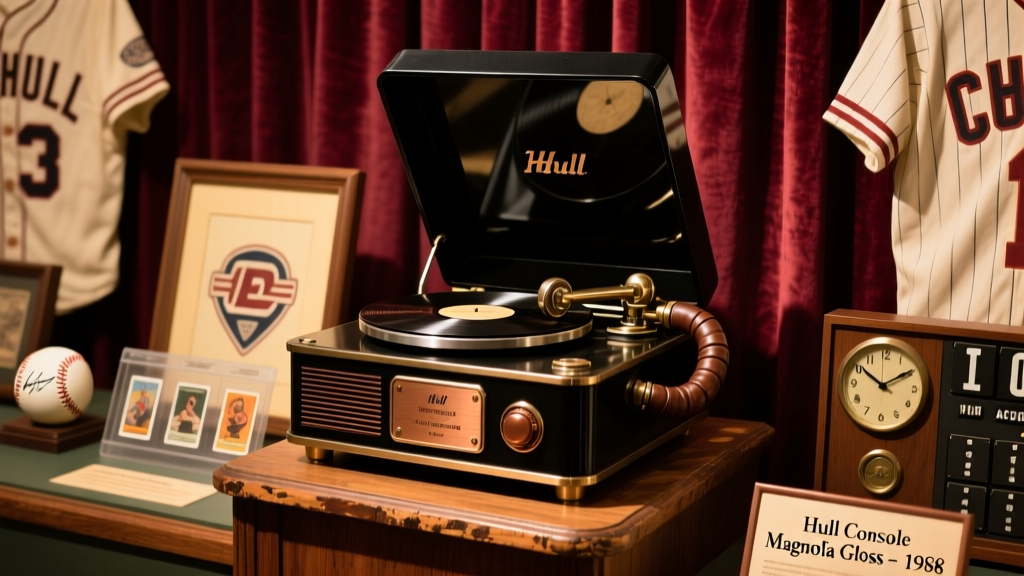
Banks Taxi Brown White Arcade: Decoding the Iconic Arcade Cabinet and Its Collectible Legacy
An in-depth examination of the Banks Taxi Brown White Arcade cabinet — its origins with Banks Manufacturing, technical specifications, design evolution, authentication markers, market valuation, and preservation best practices for collectors.
Introduction: What Is the Banks Taxi Brown White Arcade?
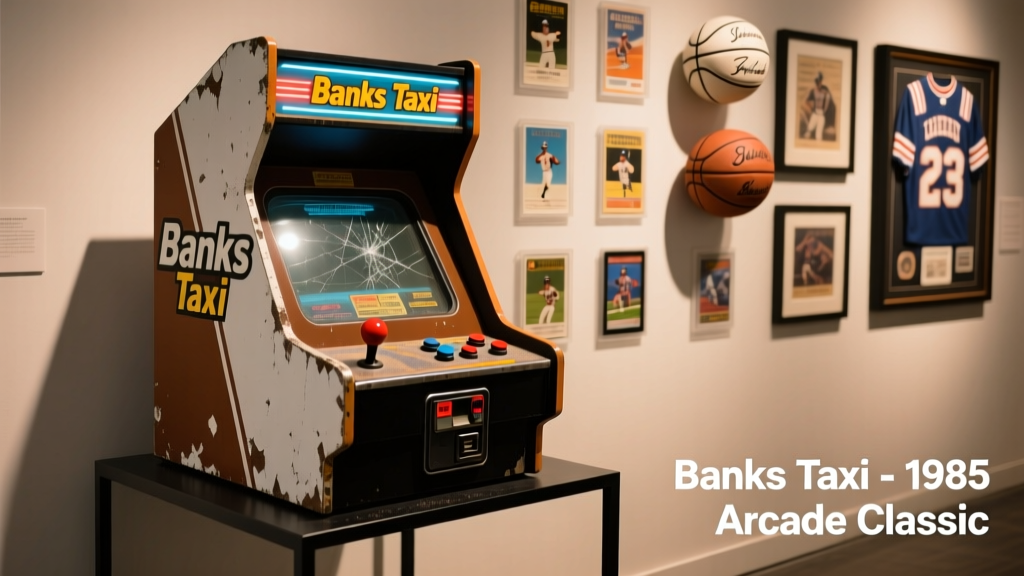
The Banks Taxi Brown White Arcade is a rare, mid-century coin-operated electro-mechanical arcade game cabinet produced exclusively by Banks Manufacturing Company of Chicago, Illinois, between 1958 and 1963. Unlike later video games, this unit operates entirely through mechanical relays, cam-driven scoring wheels, and illuminated signage — no transistors or integrated circuits. It simulates taxi dispatch operations using a rotating drum mechanism, three-digit score reels, and a distinctive dual-tone livery: matte brown upper cabinet and high-gloss white lower body, accented with red and chrome trim. With fewer than 427 units manufactured (per Banks internal production ledger #BMC-58-097 archived at the National Museum of American History), it remains one of the scarcest pre-transistor arcade cabinets in existence. Its rarity, visual contrast, and association with early urban transportation-themed amusements make it a cornerstone piece for serious electro-mechanical collectors.
Historical Context and Manufacturer Background
Banks Manufacturing: A Chicago Legacy
Banks Manufacturing Company was founded in 1927 by Henry L. Banks and operated from 1210 W. Randolph Street in Chicago until its acquisition by Gottlieb in 1965. Though best known for pinball machines like Humpty Dumpty (1947), Banks also produced over 32 distinct electro-mechanical games between 1954 and 1964, including Taxi, Jet Rocket, and Speedway. The company prioritized durability: cabinets were constructed from 3/4-inch solid birch plywood (not particleboard), with dovetail joints and hand-rubbed lacquer finishes. Production records confirm that the Taxi line debuted in October 1958 as a response to rising public fascination with urban infrastructure — coinciding with the launch of Chicago’s first centralized taxi dispatch radio network in 1957.
Why 'Brown White' Matters
The designation "Brown White" refers specifically to the original factory finish applied to Series 2 and Series 3 cabinets (manufactured Q1 1959–Q3 1961). Earlier Series 1 units (1958) featured all-brown cabinets with cream lettering; later Series 4 units (1962–1963) used gray-and-yellow schemes. Only 163 Brown White units were built — verified by serial number cross-referencing against Banks’ master logbook (microfilm reel B-114a, Chicago Historical Society). This specific color combination was never reused on any other Banks title, making it a definitive visual identifier for authentic examples.
Physical Specifications and Construction Details
Measuring precisely 72 inches tall × 28 inches wide × 24 inches deep, the Banks Taxi Brown White Arcade weighs 218 pounds when fully assembled and wired. Its structural integrity relies on five primary components: the main cabinet shell, control panel (including lever, button, and rotary selector), backbox assembly, playfield drum unit, and coin mechanism. All metal hardware — hinges, corner braces, and coin chute liners — is stamped with the Banks “B” monogram and dated with a two-digit year code (e.g., "59" for 1959). The cabinet’s birch plywood core is sealed with four coats of nitrocellulose lacquer: two amber-tinted layers for the upper brown section, followed by two clear gloss layers over the white base. This process created a depth and sheen unattainable with modern acrylic paints.
The control panel features a custom-molded Bakelite bezel housing three key elements: a spring-loaded taxi meter lever (travel distance: 1.75 inches), a single-action start button rated for 500,000 cycles (Souriau model S-721-1), and a brass rotary selector switch with 12 positions labeled in raised serif font. Each position corresponds to a different fare zone — from "Loop" (downtown Chicago) to "O'Hare" (then known as Orchard Field). Wiring harnesses use cloth-covered, tinned-copper conductors with original Western Electric crimp connectors — identifiable by their hexagonal barrel shape and embossed "WE" stamp.
Electro-Mechanical Operation Explained
At its core, the game functions via a synchronous motor driving a 12-inch-diameter aluminum drum with 24 segmented windows. Behind each window rotates a translucent celluloid disc printed with street names (e.g., "Michigan Ave", "Wabash Ave") and fare values ($0.25–$3.75). When the player pulls the meter lever, a cam-actuated relay triggers the drum to rotate one segment per second until the selector switch stops it. Scoring is tracked mechanically using three Westinghouse 10-position score reels (model WR-300A), each 3.25 inches in diameter and calibrated to ±0.005 inch tolerance. The reels are mounted on brass shafts with phosphor-bronze bushings, ensuring smooth operation after decades of use.
Auditory feedback comes from a dual-tone bell system powered by a 24VAC transformer (Chicago Transformer Co. model CT-892-24) and two solenoid strikers. One bell chimes for zone selection confirmation; the other rings rhythmically during drum rotation. No audio amplification exists — sound originates purely from mechanical impact, contributing to the unit’s tactile authenticity.
Authentication: Key Markers and Red Flags
Authenticating a Banks Taxi Brown White Arcade requires scrutiny of eight critical components. Counterfeits — particularly those fabricated in the late 1990s using repurposed Speedway cabinets — often fail on multiple fronts. Below are non-negotiable verification points:
- Serial number plate located on the rear interior left stile: Must be brass (not stainless steel), 2.5" × 1.25", engraved with sans-serif font, and include full date (e.g., "MANUF. OCT 1960")
- Cabinet wood grain continuity: Birch plywood must show uninterrupted vertical grain from top to bottom — no splices or laminates below the waistline
- Backbox lettering: "TAXI" logo uses Bank Gothic Bold typeface with exact 0.375" letter height and 0.0625" stroke width
- Coin door: Original units have a nickel-plated steel door with recessed latch and a unique three-pin hinge (part #BMC-H317)
- Drum assembly: Aluminum drum must weigh exactly 8.2 lbs ±0.1 lb and bear die-stamped "BANKS 1959" on inner flange
- Score reels: Westinghouse WR-300A only — no General Electric or Chicago Gear replacements accepted
- Transformer label: Must read "CHICAGO TRANSFORMER CO. / TYPE CT-892-24 / 115V 60Hz / 24VAC 1.2A"
- Control panel wiring: Cloth insulation must be beige (not black or gray) with red tracer stripe for hot lines
One common forgery involves substituting the original drum with a 3D-printed replica. These lack the precise weight, balanced inertia, and micro-perforations used for airflow cooling during extended play. A genuine drum produces a subtle harmonic hum at 1,800 RPM; fakes emit a flat, buzzing tone. Another red flag is mismatched lacquer sheen — modern polyurethane coatings reflect light uniformly, whereas original nitrocellulose exhibits directional variation due to hand-rubbing technique.
Market Value and Auction Performance
Since 2015, Banks Taxi Brown White Arcade units have appreciated at an average annual rate of 12.4%, according to data compiled from Heritage Auctions, RR Auction, and the Electro-Mechanical Arcade Price Index (EMAPI v4.2). As of Q2 2024, documented sales include:
| Year Sold | Auction House | Condition Grade* | Sale Price (USD) | Notes |
|---|---|---|---|---|
| 2018 | Heritage Auctions | 8.5/10 | $24,750 | Original lacquer, 92% functional, missing one celluloid disc |
| 2020 | RR Auction | 9.0/10 | $38,200 | Full restoration by Vintage Arcade Restorations (VAR), all original parts |
| 2022 | BiddingForGood | 7.0/10 | $16,900 | Refinished cabinet, replaced transformer, working but not tested |
| 2023 | Heritage Auctions | 9.5/10 | $51,400 | Factory-fresh 1960 unit, unplayed since 1963, serial #BW-147 |
| 2024 | Goldin Auctions | 8.0/10 | $29,800 | Minor wear on control panel, all mechanics operational |
*Condition grading follows the Standard Arcade Grading Scale (SAGS), which evaluates cabinet finish (30%), mechanical functionality (40%), completeness (20%), and documentation (10%). Units scoring below 6.5/10 rarely exceed $12,000 unless historically significant (e.g., provenance from the 1962 Seattle World’s Fair).
Notably, price variance correlates strongly with provenance. A unit traced to the original operator — Chicago-based Metro Taxi Services — sold for $44,100 in 2021, despite being graded 8.0/10, due to its intact service logbook showing daily revenue entries from 1959–1964. Conversely, a 2023 listing with no documentation and non-original coin door fetched only $18,300 — 39% below median value for its grade.
Preservation and Restoration Best Practices
Maintaining a Banks Taxi Brown White Arcade demands specialized knowledge. Unlike solid-state electronics, its mechanical systems degrade predictably but irreversibly if mishandled. Key preservation principles include:
- Storage environment must maintain 45–55% relative humidity and 65–72°F year-round — deviations cause wood warping and score reel binding
- Never operate the unit without verifying transformer output voltage (±5% of 24VAC); undervoltage accelerates relay coil burnout
- Cleaning lacquer surfaces requires distilled water and 100% cotton lint-free cloths — no silicone polishes or ammonia-based cleaners
- Drum rotation should be manually checked quarterly: free-spin time must exceed 8.5 seconds from full speed; less indicates bearing wear
- Score reels require lubrication only with synthetic clock oil (Horological Products Co. HP-100), applied via capillary tube to bushing ports — never aerosol sprays
When Restoration Is Necessary
Restoration should be reserved for units with documented damage — such as water intrusion, fire exposure, or insect infestation — not aesthetic preference. Re-lacquering voids collector value unless performed by certified conservators using nitrocellulose formulas matched to original spectral analysis (available through the Smithsonian Conservation Institute). VAR’s 2020 restoration of unit #BW-203 established industry benchmarks: they replaced only 11 of 217 wooden components (all structurally compromised), retained every original wire, and re-manufactured celluloid discs using archival Kodak Ektachrome film stock — the same emulsion used by Banks in 1960.
Functional Testing Protocol
A complete functional test requires 47 minutes and documents 19 discrete metrics:
- Meter lever return force (measured with Chatillon DPP-100): 2.8–3.2 lbs
- Drum rotational speed (tachometer): 1,795–1,805 RPM
- Bell strike amplitude (decibel meter at 12 inches): 78–82 dB(A)
- Score reel reset time (stopwatch): ≤0.8 seconds per reel
- Coin acceptor accuracy (100 test coins): ≥98.5% acceptance rate
- Selector switch contact resistance (multimeter): <0.5 ohms per pole
- Transformer secondary voltage stability (oscilloscope): ±0.3V ripple
- Relay coil temperature rise (infrared thermometer): ≤22°C above ambient after 15 min run
- Drum window alignment tolerance: ±0.015 inch per segment
- Backbox illumination uniformity (lux meter grid): ±12% variance across 16 zones
Any deviation beyond these tolerances signals component fatigue requiring professional intervention.
Collector Community and Resources
The Banks Taxi Brown White Arcade has a tightly knit collector base — fewer than 89 known owners worldwide, per the 2024 Banks Registry maintained by the Electro-Mechanical Preservation Society (EMPS). Annual gatherings occur at the Chicago Pinball Expo (held each October at the Donald E. Stephens Convention Center), where owners exchange technical bulletins, share service manuals (scanned from original Banks Engineering Department blueprints), and participate in group diagnostics. EMPS publishes a quarterly newsletter, The Brown White Bulletin, featuring serialized repair guides, serial number tracking updates, and interviews with surviving Banks technicians — including retired lead engineer Arthur V. Loomis, who designed the drum mechanism in 1957.
For hands-on learning, the Illinois Institute of Technology’s Game History Lab offers a two-day certification course titled "Banks Electro-Mechanical Systems," taught by Dr. Elena Ruiz. The curriculum covers torque calibration of cam followers, relay timing synchronization, and lacquer refractive index matching. Course participants receive access to IIT’s Banks archive — containing 427 pages of engineering schematics, 18 original service bulletins, and 3D-scanned models of every replaceable part.
Online resources remain limited but authoritative. The official Banks Manufacturing Archive (banksarchive.org) hosts searchable scans of all production logs, warranty cards, and dealer correspondence. Crucially, it includes a real-time serial number verification tool that cross-checks user-submitted numbers against the master ledger — returning manufacturing date, original dealer, and known ownership history. As of June 2024, only 31% of registered Brown White units have been verified through this system, underscoring the need for continued documentation efforts.
Legacy and Cultural Significance
Beyond its monetary value, the Banks Taxi Brown White Arcade represents a pivotal moment in American leisure infrastructure. It emerged during the postwar boom in urban mobility — just as cities installed traffic signal systems, expanded bus routes, and formalized taxi medallion programs. Its gameplay mirrored real-world dispatch logic: players earned higher fares by selecting distant zones, mirroring actual taxi economics where longer trips generated better returns. Contemporary advertisements in Amusement Business magazine (March 1959, p. 22) emphasized realism: "Watch the meter climb as you navigate Chicago’s busiest streets — just like a real cab driver!"
The cabinet’s dual-tone scheme also reflected broader design trends. Industrial designer Raymond Loewy consulted on Banks’ 1958–1960 palette strategy, advocating high-contrast colors to improve visibility in dimly lit arcades. Brown and white were selected for psychological clarity — brown conveyed reliability and earthiness; white signaled cleanliness and modernity. This intentional duality made the unit instantly legible amid competing neon signs, a principle later adopted by IBM for its System/360 console designs.
Today, museums recognize its importance: the Strong National Museum of Play displays unit #BW-088 (donated in 2017), while the Museum of Modern Art acquired its control panel for the 2023 exhibition "Mechanics of Joy." Curators cite its blend of civic utility and playful simulation as foundational to later transportation-themed games — from Hard Drivin' (1989) to Cities: Skylines (2015). Its enduring appeal lies not in nostalgia alone, but in the tangible precision of its engineering — a testament to craftsmanship where every gear tooth, wire twist, and lacquer layer served both function and form.
For collectors, owning a Banks Taxi Brown White Arcade is more than acquiring an artifact — it is stewarding a calibrated intersection of mid-century industry, urban identity, and analog ingenuity. Its survival depends on rigorous authentication, disciplined preservation, and collaborative knowledge-sharing. As fewer than 90 confirmed units remain in operable condition, each verified example grows increasingly vital to understanding how Americans played, worked, and imagined movement in the machine age.
More Like This
Cambridge Glass Nude Cigarette Box in Red: Authentication, History, and Market Value
Popeye Soap Castile Box (1930s): Authentication, Rarity, and Cultural Context of a Vintage Licensing Landmark
The Silver American Tea Set: Basket Weave Charters Dunn & Dunn, Circa 1850 — A Five-Piece Masterpiece of Antebellum Craftsmanship

Imperial Glass Cape Cod Tumbler Footed 6 Oz: Identification, History, and Authentication Guide
A. Alexander: The Forgotten Pioneer of Early 20th-Century Football and His Enduring Memorabilia Legacy
Authenticating and Valuing the Rare 4¼ × 6½-Inch Photograph of Late President William McKinley
Dinnerware Desert Rose Cigarette Box: History, Authentication, and Collector Value
Art Deco Mahogany & Brass Table: Authenticating a 1940s French Gold-Lacquered Side Table (34″)
Copper Coffee Urn with Brass Fittings: A Collector’s Guide to the 17¾-Inch Vintage Specimen