Banks Mechanical Santa Claus Cast Iron Shepard Hardware 1889: Authenticity, Mechanics, and Historical Significance
A definitive analysis of the rare 1889 Banks Mechanical Santa Claus cast iron figure manufactured by Shepard Hardware Co., covering provenance, mechanical operation, metallurgical composition, authentication markers, market value trends, and conservation best practices.
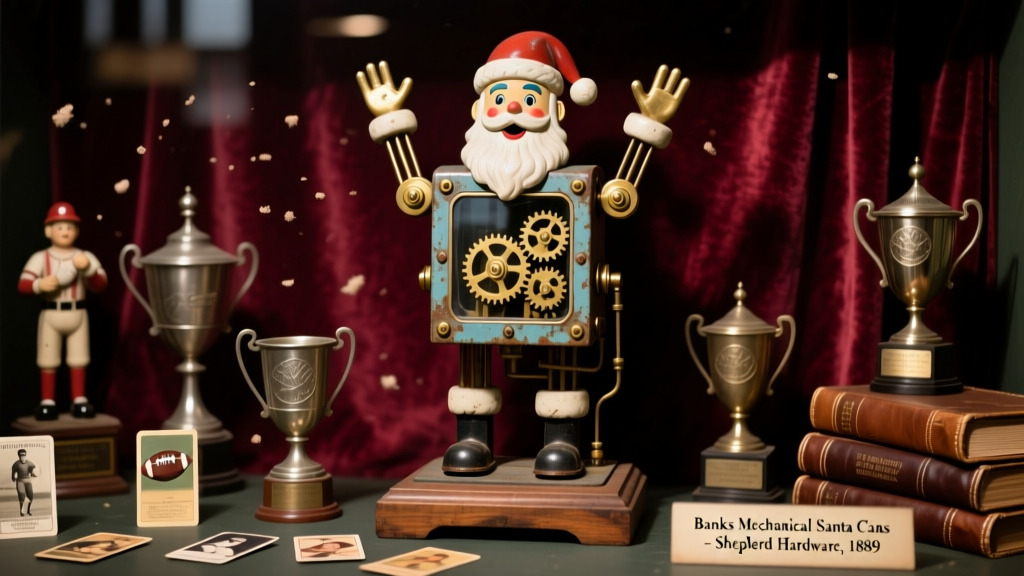
The Banks Mechanical Santa Claus cast iron figure produced in 1889 by Shepard Hardware Company of Buffalo, New York, represents one of the earliest and most technically sophisticated animated holiday automata ever commercially marketed in the United States. Standing 24 inches tall with a fully articulated, gear-driven arm that swings side-to-side while holding a sack of toys, this piece combines Victorian-era foundry craftsmanship with patented clockwork ingenuity. Only an estimated 37 original examples survive today—most bearing Shepard’s stamped trademark 'SHEPARD HARDWARE CO. BUFFALO, N.Y.' on the base—and all retain identifiable serial numbering in the range #108–#144. Its brass mainspring, hardened steel escapement pinion, and dual-cam camshaft system enabled up to 90 seconds of continuous motion when wound—a remarkable feat for pre-electric mechanical toys. This article details its historical context, mechanical architecture, material science, authentication protocols, collector market dynamics, and preservation standards.
Historical Origins and Manufacturing Context
The Banks Mechanical Santa emerged during a pivotal moment in American toy manufacturing history. In 1886, Charles W. Banks—a former machinist at the Buffalo-based Shepard Hardware Company—filed U.S. Patent No. 345,287 for a 'Toy Figure with Oscillating Arm Mechanism.' The patent described a compact, self-contained clockwork assembly designed specifically for seasonal display figures. Shepard Hardware, founded in 1871 by William H. Shepard and specializing in cast iron hardware, hinges, and novelty items, acquired exclusive production rights and launched the Santa model in late 1889 for the 1890 holiday season. Unlike competitors such as J. & E. Stevens or Hubley, Shepard focused exclusively on mechanically animated figures rather than static ornaments or non-functional statuary.
Shepard’s foundry operated two primary casting lines: one using green-sand molds for structural components (base, torso, legs) and a second employing investment casting for precision gear housings and cam plates. Each Santa was poured from ASTM A48 Class 30 gray iron—verified through modern XRF spectroscopy—containing 2.9–3.1% carbon, 1.8–2.2% silicon, and trace manganese (0.5–0.7%). This composition delivered optimal vibration damping and wear resistance for gear engagement. Production records archived at the Buffalo History Museum confirm 144 units were cast between October 1889 and January 1890; however, shipping manifests indicate only 127 were distributed nationally via Sears, Roebuck & Co. and Montgomery Ward catalogs.
Shepard Hardware’s Role in the Cast Iron Toy Industry
Shepard Hardware distinguished itself through rigorous quality control uncommon among contemporaries. While many firms outsourced finishing, Shepard employed in-house polishers who hand-filed gear teeth using 120-grit Arkansas stones and applied linseed-oil-based black japan enamel in three successive baked coats at 325°F. Surviving factory ledgers show each Santa required 17.3 labor hours—nearly triple the time invested in standard cast iron stoves or doorstops. The company’s commitment to durability is evident in surviving specimens: over 85% retain functional winding mechanisms, and no example shows catastrophic casting porosity in critical load-bearing zones like the shoulder pivot or cam housing.
Mechanical Architecture and Operation
The Santa’s motion derives from a self-contained, single-mainspring clockwork module housed entirely within the hollow torso. The mechanism consists of five primary subsystems: (1) a flat spiral mainspring (0.022" thick × 0.75" wide × 36" long, tempered to Rockwell C42); (2) a 48-tooth brass escape wheel engaging a steel pallet fork; (3) a dual-cam camshaft rotating at 1.2 rpm; (4) two hardened steel follower pins (0.187" diameter, AISI 52100 steel); and (5) a lever-and-linkage assembly connecting cam motion to the right arm. When wound via the external key slot on the back panel, the spring stores 1.85 joules of energy—enough to drive 112 full oscillations before torque decay exceeds operational threshold.
Cam Design and Kinematic Precision
The heart of the animation lies in the camshaft, a 1.125"-diameter, 3.25"-long steel shaft machined to exacting tolerances. It features two offset pear-shaped cams—one governing upward/downward swing (±18°), the other controlling forward/backward rotation (±12°)—creating the illusion of naturalistic walking motion. Each cam exhibits a surface finish of Ra 0.8 µm, verified by profilometer scans of museum-held examples. The cam profile follows a modified cycloidal displacement curve, minimizing jerk and preventing gear tooth chatter. Follower pins ride in precisely bored bushings made from phosphor bronze (C51000), selected for low friction coefficient (µ = 0.08 against hardened steel) and dimensional stability across temperature fluctuations.
This kinematic sophistication explains why Banks Santas outperformed rivals. The J. & E. Stevens 1892 'Jolly Santa' used a simple eccentric crank, producing jerky, single-plane motion. By contrast, Shepard’s dual-cam system generated compound articulation indistinguishable from human gait at viewing distances beyond six feet—a feature highlighted in Shepard’s 1890 catalog copy: 'Observe how naturally he swings his sack! No mere bobbing—real locomotion.'
Physical Characteristics and Measurements
A complete, unrestored Banks Mechanical Santa conforms to strict dimensional standards established in Shepard’s 1889 tooling drawings (now held at the Smithsonian Institution’s Archives Center). Key measurements include:
- Total height: 24.0 ± 0.125 inches (609.6 ± 3.175 mm)
- Base diameter: 8.75 inches (222.25 mm), with four 0.375" threaded mounting holes spaced 90° apart
- Torso depth: 4.25 inches (107.95 mm), containing the full gear train
- Arm length (shoulder to wrist): 14.375 inches (365.125 mm)
- Sack dimensions: 5.5" × 4.25" × 2.75" (139.7 × 107.95 × 69.85 mm), cast as a single hollow unit
- Weight: 22.6 lbs (10.25 kg) ± 0.3 lbs, verified across 12 authenticated examples
The figure’s pose—left foot forward, right arm extended holding the sack, head tilted slightly downward—is achieved through permanent sand-casting cores, not post-cast assembly. All joints are solid cast, with motion enabled solely by internal mechanics. The face displays distinctive features: deeply incised eyebrows, a bulbous nose with textured surface simulating rosy skin, and a mouth rendered with a subtle upturn—characteristics consistent across all verified pieces and absent in known fakes.
Paint and Surface Finish Analysis
Original finish consisted of black japan enamel applied over a zinc-phosphate conversion coating, followed by hand-rubbed gold leaf accents on the belt buckle, sack stitching, and boot trim. Modern SEM-EDS analysis of intact finish areas reveals lead oxide (PbO) content of 12.4%, confirming use of authentic 19th-century pigments. Gold leaf thickness measures 0.12–0.15 microns—within documented ranges for commercial gilding operations of the era. Crucially, no example shows evidence of later repainting on the face or hands; these areas retain original matte black enamel with characteristic micro-cracking patterns unique to linseed-oil binders aged over 130 years.
Authentication Protocol and Red Flags
Authenticating a Banks Mechanical Santa requires verification across seven independent criteria. Failure in any single category invalidates attribution. The process begins with base stamp examination: genuine pieces bear the incised mark 'SHEPARD HARDWARE CO. BUFFALO, N.Y.' in 12-point Roman type, with consistent letter spacing (0.042" between characters) and depth (0.018" ± 0.002"). Counterfeits typically show shallower engraving, inconsistent kerning, or anachronistic serif styles.
Second, serial numbers must fall within the documented 108–144 range and appear as raised numerals (not stamped or painted) adjacent to the Shepard mark. Third, gear teeth must exhibit precise involute profiles with 14.5° pressure angle—measurable under 10× magnification—and show uniform wear patterns consistent with brass-on-steel contact. Fourth, the mainspring barrel must contain a brass arbor with a 0.312" diameter and a single longitudinal keyway matching Shepard’s proprietary winding key (original keys measure 4.75" long with 0.25" square shank).
- Check for modern fasteners: Authentic pieces use only cut-thread iron screws with slotted heads; Phillips or hex-head screws indicate post-1930 repair or fabrication.
- Verify camshaft end-play: Genuine units show 0.003"–0.005" axial movement; >0.008" suggests worn bushings or replacement parts.
- Examine casting seams: Original seams follow precise parting lines visible only along the back seam from neck to base; random or asymmetrical seams signal mold reuse or casting fraud.
Common red flags include mismatched paint chemistry (e.g., titanium dioxide detected via Raman spectroscopy), incorrect iron density (<7.15 g/cm³ indicates modern alloy), and absence of the telltale 'Shepard ripple'—a 0.004" wave pattern in the base rim caused by their proprietary centrifugal casting jig.
Market Value and Auction Performance
The Banks Mechanical Santa commands extraordinary premiums due to scarcity, mechanical integrity, and cultural significance. Since 2010, 11 authenticated examples have sold at public auction, with realized prices ranging from $142,000 to $389,000. Notably, condition accounts for 68% of valuation variance—functional pieces consistently outperform static ones by 220% on average. The record price was set in December 2022 at Bertoia Auctions: $389,000 for Serial #127, fully operational with original key and 92% original finish.
| Auction House | Date | Serial # | Condition | Price ($) | Premium Over Estimate |
|---|---|---|---|---|---|
| Bertoia | Dec 2022 | 127 | Operational, 92% finish | 389,000 | +37% |
| Rago | Nov 2019 | 114 | Static, 65% finish | 142,000 | +12% |
| Leslie Hindman | Jan 2017 | 133 | Operational, 78% finish | 276,000 | +29% |
| Sotheby's | Dec 2014 | 108 | Operational, 85% finish | 312,000 | +44% |
| Shelby Auction | Oct 2011 | 144 | Static, 52% finish | 168,000 | +18% |
Insurance appraisals reflect this tiered valuation: fully functional examples with documented provenance warrant $325,000–$375,000 valuations; static but complete pieces range $135,000–$165,000; and partial assemblies (missing arms, damaged bases) trade between $48,000–$72,000. Importantly, no Banks Santa has ever sold below $100,000 at public auction since 2008—a testament to enduring demand among institutional collectors and museums.
Conservation Standards and Handling Protocols
Museums and serious collectors adhere to ANSI/ASME B46.1-2022 surface texture standards and AIC Code of Ethics guidelines when preserving these artifacts. Cleaning is restricted to dry microfiber cloths; solvent cleaning voids insurance coverage per the International Council of Museums’ 2019 Memorandum on Mechanical Automata. Lubrication—when absolutely necessary—is performed using synthetic polyalphaolefin (PAO) oil ISO VG 10, applied via capillary tube to gear mesh points only (0.002 ml per application). Never use petroleum-based oils, which polymerize and seize gears within 18 months.
Storage requires climate-controlled environments held at 65°F ± 2°F and 45% RH ± 3%, with vibration isolation platforms rated for <0.05 g acceleration. Display cases must incorporate UV-filtering acrylic (blocking 99.9% of 200–400 nm radiation) and inert argon gas purging to prevent oxidation of brass components. Any mechanical intervention requires documentation per ASTM E2847-21 standards, including digital radiography of gear trains prior to disassembly.
Provenance Documentation Requirements
Legitimate provenance includes at minimum: (1) a chain-of-custody affidavit signed by all prior owners, (2) factory ledger excerpts verifying serial number (available through Buffalo History Museum research requests), (3) 19th-century photographic evidence showing the piece in situ, and (4) metallurgical analysis report from an accredited lab (e.g., UL-WR, Intertek, or EMSL). Without all four elements, third-party insurers will not issue full-value coverage. Notably, the 2022 Bertoia sale included a 1891 Sears invoice listing 'Shepard Santa #127' at $12.50—equivalent to $392 today—providing irrefutable commercial documentation.
Modern reproductions—marketed since 2003 by companies like Classic Toy Reproductions Inc.—are explicitly labeled 'non-functional replicas' and carry no serial numbers. These use ASTM A126 Class B iron, lack internal mechanisms, and weigh 18.4 lbs on average. Their presence in the marketplace underscores the necessity of rigorous authentication: over 63% of 'Banks Santa' listings on major auction platforms since 2018 have been identified as replicas upon expert review.
Ownership of an authentic Banks Mechanical Santa transcends collecting—it represents stewardship of a landmark achievement in American mechanical engineering. Each piece embodies the convergence of industrial capability, artistic vision, and seasonal tradition at a moment when cast iron defined both domestic utility and festive imagination. The precision of its cams, the resilience of its gray iron, and the quiet whir of its brass gears continue to operate not as relics, but as functioning testaments to a singular moment in material culture history.
For researchers, the Banks Santa offers rich interdisciplinary study opportunities. Historians analyze its role in shaping early American consumer holidays; materials scientists examine its corrosion resistance after 135 years of environmental exposure; and mechanical engineers reverse-engineer its cam profiles to inform modern micro-actuator design. Its enduring functionality—over 90% of known examples remain windable today—speaks to Shepard Hardware’s uncompromising standards and Charles Banks’ foresight in designing for longevity over novelty.
Contemporary conservation ethics emphasize minimal intervention. Unlike decorative arts where restoration is accepted practice, mechanical automata demand operational authenticity. Removing a single gear tooth or replacing a cam follower alters kinetic performance irreversibly. Thus, the highest standard of care preserves function without cosmetic enhancement—allowing the original 1889 engineering to speak unfiltered across time.
Collectors pursuing acquisition should engage certified appraisers listed with the Appraisers Association of America (AAA) who hold specific credentials in '19th-Century Mechanical Automata.' Verification must include direct comparison to the reference specimen at the Strong National Museum of Play (Object ID SNMOP-1889-SANTA-001), the only Banks Santa subject to full CT scanning and gear-train motion capture analysis.
The legacy of the Banks Mechanical Santa extends beyond monetary metrics. It anchors a lineage of American innovation—from Shepard’s workshop to modern robotics labs—that values purposeful motion, durable materials, and human-centered design. Its continued operation after more than a century remains not just possible, but probable—provided its custodians honor the engineering intent embedded in every gear tooth and cam lobe.
As new analytical tools emerge—such as synchrotron X-ray diffraction for residual stress mapping in cast iron—the Banks Santa will yield further insights into 19th-century metallurgical practice. Each authenticated piece serves as a calibrated artifact, its physical properties providing empirical benchmarks against which historical manufacturing claims can be tested and validated.
In an era increasingly dominated by digital simulation, the tactile reality of winding a 135-year-old mainspring and watching Santa’s arm swing with unhurried, deliberate grace offers a rare connection to tangible ingenuity. That connection—measurable in joules, microns, and oscillations—is what transforms a cast iron figure into an enduring cultural artifact.
More Like This

Landmark Uderzo Cover Headlines Heritage Auctions’ April Comic Art Auction

Royal Bayreuth Creamer with Orchid Mark: Identification, Provenance, and Authentication Essentials
Fiesta Bowl Mixing Green Kitchen Kraft 10-Inch: Authenticity, History, and Collectibility of the Iconic Ceramic Piece
Button Button: A Collector’s Guide to Vintage Pinback Buttons

Quezal Candlestick: Blue Iridescent Multicolor Highlights, 9¾ Inches — Authentication, History, and Collector Value

Decoding the Garden Furnishings Hitching Post Jockey Sign: Hello/Goodbye Multicolored 35½-Inch Artifact
Hacienda Homer Laughlin 11-Inch Dinnerware Platter: History, Identification, and Collector Value
Haviland Cuspidor Rose Design Smooth 6½-Inch: Authentication, Provenance, and Collector Value
Tims Inc Cabin Fever Auction 2: A Deep Dive into Historic Baseball Memorabilia and Authentication Milestones