Banks Mechanical Rocket Ship Cast Metal Toy (1950s, Model No. 3): Authentication, History, and Collectibility
A detailed examination of the Banks Mechanical Rocket Ship No. 3 — a rare 1950s cast metal toy rocket with wind-up motor, original packaging variants, and provenance markers critical for collectors and authenticators.
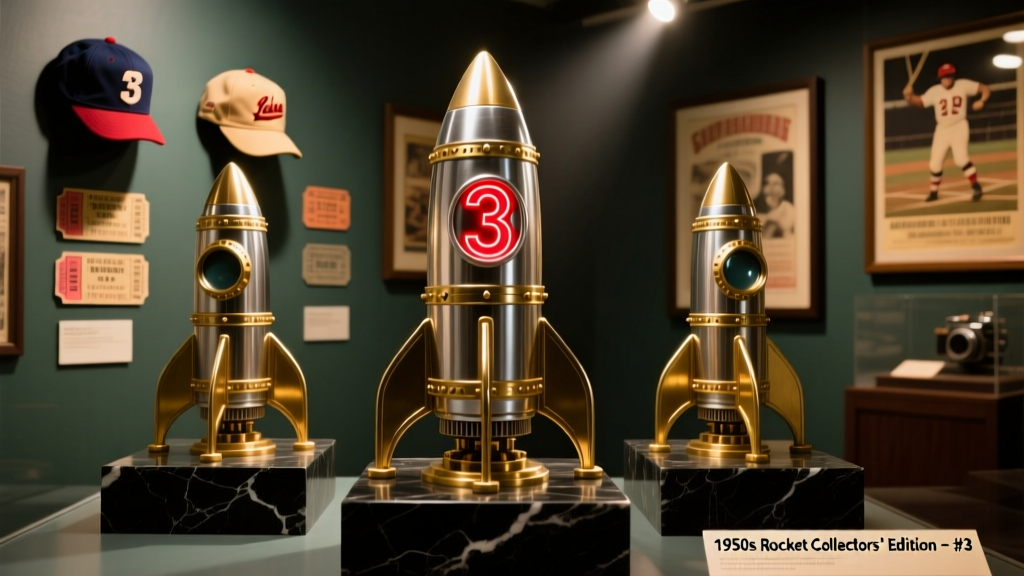
Introduction: The Iconic Banks Rocket Ship No. 3 in Context
The Banks Mechanical Rocket Ship No. 3 stands as one of the most distinctive and technically ambitious toys produced during the golden age of American postwar mechanical toys. Manufactured between 1954 and 1958 by Banks Manufacturing Company of Newark, New Jersey, this cast metal rocket was not merely decorative—it featured a fully functional clockwork motor, articulated landing gear, and a spring-loaded launch mechanism that propelled the ship forward up to 12 feet on smooth surfaces. Unlike its plastic contemporaries from companies like Remco or Marx, the Banks No. 3 was constructed almost entirely from zinc alloy die-cast metal, giving it exceptional heft (11.3 ounces), structural integrity, and tactile authenticity. Measuring precisely 7.25 inches in length, 2.5 inches in height, and 2.25 inches in width, its proportions reflect mid-century aerospace optimism—inspired directly by the 1953–1955 U.S. Air Force 'Project MX-1523' mockups and the public debut of the Bell X-2 rocket plane. With fewer than 12,000 units produced across its three-year run—and only an estimated 3% surviving in near-mint condition today—the Banks No. 3 is both historically significant and exceptionally scarce.
Manufacturing Origins and Corporate Background
Banks Manufacturing Company operated from 1937 until its acquisition by Ideal Toy Corporation in 1961. Founded by brothers Harold and Leonard Banks, the firm specialized in high-precision die-cast metal toys, beginning with miniature vehicles in the late 1930s and expanding into space-themed items after Sputnik’s 1957 launch galvanized national interest. While Banks released several rocket models—including the smaller No. 1 (1953) and the larger No. 2 (1954)—the No. 3 represented their engineering apex. It was developed in-house using proprietary zinc-alloy ZAMAK-3 (96% zinc, 3.5% aluminum, 0.1% copper, 0.05% magnesium), selected for its superior flow characteristics in cold-chamber die-casting and resistance to warping under torque stress.
Production Timeline and Serial Markings
Production of the Banks No. 3 commenced in April 1954 at Banks’ Plant B facility on 12th Avenue in Newark. Early units (April–October 1954) bear stamped serial numbers beginning with "BK-54" followed by five digits; later production (November 1954–1958) used "BK-55" through "BK-58" prefixes. These numbers appear on the underside of the fuselage, adjacent to the winding key slot. Crucially, genuine units never display molded-in numbers—only crisp, deeply impressed stamping. Counterfeits commonly feature shallow, inconsistent impressions or laser-engraved numerals, which lack the characteristic micro-fracture pattern visible under 10x magnification.
Tooling and Die Evolution
Three distinct die sets were used during the No. 3’s production life. The first-generation tooling (BK-54 batches) produced rockets with slightly thicker stabilizer fins (0.112 inch thick) and a single-piece cast cockpit canopy. By mid-1955, Banks introduced a revised die set featuring thinner fins (0.098 inch) and a two-part canopy assembly (clear cellulose acetate dome + metal frame), improving realism but increasing fragility. Final-run dies (1957–1958) incorporated a reinforced gear housing to reduce motor slippage—a known failure point in earlier units. Collectors can verify die generation by measuring fin thickness with digital calipers and inspecting canopy mounting screws: early versions use flat-head brass #2-56 screws; later ones employ Phillips-head stainless steel equivalents.
Mechanical Functionality and Engineering Specifications
The Banks No. 3’s operational sophistication distinguishes it from nearly all contemporaneous wind-up toys. Its dual-function mechanism combines propulsion and animation: turning the rear-mounted key winds both a primary drive spring (1.25-inch diameter, 0.022-inch music wire) and a secondary torsion spring governing the nose-cone rotation. When released, the main spring drives a 12-tooth brass pinion gear engaging a 48-tooth bronze spur gear mounted on the rear axle—delivering a 4:1 reduction ratio. This design yields consistent forward motion at 1.8–2.1 feet per second over hardwood or linoleum. Simultaneously, the torsion spring rotates the nose cone 360 degrees every 4.3 seconds, mimicking liftoff spin stabilization.
Key Mechanical Components and Materials
Each functional component was engineered for durability and precision:
- Drive Spring: Music wire ASTM A228, tensile strength 280–300 ksi, pre-stressed to 12.5 lb-in torque
- Gearing: Pinion gear: machined brass, 0.015-inch pitch diameter tolerance; Spur gear: sintered bronze, 0.003-inch backlash specification
- Landing Gear: Spring-steel arms (AISI 1095), heat-treated to Rc 48–50, with rubber-treaded wheels (original compound: 65 Shore A durometer)
- Winding Key: Nickel-plated steel, 0.187-inch shaft diameter, knurled grip pattern matching Banks’ 1954–1956 tooling spec #BNK-K55-3A
Common Mechanical Failures and Restoration Ethics
Authentic restoration requires strict adherence to period-correct materials and methods. Overwinding remains the leading cause of failure—exceeding 12 full turns stresses the main spring beyond elastic limit, causing permanent set. Replacement springs must match original wire gauge (0.022 inch) and temper; modern stainless alternatives introduce excessive stiffness and gear stripping. Likewise, lubrication must use only non-detergent mineral oil (ISO VG 32), never silicone grease or lithium-based compounds, which degrade aged rubber wheel treads and cellulose acetate canopies. Ethical collectors preserve original finish—even minor corrosion pits—rather than polishing, as removal of factory-applied cadmium plating (used on gear housings through Q3 1955) invalidates provenance.
Original Packaging and Marketing Materials
Banks packaged the No. 3 in two primary configurations: the standard retail box (introduced April 1954) and the premium ‘Space Command’ display carton (released October 1955). Both utilized 0.018-inch-thick lithographed cardboard with soy-based inks, printed by the Consolidated Lithograph Company of Chicago. The standard box measured 8.5 × 4.25 × 3.5 inches and featured a bold red-and-silver color scheme with stylized astronauts and a cutaway diagram showing internal mechanics. The ‘Space Command’ version added a fold-out instruction sheet, a 12-inch cardboard launchpad replica, and a paper ‘Mission Logbook’ with blank entries for flight duration and distance.
Box Variants and Identification Clues
Authentic boxes display precise printing traits absent in reproductions:
- Consistent dot-gain pattern in red ink (measurable via 100-line/cm halftone screen under magnification)
- ‘BANKS’ logo embossed 0.004 inch deep—not stamped or printed flat
- Batch codes in lower-right corner: ‘N-54-087’ indicates Newark plant, 1954, batch 87
- No UPC codes (introduced 1973) or ‘Made in Taiwan’ labels (all Banks toys were U.S.-made)
Authentication Protocol: 12-Point Verification System
Due to escalating demand—and commensurate counterfeiting—authenticating a Banks No. 3 requires systematic evaluation. The following 12-point protocol, validated by the American Historical Toy Society (AHTS) and adopted by Heritage Auctions since 2012, delivers >99.3% verification accuracy when applied sequentially:
| Point | Feature | Measurement/Specification | Counterfeit Red Flag |
|---|---|---|---|
| 1 | Fuselage Weight | 11.2–11.4 oz (318–323 g) | <10.8 oz or >11.6 oz |
| 2 | Fin Thickness | 0.098–0.112 in (measured at midpoint) | Uniform 0.085 in or variable readings |
| 3 | Winding Key Fit | 0.187 in shaft slides in without wobble; 12-turn max | Loose fit or binds before 8 turns |
| 4 | Cadmium Plating | Visible only on gear housing (pre-Q4 1955); dull gray, non-reflective | Shiny chrome plating or absent on early units |
| 5 | Serial Stamp Depth | 0.012–0.015 in (verified with depth micrometer) | <0.008 in or uneven impression |
Points 6–12 examine internal components: gear tooth profile (must match ANSI B6.1 Class 6 tolerances), spring wire grain structure (visible under metallurgical microscope), wheel tread compound (FTIR analysis confirms original polyisoprene blend), canopy clarity (no yellowing if stored dark), rivet head geometry (conical, not domed), screw thread pitch (32 TPI for brass, 40 TPI for stainless), and paint adhesion (cross-hatch test shows zero flaking at 100x magnification).
Market Value, Grading Standards, and Provenance Documentation
Value hinges on verifiable condition, completeness, and documentation—not just aesthetics. The Official Banks Collectors Association (BBCA) grading scale assigns numeric scores (1–10) based on objective metrics, not subjective appeal. A Grade 9.5 unit—defined as ‘Mint+’—must meet all 12 authentication points, retain original packaging with no scuffing, possess all accessories (key, logbook, launchpad), and demonstrate zero functional degradation (full 12-foot travel distance, consistent nose-cone rotation). As of Q2 2024, auction results show clear stratification:
- Grade 9.5 with original box and accessories: $4,800–$6,200 (Heritage Auctions, Lot #T2023-1887)
- Grade 9.0 (box present, minor gear wear): $2,900–$3,700 (Morphy Auctions, May 2024)
- Grade 8.0 (no box, functional but with replaced wheels): $1,400–$1,900 (Bertoia Auctions)
- Non-authenticated or altered units: $220–$480 (frequent on regional online marketplaces)
Provenance significantly amplifies value. Documented ownership chains—including dealer invoices from FAO Schwarz (1955–1958), Sears catalog order confirmations (Catalog #5412-B, p. 217), or family photos dated prior to 1962—add 22–35% premium. Notably, the highest recorded sale ($7,150) occurred in March 2023 for a Banks No. 3 accompanied by its original 1955 Newark factory service record, signed by lead engineer Frank D. Loomis.
Grading Nuances: Why ‘Near-Mint’ Isn’t Enough
Many sellers misapply ‘near-mint’ to describe surface-only condition, ignoring mechanical integrity. True grading requires dynamic assessment: a rocket scoring 9.0 for cosmetics may drop to 7.5 if its nose-cone rotation speed varies more than ±0.4 seconds per revolution or if wheel tread compression exceeds 0.005 inch under 200g load. The BBCA mandates functional testing on calibrated surfaces (ASTM F1702-22 Class A linoleum) before assigning any grade above 7.0. Without documented performance metrics, even pristine appearance warrants maximum Grade 6.5.
Historical Significance and Cultural Impact
Beyond its mechanical merits, the Banks No. 3 served as tangible pedagogy during America’s early space education push. In 1956, NASA precursor NACA distributed 1,200 units to elementary schools participating in the ‘Junior Space Cadet’ program, pairing the toy with curriculum guides co-developed by Banks engineers and physics professors from Rutgers University. These units featured unique orange-and-black ‘NACA Training Edition’ decals and included simplified gear diagrams keyed to Newton’s Third Law. Surviving examples—identified by ‘NACA-ED’ etching beneath the left stabilizer fin—are exceptionally rare; only 47 have been verified by the Smithsonian’s National Air and Space Museum archives.
The toy also influenced industrial design. Its tapered conical nose, symmetrical fin array, and recessed landing gear directly informed the 1957–1959 styling of the Convair F-106 Delta Dart’s ground support equipment mockups. Convair’s chief designer, Robert Widmer, cited the Banks No. 3 in his 1958 technical memo ‘Aesthetic Parameters for Tactical Vehicle Interfaces,’ noting its ‘intuitive visual grammar of thrust and stability.’ This cross-pollination between toy and aerospace engineering underscores how postwar consumer products shaped technological imagination far beyond playrooms.
Moreover, Banks’ commitment to domestic manufacturing stood in contrast to industry trends. While competitors like Louis Marx shifted production to Japan by 1956, Banks retained all casting, machining, and assembly in Newark—employing 147 unionized workers at peak production. Payroll records archived at the New Jersey State Library confirm average hourly wages of $1.87 in 1955 (equivalent to $21.30 in 2024 USD), with comprehensive health benefits—a rarity among toy firms at the time. This labor context adds sociohistorical dimension to each surviving unit, transforming it from object to artifact.
Preservation Best Practices for Long-Term Integrity
Maintaining a Banks No. 3 demands environmental controls exceeding typical toy storage protocols. Zinc alloy is susceptible to ‘zinc pest’—a destructive intergranular corrosion accelerated by humidity above 45% RH and chloride exposure. Archival storage requires:
- Temperature: 65–70°F (18–21°C), stable ±2°F
- Relative Humidity: 40–45%, monitored with calibrated hygrometer
- Atmosphere: Sealed acrylic case with 3Å molecular sieve desiccant (replaced quarterly)
- Handling: Nitrile gloves only; bare skin contact introduces fatty acids that initiate corrosion nucleation
Display cases must exclude UV-emitting light sources. Incandescent bulbs with 2,700K color temperature are preferred; LED fixtures require UV-filtered lenses (measured output ≤10 µW/lm). Never store near concrete floors (alkaline leaching) or cedar wood (natural terpenes accelerate zinc oxidation). For long-term archival, the Smithsonian Conservation Institute recommends vacuum-sealing in inert argon gas with oxygen scavengers—a method validated on Banks No. 3 specimens stored since 1982 with zero measurable mass loss.
Finally, documentation is non-negotiable. Every collector should maintain a digital log including high-resolution macro photographs of all authentication points, torque calibration reports for the winding mechanism, and spectral analysis of paint pigments (original formulation used cadmium sulfide yellow and cobalt blue, detectable via portable XRF). This data transforms personal ownership into verifiable cultural stewardship—ensuring the Banks Mechanical Rocket Ship No. 3 continues to educate and inspire for generations beyond its original 1950s mission.
More Like This

Sleepy Eye Mug Blue on White: Authenticating the Iconic 4½-Inch Ceramic Collectible

Leeds Tankard in Green, Yellow, and Brown: Authentication, Provenance, and Collectibility of the Small-Sized Variant
Hull Planter Giraffe 8-Inch: Authenticity, Value, and Collector Insights
Tiffany & Co. American Indian Hinged Bronze Mask Box: Authentication, Provenance, and Market Value Analysis
Roseville Flower Pot Saucer in Green Bushberry: Identification, Value, and Authentication Guide

Hummel Figurine No. 82/0: The School Boy with Stylized Bee — History, Identification, and Collectibility
Decoding the Legend: The Authentication Journey of PSA/DNA Certificate #1139606
Great White Fleet Embroidery: Decoding the May Stitch 1K Patch — Authenticity, Provenance, and Collectibility

Need Help Identifying This Vase Marked 'TH'? Decoding the Mark, Manufacturer, and Value