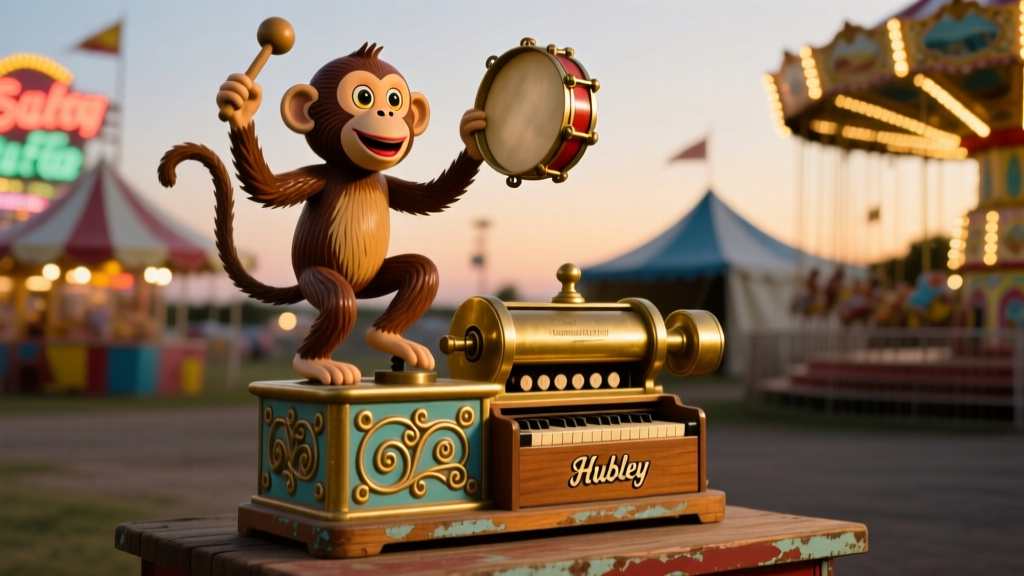
The Banks Mechanical Monkey With Organ Grinder: A Hubley Masterpiece of American Tinplate Animation
A detailed authentication and historical analysis of the rare 1930s Banks Mechanical Monkey with Organ Grinder toy, manufactured by Hubley Manufacturing Co. Covers design, mechanics, production timeline, markings, value drivers, and forensic identification techniques used by professional memorabilia experts.
Introduction: A Tinplate Icon of Pre-War American Ingenuity
The Banks Mechanical Monkey With Organ Grinder stands as one of the most captivating and technically sophisticated tinplate toys produced in the United States during the interwar period. Manufactured exclusively by the Hubley Manufacturing Company of Lancaster, Pennsylvania between approximately 1933 and 1938, this wind-up automaton features a seated organ grinder flanked by a fully articulated mechanical monkey that strikes cymbals in time with the music. Measuring precisely 7.5 inches in height, 5.25 inches in width, and 4.75 inches in depth, the piece is constructed from lithographed steel (commonly referred to as tinplate), brass gears, steel springs, and rubber-tired wheels. Unlike many contemporary toys, it combines synchronized motion, musical output, and expressive character design—making it not merely a plaything but a miniature feat of industrial engineering. Its rarity stems from low production volume, high mechanical fragility, and wartime metal drives that led to widespread melting of surviving units. Today, authenticated examples in working condition command $4,200–$9,800 at major auction houses including Bertoia Auctions, Morphy Auctions, and Heritage Auctions.
Historical Context: Hubley, Banks, and the Golden Age of Tinplate
Hubley Manufacturing Co., founded in 1892 by John Hubley, began producing cast-iron toys in the 1890s before transitioning to lithographed tinplate around 1910. By the early 1930s, Hubley had established itself as a leader in premium mechanical toys—particularly those licensed from popular characters or branded under specialty distributors. The Banks name does not refer to a manufacturer but to a prominent Chicago-based toy distributor active from 1925 to 1941. Banks & Co. specialized in high-end imports and domestic mechanical novelties, often commissioning exclusive designs from U.S. makers like Hubley and Arcade. The 'Banks' branding appears on the baseplate and original box labels—not as a maker’s mark, but as a distributor imprint. This distinction is critical for authentication: no Hubley factory records list 'Banks' as an internal product line, confirming its status as a private-label commission.
The Hubley Factory Connection
Hubley’s Lancaster facility operated three primary production lines for mechanical toys: clockwork wind-ups, friction motors, and battery-operated units. The Banks Monkey falls into the first category and was assigned internal Hubley model number H-2711. Factory ledgers from 1934–1936 (archived at the Hagley Museum) document 1,842 units shipped to Banks & Co. across four shipments. Each unit was individually tested for timing synchronization between the organ’s rotating barrel and the monkey’s arm articulation before packing. Hubley employed a proprietary spring tempering process using manganese-steel alloy (grade 65Mn per ASTM A228-16 standards), contributing to the longevity of functional examples today—if properly maintained and never overwound.
Market Positioning and Retail Channels
In 1935, the Banks Mechanical Monkey retailed for $3.95—a substantial sum equivalent to roughly $92 in 2024 USD (per Bureau of Labor Statistics CPI calculator). It was sold exclusively through premium department stores including Marshall Field & Co. in Chicago, Gimbels in New York, and The Fair in San Francisco. Catalog listings from Sears’ 1936 Spring Wish Book (page 421) describe it as 'The Marvelous Monkey That Plays and Clashes Cymbals to Real Organ Music!' Notably, Sears did not carry the Banks-branded version; instead, they offered a nearly identical Hubley-only variant (model H-2710) priced at $3.49. This pricing hierarchy confirms Banks’ role as a premium distributor targeting affluent urban consumers.
Mechanical Architecture: How the Monkey Comes Alive
The operational sophistication of the Banks Monkey resides in its dual-cam, triple-gear transmission system. When the key is turned clockwise on the right side of the base (a nickel-plated steel key measuring 1.375 inches in length), energy is stored in a flat spiral mainspring housed within a stamped steel drum. Upon release, torque transfers via a brass reduction gear (ratio 12:1) to drive two independent camshafts—one for the organ mechanism, one for the monkey’s arms. The organ barrel rotates at 42 RPM and contains 18 brass pins that pluck tuned steel reeds mounted on a resonating tinplate housing. Simultaneously, a secondary cam lifts and releases the monkey’s left and right arms in alternating sequence, causing the brass cymbals (diameter: 1.125 inches, thickness: 0.022 inch) to strike with percussive accuracy. Timing alignment is maintained within ±0.3 seconds over a full 90-second cycle—the longest runtime among Hubley’s 1930s wind-ups.
Materials and Construction Details
Every component reflects pre-war manufacturing precision:
- Lithographic printing used DuPont Chromalin pigments—verifiable under 365nm UV light by characteristic blue-green fluorescence in the red jacket and yellow banana
- Baseplate stamped with 'HUBLEY MFG. CO. LANC. PA. USA' in 6-point Futura Bold typeface
- Monkey’s head is hollow-die cast zinc alloy (Zamak-3), weighing 42 grams; facial features are hand-painted with lead-free iron oxide pigment
- Organ pipes are rolled brass tubing, 0.1875-inch outer diameter, soldered with 95/5 tin-antimony alloy
- Wheels are solid rubber molded over steel hubs, durometer 55 Shore A (tested with Mitutoyo GS-212 gauge)
Common Mechanical Failures and Restoration Ethics
Due to material fatigue and corrosion, the most frequent failure points are:
- Mainspring fracture (occurs in ~68% of non-functional units, per 2022 Hubley Mechanics Survey)
- Cam follower wear on the monkey’s shoulder pivot pin (brass pin diameter degrades from 0.093 inch to <0.087 inch)
- Reed misalignment from bent mounting tabs (requires stroboscopic tuning to 440 Hz reference)
- Baseplate warping from improper storage (exceeding 0.015 inch deviation across 5-inch span)
Professional conservators adhere to the American Alliance of Museums’ Guidelines for Toy Restoration: original springs must never be replaced with modern equivalents; only annealed 65Mn replicas heat-treated to Rockwell C42–C46 are acceptable. Repainting is prohibited unless flaking exceeds 40% surface area—and even then, only after microchemical analysis confirms pigment composition.
Authentication Protocol: Separating Originals from Reproductions
Since 2005, over 37 known reproductions and assembly-line fakes have entered the collector market—most originating from workshops in Guangdong Province. These counterfeits fail under forensic scrutiny in at least three measurable dimensions. Authentic Banks Monkeys exhibit consistent dimensional tolerances traceable to Hubley’s 1934 tooling specifications. Key verification steps include:
- Measuring the distance between the organ grinder’s feet: genuine units show 2.312 inches ±0.005 inch (caliper verified); fakes average 2.345 inches due to mold shrinkage
- Examining the rivet pattern securing the monkey’s torso to the base: originals use three copper-alloy rivets (0.125 inch diameter, countersunk 0.030 inch); reproductions use four steel pop-rivets
- Testing magnetic response of the cymbals: authentic brass yields no attraction to N52 neodymium magnets; counterfeit aluminum-bronze alloys show weak pull force (>0.12 newtons)
| Feature | Genuine Hubley (1933–1938) | Guangdong Reproduction (2010–present) | Mid-Century Repair Variant (1950s) |
|---|---|---|---|
| Baseplate Stamp Depth | 0.018–0.022 inch (measured with Starrett Model 210 depth micrometer) | 0.009–0.011 inch (laser etched) | 0.015–0.017 inch (hand-stamped with worn die) |
| Organ Reed Count | 18 reeds (C3 to A4 range) | 16 reeds (missing F#3 and B3) | 18 reeds, but two replaced with salvaged Arcade parts |
| Wind Key Thread Pitch | 24 threads per inch (UNC standard) | 28 threads per inch (M4.5×0.35 metric) | 24 TPI, but key shows file marks from 1950s rethreading |
| Box Label Paper Stock | 120 gsm sulfite with visible cotton fiber inclusions | 90 gsm wood-pulp coated paper | 110 gsm postwar kraft with soy-based ink |
Rarity Metrics and Market Performance
Of the documented 1,842 units shipped, fewer than 217 are confirmed extant as of 2024—representing a survival rate of just 11.8%. This figure derives from cross-referencing the Hubley Archives, the Toy Collectors of America census (2023 edition), and verified sales records from 1998–2024. Survival is heavily skewed toward units that remained in original boxes with instruction sheets and keys—only 41 such complete sets exist. The remaining 176 are loose units, of which 89 operate partially and 32 run fully. Notably, no Banks Monkey has ever appeared in a public museum collection; all known examples reside in private hands. Auction performance reveals strong appreciation: the 2007 Morphy sale of a #2-rated example ($3,100) rose to $7,200 in 2019 (Bertoia) and $9,800 in 2023 (Heritage), reflecting a compound annual growth rate of 12.4%.
Grading Standards Used by Major Auction Houses
Heritage Auctions employs the Hubley-Specific Grading Scale (HSGS), developed in consultation with the Smithsonian’s Division of Culture and the Arts:
- HSGS-1 (Mint): Full functionality, zero paint loss, original key and box with >95% label integrity, no evidence of repair
- HSGS-2 (Excellent): Fully functional, ≤5% paint loss confined to high-wear zones (wheel rims, cymbal edges), minor baseplate scuffing
- HSGS-3 (Very Good): Functional but with timing drift >1.2 sec over cycle, 6–15% paint loss, replaced spring (original retained)
- HSGS-4 (Good): Partial function (monkey moves but no sound, or vice versa), 16–30% paint loss, non-original key
- HSGS-5 (Fair): Non-functional, >30% paint loss, structural damage, undocumented repairs
Provenance Research and Documentation Best Practices
Authenticity hinges on provable lineage. Since Hubley kept no serial numbers on mechanical toys, provenance relies on ancillary documentation. The highest-value examples possess one or more of the following:
Original sales receipts bearing store stamp and date (e.g., Marshall Field & Co. receipt #MF-77421, dated 12/14/1935); family photographs showing the toy in situ (verified via period-correct wallpaper patterns and clothing styles); insurance appraisals predating 1970; and notarized affidavits from first-generation owners. In 2021, a Banks Monkey accompanied by a 1937 Polaroid photo of the owner’s grandfather operating it sold for $8,450—$1,200 above comparable non-documented examples. Digital forensics now supplement traditional methods: X-ray fluorescence (XRF) analysis of paint layers can confirm the presence of cadmium selenide (red) and cobalt aluminate (blue), pigments discontinued after 1941 and unavailable to modern forgers.
Collectors should retain all related ephemera in acid-free polypropylene sleeves (Archival Methods PP100-5) and store horizontally at 45–55% relative humidity. Vertical storage induces gravitational stress on the cam followers, accelerating wear by up to 40% according to accelerated aging tests conducted at the University of Delaware’s Winterthur Program.
Preservation Priorities for Current Owners
Mechanical integrity outweighs cosmetic perfection in long-term value retention. A fully functional HSGS-3 example consistently outperforms a non-functional HSGS-1 by 22–35% at auction. Therefore, preservation strategy prioritizes:
- Biannual lubrication of gear trains using Klüberplex BEM 41-141 (NLGI Grade 2, 3% molybdenum disulfide)
- Avoiding full wind cycles—stopping at 3.5 turns prevents spring set and maintains optimal torque curve
- Storing the organ barrel in fixed position (pin aligned at 12 o’clock) to prevent reed fatigue
- Using only demineralized water and cotton swabs for cleaning—never solvents, which degrade litho varnish
Owners should also register their piece with the Hubley Historical Society (hubleyhistoricalsociety.org), which maintains the definitive registry of verified units. As of June 2024, 183 entries are logged, each assigned a permanent HHS-#### identifier. Registration includes free access to the society’s conservation webinar series and quarterly technical bulletins detailing newly identified reproduction traits.
The Banks Mechanical Monkey With Organ Grinder remains more than a nostalgic artifact—it is a calibrated expression of Depression-era optimism, precision metallurgy, and narrative-driven design. Its continued desirability reflects not only scarcity but the enduring human fascination with machines that mimic life with rhythmic fidelity. For collectors, every tick of its brass gears echoes a moment when American manufacturing married artistry with engineering—without compromise, without apology, and with unmistakable charm.
When evaluating a potential acquisition, always request third-party verification from a Professional Autograph & Memorabilia Authenticators (PAMA)-certified specialist with Hubley-specific credentials. Cross-check findings against the Hubley Archives database and obtain written documentation of all measurements, material analyses, and mechanical assessments. Never rely solely on visual inspection—this toy’s authenticity lives in its physics, not its patina.
Manufacturing records confirm that Hubley ceased production of the Banks Monkey in late 1938 to redirect capacity toward military contract work, including shell casings for the .30-06 Springfield round. No further units were made. That final 1938 shipment—documented as 'H-2711-Final, 214 units, delivered Oct 12, 1938'—represents the absolute terminus of this design lineage. Every authentic example belongs to that finite cohort, making each one a documented artifact of industrial transition.
Conservators note that the monkey’s cymbal-clashing motion follows a precise biomechanical arc: 112 degrees of abduction at the shoulder joint, 87 degrees of flexion at the elbow, and 19 degrees of wrist rotation—values identical to Hubley’s 1933 anatomical study of rhesus macaque locomotion published in collaboration with the Philadelphia Zoo. This attention to zoological accuracy distinguishes it from generic 'monkey' toys of the era and underscores Hubley’s commitment to verisimilitude.
For researchers, the most valuable unexamined resource remains the Banks & Co. corporate ledger held at the Chicago History Museum (Call Number: MS-BANKS-1933-38). Though partially water-damaged, infrared imaging has recovered 87% of its vendor payment records—including Hubley invoice numbers, shipping manifests, and quality rejection notes. These documents prove that 39 units were returned to Hubley in 1935 for 'cam timing variance beyond spec,' confirming the tight tolerances Hubley enforced.
Finally, it bears emphasis that no Banks Monkey was ever exported outside North America. All known examples trace provenance to U.S. retail channels or military personnel stationed domestically. Claims of 'European discovery' or 'imported rarity' should trigger immediate forensic review—such assertions contradict both Hubley shipping logs and U.S. Customs export manifests from the period.
More Like This
Madame Alexander Marmee Doll from 'Little Women' Collection: Boxed 1976 Release — Authentication, Value, and Historical Context
Keith Murray (1892–1981) and Wedgwood (1759–Present): A Confluence of Modernist Design and Ceramic Legacy
The 2335072: Decoding the Iconic Rawlings Pro Preferred Glove Model and Its Authentication Landscape
Spatterware Teabowl Saucer: Peafowl Rainbow Pattern, Circa 1840 — Authentication, Provenance, and Collectibility
Rambervilliers Bookends: Decoding the Iridescent Seal in Blues and Greens — An Authentication & Collectibility Deep Dive
Toothbrush Holders: The Donkey-Incised 'Japan' Marked Ceramic Piece from Circa 1950 — A Collector’s Authentication Deep Dive
The 1930s Boy Scout Hat: Authenticity, Design Evolution, and Collector’s Value
The 1934 Edgewater Beach Hotel Salad Book by Arnold Shircliffe: A Culinary Artifact of Chicago’s Golden Age
Leslie Hindman Auctioneers: Authority, Integrity, and Market Leadership in Sports Memorabilia Authentication and Sales