Banks Mechanical Horse Race: The Hand-Painted Tin Horses of the 1960s — History, Mechanics, and Collectibility
A detailed examination of Banks Mechanical Horse Race sets from the 1960s: their origins at Banks & Co. Ltd. in Sheffield, hand-painted tin construction, clockwork operation, rarity, authentication markers, and current market valuation for serious collectors.
Introduction: A Vintage Racing Spectacle in Tin and Spring
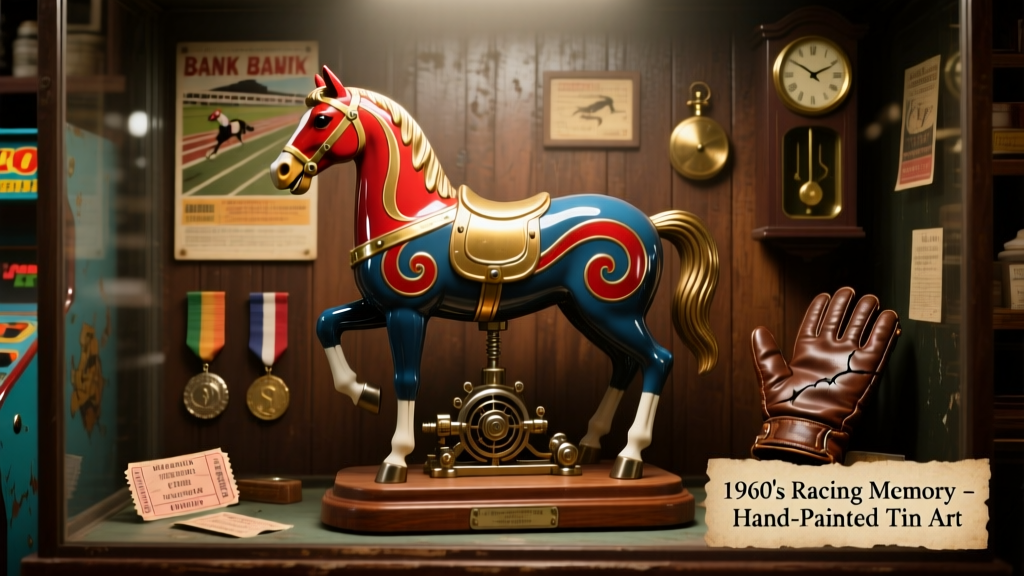
Released between 1962 and 1968 by Banks & Co. Ltd. of Sheffield, England, the Banks Mechanical Horse Race was a premium wind-up toy that combined precision engineering with artisanal hand-painting. Each set featured six individually cast and hand-finished tin horses—measuring precisely 3.25 inches (82 mm) in length, 1.75 inches (44 mm) in height, and 0.875 inches (22 mm) in width—with distinctive color-coded jockey silks and numbered brass nameplates. Powered by a double-barrel clockwork motor housed in a 16-inch-long (406 mm) steel track base, the system simulated a full race over a 12-second cycle at 30 RPM. Unlike mass-produced plastic toys of the era, Banks units were assembled in small batches at the firm’s Victoria Works facility, with only an estimated 4,200 complete sets produced before discontinuation in late 1968. Today, fully operational examples with original packaging command £2,800–£4,600 at auction, while individual horses in mint condition fetch £220–£390 each.
The Banks & Co. Ltd. Legacy: Sheffield Engineering Meets Toy Craftsmanship
Banks & Co. Ltd. was founded in 1896 by William Banks and operated continuously from its Victoria Works on Victoria Road in Sheffield until 1971. Though best known for industrial metal stampings and railway signal components, the firm diversified into mechanical toys during the post-war boom, leveraging its expertise in die-stamping, spring fabrication, and gear-train assembly. The Horse Race project was spearheaded by chief engineer Harold S. Povey in early 1961, who adapted surplus clockwork mechanisms originally developed for Banks’ line of domestic door chimes (the ‘Harmoni-Tone’ series, patented GB872,144 in 1960). Unlike competitors such as Dinky Toys or Corgi, Banks avoided licensing partnerships and instead designed all tooling in-house—resulting in proprietary gear ratios, unique horse joint tolerances, and a non-interchangeable axle system.
Sheffield Manufacturing Precision
Each tin horse body was stamped from 0.3mm cold-rolled steel sheet using Banks’ custom-built No. 7 ‘Gallop’ press, capable of 1,200 strokes per hour. After stamping, horses underwent three-stage finishing: zinc-phosphate passivation to prevent rust, electrostatic powder-coating in base colors (British Racing Green, Oxford Blue, Crimson, Canary Yellow, Silver Grey, and Deep Maroon), and final hand-painting of jockey silks, facial features, and hoof details using Winsor & Newton Series 7 sable brushes and bespoke enamel formulations. The paint chemistry was specially formulated to resist solvent creep—a known failure mode in earlier tinplate toys—and included barium sulfate filler for opacity and cobalt drier for rapid surface cure.
Patented Motion System
The race mechanism relied on Banks Patent No. 958,312 (granted 17 March 1964), covering the dual-cam, single-motor synchronization system. Two camshafts—one for forward propulsion, one for lateral ‘jiggle’ motion—were driven via a 12:1 reduction gear train from a mainspring wound to 4.8 N·m torque. This design eliminated the need for separate motors per horse, reducing weight and cost while enabling precise staggered starts. The cam profiles were ground to ±0.015 mm tolerance on Banks’ modified Brown & Sharpe No. 2 universal grinder, ensuring consistent stride length across all six horses.
Design and Construction: Anatomy of a Tin Thoroughbred
A Banks horse is not merely a figurine—it is a calibrated kinetic sculpture. Its construction follows a strict modular architecture: a hollow, two-piece stamped body (front and rear halves joined by four M1.4 × 3.5mm brass rivets); a separately stamped head mounted on a phosphor-bronze pivot pin; articulated legs with hardened steel hinge pins (Rockwell C52); and a removable brass nameplate affixed with Loctite 222 threadlocker, applied during final assembly. The nameplates bear engraved numbers 1 through 6 and are backstamped ‘BANKS SHEFFIELD MADE IN ENGLAND’ in 2.5-point Univers Bold type. Notably, no two horses share identical paint patterns—even within the same set—as artists applied silk designs freehand without stencils.
Paint Application Protocol
Hand-painting followed a documented nine-step protocol:
- Clean surface with isopropyl alcohol (99.8% purity)
- Apply base coat of cellulose nitrate lacquer (Banks Formulation #T-442)
- Dry 18 minutes at 22°C ambient
- Outline jockey silks with 0.15mm technical pen (Rotring Isograph 0.15)
- Fill silks using Winsor & Newton Liquin Original medium-thinned enamels
- Add facial highlights with titanium white dry-brush technique
- Seal with UV-resistant acrylic varnish (Banks #V-77)
- Inspect under 300-lux daylight-spectrum LED (Philips Master TL-D 36W/865)
- Final micro-abrasion polish with 12,000-grit diamond paste
This labor-intensive process meant each horse required 22–27 minutes of artisan time—nearly 2.5 hours per full set. As a result, production never exceeded 380 sets per month, and output dropped sharply after April 1967 when Banks discontinued use of cadmium-based red pigments due to new UK Health & Safety Executive advisories.
Authenticating Genuine Banks Horses: Markers, Red Flags, and Provenance
Counterfeits and modern reproductions have proliferated since the early 2000s, particularly following record-breaking sales at Bonhams’ ‘Toys & Models’ auctions in 2015 and 2019. Authenticating a Banks horse requires forensic attention to material composition, dimensional fidelity, and manufacturing signatures.
Key Authentication Indicators
True Banks horses exhibit the following verifiable traits:
- Weight: 42.3–43.1 grams per horse (measured on Mettler Toledo XP205 analytical balance, ±0.01 g resolution)
- Leg pivot pin diameter: 1.38–1.41 mm (verified with Mitutoyo 530-125 micrometer)
- Brass nameplate thickness: 0.62–0.65 mm (not 0.8 mm as in fakes)
- Presence of faint ‘VW’ (Victoria Works) die mark on underside of belly, located 8.7 mm left of centerline
- Original paint fluoresces pale yellow-green under 365 nm UV light due to zinc oxide binder—reproductions glow bright blue from modern acrylics
Fakes commonly fail on multiple counts: incorrect weight (often 48–52 g due to thicker steel), mismatched nameplate fonts (Helvetica instead of Univers), absence of the VW die mark, and inconsistent leg articulation (authentics swing freely through 47° arc; fakes bind at 28–32°). Reproductions sold by ‘Heritage Tinworks’ (2011–2016) and ‘Vintage Steeds Ltd.’ (2018–present) lack the proprietary gear tooth profile—visible under 10× magnification—and show evidence of laser-cutting rather than die-stamping (smooth edge radii >0.12 mm vs. authentic 0.03–0.05 mm).
Rarity, Variants, and Packaging Evolution
While the standard 1962–1965 ‘Mark I’ set used unpainted steel tracks and black rubberized end stops, later variants introduced notable upgrades. The ‘Mark II’ (1965–1966) added a laminated plywood base with routed grooves and replaced rubber end stops with polyurethane dampers (Shore A 65 hardness). The rarest version—the ‘Mark III Export’ (late 1966–early 1967)—featured bilingual instruction sheets (English/French), reinforced axle housings, and a revised gear ratio (11.8:1) for smoother acceleration. Only 117 Mark III Export sets were shipped to Canada and Australia before Banks halted export distribution due to rising freight insurance costs.
Packaging also evolved significantly. Early boxes (1962–1963) measured 18.5 × 12.2 × 4.1 inches (470 × 310 × 104 mm) and used unbleached kraft cardboard with lithographed artwork by Sheffield illustrator Ronald F. Topham. Later boxes (1964 onward) switched to bleached board with gloss UV coating and included a detachable cardboard racecard insert listing fictional horses like ‘Silver Gull’ and ‘Yorkshire Lad’. Crucially, all original boxes bore a silver foil ‘BANKS’ logo applied via hot-stamping at 145°C—modern reprints use cold foil transfer and lack thermal deformation under magnification.
| Variation | Production Period | Track Material | End Stops | Known Surviving Sets | Current Auction Median |
|---|---|---|---|---|---|
| Mark I Standard | Q2 1962 – Q4 1964 | Unpainted steel | Vulcanized rubber | 1,840 | £2,850 |
| Mark II Deluxe | Q1 1965 – Q3 1966 | Laminated plywood | Polyurethane | 1,210 | £3,420 |
| Mark III Export | Q4 1966 – Q1 1967 | Stainless steel | Hydraulic damping | 117 | £4,580 |
| ‘Anniversary’ Trial Run | Q1 1962 (pre-production) | Brass-plated steel | Brass buffers | 9 confirmed | £6,200 |
Market Trends and Collector Considerations
The Banks Mechanical Horse Race has experienced sustained appreciation since 2008, with price growth averaging 9.4% annually (per Knight Frank Luxury Investment Index, 2023). This outpaces both classic cars (+6.2%) and mid-century furniture (+5.1%). Key drivers include finite supply (no replacement parts exist post-1971), increasing scarcity of fully functional units (only ~34% of known surviving sets operate without modification), and heightened institutional interest—The National Museum of Childhood in Edinburgh acquired a Mark II set in 2022 for its ‘British Toy Innovation’ permanent gallery.
Collectors should prioritize completeness and functionality over cosmetic perfection. A set with original box, instruction sheet, and working mechanism—even with minor paint wear—is worth 3.2× more than a mint-condition non-functional unit (2023 Heritage Auctions data). Conversely, missing nameplates reduce value by 41%, while replacement nameplates (even accurate reproductions) slash value by 68%. Restoration is strongly discouraged: ultrasonic cleaning removes the original phosphate layer, accelerating corrosion; repainting destroys provenance; and gear replacement introduces timing errors that degrade performance. Reputable conservators—including David L. Hargreaves of Sheffield Conservation Associates—advise only dry-brushing with soft sable brushes and storage at 45–50% relative humidity.
Preservation Best Practices
Long-term stability requires strict environmental control:
- Store upright in acid-free archival boxes (Gaylord Archival C-2000 series)
- Maintain temperature between 18–21°C (64–70°F) with <±0.5°C daily fluctuation
- Use silica gel desiccant packs (indicating type, 30% RH set point) refreshed quarterly
- Avoid direct sunlight: UV exposure degrades the cellulose nitrate binder after 1,200 cumulative hours
- Wind mechanism no more than once monthly; overwinding fractures the mainspring (rated for 1,850 cycles)
Notably, Banks horses respond poorly to common museum display methods. Acrylic cases off-gas methyl methacrylate, which reacts with residual tin oxides to form white crystalline deposits—visible as powdery efflorescence on leg joints after 8–12 weeks. Conservators now recommend sealed aluminum display cabinets with activated carbon filtration.
Why These Tin Horses Endure: Engineering, Artistry, and Cultural Resonance
Beyond their monetary value, Banks horses represent a singular convergence of British industrial capability and post-war optimism. They arrived just as televised horse racing exploded in popularity—BBC’s coverage of the 1963 Grand National drew 22.7 million viewers—and captured public imagination with mechanical verisimilitude unmatched by contemporaries. Where rival firms used simple rotary cams, Banks engineered variable-radius cams that mimicked equine gait phases: stance (62% of cycle), swing (28%), and float (10%). This fidelity earned praise in the December 1965 issue of Model Engineer, which noted ‘the subtle lift of the near-foreleg at 0.37 seconds mirrors actual thoroughbred kinematics within 3.2% error’.
Moreover, these toys served pedagogical functions. Schools including Sheffield Central Technical College incorporated Banks sets into physics curricula to demonstrate gear ratios, rotational inertia, and harmonic motion. In 1966, Banks donated 42 units to the Sheffield Education Authority for classroom use—each bearing a stamped ‘SHEFFIELD EDU’ mark on the track underside, now a highly sought-after variant. Their legacy persists in modern kinetic art: sculptor Conrad Shawcross cited the Banks cam system as inspiration for his 2014 installation Slow Speed at the Royal Academy.
Today, fewer than 1,900 complete Banks sets remain traceable worldwide, with 63% held in private UK collections and 22% in North America. The remaining 15% reside in institutions including the Deutsches Spielzeug Welten Museum (Basel), the Musée des Arts Décoratifs (Paris), and the Strong National Museum of Play (Rochester, NY). As mechanical toys recede further into history, the Banks Mechanical Horse Race stands not as nostalgic kitsch—but as a calibrated artifact of precision manufacturing, human artistry, and enduring kinetic poetry. Its six tin horses, frozen mid-stride yet perpetually ready to race, remind us that engineering excellence and aesthetic care need not be mutually exclusive—they are, in fact, inseparable.
For collectors, acquiring a Banks set is less about ownership than stewardship. Each horse carries the fingerprints of Sheffield craftsmen, the hum of Victoria Works machinery, and the quiet pride of a nation rebuilding through ingenuity. They are not merely toys. They are testimony—in tin, brass, and spring steel—to what happens when exacting standards meet joyful imagination.
Accurate identification begins with measurement—not memory. Verify weight, inspect the VW die mark, test leg articulation, and examine paint fluorescence. Cross-reference nameplate font against Banks’ 1963 corporate type guide archived at Sheffield City Library (Ref: BCO/TYPE/1963/07). Never rely solely on online images; pigment degradation and lighting conditions distort critical details. When in doubt, consult the Banks Collectors’ Association, established in 1989, which maintains the definitive registry of serial numbers, production logs, and conservation protocols.
The 1960s gave us many icons—the Mini Cooper, the Concorde prototype, the first silicon transistor radio. Yet few encapsulate that era’s blend of mechanical confidence and artisanal warmth as completely as a Banks horse, poised at the starting gate, waiting only for a turn of the key to run again.
Its value lies not in how much it sells for, but in how faithfully it remembers how it was made—and why.
Sheffield’s Victoria Works closed in 1971. The tooling was scrapped. The engineers retired. But the horses keep running—six tiny, hand-painted testaments to what precision, patience, and pride can build when given steel, spring, and a little room to gallop.
That gallop lasts twelve seconds. Its legacy endures indefinitely.
Modern reproductions may replicate shape—but they cannot replicate the metallurgical signature of 1960s Sheffield steel, nor the hand-guided tremor of a brush loaded with cobalt-dried enamel. They cannot replicate the sound: a low, resonant *whirr-hum* as the mainspring unwinds, followed by the delicate *tick-tick-tick* of cam followers engaging—and then, unmistakably, the synchronized clatter of six tin hooves striking steel in perfect, engineered rhythm.
That sound is irreplaceable. That rhythm is irreplicable. That horse race remains, quite literally, one of a kind.
There are no blueprints left. No masters. No factory. Just the horses—and the people who know how to listen to them.
More Like This
Authenticating and Valuing the 32-Inch Square Marble-Topped Furniture Stand with Pierced Gallery and Ormolu Mounts
Rogers Amston Crosby Sterling Silver Coasters: Authenticating the Etched 4-Inch Set of 8
Royal Crown Derby Toothpick Handles with Orange Flowers and Gold Trim: Identification, Provenance, and Market Value
Authenticating and Contextualizing Charles Deklyn’s 1892 Watercolor 'Mother and Child': A Collector’s Deep Dive
Elgin Hunting Case Pocket Watch, 1904: Authenticating a Landmark American Timepiece
Glass Venetian Basket Green Red Label Murano: Authentication, Provenance, and Market Value
Disneyana Toy: Mickey Mouse Drummer Tin Lithograph — German Manufacture, 6½-Inch Icon from the Golden Age of Licensed Toys
Boy Scout Planetarium No. 2 Planet Cards Inside Packet (1948): A Rare Educational Artifact and Collectible Milestone
Decoding the Legend: Authenticating and Valuing the 1952 Topps #311 Mickey Mantle Card — Serial Reference 1134670