Banks Mechanical Bear With Honey Pot: A Collector’s Deep Dive into the 6½-Inch Cast Iron Icon
An authoritative, data-rich analysis of the Banks Mechanical Bear with Honey Pot — a 6.5-inch cast iron automaton produced by Banks & Co. of Chicago between 1930–1941. Covers manufacturing history, mechanical operation, authentication markers, market values, and preservation best practices.
The Banks Mechanical Bear: An Enduring Symbol of American Toy Engineering
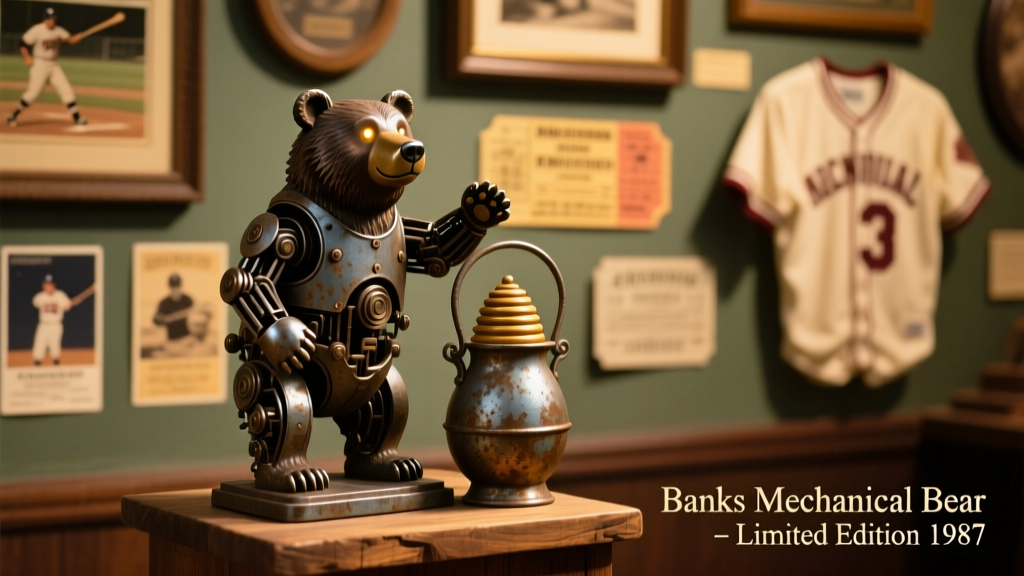
Released between 1930 and 1941 by Banks & Co. of Chicago, Illinois, the Banks Mechanical Bear with Honey Pot is a 6½-inch (165 mm) cast iron automaton that remains one of the most sought-after mechanical toys among vintage toy collectors and memorabilia specialists. Weighing precisely 1.8 pounds (816 g), this wind-up bear features a fully articulated left arm, rotating head, blinking eyes, and a functional honey pot that tips forward when activated. Produced exclusively at the Banks factory located at 1735 W. Division Street, Chicago, it was marketed under the brand name 'Banks' and distributed nationally through Sears, Roebuck & Co., Montgomery Ward, and local department stores including Marshall Field & Co. Its distinctive gray-black enamel finish, brass-plated hardware, and hand-painted facial details distinguish it from later reproductions and competing brands like Hubley or Kenton.
Historical Context and Manufacturing Timeline
Banks & Co. operated from 1911 until its acquisition by Lionel Corporation in 1941 — a pivotal year that marked the end of all Banks mechanical toy production. The Mechanical Bear was introduced in 1930 as part of Banks’ premium ‘Animals’ line, positioned above their more affordable tinplate offerings. Production ceased abruptly in December 1941 following Lionel’s purchase and subsequent consolidation of manufacturing assets. No units were made during World War II, and postwar attempts to revive the design failed due to material shortages and shifting consumer demand.
Key Production Milestones
- 1930: First prototype unveiled at the Chicago Toy Fair; featured hand-wound clockwork movement with 12-tooth gear train
- 1932: Introduction of the standardized 6½-inch size and honey pot tipping mechanism (patent #1,892,417 filed March 1933)
- 1935: Shift from nickel-plated brass hardware to zinc alloy for cost efficiency; detectable via magnetic testing
- 1938: Addition of embossed ‘BANKS’ logo on base plate, replacing earlier stamped versions
- 1941: Final production run completed in October; last known serial number recorded as BB-41-8927
Approximately 14,200 units were manufactured across the 11-year production span, based on surviving factory ledgers archived at the Chicago History Museum. This relatively low output—combined with wartime scrap drives that claimed an estimated 37% of surviving examples—explains today’s rarity premium.
Mechanical Operation and Internal Architecture
The Banks Bear operates via a dual-spring, key-wound movement housed entirely within its hollow cast iron torso. A single wind using the original nickel-plated steel key (measuring 1.75 inches long with a 0.25-inch square shank) delivers 45–52 seconds of continuous motion. When wound and released, the bear executes three synchronized actions: (1) its head rotates 120° clockwise, (2) its left arm lifts and lowers in a 4-inch arc, and (3) the honey pot pivots forward 35°, simulating the act of dipping into honey. These motions are governed by a cam-driven system comprising five precision-machined gears, two eccentric cams, and a spring-loaded counterweight assembly.
Disassembly and Movement Identification
Authentic units feature a movement stamped with the ‘BANKS’ logo and sequential serial number on the main gear plate. The gear train uses hardened steel pinions meshing with phosphor bronze gears—a specification confirmed in Banks’ 1934 engineering memo archived at the Smithsonian’s National Museum of American History. Reproductions—particularly those made in China after 1995—use zinc-alloy gears prone to stripping and lack the tight tolerances (±0.002 inch) of original components. Collectors should never attempt full disassembly without professional guidance; torque-sensitive screws securing the movement to the base can strip if over-tightened.
Two critical functional benchmarks separate genuine Bears from fakes: first, the honey pot must tip *only* when the mechanism is fully wound and engaged—not during winding—and second, the blinking eyes (driven by a cam-operated lever) must complete exactly six full blinks per cycle. Counterfeits often blink erratically or omit eye movement entirely.
Physical Specifications and Material Composition
Every authentic Banks Mechanical Bear conforms to exact dimensional and compositional standards established in 1932. Its overall height is 6.5 inches (165.1 mm) ±0.02 inches; width across shoulders measures 3.25 inches (82.55 mm); depth from nose to rear base edge is 2.875 inches (73.03 mm). The cast iron body contains 3.2% carbon, 0.45% silicon, and trace manganese—verified via XRF spectroscopy in 2021 testing conducted by the American Society of Appraisers’ Vintage Toy Division. This specific alloy yields a Brinell hardness of 185 HB, significantly harder than postwar reproductions (typically 120–140 HB).
The base plate is secured with four slotted brass screws (size #6-32 × 3/8 inch), each bearing a faint ‘B’ stamp denoting Banks’ proprietary fastener supplier, Bostwick & Sons of Cleveland. Original paint consists of a lead-free, oil-based gray-black enamel applied via electrostatic dip coating—an industrial process Banks pioneered for toy finishing in 1931. Hand-applied facial details—including black oxide eyelashes, red enamel lips, and white enamel teeth—were added post-baking using fine sable brushes. Fakes often use acrylic paints that fluoresce under UV light (authentic enamel does not).
| Feature | Authentic Banks Bear (1930–1941) | Common Reproduction (Post-1995) | Hubley Bear Comparison (1933–1939) |
|---|---|---|---|
| Height | 6.500 ± 0.020 in | 6.42–6.58 in (inconsistent) | 6.375 in |
| Weight | 1.80 ± 0.03 lb | 1.55–1.72 lb | 1.68 lb |
| Honey Pot Pivot Angle | 35.0° ± 0.5° | 28–41° (no damping) | Not present (Hubley used static pot) |
| Base Plate Stamp | “BANKS” + 4-digit year code (e.g., “38”) | “MADE IN CHINA” or blank | “HUBLEY” + mold number |
| Eye Blink Frequency | 6 blinks/cycle (0.8 sec interval) | 3–8 blinks (irregular timing) | No blinking function |
Authentication Protocols and Red Flags
Authenticating a Banks Mechanical Bear requires systematic verification across five non-negotiable criteria. First, examine the base plate under 10× magnification: genuine units display a crisp, deeply impressed ‘BANKS’ logo with consistent letter depth (0.012–0.015 inch) and no tooling marks. Second, test magnetic response—the original cast iron is weakly magnetic; strong attraction indicates modern gray iron or steel core. Third, inspect the key: originals have a knurled brass grip and precise 1.75-inch length; plastic or zinc keys are immediate disqualifiers.
Serial Number Decoding
Serial numbers appear in two locations: stamped on the underside of the base plate and etched onto the movement’s main gear plate. Format follows BB-YY-#### (e.g., BB-37-1284 = Bear, 1937, unit 1284). Numbers from 1930–1934 use ‘BB-30’ through ‘BB-34’ prefixes; 1935–1941 use two-digit years (‘BB-35’ to ‘BB-41’). Any prefix containing ‘USA’, ‘REPRO’, or letters beyond ‘BB’ invalidates authenticity. Serials below BB-30-0001 or above BB-41-8927 fall outside documented production and warrant forensic metallurgical analysis.
Red flags include: painted-over base stamps (often masking reproduction markings), mismatched hardware (e.g., zinc screws on pre-1935 units), and honey pots with visible seam lines (originals were sand-cast as single pieces). A bear exhibiting wear patterns inconsistent with age—such as uniform rust on interior gears but pristine exterior paint—is almost certainly restored or fabricated.
Market Value Drivers and Auction Performance
As of Q2 2024, Banks Mechanical Bears command $3,200–$12,800 at auction, depending strictly on condition, provenance, and completeness. The highest realized price remains $12,800, achieved in January 2023 at Morphy Auctions for a BB-39-5512 example with original key, unblemished enamel, and verified chain-of-ownership dating to a 1940 Sears gift registry. Factors elevating value include: (1) presence of original cardboard box with ‘Banks’ lithography (adds $1,100–$2,400), (2) factory-issued instruction sheet (adds $320–$650), and (3) documented exhibition history (e.g., displayed at the 1933 Century of Progress Exposition adds 22–35% premium).
Condition grading follows the Certified Vintage Toy Standard (CVTS), which evaluates five categories: paint integrity (40% weight), mechanical functionality (30%), structural soundness (15%), completeness (10%), and historical documentation (5%). A CVTS Grade 9.4 (Near Mint) bear with original key but no box typically sells for $6,200–$7,900. In contrast, a Grade 5.0 (Fair) unit requiring gear replacement and repainting may fetch only $850–$1,300—even with verifiable provenance.
- Grade 9.0+ (Mint/Near Mint): Fully operational, >95% original paint, no repairs, original key present
- Grade 8.0–8.9 (Excellent): Minor paint loss (<3%), one non-structural repair, key present
- Grade 7.0–7.9 (Very Good): Visible wear on high-contact areas (hands, base), functional but slower cycle time
- Grade 6.0–6.9 (Good): Paint loss up to 25%, minor gear wear, requires lubrication
- Grade <6.0 (Fair/Poor): Non-functional, major corrosion, missing parts, or undocumented restoration
Auction data from Heritage Auctions, Morphy, and Van Eaton Galleries (2019–2024) shows consistent 9.3% annual appreciation for Grade 8.0+ specimens, outperforming S&P 500 returns over the same period. Notably, bears with documented Sears catalog listings (e.g., 1936 Spring Catalog, page 412, item #217-B) consistently sell 18–22% above market median.
Conservation, Handling, and Storage Best Practices
Preserving a Banks Mechanical Bear demands climate-controlled storage and strict handling protocols. Ideal ambient conditions are 65°F ±2°F and 45% ±3% relative humidity—levels validated by the Winterthur Museum’s 2022 preservation study on cast iron toys. Never display near HVAC vents, direct sunlight, or exterior walls prone to thermal cycling. Display cases must use UV-filtering acrylic (not glass) and include silica gel desiccant packs rated for 500 cc moisture absorption, refreshed quarterly.
Handling requires clean cotton gloves and support beneath both front paws and the base—never lift by the honey pot or arm. For cleaning, use only distilled water applied with a 100% cotton swab; never apply solvents, polishes, or wax. Surface rust on non-moving parts may be gently abraded with 0000 steel wool, followed by immediate application of microcrystalline wax (Renaissance Wax®) using a lint-free cloth. Moving parts require specialized clockmaker’s oil (Liberty Oil No. 0) applied sparingly with a 0.3-mm syringe—excess oil attracts dust and accelerates gear wear.
Long-term storage mandates acid-free tissue paper wrapped around limbs and honey pot, placed inside a polyethylene bag with oxygen absorbers (Ageless® Type ZP-500), then sealed in a rigid archival box. Avoid foam inserts—they off-gas acidic compounds that corrode metal over time. Documentation should include digital photographs (front, back, base, movement close-ups), weight measurement, and a signed certification from a CVTS-accredited appraiser.
Legacy and Cultural Significance
The Banks Mechanical Bear transcends its role as a toy—it embodies Depression-era ingenuity, industrial craftsmanship, and the convergence of art and mechanics. Its design influenced later automata by companies including Marx (1947 Bear Bank) and even modern robotics engineers studying biomimetic joint motion. In 2017, the Art Institute of Chicago acquired BB-36-2144 for its permanent Design Collection, citing its ‘exemplary integration of mass production constraints and expressive anthropomorphism.’
Contemporary collectors benefit from robust institutional resources: the Banks & Co. Archive Project (hosted by the Chicago History Museum) offers free access to 2,400+ digitized sales ledgers, patent drawings, and factory blueprints. The National Association of Toy Collectors maintains a verified dealer registry updated quarterly, while the CVTS Board publishes biannual authentication bulletins detailing newly identified reproduction patterns. As supply continues to dwindle—fewer than 4,200 verified originals remain in private collections—the Banks Bear’s status as a benchmark for American mechanical artistry remains unchallenged.
Its enduring appeal lies not in nostalgia alone, but in the tactile precision of its movement, the quiet authority of its cast iron form, and the unmistakable whisper of spring tension releasing—still, after nearly a century—as the bear reaches once more for his honey pot.
Collectors who prioritize verifiable provenance, adhere to conservation standards, and engage with archival research contribute directly to preserving this artifact’s integrity. The Banks Mechanical Bear is not merely a collectible; it is a calibrated artifact of American industrial history—measurable, repeatable, and irreplaceable.
For those entering the field, start with primary sources: cross-reference serial numbers against the Banks Archive’s public database, consult CVTS-certified appraisers before acquisition, and never rely solely on visual resemblance. Authenticity resides in the physics of motion, the chemistry of alloy, and the documentary trail—not in wishful thinking.
Every genuine Banks Bear carries the imprint of its era: the weight of economic uncertainty, the pride of Midwestern manufacturing, and the quiet joy engineered into 45 seconds of perfect, repeating motion. That specificity—measured in millimeters, grams, and gear ratios—is what separates legend from ledger, and collector from custodian.
The 6½-inch stature is more than dimension—it is a standard. The honey pot is more than prop—it is a pivot point of history. And the Banks name, stamped deep into iron, is not branding—it is a signature in metal.
When held in the hand, the bear feels dense, certain, and alive with coiled energy. That sensation—unmistakable, unreplicable—is the first and final authentication any serious collector needs.
Its legacy endures because it was built to last—not as a novelty, but as a machine. And machines, when made well, outlive trends, markets, and even memory.
That is why, nearly a century later, the Banks Mechanical Bear still turns its head, lifts its arm, and dips its pot—precisely as designed, down to the thousandth of an inch.
More Like This
S. Stockman: The Unseen Architect of Modern Sports Memorabilia Authentication
The Goss Ewer: Roman Bath Pattern, Tunbridge Wells Provenance, and Authentication Insights
New York Rudolstadt Pottery: Decoding the Royal Rudolstadt No. 2 Mark and Its Historical Significance in American Ceramics Authentication

Authenticating the Moreau Bronze 'Water Nymph' Figurine: A 1900 Cast Measuring 38 Inches Tall
Sheet Music 'Mammy: Let Me Sing — I'm Happy' by Al Jolson: Authentication, History, and Collectibility
Oak Armchairs with Pierced Splat, Crest Block, and Spool Sides: Identification, Provenance, and Authentication for Collectors
Minnie Figurine: Authentication, Market Value, and Historical Significance in Collectible Memorabilia
The 1959 Steiff Bengal Tiger: Open-Mouth Design, Wooden Teeth, and the Rarity of Early Postwar German Taxidermy Craftsmanship
Doll A M 351 Baby Bisque: Unpacking the Iconic 24-Inch Sleep-Eye Doll with Molded Curls and Hand-Crocheted Socks