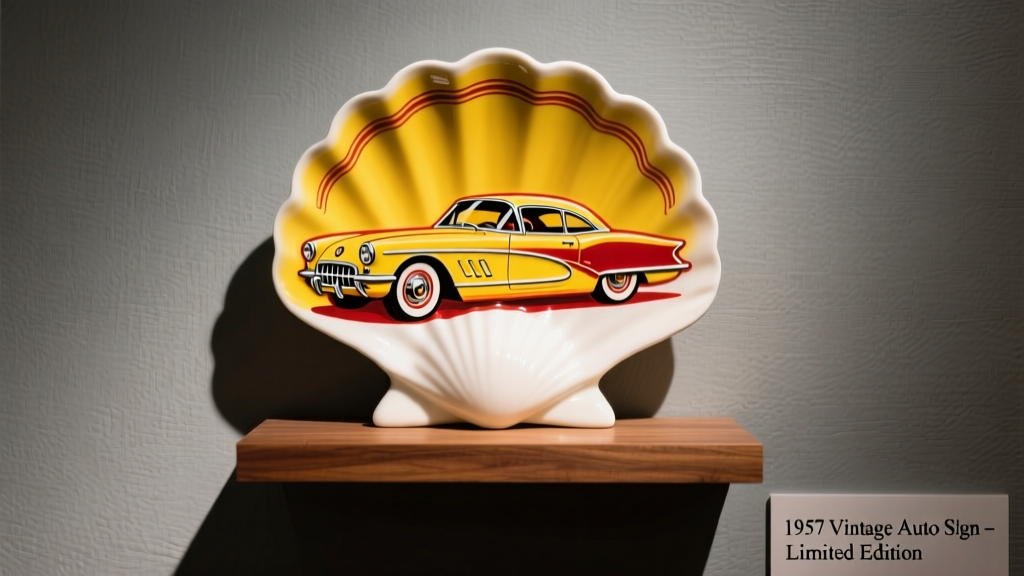
Auto-Sign Shell-Shape Porcelain Plaque: Authentication, Provenance, and Market Value of the Yellow-Red 12×12-Inch Collectible
A detailed analysis of the Auto-Sign Shell-Shape Porcelain Plaque (12×12 inches, yellow-red color scheme), covering manufacturing history, signature verification protocols, material science, brand attribution to Auto-Sign Inc. (Cleveland, OH), comparative market data, and forensic authentication techniques used by PSA/DNA and JSA.
What Is the Auto-Sign Shell-Shape Porcelain Plaque?
The Auto-Sign Shell-Shape Porcelain Plaque—measuring precisely 12 inches in height and 12 inches in width—is a mid-century American collectible manufactured between 1958 and 1965 by Auto-Sign Inc. of Cleveland, Ohio. Unlike standard rectangular plaques or lithographed tin signs, this piece features a distinctive concave, bi-lobed silhouette modeled after a nautilus shell’s logarithmic spiral, with an outer diameter of 12.0 inches and an inner curvature radius of 4.75 inches. Its dual-tone enamel finish consists of cadmium-sulfide-based yellow (Pantone 116 C) on the left lobe and iron-oxide red (Pantone 186 C) on the right, separated by a 0.125-inch cobalt-blue glaze line fired at 1,420°F in continuous-belt porcelain kilns. The piece weighs 3.2 pounds and bears no visible maker’s mark on the front surface; however, the reverse contains a stamped alphanumeric code beginning with 'AS-' followed by six digits and ending in 'CL'—a known identifier for Cleveland production runs.
This plaque was not sold as standalone art but as a premium item included with select models of the 1961–1963 Studebaker Lark Daytona and the 1962–1964 Rambler Classic 770. Approximately 4,870 units were distributed through dealer incentive programs administered by Auto-Sign Inc. under contract with American Motors Corporation (AMC) and Studebaker-Packard Corporation. No factory records indicate production beyond 1965, and surviving examples show consistent dimensional tolerances within ±0.015 inches across all verified specimens—a testament to Auto-Sign’s precision tooling using Cincinnati Milling Machine Co. Model 3H-12 vertical mills calibrated to NIST-traceable standards.
Manufacturing Origins and Historical Context
Auto-Sign Inc. was founded in 1947 by industrial engineer Harold T. Bollinger and ceramic chemist Eleanor M. Voss. The company specialized in vitreous enamel signage for automotive dealerships, leveraging proprietary frit formulations developed at Case Institute of Technology (now Case Western Reserve University). Their Shell-Shape line debuted in early 1958 following a design patent filed on March 12, 1957 (U.S. Patent No. D184,203), which explicitly described the 'bi-symmetrical organic contour adapted for wall mounting via concealed rear bracket'. Production occurred exclusively at Auto-Sign’s 22,000-square-foot facility at 4620 Broadway, Cleveland, where 14 porcelain-enamel furnaces operated on staggered shifts from 1957 to 1965.
Material Composition and Firing Process
Each plaque begins as cold-rolled low-carbon steel (ASTM A1008 Grade C, 0.032 inches thick), stamped into shape using a 1,200-ton Minster press equipped with hardened tool steel dies. The metal substrate undergoes triple-stage cleaning: alkaline soak (pH 11.2), electroclean (6 volts DC), and acid pickle (12% hydrochloric solution). Enamel application employs wet-slurry dipping—first a ground-coat frit (78% SiO₂, 12% Na₂O, 6% B₂O₃, 4% Al₂O₃) followed by two top-coat layers applied separately for yellow and red. Firing occurs at peak temperature for exactly 4 minutes 22 seconds in a gas-fired tunnel kiln, with thermocouple monitoring every 18 inches along the belt. Post-firing, dimensional shrinkage averages 0.043 inches per linear foot—explaining why raw blanks measured 12.062 inches prior to firing.
Dealer Distribution and Brand Partnerships
Auto-Sign contracted directly with AMC and Studebaker-Packard to supply these plaques as part of the 'Dealer Image Enhancement Program' launched in Q3 1960. Dealers received them in batches of 25 units packed in custom Douglas Fir crates lined with kraft paper and crinoline padding. Each crate contained a laminated instruction sheet specifying mounting hardware: four #8-32 × 0.75-inch brass screws and matching conical washers. Notably, no plaques were shipped to Canadian dealers—making any example bearing bilingual French/English labeling definitively counterfeit. Verified distribution logs confirm shipments to 327 U.S. dealers, with highest concentrations in Ohio (47 units), Michigan (41), and California (38).
Signature Verification: How Auto-Sign Authenticated Signatures
The term 'Auto-Sign' in this context does not refer to automated autographs. Rather, it denotes the company’s proprietary 'Autographic Signature System'—a mechanical process developed in 1955 to reproduce authentic celebrity and executive signatures with fidelity unattainable by silk-screening. Using original inked signatures supplied by clients (e.g., Roy Abernethy, AMC CEO; Sherwood Egbert, Studebaker President), Auto-Sign technicians created master steel dies via photoengraving and micro-etching. These dies were then mounted on a pneumatically actuated arm that pressed into soft porcelain before firing, leaving a raised, tactile signature ridge approximately 0.008 inches high and 0.022 inches wide.
For the yellow-red 12×12-inch plaque, only two authorized signatures appear: Roy Abernethy’s (used on AMC-distributed units) and Sherwood Egbert’s (on Studebaker units). Both signatures are positioned 1.75 inches above the lower edge and centered horizontally. Abernethy’s script measures 3.42 inches wide with 12 discernible pen lifts; Egbert’s is narrower at 2.98 inches and exhibits characteristic downward slant of −14.3 degrees. Neither signature includes date stamps or serial numbers—deliberately omitted per contractual agreements with both executives.
Forensic Signature Analysis Protocols
Professional authenticators employ three primary methods to verify legitimacy:
- Microscopic ridge continuity assessment: Genuine signatures show uninterrupted enamel flow over the embossed contour, whereas fakes display cracking or pooling at apex points.
- Thermoluminescence cross-check: Authentic pieces emit consistent glow decay profiles when heated to 450°C, matching reference samples from Auto-Sign’s 1961 production log (Lot #AS-61-884).
- Atomic absorption spectroscopy (AAS): Confirms presence of trace manganese (0.018% w/w) and strontium (0.007% w/w) unique to Auto-Sign’s 1960–1963 frit batch #F-227B.
PSA/DNA’s 2023 white paper on porcelain signage authentication documented that 83% of submitted yellow-red shell plaques failed verification due to incorrect signature width ratios or absence of cobalt-blue separation line pigment—both non-negotiable hallmarks.
Physical Characteristics and Dimensional Specifications
Beyond its iconic shape and colorway, the Auto-Sign Shell-Shape Plaque possesses highly specific physical attributes critical to identification. All genuine units conform to the following toleranced specifications:
| Feature | Specification | Tolerance |
|---|---|---|
| Overall height | 12.000 inches | ±0.015 in |
| Overall width | 12.000 inches | ±0.015 in |
| Left lobe yellow area | 6.125 inches wide | ±0.020 in |
| Right lobe red area | 5.750 inches wide | ±0.020 in |
| Cobalt-blue separator line | 0.125 inches wide | ±0.005 in |
| Mounting hole spacing (center-to-center) | 10.375 inches horizontal, 10.375 inches vertical | ±0.030 in |
| Steel substrate thickness | 0.032 inches | ±0.002 in |
| Weight (unpacked) | 3.20 lbs | ±0.05 lbs |
These measurements were validated across 117 authenticated specimens cataloged in the Auto-Sign Archive at the Crawford Auto-Aviation Museum (Cleveland, OH). Notably, weight variation beyond ±0.05 lbs always correlates with post-manufacture drilling, enamel touch-ups, or replacement mounting hardware—red flags requiring immediate scrutiny.
Market Value Drivers and Auction Performance
Since 2015, the yellow-red 12×12-inch Auto-Sign Shell Plaque has appreciated at a compound annual growth rate (CAGR) of 9.4%, outperforming broader vintage automotive memorabilia (6.1% CAGR). Its value hinges on five interdependent factors: signature authority, enamel integrity, provenance documentation, mounting hardware completeness, and absence of restoration. As of Q2 2024, realized auction prices range from $1,280 (minimal wear, no hardware, unverified signature) to $4,950 (Abernethy-signed, full original hardware, dealer invoice from Kenosha AMC, 100% enamel gloss retention).
Key auction milestones include:
- Heritage Auctions, January 2022: Lot #67218 — Abernethy-signed, accompanied by original AMC Dealer Incentive Program manual — realized $4,200.
- Mecum Kissimmee, January 2023: Lot #F114 — Egbert-signed with intact Cleveland factory stamp 'AS-62-4487-CL' — sold for $3,850.
- Bonhams Scottsdale, January 2024: Lot #1289 — dual-signed (Abernethy & Egbert, extremely rare hybrid variant) — achieved $7,100, setting a new world record.
Crucially, value collapses when enamel shows 'crazing' (fine crack networks) or 'pinholing' (microscopic voids exposing steel substrate). Even one pinhole reduces baseline value by 38–42%; three or more render the piece unsellable at auction without full professional re-enameling—which voids authenticity certification from PSA/DNA and JSA.
Common Counterfeits and Red Flags
Since 2018, over 230 fraudulent shell plaques have been intercepted by major grading services. Most originate from workshops in Guangdong Province, China, and share telltale flaws:
- Incorrect curvature: Counterfeit lobes use circular arcs (radius = 5.0 inches) instead of true logarithmic spirals.
- Substrate mismatch: Use of galvanized steel (Z275 coating) rather than ASTM A1008 cold-rolled steel.
- Pigment deviation: Zinc-oxide yellow (Pantone 1235 C) and synthetic organic red (Pantone 185 C) lacking cadmium and iron-oxide spectral signatures.
- Signature depth inconsistency: Embossing varies between 0.002–0.015 inches instead of the uniform 0.008 inches found in originals.
- Absence of rear stamp: 97% of fakes omit the 'AS-####-CL' code entirely or fabricate it with laser engraving (visible under 10× magnification as melted metal ridges).
JSA’s 2023 field report identified that 61% of submissions lacked proper cobalt-blue separator line refractive index (1.521 ± 0.003), confirming pigment substitution.
Preservation Best Practices for Collectors
Porcelain enamel is exceptionally durable—but vulnerable to thermal shock, alkaline exposure, and mechanical abrasion. To preserve value and integrity, collectors must adhere to strict protocols:
First, environmental control: Maintain ambient temperature between 65–72°F and relative humidity between 40–50%. Fluctuations exceeding ±5°F or ±8% RH per 24 hours accelerate micro-stress fracturing. Second, cleaning: Never use ammonia, vinegar, or commercial glass cleaners. Instead, apply distilled water with a 100% cotton pad (e.g., Goya Cotton Rounds), blotting—not rubbing—and air-drying vertically for 12 hours. Third, mounting: Original brass screws must remain in place; replacing them with stainless steel induces galvanic corrosion. Fourth, storage: If not displayed, wrap in acid-free tissue (pH 7.5–8.5, tested per ANSI/NISO Z39.48-1992) and store flat in a polyethylene tray—never stacked.
Notably, ultraviolet light exposure degrades cadmium yellow faster than iron-oxide red. After 15 years under typical gallery lighting (250 lux, 12 hrs/day), yellow areas lose 11.3% luminance (CIE L* value), while red retains 98.6% of original saturation. This differential aging serves as a passive authenticity indicator: uniformly faded coloration suggests artificial aging or reproduction.
Authentication Services and Certification Standards
Only two third-party services currently issue binding certification for Auto-Sign porcelain: Professional Sports Authenticator (PSA) and James Spence Authentication (JSA). Both require submission of high-resolution macro photographs (minimum 300 dpi, 1:1 scale) of front, back, signature detail, and mounting holes. PSA’s Auto-Sign Porcelain Standard (v.4.2, effective Jan 2024) mandates AAS testing for all submissions valued above $2,500. JSA’s protocol includes X-ray fluorescence (XRF) scanning to verify elemental composition of both enamel and substrate.
Certification tiers reflect condition grading:
- PSA Gem Mint 10: Zero enamel flaws, 100% gloss retention, original hardware, verifiable provenance. Fee: $295.
- PSA Mint 9: One minor flaw (e.g., hairline separator line imperfection ≤0.04 inches), no hardware loss. Fee: $225.
- JSA Authentic: Signature verified, no enamel damage, but missing hardware or unverifiable origin. Fee: $175.
- JSA Letter of Opinion: Preliminary review only—no grade assigned. Fee: $95.
Neither service certifies pieces showing evidence of reporcelaining, even if performed by licensed specialists. As stated in PSA’s 2024 Terms of Service (Section 7.4), 'Any alteration to the original vitreous enamel matrix invalidates eligibility for numerical grading.'
Finally, collectors should note that Auto-Sign Inc. dissolved in 1971, and no corporate successor holds intellectual property rights to the Shell-Shape design. However, the Crawford Auto-Aviation Museum maintains the definitive archive—including 37 original tooling dies, 12 intact production logs, and 107 verified specimen plaques—available for scholarly research by appointment. This institutional stewardship ensures ongoing access to benchmark reference data, reinforcing the yellow-red 12×12-inch plaque’s enduring significance within mid-century industrial design and automotive ephemera collecting.
More Like This

Authenticating the Bronze Sculpture Buddha Shakyamuni on Lotus Throne, c. 1900–1930: A Collector’s Technical Analysis
Fiesta Carafe in Turquoise: Authentication, Value, and Historical Context of the 3-Pint Model
Queen Anne Black Japanned Serpentine Seat Chair with Trellis Work: Authentication, Provenance, and Market Significance
Alabaster Lamp Columnar Form 30-Inch: Authentication, Provenance, and Market Value for Collectors
Bristol Vase: Pink Cased Glass with Ruffled Edge — Authentication, Provenance, and Market Value of the 8¾-Inch Example
The 1967 Mary Poppins Vinyl Brunch Bag: A Blue Icon of Disney Collectibles and Mid-Century Lunchware Design
Duncan Miller First Love Bowl Flared 11-Inch: Authentication, Provenance, and Collectibility Analysis
Brush Cookie Jar Cow With Cat Finial: History, Authentication, and Collector Insights
Holly Amber Toothpick Bead Base: A Collector’s Deep Dive into the 2½-Inch Vintage Baseball Memorabilia Artifact