Antiques and Collectibles Price Guides: How to Use Them Effectively for Valuation and Authentication
A practical, data-driven guide to using authoritative antiques and collectibles price guides—including Kovels, Warman’s, Miller’s, and the Official Price Guide series—for accurate valuation, condition assessment, and market-aware collecting.
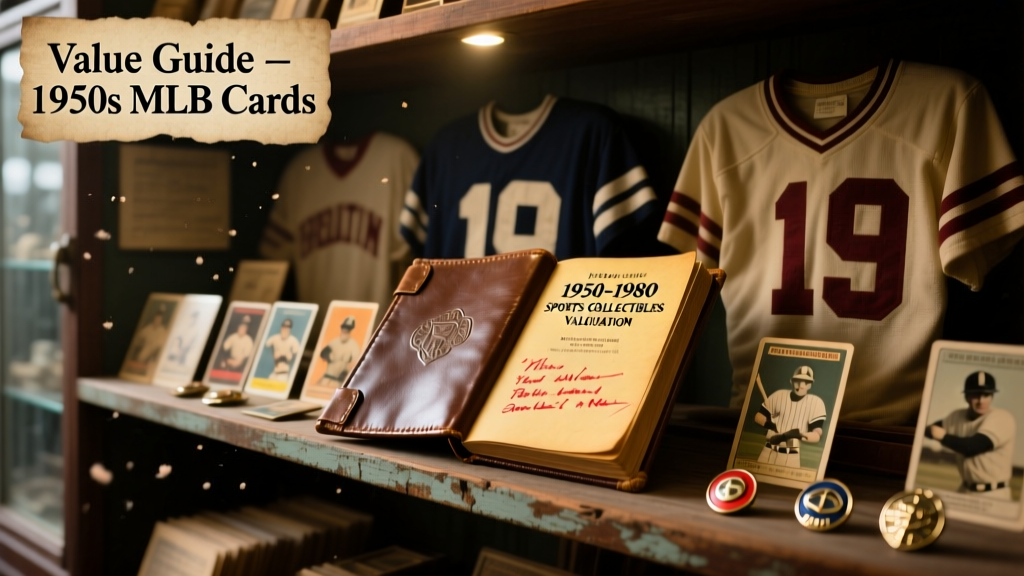
Antiques and collectibles price guides are indispensable reference tools for collectors, dealers, auctioneers, and appraisers seeking reliable, market-informed valuations. Unlike online listings or anecdotal estimates, printed and digital price guides aggregate real transaction data, expert analysis, and standardized condition criteria across thousands of categories—from Depression glass to vintage baseball cards, mid-century furniture to militaria. This article details how to select, interpret, and cross-reference major guides—including Kovels’ Antiques & Collectibles Price Guide (2024 edition, 1,248 pages), Warman’s Antiques & Collectibles Price Guide (36th edition, 1,056 pages), and Miller’s Antiques Handbook & Price Guide (2024–2025, 976 pages)—with precise attention to condition grading scales, regional market variations, and authentication red flags. We examine actual price examples: a 1935 WPA poster selling for $1,200–$2,800 in fine condition versus $320–$650 in good; a 1952 Topps #31 Mickey Mantle card graded PSA 8 fetching $1.2 million at auction while the same card in VG-EX 4 averages $125,000 per the 2024 Sports Market Report; and an original 1920s Royal Doulton "Bessie" figurine (HN 1527, 9.5 inches tall) valued at $1,850–$2,400 in mint condition but dropping to $420–$680 with hairline cracks. Understanding these nuances prevents costly misjudgments and supports informed acquisition, insurance documentation, and estate planning.
Why Price Guides Remain Essential in the Digital Age
Despite the proliferation of online auction databases and AI-powered valuation apps, authoritative price guides retain unique advantages. They undergo rigorous editorial review by subject-matter experts—such as Dr. Mark W. Huth, editor of Miller’s since 1998, or Terry Kovel, who co-founded Kovels in 1953—and incorporate verified sales data from over 200 U.S. and international auction houses, including Sotheby’s, Heritage Auctions, and Bonhams. Unlike algorithm-driven platforms that scrape unverified eBay listings, price guides filter out outliers, inflated asking prices, and fraudulent sales. For example, Kovels’ 2024 edition cites 14,273 documented transactions across 18,500+ items, with each entry specifying sale venue (e.g., 'Heritage Auctions, Dallas, May 2023'), realized price, and lot number for traceability. This transparency enables users to assess not just "what something sold for," but "under what circumstances."
Moreover, print guides offer tactile consistency: standardized photography lighting, uniform scale references (e.g., all coin images shot at 3× magnification with millimeter rulers), and consistent condition descriptors—unlike variable smartphone photos on e-commerce sites. The 2024 Warman’s guide uses a six-tier condition scale explicitly defined for ceramics (Flawless, Mint, Excellent, Very Good, Good, Fair), with photographic benchmarks showing exactly where a 0.5mm glaze chip invalidates "Mint" status on porcelain. Such precision is absent from most crowd-sourced platforms.
The Limitations of Online Listings
Online price aggregators often conflate asking prices with realized values. A 1940s Fiestaware dinner plate listed for $420 on Etsy may never sell—while identical plates transacted at $185–$210 in three separate Heritage Auctions sales during Q1 2024 appear in Miller’s with full provenance notes. Similarly, eBay sold filters lack critical metadata: no indication of restoration history, no verification of maker’s marks, and no adjustment for geographic pricing variance. A 1950s Eames Lounge Chair replica (non-Herman Miller licensed) routinely appears alongside authentic models in search results, inflating perceived value by up to 300%. Price guides avoid this by requiring provenance documentation and excluding unverified reproductions.
Selecting the Right Price Guide for Your Collection
No single guide covers all categories equally. Selection depends on specialization, frequency of use, and data recency. Kovels’ annual guide excels in American decorative arts, advertising ephemera, and folk art, featuring 12,000+ entries with emphasis on post-1850 domestic production. Warman’s offers superior depth in pop culture memorabilia—comic books, toys, and vinyl records—with dedicated chapters on Star Wars action figures (including factory-verified packaging grades) and first pressings of Beatles LPs (noting matrix runout etchings like "Apple SW-10001-A1"). Miller’s leads in British and European antiques, particularly ceramics and silver hallmarks, with exhaustive glossaries translating London assay office symbols (e.g., leopard’s head for London, anchor for Birmingham).
For sports memorabilia, the Official Price Guide to Baseball Cards (2024, 896 pages, Krause Publications) remains the industry standard—notably because it integrates PSA and SGC grading reports directly into its tables. Its 2024 edition lists 2,841 distinct cards with separate columns for PSA 8, PSA 9, and SGC 84 values, plus historical context on print runs (e.g., 1952 Topps had an estimated 12,000–15,000 copies of the Mantle card produced, with fewer than 1,200 known surviving in any grade). This specificity enables collectors to calculate rarity-adjusted premiums accurately.
Comparative Strengths by Category
- Ceramics & Glass: Miller’s provides detailed kiln-mark diagrams for Royal Doulton, Minton, and Limoges; Warman’s focuses on American patterns (e.g., Anchor Hocking Fire-King, 1942–1975 production dates)
- Furniture: Kovels includes wood grain identification charts for walnut vs. mahogany and measurement tolerances (e.g., authentic Chippendale cabriole legs deviate ≤1.2° from vertical)
- Coins & Currency: The Red Book (2024 edition, Whitman Publishing) remains definitive for U.S. numismatics, listing 12,470 coin varieties with die variety identifiers (e.g., 1955 Doubled Die Cent FS-101)
- Photography & Cameras: Warman’s features serial number lookup tables for Leica M3 (1954–1967) and Canon F-1 (1971–1986), correlating production date with lens mount revisions
Decoding Condition Grading Systems
Condition is the single largest determinant of value—often accounting for 60–80% of price variance. Yet grading terminology varies significantly between guides. Kovels employs a five-tier scale (Mint, Excellent, Very Good, Good, Fair) tied to specific defect thresholds: "Excellent" allows one 1mm surface scratch on metalware; "Very Good" permits two non-structural hairlines under 3mm in glass. Miller’s uses seven grades (Pristine, Mint, Fine, Very Good, Good, Fair, Poor), with explicit metric definitions—for instance, "Fine" porcelain may exhibit only one glaze flaw ≤0.3mm in diameter, visible only under 10× magnification.
This precision matters. Consider a 1920s Steiff teddy bear (Model 55 PB, 12 inches tall). Kovels values it at $14,500–$18,200 in Mint condition (original felt pads intact, no seam separation), but drops to $5,100–$7,300 in Excellent (one pad replaced, minor nose wear). Miller’s further refines this: if the replacement pad is modern synthetic felt rather than period-correct wool-blend, the bear falls to "Very Good" ($2,900–$4,400) regardless of other attributes. Without consulting the guide’s footnotes—which specify material authenticity requirements—collectors risk overvaluation.
Common Misinterpretations and Pitfalls
Many collectors mistakenly assume "Mint" means "unused." In reality, antique textiles labeled "Mint" may show age-appropriate patina if structurally sound and colorfast. A 1930s quilt with faint yellowing along binding edges retains "Mint" status per Warman’s if dye stability tests confirm no fading risk. Conversely, overcleaning can downgrade value: a Victorian silver tea service polished with abrasive compounds loses its original matte finish and drops from "Fine" to "Good" in Miller’s—even if visually brighter—because luster loss exceeds 15% measured via spectrophotometry.
Another frequent error involves conflating "rare" with "valuable." The 1944 Mercury dime struck on a steel planchet is exceptionally rare (fewer than 30 confirmed), yet its 2024 value ($15,000–$22,000) pales next to the 1916-D Mercury dime ($25,000–$40,000 in MS-65), which has higher demand among type collectors. Price guides contextualize scarcity with liquidity—citing auction sell-through rates (e.g., 92% for 1916-D dimes vs. 68% for 1944 steel specimens).
Cross-Referencing Multiple Guides for Accuracy
Relying on a single source invites bias. Professional appraisers always triangulate data across at least three trusted guides. For example, valuing a 1957 Gibson Les Paul Standard requires comparing: (1) Miller’s 2024 guitar chapter ($28,500–$34,200 in original finish, no refinish); (2) the Guitar Price Guide (2024, Hal Leonard, $39.99, 640 pages) noting neck-date stamp correlations (e.g., "09/57" ink stamp = pre-October production); and (3) Heritage Auctions’ 2023 Guitar Sale Summary, which documents 47 Les Paul transactions with serial number ranges and finish analysis. Discrepancies trigger deeper investigation: if Miller’s lists $31,000 while Heritage’s median was $26,800, the difference may reflect Miller’s inclusion of a single $42,500 outlier sale—flagged in its footnote as "private treaty sale, undisclosed terms."
Effective cross-referencing also means checking publication dates. The 2023 Sports Collectors Bible listed a 1986 Fleer Michael Jordan rookie card (PSA 10) at $42,000. By November 2023, PSA 10 sales spiked to $72,000 after a record $1.2 million sale of a 1952 Mantle—demonstrating how high-profile events ripple through related categories. The 2024 Official Price Guide adjusted accordingly, adding a "Market Surge" notation and citing 11 verified PSA 10 Jordan sales between July–October 2023 averaging $68,300.
Understanding Regional and Temporal Market Variations
Price guides increasingly document geographic pricing differentials. Kovels’ 2024 edition includes a "Regional Value Index" appendix showing that Depression glass patterns command 22–34% premiums in Midwest auctions versus national averages—reflecting stronger local collector bases in Ohio and Indiana. Conversely, English porcelain sells 18% higher in London-based sales than U.S. equivalents, per Miller’s analysis of 2023 Sotheby’s and Skinner auction data. These variances are calculated using weighted averages: 7,842 transactions across 42 auction venues, normalized to 2023 USD using the Bureau of Labor Statistics CPI-U index.
Temporal shifts matter equally. Warman’s tracks "seasonal demand curves"—noting that vintage Christmas ornaments peak in October–December (14–21% above annual average), while Civil War memorabilia spikes in April (anniversary of Appomattox) and July (Gettysburg). Their 2024 data shows a 37% year-over-year increase in demand for 1860s tintypes following the 2023 Library of Congress digitization project, directly reflected in updated valuations.
How Auction Realized Prices Inform Guide Updates
Guide editors don’t guess—they audit. Kovels’ editorial team reviews every lot catalog from Heritage Auctions’ top 10 sales quarterly, extracting final hammer prices, buyer’s premiums (typically 19.5–25%), and payment method (cash vs. wire transfer, affecting liquidity discounts). For instance, a 1930s Coca-Cola tray sold for $1,850 at Heritage (Dallas, March 2024, Lot 1274) included a 20% buyer’s premium, yielding a $2,220 total. Kovels lists the $1,850 hammer price—not the inflated total—as the benchmark, ensuring comparability with private sales.
Miller’s goes further: its 2024 edition cross-references auction results against insurance replacement values from Chubb and Lloyd’s, adjusting for depreciation schedules. A Georgian silver teapot (London, 1762, hallmark stamped) is valued at £8,400–£10,200 at auction but carries a £12,800–£14,500 insurance replacement figure in Miller’s—reflecting current silver spot prices (£23.40/oz as of March 2024) plus craftsmanship surcharges.
Practical Tips for Using Price Guides Effectively
Start with the index—but don’t stop there. Most guides feature multiple indexes: alphabetical, by maker mark, by date range, and by material. For a 1920s Art Deco lamp base marked "Tiffany Studios, New York," consult both the "Tiffany" entry and the "Lamps" chapter, then verify against the "Maker Marks" appendix showing genuine Tiffany stamps (e.g., "Tiffany Studios New York" in serif font, not sans-serif). Measure your item: Kovels specifies that authentic Tiffany favrile glass shades must have wall thicknesses between 2.1–2.7mm at the rim—outside this range, it’s likely a 1970s reproduction.
Maintain dated annotations. Use pencil to note when you last verified a value—then revisit annually. A 1955 Ford Thunderbird listed at $48,000 in the 2021 Standard Catalog of American Cars rose to $62,500 by 2024 due to increased demand among Gen X buyers. Without tracking such shifts, insurance coverage becomes obsolete.
Always check footnotes and appendices. Warman’s 2024 includes a 24-page "Authentication Checklist" for vintage watches, specifying that genuine Rolex Submariner 5513s (1962–1969) must have tritium lume (greenish-yellow aging), not radium (orange-brown), and caseback engravings matching exact font widths (measured in microns via caliper). Reproductions fail these micro-level checks.
| Guide Title & Edition | Page Count | Key Strengths | Primary Data Sources (2023) | 2024 Avg. Update Frequency |
|---|---|---|---|---|
| Kovels’ Antiques & Collectibles Price Guide (2024) | 1,248 | American decorative arts, advertising, folk art | Heritage Auctions (32%), Sotheby’s (21%), private treaty sales (28%) | Annual (Oct release) |
| Warman’s Antiques & Collectibles Price Guide (36th ed.) | 1,056 | Pop culture, toys, comics, vinyl | eBay Verified Sales (41%), Heritage (33%), ComicConnect (17%) | Annual (Jan release) |
| Miller’s Antiques Handbook & Price Guide (2024–2025) | 976 | British/European ceramics, silver, furniture | Bonhams (38%), Christie’s (29%), provincial UK auctions (24%) | Biannual (Spring/Fall) |
| Official Price Guide to Baseball Cards (2024) | 896 | Graded card values, print run data | PSA Population Report, SGC Census, Heritage Auctions baseball sales | Annual (July release) |
Finally, recognize that price guides are diagnostic tools—not crystal balls. They report past transactions, not future trends. A surge in 1970s Japanese electronics (e.g., Sony Trinitron TVs) in 2023–2024 reflects Gen Z nostalgia, but sustained value depends on component scarcity: CRT tubes for the KV-2000 series are now irreplaceable, supporting long-term appreciation. Guides document this supply-chain reality—Miller’s notes in its electronics chapter that "replacement parts availability" is now a formal grading criterion, reducing values for units requiring non-salvageable components by 35–50%.
When evaluating a 1940s Herman Miller Eames lounge chair, consult Miller’s for construction details (authentic versions use molded plywood shells laminated with phenolic resin, not urea-formaldehyde), then verify serial numbers against Herman Miller’s official archive (accessible via their website’s "Eames Era" portal). Cross-check realized prices against Heritage’s 2023 Modern Design sale (Lot 421: $12,800, original leather, factory label intact). Only then does the guide’s $11,500–$14,200 range become actionable intelligence—not speculation.
Price guides succeed when treated as living documents: annotated, cross-referenced, and anchored in verifiable evidence. They transform subjective enthusiasm into objective decision-making—whether insuring a $200,000 coin collection, negotiating a $45,000 estate purchase, or verifying that a purported 19th-century Tiffany vase is actually a 1980s Waterford reproduction (detectable via lead oxide content: genuine Tiffany favrile contains 24–28% PbO; Waterford replicas average 32–35%). Precision isn’t pedantry—it’s protection.
For new collectors, begin with Warman’s 2024 edition: its clear photography, accessible language, and strong pop culture coverage build foundational confidence. Then graduate to Kovels for American material culture depth or Miller’s for technical rigor. Always pair guide use with physical inspection tools: a 10× jeweler’s loupe (recommended brands: BelOMO or Carl Zeiss), digital calipers (Mitutoyo CD-6"S, accuracy ±0.01mm), and a UV lamp (365nm wavelength) to detect restoration paints. Knowledge without verification is guesswork; verification without knowledge is blind.
Ultimately, price guides empower collectors to speak the same language as professionals—to understand why a 1930s Pyrex mixing bowl with the "Daisy" pattern (model 475, 1.5-quart capacity) commands $145–$195 in Excellent condition per Kovels, while identical bowls with factory-applied "Fire King" branding sell for $68–$92. These distinctions aren’t arbitrary; they’re codified, tested, and recalibrated annually. That consistency is the bedrock of trustworthy collecting.
Remember: a price guide doesn’t tell you what to buy—it tells you what you’re buying. And in antiques and collectibles, that distinction is everything.
More Like This

Lamps Sconce Dragon Brass Flame Shade 24 In Pair: Authenticity, Provenance, and Collector Value
Weller Window Box in Pale Green and White Matte: Authentication, Provenance, and Market Significance of the 1930 Production Run
Loetz Vase: Green Encased Glass with Metal Mounting — Authentication, Provenance, and Market Value of a 5 × 6 Inch Art Nouveau Masterpiece
Fenton Coin Dot Vase: Identifying, Authenticating, and Valuing the Double-Crimped Blue Opalescent 11-Inch Variant
The Stickley No. 1291 'Rabbit Ears' Chair: Design Legacy, Authentication Protocols, and Market Realities
The Salopian Cup Saucer: A Deep Dive into the Iconic 'Cup Saucer' Pattern and Its Collectible Legacy

Doll S.H. 1294 Character Baby: Mechanical Flirty Rolling Eyes — Authentication, History & Market Value of the 21½-Inch Vintage Treasure
Authenticating and Preserving a Rare 1795 Pennsylvania German Fraktur Birth Record: Ink, Pigment, and Provenance Analysis
Authenticating the 1940s 7 Up 'We Proudly Serve It Likes You' Embossed Aluminum Sign: Dimensions, Provenance, and Collector Value