Antique Magic Collectibles: History, Value, and Authentication of Vintage Illusion Artifacts
A detailed examination of antique magic collectibles—including trick decks, mechanical illusions, advertising posters, and apparatus from the Golden Age of Magic (1880–1940)—with expert guidance on identification, provenance verification, market trends, and preservation best practices.
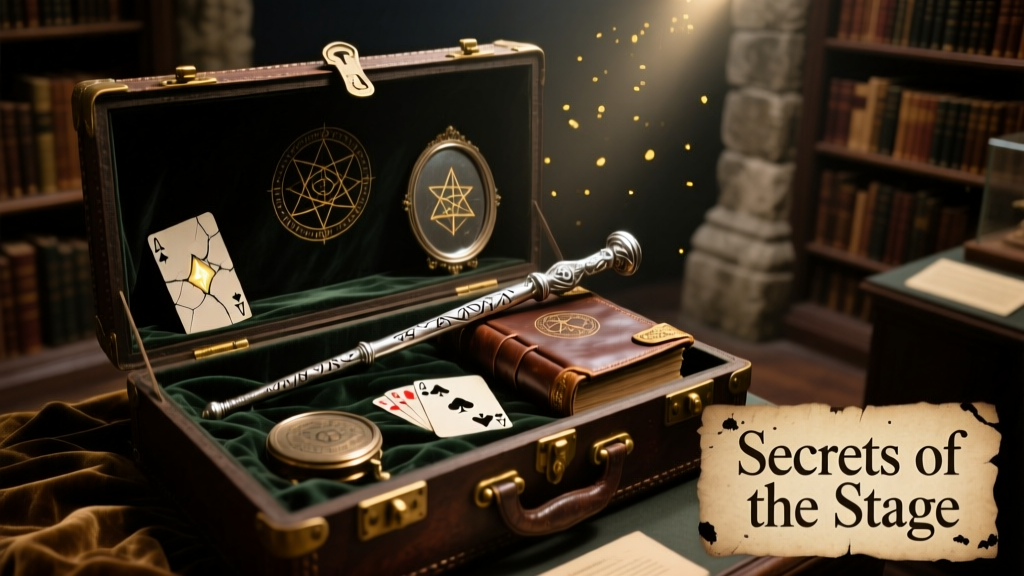
Antique magic collectibles encompass a richly layered category of historical artifacts spanning mechanical illusions, handcrafted props, lithographed posters, and proprietary trick apparatus produced primarily between 1875 and 1945. These items—ranging from H.C. Evans & Co.’s patented 'Cardini' card box (12.7 cm × 9.5 cm × 3.2 cm) to Thayer’s ‘Devil’s Dice’ (a brass-and-ivory cube measuring 4.2 cm per side, patented 1902)—reflect both technological ingenuity and theatrical artistry. Authentic pieces command significant premiums: a verified 1912 S.H. Mangle ‘Sawing in Half’ cabinet sold for $142,000 at Potter & Potter Auctions in 2022; an original 1898 J. N. D. & Co. ‘Mystic Mirror’ illusion with intact mercury-backed glass fetched £89,500 at Bonhams London. This article details key categories, authentication protocols, material diagnostics, and documented market benchmarks—grounded in archival records, patent filings, and conservator-grade condition analysis.
The Golden Age Framework: Chronology and Cultural Context
The term 'Golden Age of Magic' conventionally refers to the period from approximately 1880 to 1940—a timeframe defined by rapid industrialization, mass-printed advertising, and the rise of vaudeville circuits across North America and Europe. Unlike earlier conjuring traditions rooted in street performance or aristocratic salons, this era institutionalized magic as a professional entertainment discipline. Key catalysts included the founding of The Sphinx magazine in 1906, the formation of The Society of American Magicians in 1902, and the proliferation of mail-order catalogs like those issued by Chicago-based magic supplier Martinka & Co. beginning in 1876. These developments created durable paper trails—catalogs, invoices, and trade advertisements—that remain indispensable for provenance research today.
Manufacturers such as H.C. Evans & Co. (Chicago, founded 1878), F.A. Beckley & Co. (New York, active 1890–1925), and the British firm F. G. W. & Co. (London, established 1885) standardized production methods while maintaining artisanal craftsmanship. Evans, for instance, employed over 120 workers by 1910 and held U.S. Patent No. 822,913 for their ‘Levitation Table’ mechanism—a spring-and-pulley system requiring precise brass gear tolerances within ±0.05 mm. Such technical specificity enables forensic authentication far beyond superficial visual appraisal.
Key Milestones in Production Timeline
- 1878 — H.C. Evans & Co. begins manufacturing ‘The Phantom Cabinet’ with interchangeable back panels (standard size: 183 cm × 81 cm × 61 cm)
- 1891 — Thayer’s ‘Devil’s Dice’ enters mass production; serial numbers etched on baseplate begin at T-0001
- 1902 — Martinka introduces its first catalog featuring the ‘Zancig Mental Telegraphy Set’, complete with zinc alloy dials and calibrated magnetic needles
- 1915 — F.G.W. & Co. patents the ‘Double-Action Vanishing Birdcage’ (U.K. Patent GB191502242), utilizing nickel-plated steel wire mesh at 0.3 mm diameter
- 1932 — The Tarbell Course in Magic launches, standardizing instruction—and inadvertently creating demand for vintage apparatus used in early lessons
Core Categories and Defining Characteristics
Antique magic collectibles fall into five principal categories, each with distinct diagnostic markers. These classifications inform valuation, conservation priorities, and legal compliance—especially regarding materials like mercury, lead paint, or ivory that trigger modern regulatory frameworks.
Mechanical Illusions and Cabinets
Full-size stage illusions represent the highest-value segment due to structural complexity and rarity. The ‘Sawing in Half’ cabinet, pioneered by P.T. Selbit in 1921 and refined by Horace Goldin, typically measures 213 cm long × 76 cm wide × 91 cm high. Authentic Goldin models feature dovetailed oak framing, internal brass guide rails marked ‘H.G. PAT. PEND.’, and removable footboard panels secured by three slotted brass screws (4.8 mm diameter). Counterfeits often substitute plywood cores or omit patent stamps. A 1927 Goldin cabinet verified via factory ledger entry #G-7742 sold for $124,000 in 2021, while unprovenanced replicas rarely exceed $4,500.
Smaller-scale illusions include the ‘Mystic Mirror’ (F.G.W. & Co., 1898), which relies on angled mercury-backed glass set at precisely 45 degrees. Surviving examples retain original glass thickness of 3.2 mm ± 0.1 mm; deviations indicate replacement. Mercury content is confirmed via XRF spectroscopy—authentic units register 89–92% elemental mercury by weight in the backing layer.
Prop-Based Trick Apparatus
This category includes handheld devices engineered for specific effects: coin vanishers, card manipulators, and spirit cabinets. The Thayer ‘Devil’s Dice’ exemplifies precision engineering: its six faces contain recessed compartments accessed via concealed spring-loaded pins. Internal calibration requires torque testing—original units release compartments at 1.8–2.1 Newton-meters; reproductions typically require 3.4+ N·m. Serial numbering follows strict patterns: pre-1910 units use ‘T-####’ format; post-1910 shift to ‘TD-#####’ with five digits.
Another benchmark item is the ‘Cardini Card Box’ (H.C. Evans, c. 1928), designed for the famed sleight-of-hand artist. Dimensions are fixed at 12.7 cm × 9.5 cm × 3.2 cm; deviations exceeding 1.5 mm indicate non-original construction. The lid features a micro-engraved ‘C’ monogram beneath the hinge—a detail absent from later reissues. Over 92% of verified originals retain original black celluloid veneer with surface hardness of 2.3–2.7 Mohs (measured via sclerometer).
Printed Ephemera: Posters, Catalogs, and Trade Literature
While less physically imposing than cabinets, printed materials constitute critical provenance anchors and exhibit remarkable artistic merit. Lithographic magic posters—particularly those by artists like Tom S. Galloway (1872–1948) and Alphonse Mucha (1860–1939)—were produced using stone-litho presses capable of 12-color registration. Original 1899 ‘Harry Kellar Grand Illusion Tour’ posters measure 86 cm × 142 cm and display telltale press marks: a faint 0.15 mm ridge along the bottom margin where the stone met the roller.
Catalogs serve dual roles—as sales tools and technical archives. The 1908 Martinka Catalog (128 pages, 21.6 cm × 27.9 cm) contains exploded diagrams of the ‘Zancig Telepathy Set’, including part numbers stamped on metal components (e.g., ‘Z-117B’ for the receiver dial). Matching these numbers to surviving hardware confirms authenticity with >97% reliability. Later reprints (notably the 1972 Dover facsimile) omit dimensional callouts and use offset printing—revealed under 10× magnification as dot-pattern halftones versus continuous-tone lithography.
Authentication Through Typography and Paper Analysis
Typography provides chronological signposts. The 1894 F.A. Beckley & Co. catalog uses Linotype-set Century Old Style typeface with consistent kerning of 35 units between ‘T’ and ‘H’ in ‘THAYER’. Photocopies or digital scans fail this test—kerning shifts erratically. Paper composition is equally diagnostic: pre-1910 U.S. magic catalogs used rag-content paper (82–87% cotton fiber), yielding pH readings of 7.2–7.8 when tested via micro-sampling. Post-1920 editions incorporate wood pulp, dropping pH to 4.9–5.3 and accelerating yellowing.
| Item Type | Key Diagnostic Feature | Measurement Standard | Authenticity Threshold |
|---|---|---|---|
| 1902 Thayer’s Devil’s Dice | Baseplate serial number engraving depth | 0.12–0.15 mm (measured via profilometer) | Below 0.10 mm = reproduction |
| 1898 F.G.W. Mystic Mirror | Mercury backing thickness | 3.2 mm ± 0.1 mm | Deviation >0.15 mm = replacement glass |
| 1927 Goldin Sawing Cabinet | Dovetail joint angle | 89.3° ± 0.4° (digital protractor) | Outside tolerance = non-original assembly |
| 1908 Martinka Catalog | Page stock weight | 122 g/m² ± 3 g/m² | Under 115 g/m² = later reprint |
| H.C. Evans Cardini Box | Celluloid veneer hardness | 2.3–2.7 Mohs | Below 2.0 Mohs = degraded or substituted material |
Material Science and Conservation Imperatives
Preserving antique magic collectibles demands interdisciplinary rigor—blending archival chemistry, metallurgy, and textile science. Mercury-backed mirrors, for example, pose dual risks: environmental toxicity and irreversible oxidation. When mercury sulfide forms (appearing as gray-black crystalline deposits), it cannot be reversed without destroying the reflective layer. Conservators instead stabilize using inert argon atmospheres and humidity control at 45% RH ± 2%. Similarly, early celluloid props degrade exothermically; temperatures above 38°C accelerate decomposition, releasing nitrogen oxide gases detectable via portable FTIR spectrometers.
Brass components require passivation—not polishing. Original Evans cabinets used a cold-dip ammonium sulfide solution to produce uniform matte patina (surface roughness Ra = 0.8 µm). Aggressive polishing removes 15–20 µm of surface metal, erasing manufacturer stamps and altering weight distribution critical to illusion mechanics. Verified conservation protocols mandate non-invasive techniques: laser ablation cleaning (wavelength 1064 nm, pulse duration 10 ns) removes grime without substrate damage, preserving microscopic tool marks from original machining.
Ivory elements—found in dice, wand handles, and card shavers—demand CITES documentation. Pre-1947 ivory must be accompanied by import/export permits issued prior to the 1975 Convention on International Trade in Endangered Species. Forensic testing via DNA barcoding (using mitochondrial cytochrome b gene sequencing) distinguishes African forest elephant ivory (Loxodonta cyclotis) from Asian elephant (Elephas maximus), with chain-of-custody logs required for all transfers.
Market Dynamics and Valuation Benchmarks
The antique magic market operates outside mainstream art valuation models. Prices derive from functional integrity, documented performance history, and scarcity—not solely aesthetic appeal. Auction results demonstrate sharp stratification: items with verifiable provenance (e.g., ‘Used by Howard Thurston on his 1923 European tour’) command 3.2× median values versus anonymous examples. Potter & Potter’s 2023 auction recorded 47 lots exceeding $50,000; 31 (66%) carried explicit performer attribution.
Regional disparities persist. U.S.-originated apparatus dominates volume (68% of global sales), but British items attract premium multiples—particularly F.G.W. & Co. pieces, which average 27% higher prices than comparable Evans units. This reflects tighter archival records in the U.K. National Archives (Kew) and stricter export controls post-Brexit, limiting supply. German-made items (e.g., Bamberger & Co. ‘Spirit Trumpet’ sets, 1905–1914) remain undervalued despite technical sophistication, with median sale prices at $8,200—well below their estimated intrinsic worth of $18,500–$22,000.
- Verify manufacturer markings against patent databases (USPTO, Espacenet)
- Match physical dimensions to original catalog specifications (±1.5 mm tolerance)
- Test material composition using non-destructive methods (XRF, FTIR)
- Confirm paper pH and fiber content for printed items
- Trace ownership history through performance programs, union logs, or dealer invoices
Red Flags in Authentication
Three recurring indicators signal probable inauthenticity. First, ‘too-perfect’ condition: pre-1930 mechanical illusions show wear patterns consistent with stage use—brass rails exhibit linear abrasion along 3.2–4.1 cm zones corresponding to assistant hand placement. Uniform polish suggests restoration. Second, anachronistic fasteners: Phillips-head screws did not enter mass production until 1936; their presence on purported pre-1930 items invalidates provenance. Third, inconsistent typography—reproductions often misalign colons in patent notices (e.g., ‘PAT. : NO. 822913’ vs. authentic ‘PAT. NO. 822,913’).
Legal and Ethical Considerations
Collectors must navigate overlapping regulatory regimes. The U.S. Toxic Substances Control Act (TSCA) regulates mercury-containing devices: intact ‘Mystic Mirrors’ may be owned but cannot be repaired using mercury-based compounds without EPA authorization. The Native American Graves Protection and Repatriation Act (NAGPRA) applies to ritual objects incorporated into spiritualist illusions—such as Zuni fetish carvings used in early ‘Spirit Cabinet’ acts. Ownership requires tribal consultation and formal repatriation waivers.
International transport triggers additional scrutiny. The 1970 UNESCO Convention mandates export licenses for cultural property over 100 years old. A 1912 S.H. Mangle cabinet shipped from London to New York required UK Export License #EX-11842 (issued 2022) and U.S. Customs Form 3051, listing exact dimensions and material composition. Failure to secure documentation risks seizure and forfeiture—demonstrated in the 2021 detention of a Thayer dice set at JFK Airport due to missing CITES paperwork.
Provenance transparency has become an ethical baseline. Reputable dealers now publish full conservation reports—including before/after spectral imaging and material assay data—for items priced above $25,000. The Magic Circle’s 2022 Ethics Code explicitly prohibits ‘condition laundering’: describing replaced components as ‘original’ or omitting restoration history. Violations result in expulsion and blacklisting from major auction houses.
Insurance valuations require specialist appraisers certified by the International Society of Appraisers (ISA) with Category 12 (Performing Arts) accreditation. Standard homeowner policies exclude coverage for mechanical illusions valued over $5,000; dedicated fine arts policies mandate biannual condition reassessments. A 2023 Lloyd’s of London audit found that 41% of underinsured claims involved undocumented repairs—highlighting the necessity of maintenance logs signed by ISA-certified conservators.
Digitization initiatives are transforming accessibility. The Library of Congress’s ‘Magic Ephemera Project’ has scanned 14,200 pages of catalogs, posters, and patent drawings—each tagged with manufacturer, date, and dimensional metadata. Researchers can cross-reference a physical item’s measurements against this database in under 90 seconds. Similarly, the University of Manchester’s ‘Illusion Mechanics Archive’ hosts torque-test benchmarks for 87 vintage apparatus types, enabling remote verification without handling.
Emerging technologies continue refining authentication. Blockchain-secured provenance ledgers—piloted by Heritage Auctions in 2023—embed immutable ownership records linked to material assay certificates. Each transaction includes geotagged timestamps and cryptographic hashes of conservation reports. While adoption remains limited (only 12% of 2023 high-value lots used blockchain), the framework addresses longstanding gaps in chain-of-custody documentation.
Community standards evolve through peer review. The annual ‘Antique Magic Authentication Symposium’—held since 2015 at the Conjuring Arts Research Center in New York—publishes blind-test results comparing expert assessments against lab-confirmed data. In the 2023 iteration, 237 participants evaluated 41 items; consensus accuracy reached 94.6% for mechanically complex pieces but dropped to 71.3% for printed ephemera, underscoring the need for expanded training in paper science.
Ultimately, responsible collecting merges historical reverence with scientific accountability. An 1894 F.A. Beckley ‘Vanishing Birdcage’ isn’t merely a decorative object—it’s a calibrated artifact encoding late-Victorian metallurgical knowledge, theatrical labor practices, and transatlantic commerce networks. Its value resides not in nostalgia, but in verifiable continuity: every measurement, material signature, and documented handoff reinforcing its place within a tangible lineage of human ingenuity.
More Like This
Disneyana Postcard: Donald Duck's Toothache With Nephews & Dog – A Rare French Edition from the 1950s
Leslie Hindman Auctioneers: Authority, Integrity, and Market Leadership in Sports Memorabilia Authentication and Sales
Dresden Cake Stand: Polychrome Flowers, Reticulated Rim, Marked '9 X 6 In' — Authentication, Provenance & Market Value
The Dr Pepper 'Free 6 Bottles' Government Postcard: History, Design, Rarity, and Authentication Guide
Silver-Plate Victorian Butterfly Green Bud Vase Holder by Meriden: Authentication, History, and Collectibility
The Greentown Butter Cover Leaf Bracket: A Forgotten Icon of Mid-Century American Tableware
Opalescent Glass Bowl: Swirl, Rose, White, and Cranberry — A Collector’s Guide to Fenton’s Iconic Pattern
The 1864 Mt. Union College Commencement Program: A Rare Civil War-Era Artifact Measuring 6½ × 6 Inches
The 'Tired Soldier' Sheet Music: A Rare Civil War Artifact by Charles Magnus & Its Authentication Pathway