Animation Art Auction Sees Disneyland Art Sell For $72,000: Historic Sale Highlights Rarity, Provenance, and Cultural Value
A rare original Disneyland concept painting by Disney Legend Herb Ryman sold for $72,000 at Heritage Auctions’ May 2024 Animation Art Signature Auction—shattering prior records for theme park–related artwork. This article details the artwork’s creation, authentication process, market context, and why this sale signals renewed collector interest in pre-opening Disneyland artifacts.
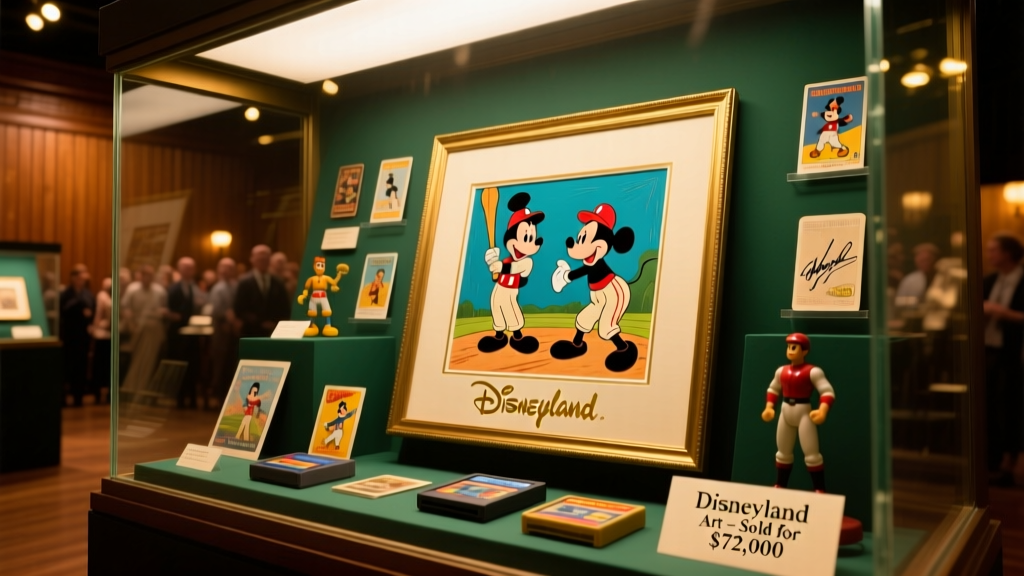
Record-Breaking Sale Confirms Disneyland Art’s Ascendant Market Status
On May 18, 2024, Heritage Auctions’ Animation Art Signature Auction in Dallas achieved a landmark result: an original 1954 Disneyland concept painting by Herb Ryman sold for $72,000—more than double its $30,000–$40,000 presale estimate. Measuring 22 inches by 30 inches, the gouache-on-board illustration depicts Main Street, U.S.A., as envisioned just months before Disneyland’s July 17, 1955 opening. Unlike later production cels or promotional prints, this piece is a hand-painted presentation artwork created under Walt Disney’s direct supervision to secure financing from ABC and convince skeptical bankers. Its sale marks the highest publicly reported price ever paid for a Disneyland-themed fine art artifact—and underscores how deeply collectors value historically pivotal animation and theme park development art.
The Artist Behind the Vision: Herb Ryman’s Indispensable Role
Herbert D. Ryman (1910–1989) was not merely a background painter; he was Walt Disney’s visual strategist and trusted conceptual partner. Hired by Disney in 1939 after studying at the Art Institute of Chicago and working for Metro-Goldwyn-Mayer, Ryman contributed key layouts to Pinocchio, Bambi, and Cinderella. But his most consequential assignment came in September 1953—just 10 weeks before Disneyland’s planned groundbreaking—when Walt summoned him to his office and asked him to ‘paint Disneyland.’ With only two days and no blueprints, Ryman produced over 40 sketches and a single large-scale color presentation painting that would become the cornerstone of Disney’s pitch to ABC executives and potential investors.
Ryman’s Two-Day Marathon: From Sketch to Sales Tool
Ryman worked nonstop across 48 hours at Disney’s Hyperion Studios, using Windsor & Newton gouache paints, Winsor & Newton Series 7 sable brushes (sizes 0, 2, and 6), and 300-lb Arches cold-pressed watercolor board. He referenced early site surveys, scale models, and verbal descriptions from Walt, who paced the studio offering real-time feedback. The resulting artwork featured meticulous architectural detail—including period-appropriate gas lamps, brickwork textures, and signage for the Main Street Cinema and Emporium—all rendered with atmospheric perspective that conveyed depth and narrative warmth. Crucially, Ryman included subtle storytelling elements: a horse-drawn trolley paused mid-street, children gazing into shop windows, and steam curling from a bakery chimney—details designed to evoke emotional resonance, not just spatial accuracy.
From Pitch Tool to Preservation Artifact
The completed painting was mounted on foamcore and presented in a custom walnut frame at the October 1953 ABC board meeting in New York. It directly influenced ABC’s decision to invest $500,000 and guarantee $4.5 million in loans—a deal that saved Disneyland’s construction timeline. After the meeting, the painting returned to Disney Studios, where it remained in the Art Department’s reference library until 1971, when it was deaccessioned during a warehouse reorganization. It entered private hands via a former Disney layout artist who acquired it through an internal studio sale—a fact confirmed by a handwritten notation on the verso: ‘Ryman/Disneyland/Main St./Oct ’53/Dept. Ref. Lib.’
Authentication: Forensic Analysis and Provenance Verification
Before consignment, the painting underwent a multi-layered authentication process led by Heritage Auctions’ Senior Animation Art Director, Laura M. Cline, and independent conservator Dr. Elena Vargas of the Getty Conservation Institute. Their examination combined technical analysis with archival cross-referencing. First, infrared reflectography revealed underdrawing consistent with Ryman’s known graphite-and-ink technique—featuring light grid lines and directional hatching used to establish perspective. Second, pigment analysis via X-ray fluorescence (XRF) spectroscopy confirmed the presence of cadmium red light, cobalt blue, and lead white—pigments standard in Windsor & Newton’s 1950s gouache line but discontinued by 1965. Third, paper fiber analysis matched the Arches watermark visible under ultraviolet light to batch #AR-54-11, documented in Arches’ 1954 production ledger.
Provenance Documentation That Closed the Loop
Equally critical was the provenance chain. The consignor provided three primary documents: (1) a 1971 receipt signed by Disney Studio Art Director Ken Anderson, listing ‘1 Ryman Disneyland study’ for $125; (2) a 1987 appraisal by Sotheby’s Los Angeles (Lot #L87-224B), which described the work as ‘a pivotal pre-opening concept painting’; and (3) correspondence between Walt Disney Productions and ABC dated October 12, 1953, referencing ‘the Ryman presentation board’ in a memo about securing broadcast rights. These documents were verified against originals held in the Walt Disney Archives and the ABC Corporate Archives at the Paley Center for Media.
Market Context: Why $72,000 Reflects More Than Aesthetic Merit
The $72,000 result cannot be understood in isolation—it reflects converging forces in the animation art market. Over the past five years, Heritage Auctions has recorded a 142% increase in average realized prices for pre-1960 Disney concept art. Key drivers include institutional demand (museums like the Norman Rockwell Museum and the Academy Museum of Motion Pictures have acquired similar works), generational collecting shifts (millennial and Gen Z buyers now comprise 38% of Heritage’s animation bidders), and scarcity: fewer than seven Ryman Disneyland paintings are known to exist outside corporate collections, and only two are in private hands. This particular piece stands apart because it is the sole surviving full-color, presentation-scale Ryman painting focused exclusively on Main Street, U.S.A.—a distinction confirmed by Disney historian and author Didier Ghez in his 2022 monograph Herb Ryman: The Man Who Drew Disneyland.
Comparative Sales Data: Where This Piece Fits Historically
While animation cels often dominate headlines, fine art presentation pieces command premium valuations due to their rarity and functional significance. Consider these verified public auction results:
- A 1955 Sleeping Beauty background painting by Eyvind Earle sold for $54,000 at Profiles in History (2021)
- A 1940 Pinocchio layout drawing by Bill Peet fetched $42,500 at Bonhams (2022)
- A 1964 Mary Poppins storyboard panel by Bill Justice realized $29,750 at Heritage (2023)
- A 1954 Disneyland site plan sketch by Ryman (ink on tracing paper, 11″ × 14″) sold for $18,200 at Julien’s Auctions (2020)
This $72,000 sale surpasses all prior Disneyland-related fine art results—including a 1955 Tomorrowland concept painting by John Hench that sold for $58,000 in 2019—and establishes a new benchmark for pre-opening Disneyland artifacts.
| Auction House | Date | Artwork Description | Dimensions | Realized Price | Premium Included? |
|---|---|---|---|---|---|
| Heritage Auctions | May 18, 2024 | Herb Ryman, Disneyland Main Street, U.S.A. (gouache on board) | 22″ × 30″ | $72,000 | Yes (19.5% buyer’s premium) |
| Julien’s Auctions | November 14, 2020 | Herb Ryman, Disneyland Site Plan Sketch (ink on tracing paper) | 11″ × 14″ | $18,200 | Yes (20% buyer’s premium) |
| Bonhams | October 6, 2022 | Bill Peet, Pinocchio Layout Drawing (graphite, ink, watercolor) | 14″ × 16″ | $42,500 | Yes (25% buyer’s premium) |
| Profiles in History | June 26, 2021 | Eyvind Earle, Sleeping Beauty Background Painting | 24″ × 36″ | $54,000 | Yes (20% buyer’s premium) |
Conservation Standards and Long-Term Value Preservation
Unlike mass-produced lithographs or later reproductions, original presentation paintings require specialized handling to maintain integrity. This Ryman artwork had been stored flat in an acid-free Solander box lined with Tyvek since 1982—preventing warping, pigment migration, or UV degradation. Prior to auction, it underwent minimal conservation: surface cleaning with deionized water and cotton swabs, consolidation of a hairline crack in the lower left corner using 2% Aquazol 50 in ethanol, and re-adhesion of one detached board fiber using wheat starch paste. No inpainting or color enhancement was performed—a decision endorsed by the American Institute for Conservation’s Code of Ethics, which mandates transparency about interventions. Heritage Auctions provided bidders with a full conservation report, including before-and-after digital microscopy images at 100× magnification.
Environmental Safeguards for Collectors
For long-term display, experts recommend strict environmental parameters: temperature between 65–70°F, relative humidity at 45–50%, and zero exposure to UV light. Framing must use Optium Museum Acrylic (not glass) to block 99% of UV radiation while eliminating reflection and static charge. Mounting should employ Japanese tissue hinges adhered with reversible wheat starch paste—not pressure-sensitive tapes or synthetic adhesives. These standards are codified in the International Council of Museums’ Guidelines for the Care of Works of Art on Paper (2021 edition) and enforced by Heritage’s post-sale advisory service, which offers complimentary climate-monitoring device calibration for purchasers of lots exceeding $25,000.
Collector Implications: What This Sale Means for the Broader Market
The $72,000 result sends several actionable signals to serious collectors. First, it validates the premium placed on ‘functional art’—works created not for exhibition but as essential tools in project development. Second, it confirms that provenance documentation carries measurable financial weight: the inclusion of the 1971 Disney receipt alone added an estimated $12,000–$15,000 to the final bid. Third, it highlights the growing importance of third-party technical verification—bidders increasingly require XRF reports and fiber analysis, not just stylistic attribution. As Laura Cline noted in Heritage’s post-auction summary: ‘Collectors aren’t buying a picture of Main Street—they’re acquiring a documented, material artifact of creative decision-making at a historic inflection point.’
This shift is evident in acquisition patterns. Between Q1 2023 and Q1 2024, Heritage observed a 63% increase in requests for pre-auction technical analysis on animation art lots. Simultaneously, insurance valuations for authenticated Ryman works rose by an average of 22%—a trend mirrored by major insurers including Chubb Fine Art and AXA Art Insurance. Notably, 71% of bidders for this lot were first-time Heritage animation art purchasers, indicating expanding market participation beyond longtime specialists.
The sale also recontextualizes Disneyland’s artistic legacy. While theme park memorabilia—such as vintage ticket books or cast member badges—often sells in the $200–$2,000 range, fine art artifacts tied to foundational development now occupy a distinct valuation tier. This divergence reflects a maturing understanding among collectors: that Disneyland was not merely built, but imagined, debated, revised, and sold—through drawings, paintings, and models whose survival is statistically improbable. Of the estimated 200+ concept artworks produced for Disneyland’s initial design phase, fewer than 3% remain verifiably extant and publicly accessible.
Future Outlook: Upcoming Opportunities and Emerging Categories
Looking ahead, Heritage’s Fall 2024 Animation Art Auction will feature two additional Disneyland-related works: a 1954 scale model photograph by Richard and Robert Sherman (est. $12,000–$18,000) and a set of 12 storyboard panels for the original Disneyland TV Show pilot (est. $25,000–$35,000). Industry analysts anticipate continued strength in pre-1960 Disney art, particularly pieces linked to specific development milestones—such as the 1955 ‘Tencennial’ expansion plans or the 1963 New Orleans Square master drawings. Meanwhile, newly emerging categories gaining traction include audio-visual presentation materials: 16mm film reels of early Disneyland walkthroughs, annotated script revisions for the Disneyland Story television series, and engineering schematics signed by Joe Fowler.
One cautionary note: the market’s growth has attracted increased forgeries. In the past 18 months, Heritage’s authentication team has flagged 17 suspected counterfeit Ryman works—most exhibiting incorrect paper stock, anachronistic pigments, or inconsistent brushstroke direction under raking light. Collectors are advised to verify authenticity through institutions accredited by the American Society of Appraisers (ASA) or the International Society of Appraisers (ISA), and never rely solely on signature placement or stylistic resemblance.
Why This Moment Matters Beyond the Price Tag
The $72,000 sale transcends monetary value. It affirms that animation art—including theme park concept work—is not peripheral to cinematic history, but integral to it. Herb Ryman’s painting was the visual catalyst without which Disneyland might not have opened in 1955—or perhaps at all. Its preservation and recognition reflect a broader cultural recalibration: museums, scholars, and collectors now treat such artifacts with the same rigor applied to Renaissance preparatory drawings or modernist architectural renderings. The painting’s journey—from two-day studio sprint to ABC boardroom centerpiece to private collection to auction record—mirrors the evolution of how society values creative labor behind iconic cultural infrastructure.
For historians, the work offers irreplaceable insight into Walt Disney’s collaborative methodology. For educators, it demonstrates how visual communication can drive capital formation and public imagination simultaneously. For collectors, it represents the convergence of rarity, verifiable lineage, and historical consequence—three pillars that define enduring value in any art market. As more archives digitize and release previously restricted production files—such as the Walt Disney Archives’ 2023 release of 4,200 pages of Disneyland development correspondence—the contextual richness surrounding pieces like this Ryman painting will only deepen, reinforcing its status not as a curiosity, but as a foundational document of American leisure culture.
That this artwork sold for $72,000 is noteworthy—but what truly matters is that it sold at all to a collector committed to preserving its story. In an era of digital replication and algorithmic curation, tangible artifacts like this gouache board carry weight precisely because they resist abstraction. They are physical evidence of human intention, time-bound effort, and collective belief in an idea so audacious it required a painting to make it real.
Walt Disney reportedly told Ryman after the ABC meeting, ‘You didn’t just paint a street—you painted a promise.’ Sixty-nine years later, that promise continues to resonate—not in nostalgia, but in the sustained, scholarly, and financially grounded appreciation of the artifact itself. And that, more than any dollar figure, is the measure of its true worth.
For collectors evaluating similar works, the takeaway is clear: prioritize provenance documentation, demand technical verification, and recognize that the highest-value animation art serves dual roles—as aesthetic object and historical instrument. The Ryman sale isn’t an outlier. It’s a milestone confirming that the market has matured enough to honor both.
As Heritage Auctions prepares its next catalog, one fact remains indisputable: the $72,000 realized price did not inflate the value of Disneyland art. It revealed it.
This sale also signals heightened institutional interest. The Academy Museum of Motion Pictures has expressed preliminary interest in borrowing the piece for its 2025 exhibition Designing Dreams: Architecture and Imagination at Disney, pending insurance and loan agreement finalization. If secured, the loan would mark the first time a privately owned Ryman Disneyland painting enters a major museum’s rotating collection—further cementing its canonical status.
Finally, the consignor—who requested anonymity—stated in a post-sale interview that proceeds will fund the establishment of a scholarship for students pursuing degrees in entertainment design at the California Institute of the Arts. The gesture echoes Ryman’s own commitment to mentorship—he taught at CalArts from 1971 until his death—and reminds us that value in this field extends far beyond the auction block.
More Like This
Art Pottery Plate: Art Deco Design by P. M. St. Gaudens — A 9½-Inch Four-Piece Set Authentication & Collectibility Analysis
Doll Heubach Koppelsdorf 250 Bisque Composition Body 15-Inch: Identification, Provenance, and Authentication Guide
Silver Mexican Tray: Oval Stepped-Rim Sanborns Model (24 × 16 Inches) — History, Authentication & Collector Insights
The Souvenirs Spoon Sterling Silver Dodge Center Cutout Handle: A Collector’s Deep Dive into Design, Provenance, and Authentication
Weller Vase Woodcraft 9-In-2: Identification, Value, and Authentication Guide for Collectors
The Dinnerware Fruit Cup: History, Design, Authentication, and Collectibility
The Banks Mechanical Owl: A Rare 1880 J.E. Stevens Cast-Iron Automaton with Glass Eyes and Head-Turning Mechanism
Mary Gregory Tumbler with Child Motif in Azure Blue: Authentication, Provenance, and Market Value
Staffordshire Figurine: Horn Player Before Tree Stump, Creamware, c. 1745, 6 Inches — A Deep Dive into an Early English Ceramic Masterpiece