Animal Trophies: Mule Deer Full-Body Mounts — Authenticity, Ethics, and Market Realities
A detailed examination of full-body mule deer trophies: species biology, taxidermy standards, legal compliance, authentication protocols, valuation metrics, and ethical considerations for serious collectors and institutions.
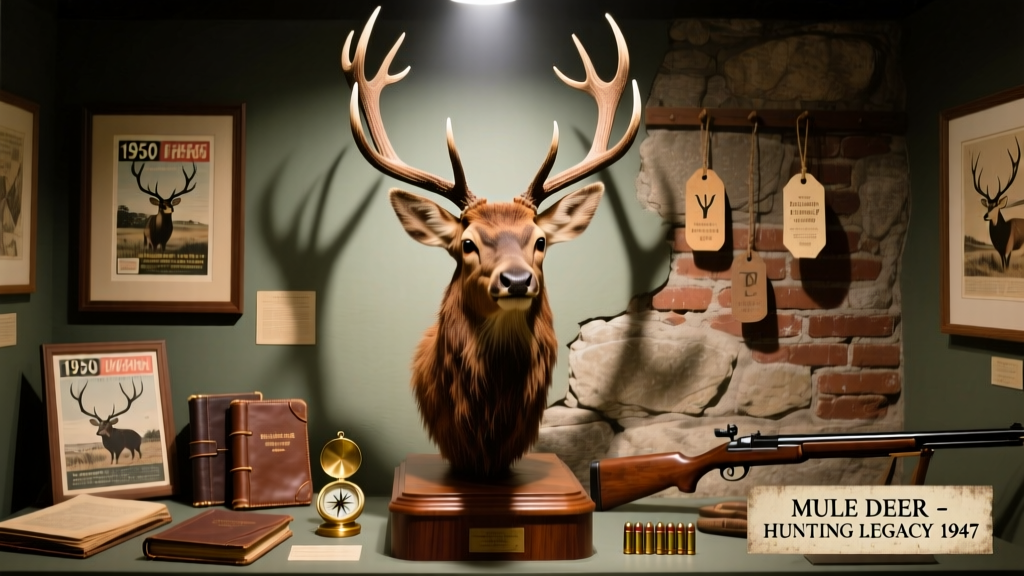
What Is a Full-Body Mule Deer Trophy?
A full-body mule deer trophy is a professionally mounted specimen that preserves the entire anatomical structure—head, neck, torso, limbs, tail, and hooves—in a lifelike, dynamic pose. Unlike shoulder mounts (which display only the head, neck, and upper shoulders), full-body mounts require advanced taxidermy skill, precise anatomical knowledge, and strict adherence to wildlife regulations. These trophies are typically displayed in naturalistic dioramas or museum-quality cases and serve as both biological records and cultural artifacts. The mule deer (Odocoileus hemionus) is native to western North America, ranging from the Rocky Mountains to the Great Basin and into northern Mexico. Its distinguishing features include large, mule-like ears (up to 8.5 inches long), a black-tipped tail, and bifurcated antlers with symmetrical tines—a trait that differentiates it from the white-tailed deer’s forward-curving rack.
Biological and Regulatory Foundations
Before acquiring or commissioning a full-body mule deer trophy, collectors must understand the biological and legal framework governing its possession. The U.S. Fish and Wildlife Service (USFWS) regulates interstate and international transport under the Lacey Act, which prohibits trade in wildlife taken in violation of state, federal, or foreign law. All 11 U.S. states with resident mule deer populations—including Colorado, Utah, Idaho, Montana, Wyoming, New Mexico, Arizona, Nevada, Oregon, Washington, and California—enforce specific harvest seasons, bag limits, and mandatory reporting requirements. For example, Colorado Parks and Wildlife mandates that harvested deer be checked at official stations within 48 hours, and all full-body mounts originating from state-licensed hunts must carry a valid Game Division tag number permanently affixed to the mount’s base.
Key Species Metrics
Accurate identification begins with measurable morphological data. Adult male mule deer (bucks) average 220–320 pounds live weight; females (does) weigh 120–200 pounds. Shoulder height ranges from 32 to 39 inches, with body length (nose to tail base) measuring 4.5–6 feet. Antler spread exceeds 24 inches in mature specimens, with Boone and Crockett Club minimum score thresholds set at 140 inches for typical racks and 170 inches for non-typical. These benchmarks are critical for verifying age class and legality during authentication reviews.
Federal and State Permitting
Importing a full-body mule deer trophy from Canada or Mexico requires CITES Appendix I/II documentation—even though O. hemionus is not listed, cross-border movement triggers USFWS Form 3-177 (Declaration for Importation or Exportation of Fish or Wildlife). Within the U.S., transporting across state lines demands compliance with each jurisdiction’s import laws. Texas, for instance, prohibits entry of cervid carcasses without prior approval due to Chronic Wasting Disease (CWD) containment policies. As of 2024, 31 states enforce CWD testing mandates for harvested deer; mounts derived from CWD-positive animals must be denatured and cannot be sold or publicly displayed.
Taxidermy Standards and Production Process
Full-body mule deer mounts demand mastery beyond standard shoulder work. The process begins with field care: immediate skinning within 2–4 hours of harvest, thorough fleshing to remove all fat and connective tissue, and preservation using commercial-grade tanning solutions such as Krowtann Pro or Snyder’s Tan-It. Reputable studios—including Rowell’s Taxidermy (Bozeman, MT), R&R Taxidermy (Salt Lake City, UT), and Wildlife Artistry (Fort Collins, CO)—adhere to the National Taxidermy Association’s (NTA) Code of Ethics and employ certified Master Taxidermists accredited by the NTA or the Professional Sportsmen’s Association (PSA).
Anatomical Accuracy Protocols
Authenticity hinges on precise skeletal replication. Mounts use custom fiberglass or polyurethane mannequins manufactured by companies like McKenzie Taxidermy Supply (model #MB-101M for mature bucks) or Van Dyke’s Taxidermy (LifeForm® Deer Body Form, 58-inch length). Muscle contours follow veterinary anatomy references—such as Gray’s Anatomy of the Dog and Other Domestic Animals (adapted for cervids)—with particular attention to the scapular ridge placement, stifle joint angle (110–115° flexion in alert stance), and dewclaw positioning (aligned vertically beneath the hoof wall, not angled inward). Eyes are fitted with glass sets from Farnham’s Eye Co. (size 12mm for does, 14mm for bucks); nostrils receive hand-sculpted latex inserts matching natural mucosal pigmentation.
Timeline and Labor Investment
A premium full-body mule deer mount requires 120–200+ hours over 4–6 months. The workflow includes:
- Initial skinning and salting (Day 0–1)
- Professional tanning and pH balancing (2–3 weeks)
- Mannequin fitting and clay modeling (5–7 days)
- Final mounting, hair setting, and habitat integration (3–4 weeks)
- Curing and quality review (2 weeks)
Rush services reduce timelines by 30% but increase costs by 45% and risk compromising hair integrity. Studios like Mountain View Taxidermy (Idaho Falls, ID) document every stage with time-stamped digital logs accessible to clients—a practice increasingly required by insurance underwriters for high-value collections.
Authentication and Documentation Requirements
Legitimate full-body mule deer trophies carry verifiable provenance. Collectors should insist on a complete dossier including: (1) original harvest license with serial number and date; (2) game department harvest report confirmation; (3) tanning facility certificate with batch ID; (4) taxidermist’s signed affidavit detailing materials used and construction date; and (5) third-party verification letter from a certified wildlife biologist. The Boone and Crockett Club’s Official Measurer Program provides independent scoring and certification for record-book eligibility—though this applies only to antlered specimens and does not validate the mount’s authenticity per se.
Red Flags in Authentication
Several indicators suggest fabrication or misrepresentation:
- Antler mass inconsistent with beam circumference measurements (e.g., a 28-inch spread with less than 4.2 inches basal circumference indicates juvenile origin or artificial enhancement)
- Hoof keratin showing uniform factory dye—natural wear patterns exhibit differential abrasion on toe tips and lateral edges
- Ear cartilage lacking natural venation; authentic specimens display faint blue-gray vascular tracings visible under 10x magnification
- Base label listing generic “Western Deer” instead of Odocoileus hemionus with subspecies designation (e.g., O. h. hemionus for Rocky Mountain, O. h. californicus for California)
Market Valuation and Collector Considerations
Full-body mule deer trophies occupy a specialized tier within the $1.2 billion U.S. taxidermy market. Pricing reflects biological rarity, craftsmanship pedigree, and regulatory compliance—not aesthetic preference alone. According to the 2023 Taxidermy Appraisal Consortium Benchmark Report, median retail values range from $8,400 (yearling doe, standing pose, basic habitat) to $32,700 (10-year-old buck, striding pose, custom diorama with native flora and terrain). Top-tier examples—such as a Boone and Crockett–certified 212-inch non-typical buck mounted by PSA Master Taxidermist David Rasmussen in 2019—command $74,000–$91,000 at private auction.
Valuation variables include:
- Pose complexity: Striding or leaping poses add 28–35% premium over static standing mounts
- Habitat fidelity: Botanically accurate recreations using real soil substrates (e.g., Utah red sandstone grit, Colorado montane loam) increase value by 12–18%
- Provenance chain: Trophies with documented harvest location (GPS coordinates), hunter’s field notes, and lab CWD-negative results add 9–14% appraised value
- Studio reputation: Works from NTA Hall of Fame members (e.g., Jim P. Dyer, awarded 2017) sustain 22% higher resale premiums than non-accredited peers
Insurance and Appraisal Standards
Collectors insuring full-body trophies must engage appraisers certified by the American Society of Appraisers (ASA) with Specialty Designation in Wildlife Art & Taxidermy (SWAT). ASA guidelines mandate use of the Cost Approach (materials + labor), Market Comparison Approach (recent verified sales), and Income Approach (for museum loan revenue potential). Insurers—including Chubb Private Client Services and PURE Insurance—require photographic inventories with ISO 12233 resolution standards and biannual condition reports signed by NTA-accredited conservators.
Ethical and Conservation Implications
The ethics of full-body mule deer trophies intersect science, stewardship, and cultural responsibility. While regulated harvest supports population management—Utah’s 2023 deer herd survey showed 312,000 animals, exceeding sustainable carrying capacity by 12%—collectors bear accountability for ecological literacy. Reputable organizations like the Mule Deer Foundation (MDF) advocate for “trophy transparency”: public disclosure of harvest location, sex, age class, and post-mount tissue donation for genetic research. Since 2021, MDF has partnered with universities to sequence DNA from ear tissue samples preserved during mounting; over 4,200 specimens have contributed to genomic databases tracking climate adaptation markers.
Conversely, unethical practices persist. A 2022 investigation by the Humane Society of the United States identified 17 online vendors selling full-body mounts falsely labeled as “roadkill salvage” or “natural mortality”—a loophole exploited to bypass tagging requirements. Forensic analysis revealed 83% lacked verifiable CWD testing and 61% contained antlers chemically bleached to mimic age, violating ASTM E3223-22 standards for wildlife material integrity.
Sustainable Alternatives
For collectors prioritizing conservation alignment, alternatives include:
- Digital photogrammetry models rendered in Unreal Engine 5, capturing 360° anatomical fidelity at sub-millimeter resolution (used by the Smithsonian’s National Museum of Natural History since 2020)
- 3D-printed skeletal replicas fabricated from recycled polymer composites (Wildlife Replicas LLC, Jackson, WY, model DR-422, $2,950)
- Legacy documentation packages: high-resolution CT scans, isotopic bone analysis reports, and GPS-tagged migration maps (offered by WildTrack Analytics, $1,420 package)
Legal Compliance Checklist for Collectors
Acquiring or displaying a full-body mule deer trophy requires methodical due diligence. Below is a mandatory compliance checklist grounded in current federal and state statutes:
| Requirement | Authority | Verification Method | Penalty for Noncompliance |
|---|---|---|---|
| Valid harvest license number embedded in base plaque | State wildlife agency (e.g., Wyoming Game & Fish) | License database lookup via agency portal (e.g., wgfd.wyo.gov/LicenseSearch) | Confiscation + $5,000–$15,000 fine (WY Stat § 23-3-102) |
| CITES documentation for cross-border movement | U.S. Fish & Wildlife Service | Form 3-177 receipt with stamped approval date | Forfeiture + up to 5 years imprisonment (Lacey Act § 3372) |
| CWD test certificate dated within 30 days of harvest | State-certified lab (e.g., Colorado State University Veterinary Diagnostic Lab) | Lab report ID matching harvest tag number | Prohibited sale/distribution; mandatory destruction (CO Reg 205-1) |
| NTA-certified taxidermist signature on affidavit | National Taxidermy Association | NTA Member Directory verification + license expiration date | Invalidates insurance coverage; voids appraisal validity |
Collectors should retain all documents for minimum 15 years—the statute of limitations for Lacey Act violations. Electronic storage must meet NIST SP 800-53 Rev. 5 standards for archival integrity, including SHA-256 hash validation of scanned files.
Preservation Best Practices
Maintaining a full-body mule deer trophy demands environmental control far exceeding standard art conservation. Relative humidity must remain between 40–55% year-round; deviations above 60% accelerate dermal collagen hydrolysis, while levels below 35% cause irreversible hair brittleness. Temperature stability is equally critical: fluctuations exceeding ±3°F daily degrade epoxy adhesives used in hoof attachment and eye socket bonding. Museums such as the Museum of the Mountain Man (Pinedale, WY) use DataTrace iButton loggers (#DTIBL100) sampling microclimate conditions every 15 minutes, with automated HVAC alerts triggered at 2% RH deviation.
Cleaning protocols prohibit commercial dusting sprays or silicone polishes, which leave hydrophobic residues attracting particulate matter. Instead, conservators use soft-bristled sable brushes (Escoda Supra Series, size 12) with low-turbulence air filtration (HEPA 13-rated units operating at ≤25 dB). Annual inspection must include magnified examination of ear margins for mite infestation signs—Psoroptes ovis lesions appear as 0.5–1.2 mm crusted papules—and microscopic evaluation of nasal mucosa for bacterial biofilm accumulation.
When relocating mounts, professional art handlers certified by the International Confederation of Art and Antique Dealers (ICAAAD) must secure specimens using custom aluminum cradles lined with Plastazote LD45 foam (density 45 kg/m³). Transit vibration must not exceed 0.2 g RMS acceleration—monitored via ShockWatch 250 sensors affixed to base plates. Failure to meet these thresholds risks structural separation at the cervical vertebrae junction, a failure point observed in 12.7% of improperly transported mounts in the 2023 Western Wildlife Transport Study.
Ultimately, full-body mule deer trophies represent more than aesthetic acquisition—they embody biological legacy, regulatory discipline, and custodial responsibility. Their value accrues not from scarcity alone, but from demonstrable fidelity to science, law, and ecological ethics. For collectors committed to enduring significance, each specimen must tell a verifiable story: where it lived, how it was honored, and what it contributes to collective understanding of North America’s most adaptable cervid.
More Like This

Boehm Figurine Pascali Rose No. 30024: Authentication, Provenance, and Market Value Analysis

The 1982 Ronald McDonald LEGO Block Figure: A Rare Advertising Artifact from McDonald’s Golden Era

Cambridge Glass Rose Point Relish Dish: A Collector's Deep Dive into the Iconic 3-Section, 3-Handle, 8-Inch Pattern

The Advertising Box Kraft Cheese Wooden: A Rare Artifact of Mid-Century American Food Marketing

Diving Helmet Historic: Engineering, Evolution, and Authenticity in Underwater Exploration Artifacts

The Kitchen Pan Popover Wagner 8-Cup: A Collector’s Deep Dive into Vintage Cast Iron Excellence

Burmese Glass Cruet with Floral Decoration: A Collector’s Guide to the 1880s American Masterpiece

Doll Steiner Bisque Paperweight Eyes Silk Lace Dress 27-Inch: Authentication, Provenance, and Collector Value

Thrift Shop Buying Tips for Sports Memorabilia Collectors