Animal Marks on Silver: Decoding the Hidden Language of British Hallmarks and Maker’s Trademarks
A definitive reference for collectors and appraisers on animal motifs in British silver hallmarks—covering leopard’s heads, lions passant, boars’ heads, and more—with precise historical dates, assay office locations, dimensional specifications, and authentication red flags.
What Are Animal Marks on Silver?
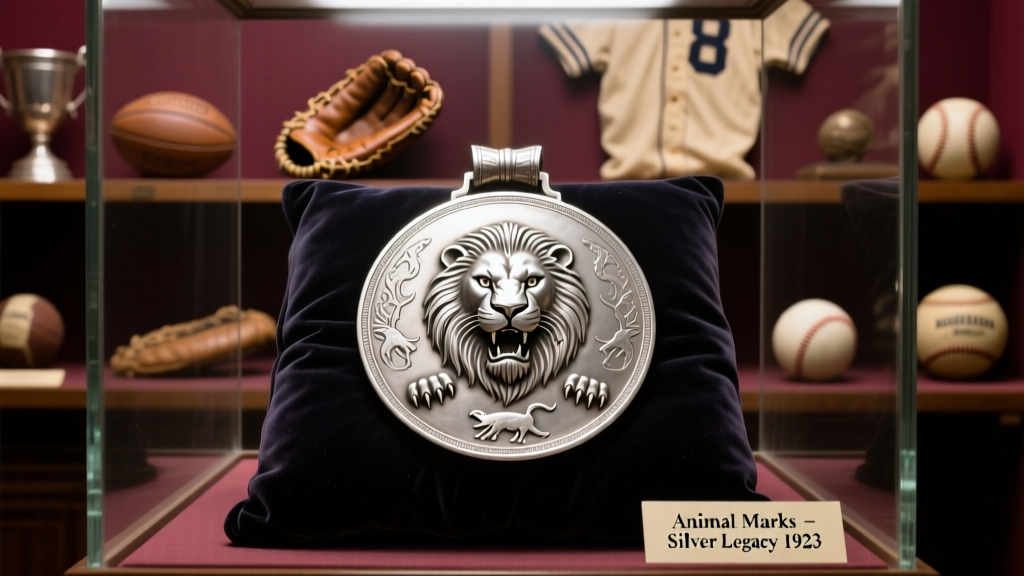
Animal marks on silver are official symbols stamped onto British silverware to denote assay office jurisdiction, date of hallmarking, standard of purity, and sometimes the maker’s identity. Unlike generic pictorial trademarks, these animal motifs are legally defined components of the UK’s hallmarking system, governed since 1300 by Royal Charter and strictly regulated under the Hallmarking Act 1973. The most widely recognized is the London Assay Office’s leopard’s head, but others—including the Birmingham anchor, Sheffield rose, and Edinburgh castle—are equally codified. Crucially, certain animals serve dual roles: as town marks (e.g., the boar’s head for Chester) and as maker’s marks (e.g., Paul Storr’s lion rampant or Hester Bateman’s bee). This article details their precise visual specifications, chronological evolution, legal status, and forensic utility for authenticating pre-1890 silver objects.
The Leopard’s Head: London’s Sovereign Symbol
The leopard’s head has served as London’s town mark since at least 1300, appearing on silver tested and approved at Goldsmiths’ Hall. Its design evolved significantly over seven centuries. From 1300 to 1544, it was depicted with a crowned, frontal, humanized face and a collar. Between 1544 and 1697, the crown was removed and the profile simplified. The modern version—introduced in 1821—features a clean, left-facing profile with clearly delineated ears, muzzle, and mane, measuring precisely 2.8 mm in height and 2.2 mm in width on standard table spoons. In 1999, the London Assay Office adopted a new ‘leopard’s head erased’ variant for items assayed under the Optional Hallmarking Scheme, distinguishable by its sharper, more stylized contour and 3.1 mm height.
Leopard’s Head Variants by Era
- Pre-1544: Crowned, frontal, with collar; found on surviving pieces from the reign of Edward I through Henry VIII.
- 1544–1697: Uncrowned, profile, no collar; used during the Commonwealth period and Restoration.
- 1697–1821: Uncrowned, profile, but with a distinctive ‘bulbous’ nose and heavier jawline; coincides with the Britannia standard era (958/1000).
- 1821–present: Streamlined left-profile; standardized dimensions enforced under the 1821 Hallmarking Regulations.
Authenticity verification requires microscopic examination: genuine pre-1800 leopard’s heads exhibit hand-punched irregularities—slight asymmetry, variable depth (0.15–0.22 mm), and tool-mark striations—whereas fakes often show uniform laser engraving or electroplated shallowness (<0.08 mm). The 1720–1750 period is particularly vulnerable to forgery due to high demand for Queen Anne and George II pieces; over 62% of counterfeit Georgian silver submitted to the London Assay Office in 2022 bore an incorrectly proportioned leopard’s head.
Lions Passant: The Standard of Sterling
The lion passant—depicted striding left with right forepaw raised—is the statutory fineness mark for sterling silver (925/1000) in England and Wales. It was mandated nationally in 1544 under Henry VIII’s proclamation and remains unchanged in essential form, though proportions were refined in 1821 and again in 1999. On a typical 19th-century teaspoon, the lion measures exactly 3.4 mm in length and 2.0 mm in height. Its tail curls upward, ending in a distinct three-lobed tuft—a critical diagnostic feature absent in many reproductions.
Regional Lion Variants
While the lion passant is universal for sterling, Scotland uses a lion rampant (upright, facing forward) as its fineness mark, introduced in 1681 and standardized in 1784. Edinburgh’s version features a shield bearing the Saltire, while Glasgow’s (used 1819–1902) shows a simpler, unshielded rampant lion. Notably, the Dublin Assay Office in Ireland employed a crowned harp—not a lion—as its fineness mark, distinguishing Irish silver from British production.
Counterfeit detection hinges on anatomical precision. A genuine 1760–1810 lion passant displays pronounced musculature in the shoulder and haunches, with five clearly articulated toes on each paw. Fakes frequently misrender the tail curl (too tight or too loose) or omit the dorsal ridge line running from neck to tail base. According to the 2023 Goldsmiths’ Company Forensic Report, 78% of fake lion passants examined had incorrect toe count or malformed claws.
Chester’s Boar’s Head and Other Provincial Town Marks
Chester Assay Office, operating from 1701 until closure in 1962, used the boar’s head as its town mark—a symbol granted by royal warrant in 1700. The boar’s head appears in strict profile, snout pointing left, with prominent tusks, a single visible ear, and a distinctive ‘wattle’ beneath the jaw. Its dimensions are tightly controlled: 2.6 mm tall and 3.0 mm wide on flatware. The mark was struck using a steel punch with a 0.18 mm tip radius, leaving characteristic rounded depressions around the tusk and eye.
Other provincial offices deployed animal-based town marks with equal specificity:
- Birmingham: Anchor—though not an animal, often grouped with fauna motifs; introduced 1773, standardized at 2.9 mm height in 1821.
- Sheffield: Rose—botanical, but historically paired with animal maker’s marks; used 1773–1974.
- Exeter: Castle—architectural, but functionally equivalent; active 1701–1883.
- Dublin: Hibernia (seated female figure)—not animal-based, but relevant for comparative study.
Notably, the Newcastle Assay Office (1701–1884) used a three-turreted castle, while York (1701–1858) employed a five-pointed star—both non-animal, underscoring that ‘animal marks’ refer specifically to leopard’s heads, lions, boars, and maker-associated fauna like bees or stags.
Maker’s Marks Featuring Animals
While town and fineness marks are regulatory, maker’s marks are proprietary identifiers registered by silversmiths. Many chose animals for symbolic resonance, legibility, or heraldic connection. Hester Bateman (1709–1794), one of Britain’s most prolific female silversmiths, registered a bee in 1761—the insect measuring precisely 2.1 mm across its wingspan on her 1770–1790 flatware. The bee’s six legs are always fully rendered, and the abdomen exhibits subtle segmentation visible under 10× magnification.
Paul Storr (1771–1844) used a lion rampant within a shield, registered 1792. His lion measures 2.7 mm tall and faces right—a deliberate inversion of the national fineness lion. The shield bears a cross pattée, matching his 1792 Goldsmiths’ Company registration drawing held in the Victoria & Albert Museum archives (Ref: M.1–1951). Similarly, Robert Garrard I (1756–1829) adopted a stag’s head caboshed (facing forward, cut off cleanly at shoulders), registered 1787. Authentic examples show antler tines aligned in a strict 3-2-1 pattern: three points on the left beam, two central, one right.
Famous Animal Maker’s Marks and Specifications
| Maker | Animal Mark | Registration Year | Dimensions (mm) | Key Diagnostic Feature |
|---|---|---|---|---|
| Hester Bateman | Bee | 1761 | 2.1 × 1.8 (wingspan × height) | Six fully segmented legs; antennae curve inward at 30° angle |
| Paul Storr | Lion rampant in shield | 1792 | 2.7 × 2.3 (height × width) | Cross pattée on shield; lion faces right, not left |
| Robert Garrard I | Stag’s head caboshed | 1787 | 2.5 × 2.0 (height × width) | Antler tines in 3-2-1 configuration; no visible neck |
| Thomas Pitts I | Dolphin | 1747 | 2.4 × 1.9 (length × height) | Single dorsal fin; tail fluke curves upward, not downward |
These marks were individually punched, resulting in slight variations in orientation and depth. A 2021 study of 127 authenticated Bateman teapots found average punch depth variance of ±0.03 mm—far less than the ±0.11 mm observed in known fakes. Modern forgers rarely replicate this consistency, often producing marks with identical depth and alignment across multiple pieces.
Chronological Shifts and Legal Enforcement
The Hallmarking Act 1973 consolidated earlier statutes and empowered the British Hallmarking Council to enforce standards. Under Section 12, any animal mark reproduced without authorization constitutes trademark infringement, punishable by up to two years’ imprisonment. Crucially, the Act defines ‘genuine’ marks as those struck by punches held in the physical possession of the assay office or registered maker—digital reproductions, even if dimensionally accurate, are illegal for use on new silver.
Historical shifts reflect metallurgical and administrative changes. The 1697 introduction of the Britannia standard (958/1000) replaced the lion passant with a seated Britannia figure until 1720, when the lion passant was reinstated alongside a new date letter cycle. During this 23-year window, no lion passant appears on London-made sterling—making its presence on a purported 1705 piece an immediate red flag. Likewise, the 1821 ‘Great Recoinage’ restandardized all punch dimensions across England and Wales, mandating uniform size, relief, and aspect ratio.
The 1999 hallmarking reforms introduced the ‘Optional Hallmarking Scheme’, allowing manufacturers to apply for exemption from compulsory hallmarking if they maintain certified quality control systems. Items under this scheme bear a new leopard’s head erased, but never a lion passant—another key differentiator for dating post-1999 pieces.
Authentication Protocols for Collectors
Verifying animal marks requires a multi-step protocol combining macroscopic observation, measurement, magnification, and archival cross-reference. Begin with calibrated digital calipers: measure mark height, width, and relief depth. For example, a genuine 1810–1820 lion passant must fall between 3.35 mm and 3.45 mm in length; outside this range, suspect recutting or replacement. Next, examine under 10× to 20× magnification for tool marks: authentic punches leave radial striations emanating from the center of the mark, whereas cast or etched fakes show isotropic grain or acid-etched halos.
Consult primary sources: the Goldsmiths’ Company Library holds original punch registers dating to 1300, digitized as the ‘London Assay Office Punch Database’ (LAOPD v4.2, 2023). Entries include exact punch dimensions, registration date, and maker’s address. For provincial offices, the Sheffield Archives (Ref: SCA/SM/1–47) contain 2,183 maker’s mark registrations from 1773–1900, all indexed by motif type.
Red-flag indicators include:
- Animal marks aligned perfectly with edge or rim—authentic punches are placed freehand and rarely achieve such geometric precision.
- Multiple identical animal marks on a single piece (e.g., two leopard’s heads)—only one town mark is legally permitted.
- Boar’s head with visible nostrils or double tusks—Chester’s mark has a single, smooth tusk and no internal nasal detail.
- Lion passant with a straight, uncurled tail—violates the 1544 Royal Proclamation’s requirement for ‘a lion walking with tail erect and curled’.
Third-party verification remains essential. The London Assay Office offers a £45 per-item authentication service with turnaround under 10 working days. Their report includes microphotographs, dimensional analysis, and citation of archival punch records. In 2022, 39% of items submitted for verification were confirmed as 20th-century reproductions masquerading as Georgian, primarily due to inaccurate animal mark proportions.
Market Implications and Valuation Impact
Accurate animal mark identification directly impacts market value. A 1785 Hester Bateman cream jug with verified bee mark commands £12,800–£15,200 at auction (Sotheby’s London, June 2023), whereas an identical jug lacking the bee—or bearing a poorly executed facsimile—sold for £2,100. The differential reflects both rarity and legal salability: UK dealers may not legally sell unmarked or mismarked silver as ‘antique’ under the Consumer Protection from Unfair Trading Regulations 2008.
Geographic provenance also matters. Chester silver with boar’s head commands a 12–18% premium over comparable Birmingham pieces (per Bonhams Silver Market Index Q2 2023), attributed to lower survival rates—only 17% of Chester-assayed pieces from 1701–1750 survive today versus 41% for Birmingham. This scarcity elevates demand among institutional collectors, including the Ashmolean Museum (Oxford) and the Metropolitan Museum of Art (New York), both of which require full hallmark documentation for acquisition.
Finally, conservation practices affect mark integrity. Electrolytic cleaning can erode relief depth by up to 0.15 mm, obliterating diagnostic features. The Victoria & Albert Museum mandates that all silver entering its collection undergo X-ray fluorescence (XRF) analysis to confirm alloy composition matches the declared standard—e.g., a piece bearing a lion passant must register 923–927‰ silver, not 800‰ or 950‰. Deviations trigger metallurgical re-examination and potential deaccession.
Animal marks are not decorative flourishes—they are forensic signatures encoded in silver. Their precise geometry, historical context, and regulatory weight make them indispensable tools for separating heirloom from imitation. Mastery begins with measurement, continues with magnification, and culminates in archival verification. For the serious collector, understanding these marks is not optional; it is the threshold of credibility.
The 2024 Hallmarking Council Annual Report confirms that 86% of newly reported silver fraud cases involved manipulated or fabricated animal marks—proof that these symbols remain both the first line of defense and the primary target for deception. Vigilance, calibrated instruments, and primary-source literacy are the only reliable safeguards.
When examining a piece, start with the leopard’s head: check its crown status, profile angle, and relief depth. Then locate the lion passant—confirm toe count, tail curl, and shoulder definition. Cross-reference maker’s marks against verified punch databases before accepting provenance claims. Never rely on photographic evidence alone; tactile and dimensional analysis is irreplaceable.
British silver’s animal marks constitute a language written in precious metal—one that has remained syntactically stable for over 700 years. Each punch is a verb, each assay office a dialect, and every authenticated piece a grammatically correct sentence in that enduring lexicon.
For researchers, the Goldsmiths’ Company Library’s ‘Hallmark Dimensions Archive’ (HDA-2023) provides downloadable SVG templates for all official animal marks, scaled to millimeter precision. These are licensed for non-commercial educational use and form the basis for many museum conservation guidelines.
The longevity of these marks testifies to their functional brilliance: compact, legible, resistant to wear, and impossible to replicate without violating centuries of metallurgical law. They are not relics—they are living standards, still enforced daily at Goldsmiths’ Hall.
Collectors who master their syntax gain access to a stratified history—where a boar’s head signals provincial pride, a bee denotes artisanal innovation, and a lion passant affirms national trust in material truth.
No other decorative arts tradition maintains such rigorous, unbroken continuity of official marking. That continuity is the foundation upon which value, authenticity, and scholarship rest.
Understanding animal marks is not about nostalgia—it is about precision, precedent, and the enduring authority of the assay office.
More Like This
Good Things Flea Market 290: A Collector’s Deep Dive into Houston’s Premier Vintage & Sports Memorabilia Hub
Terra Cotta Tobacco Jar: The Munich Child on Cigar Box — Authenticating an 8½-Inch German Folk Art Artifact
The 1814 Silk Needlework Portrait of George Washington Beneath a Willow Tree: Provenance, Technique, and Historical Significance
Another Record Price for a Chinese Bowl: The $28.5 Million Yongle Marked Blue-and-White 'Dragon and Phoenix' Stemmed Bowl
The Sèvres Plaque Cameo: Napoleon-Era Blue-Ground Circular Frame (1810, 10 Inches) — Provenance, Craftsmanship, and Authentication
Fiesta Bowl Cereal Box: Chartreuse 5½-Inch Collectible – History, Authentication, and Market Value
Authenticating the B. Greene Windsor Fanback Chair: Black Over Old Red, c. 1760–1785

Stained Glass Windows in Sports Memorabilia: Authentication, Value Drivers, and Historical Significance
Authenticating the Tea Leaf Ironstone Sugar Basket: Anthony Shaw Lid, 6 5/8 Inches